
Table of Contents
- Why Tennis Serve Consistency Matters
- Master the Ball Toss: Foundation of a Consistent Serve
- Build Your Serve Rhythm and Timing
- Tennis Serve Ball Toss Drills for Repetition
- How to Stop Double Faulting
- Fix Common Serve Mistakes That Kill Consistency
- Mental Approach: Pressure and Focus
- Conclusion
Last Updated: August 15, 2026
Why Tennis Serve Consistency Matters
A consistent serve is the foundation of competitive tennis. At Crunch Time Coaching, we’ve analyzed what separates players stuck on a plateau from those who break through: serve consistency determines match outcomes far more than raw power. When your serve falters under pressure, double faults multiply and your opponent gains momentum. A player with a 65% first serve percentage in practice might drop to 45% in a tiebreaker, that’s a consistency problem, not a skill gap.
The good news: tennis serve consistency can be systematically improved. It’s not about reinventing your motion from scratch. It’s about understanding the mechanical and mental anchors that make a serve repeatable, then drilling them until they become automatic. Professional players hit 70% or higher first serve percentages because they’ve eliminated variables. Every toss lands in the same spot. Every rhythm follows the same tempo. Every contact point is identical. This guide will show you exactly how to build that level of reliability.
Master the Ball Toss: Foundation of a Consistent Serve
The ball toss is where tennis serve consistency begins or ends. You cannot build a repeatable serve on an unreliable toss. Yet most players treat the toss as something that just happens, something they don’t actively control or practice.

The toss is your only chance to control the initial condition of every serve. A ball that lands two inches to the right requires a completely different service motion than one that lands two inches to the left.
Toss Height and Placement
The ideal toss height is approximately 12-18 inches above your racket’s reach when your arm is fully extended. This timing window, roughly 0.5 to 0.7 seconds, allows you to complete your service motion without rushing or waiting.
Placement matters more than height. Your toss should land approximately 12-18 inches in front of your baseline and 6-8 inches to the right of your shoulder (for right-handed players). This placement puts the ball in the strike zone where your racket naturally accelerates through contact. Many players toss too far to the right or too far forward, both of which create inconsistency.
Test your toss placement by tossing without hitting. Catch the ball in your non-hitting hand. If it’s consistently in the same spot, your toss is reliable. If it drifts, you’ve found your first problem.
Repeating Your Toss Every Single Time
Consistency in the toss comes from hand motion and release point. Extend your arm straight up with a slight forward angle, keeping your elbow relatively locked and your wrist neutral. The release happens at the same point in your arm’s extension every time.
Film yourself tossing 20 balls without hitting. Watch the video in slow motion. You’ll immediately see where your toss drifts. This visual feedback is the fastest way to improve.
Build Your Serve Rhythm and Timing
Tennis serve rhythm is the tempo at which you move through your service motion. When your rhythm is consistent, everything else becomes easier because your body knows what’s coming next.
The 25-Second Rule Between Points
Professional players follow a ritual between points, taking roughly 25 seconds before beginning their next serve. This window gives your nervous system time to reset while keeping you in an active state.
Adopt a consistent timeline: retrieve the ball, walk to the baseline, take two deep breaths, bounce the ball 2-3 times, then serve. Use a timer for a week until the rhythm becomes automatic. You’ll immediately notice your serves feel more controlled.
Developing a Pre-Serve Ritual
A pre-serve ritual is a sequence of physical and mental actions you perform before every serve. It might include bouncing the ball twice, taking one deep breath, visualizing the serve landing in the box, then tossing and serving.
The ritual accomplishes two things. First, it creates consistency by priming your nervous system for the same service motion. Second, it focuses your mind on something concrete and controllable rather than mechanics or outcome.
The pre-serve ritual is your mental anchor. When pressure increases and doubt creeps in, the ritual pulls your mind back to something concrete and controllable.
Tennis Serve Ball Toss Drills for Repetition
Repetition builds muscle memory, but not all repetition is equal. Deliberate, focused practice creates neural adaptation that random practice cannot.
Mini-Serve Drill: Start Small
The mini-serve is a serve hit from inside the baseline, typically from 15-20 feet from the net. You use the same service motion but with reduced distance and pressure. This removes outcome pressure and allows you to focus purely on mechanics.
Hit 10 mini-serves with the goal of landing 9 or 10 in the service box. Focus entirely on your toss placement and rhythm. After 10 mini-serves, move to the baseline and hit 5 full serves, trying to replicate the same motion.
Toss-Only Drill: Perfect the Foundation
Toss the ball 20 times in a row, catching it in your non-hitting hand. The goal is to catch the ball in the exact same spot every single time. Do this drill before your regular practice. If you can’t catch the ball in the same spot 20 times in a row, your toss isn’t reliable enough for full serves.
Full-Motion Repetition Drill: Build Muscle Memory
After warming up with mini-serves and toss-only work, hit 20 full serves from the baseline with the goal of landing 16-18 in the service box. The key is consistency in the process, not the outcome. Analyze what changed when a serve goes out, was your toss different? Did your rhythm shift?
Hit this drill 3-4 times per week. Over 4-6 weeks, you’ll notice a dramatic improvement in your first serve percentage.
A common mistake is hitting 20 serves and calling it a day. Top players hit 100+ serves per practice session. Aim for at least 50 serves per session to create real neural adaptation.
How to Stop Double Faulting
Double faults are consistency failures under pressure. The solution isn’t to serve harder. It’s to identify what changes in your motion when pressure increases, then eliminate that variable.
Identify Your Double Fault Trigger
Review your recent matches. When did you double fault? What was the situation? Film yourself serving in practice, then film yourself serving in a match or pressure situation. Compare the two. You’ll see the difference immediately, maybe your toss drifts, your knee bend disappears, or your racket drop accelerates.
Write down your specific trigger. This is your diagnosis.
Slow Down Your Service Motion
The most common response to pressure is to speed up. The counter-intuitive fix is to slow down your service motion tempo. A slower, more deliberate motion is more repeatable under pressure because it gives your body time to execute each phase correctly.
Practice hitting serves at 80% of your normal tempo. Focus on smooth transitions between your toss, knee bend, racket drop, and acceleration.
Fix Common Serve Mistakes That Kill Consistency
Most players have one or two mechanical errors that create inconsistency.
Rushing the Racket Drop
Many players rush the racket drop, which causes them to lose control of the racket path. A rushed drop throws off your timing and reduces your acceleration window. Fix this by slowing your racket drop deliberately. Your elbow should lead the motion, with your wrist staying relaxed.
Poor Stance and Weight Transfer
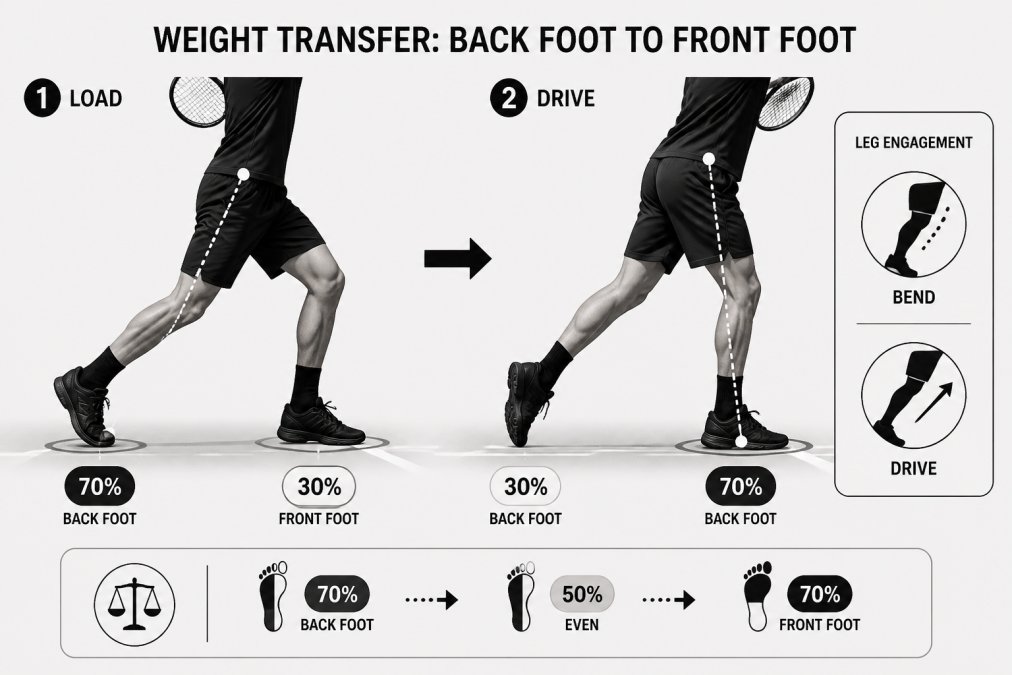
The correct stance has your feet shoulder-width apart, with your back foot perpendicular to the baseline and your front foot at a 45-degree angle. This positioning allows your weight to transfer from your back foot to your front foot as you drive into the serve. Keep your knees slightly bent and your weight on the balls of your feet.
Inconsistent Contact Point
Your contact point should be approximately 12-18 inches in front of your body and at the apex of your arm’s reach. If this point changes from serve to serve, your serve will be inconsistent. Ensure your toss is consistent, then maintain a consistent contact point by focusing on where you contact the ball.
Mental Approach: Pressure and Focus
Technical consistency is necessary but not sufficient. You also need mental consistency. A serve that’s technically perfect in practice often falls apart in a match because your mental state changes under pressure.
Focus means your attention is on the process (your ritual, your motion) rather than the outcome (winning the point or avoiding a double fault). Confidence comes from knowing you’ve practiced the serve enough times that your body can execute it automatically. Develop a pre-serve ritual that brings your focus back to the process every single time.
Video Analysis for Self-Correction
Video is one of the most powerful tools for improving tennis serve consistency. Film yourself serving in practice at least once per week. Watch the video in slow motion and compare your serves from different angles. Look for consistency in your toss, rhythm, contact point, and follow-through.
When you identify an error, film yourself making the correction. Watch the corrected version repeatedly. Your brain learns from visual feedback faster than from any other source.
Use your phone’s slow-motion feature to film serves from both the side and behind the baseline. The side view shows your weight transfer and stance. The behind-baseline view shows your toss placement and contact point. Compare 10 good serves to 10 bad serves.
Improving your tennis serve consistency doesn’t require a complete overhaul. It requires systematic attention to the variables that matter: your toss, your rhythm, your stance, and your mental approach. Crunch Time Coaching specializes in breaking down exactly these elements through step-by-step daily lessons and personalized feedback. Whether you’re working to transform your serve in a week or building long-term consistency for tournament play, the process is the same: identify your specific breakdowns, drill the fundamentals, and practice with purpose. Reserve your spot today and get the expert guidance that turns inconsistent serves into reliable weapons.
| Drill Type | Primary Focus | Frequency | Expected Improvement Timeline |
|---|---|---|---|
| Toss-Only Drill | Ball placement consistency | Daily, 5 minutes | 1-2 weeks |
| Mini-Serve Drill | Motion repetition without pressure | 3x per week | 2-3 weeks |
| Full-Motion Repetition | Complete serve consistency | 3-4x per week | 4-6 weeks |
| Video Analysis | Mechanical error identification | Weekly | Ongoing |
| Pre-Serve Ritual | Mental consistency and focus | Every serve | Immediate |
Frequently Asked Questions
How does the ball toss affect tennis serve consistency?
The ball toss is the foundation of serve consistency. A toss that varies in height, placement, or timing forces your body to compensate mid-swing, creating inconsistency. A precise toss, same height and location every time, allows your service motion to repeat identically, building muscle memory. Most players who struggle with consistency have a toss problem first.
What are the most common causes of double faults?
Double faults usually stem from rushing your service motion under pressure, an erratic ball toss, poor stance or weight transfer, or trying to hit too hard on the second serve. Pressure magnifies small technical flaws. The fix: slow down your motion, focus on toss consistency, and practice the full serve repetition drill at match intensity to build confidence.
How long does it take to fix an inconsistent serve?
Noticeable improvement typically appears within 2-3 weeks of consistent daily practice (15-20 minutes). A fundamental shift in consistency, one that holds under pressure in matches, usually takes 4-6 weeks. The timeline depends on how deeply ingrained your current pattern is and how disciplined you are with the drills. Older players returning to the sport often see faster results because they understand body awareness.
Can video analysis really help me improve my serve?
Yes. Recording your serve from the side and behind reveals issues your feel cannot detect: toss placement drift, racket drop timing, weight transfer problems, and contact point inconsistencies. Compare your video to proper mechanics, then isolate the flaw with targeted drills. Many players fix serve issues 50% faster using video feedback because they stop guessing and address the actual problem.
This article was written using GrandRanker