
Table of Contents
- What Online Tennis Coaching Actually Delivers
- Video Analysis for Tennis Improvement: The Technical Foundation
- In-Person vs. Virtual Coaching: What the Data Shows
- Best Online Tennis Coaching Platforms: Evaluating Your Options
- Cost of Online Tennis Lessons vs Private Coaching: Breaking Down the Value
- The Real Limitations: Where Online Coaching Falls Short
- How to Maximize Results From Online Tennis Coaching
Last Updated: August 20, 2026
What Online Tennis Coaching Actually Delivers
Is online tennis coaching actually effective? The short answer is yes, but with important caveats that separate real results from marketing hype.
Online coaching works best for specific skill acquisition, footwork patterns, serve mechanics, court positioning, where video analysis and detailed feedback can drive measurable improvement. The limitation is what it can’t replicate: the real-time correction of movement patterns during live match play, the feel of court positioning at full speed, and the mental pressure of competition.
At Crunch Time Coaching, we’ve analyzed what actually moves the needle for competitive players. The data shows that online tennis coaching delivers genuine technical improvement when structured correctly, but it requires active participation from the player. Passive consumption of lessons doesn’t work. Neither does expecting transformation without the willingness to drill the same movement pattern dozens of times until it becomes automatic.
The biggest misconception is that online coaching is a shortcut. It’s not. It’s a different delivery method with specific strengths and real weaknesses. Understanding both is what separates players who see results from those who buy a subscription and abandon it after three weeks.
Video Analysis for Tennis Improvement: The Technical Foundation
Video analysis is where online tennis coaching actually earns its credibility. Frame-by-frame examination of your stroke reveals things you cannot feel in the moment, and this is the core value proposition of remote instruction.
When you film your serve, forehand, or footwork from a stationary angle, a coach can pause the video and show you exactly where your racket head is at contact, how your weight transfers through your feet, or whether your shoulder rotation is opening too early. These are technical details that matter. A serve with improper pronation will consistently lack spin and control. A forehand with early shoulder opening will produce weak balls to the baseline. Footwork that doesn’t load properly on the split step will cost you reaction time.
The mechanics are measurable. A coach reviews your video submission, identifies the deviation from proper technique, and prescribes specific drills to correct it. You perform those drills, film yourself again, and the cycle repeats. This asynchronous learning model works because tennis is a skill acquisition sport. Your nervous system needs repetition to encode movement patterns, not real-time coaching during every attempt.
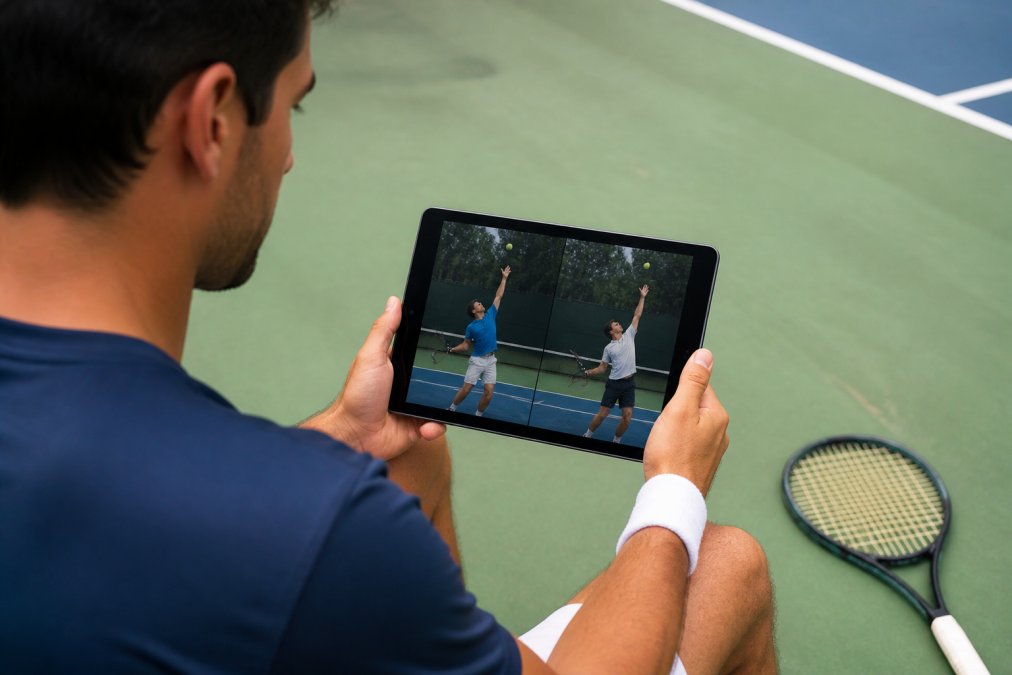
The limitation is that video analysis cannot assess feel. You might execute perfect mechanics on a slow-motion replay but feel completely wrong during actual play. The gap between what looks correct and what feels right is real, and it’s something only in-person coaching or extensive self-correction can bridge. Online coaches bridge this gap through written feedback and drill progressions, but the player must do the translation work themselves.
According to research from the International Tennis Federation on skill acquisition, biomechanical consistency is the foundation of reliable shot production. Video analysis accelerates this consistency because you can see what your body is doing, not just what it feels like.
In-Person vs. Virtual Coaching: What the Data Shows
The comparison between in-person and virtual coaching reveals that each method solves different problems.
In-person coaching excels at real-time correction during live play. A coach standing courtside can watch your movement patterns at full speed, see how you respond to pressure situations, and intervene immediately. They can feel how much tension is in your grip, observe your breathing patterns during tiebreakers, and adjust your tactical approach mid-session based on what they’re seeing in your decision-making.
Virtual coaching excels at technical breakdown and systematic skill development. The coach has time to analyze your video, research your specific issue, and design a drill progression tailored to your exact problem. They can send you written feedback with specific cues. They can reference your previous submissions to track progress over weeks and months. This systematized approach works because tennis improvement is cumulative, small corrections compound.
The data point that matters: players who use both modalities typically see faster results than those using either alone. Online coaching identifies the technical issue and provides the drill framework. In-person sessions validate that the correction is actually transferring to live play and address the mental or tactical components that video alone cannot capture.
For competitive players over 40 returning to serious play, the hybrid model is particularly effective. Online coaching rebuilds technical foundation without the wear-and-tear of intensive in-person sessions. Periodic in-person camps validate that the corrections are working and address injury prevention specific to your individual movement patterns.
| Coaching Method | Best For | Primary Limitation |
|---|---|---|
| Online (video analysis) | Technical skill development, drill progression, systematic improvement | Real-time correction during live play, match pressure response |
| In-person | Live play adjustment, tactical coaching, mental toughness | Time-intensive, harder to document progress, less systematic |
| Hybrid | Competitive players seeking fast results and sustainable improvement | Requires commitment to both modalities |
Best Online Tennis Coaching Platforms: Evaluating Your Options
When evaluating online tennis coaching platforms, three factors matter: the quality of technical feedback, the structure of the curriculum, and whether the platform actually delivers personalization or just pre-recorded content.
Crunch Time Coaching stands out because it combines world-class technical coaching with a challenge-based curriculum designed to force skill integration. Rather than isolated drills, the platform structures progression so that each skill builds on the previous one. The "Totally Obsessed" coaching methodology means the instructor actively reviews your video submissions and provides written feedback specific to your technique, not generic comments. This is the difference between a platform that teaches tennis and one that sells tennis content.
Most competing platforms fall into two categories: they either offer pre-recorded lessons with no personalized feedback, or they charge premium rates for live coaching without systematic curriculum structure. The middle ground, personalized feedback within a structured framework, is where real results happen.
When comparing platforms, ask these questions: Does the coach actually review your video submissions, or do you just watch pre-recorded lessons? Is there a progression system that builds skills sequentially, or is it a library of random drills? Can you track your improvement over time, or is each lesson isolated?
Crunch Time Coaching’s in-person training camps add a critical component: they validate that your technical improvements are actually transferring to match play and address the mental side of competitive tennis. The platform recognizes that online coaching alone has a ceiling. Breaking through that ceiling requires live validation and pressure-situation coaching.
Cost of Online Tennis Lessons vs Private Coaching: Breaking Down the Value
The pricing comparison between online coaching and private in-person lessons is straightforward: online coaching costs significantly less, but you’re trading convenience and real-time feedback for lower cost and more systematic structure.
Private coaching from a local pro typically runs higher per-session than online platforms, and you’re paying primarily for real-time correction and the coach’s physical presence. You get immediate feedback, but you don’t get the same level of technical analysis or curriculum structure that online platforms provide. value of private coaching.
Online coaching delivers better value for players who want systematic skill development and don’t need real-time correction. You’re paying for the coach’s expertise in designing progression, reviewing your video submissions, and providing written feedback, not for their time sitting courtside watching you practice.
The real question isn’t "Which costs less?" but "Which delivers the results you need?" A player trying to break a plateau in a specific skill (serve, footwork, court positioning) will likely see faster improvement with online coaching because the feedback is more targeted and the curriculum is more systematic. A player preparing for tournament competition might benefit more from in-person coaching because they need live tactical coaching and pressure-situation practice.
Crunch Time Coaching positions itself in the middle: it costs less than premium private coaching but delivers more personalized feedback and systematic structure than generic online platforms. The in-person training camps are optional, which means you can start with online coaching and add the in-person component only when you’re ready for it.
The Real Limitations: Where Online Coaching Falls Short
Online tennis coaching has hard boundaries. Acknowledging them is more honest than pretending they don’t exist.
The biggest limitation is that online coaching cannot replicate match pressure. You can drill the perfect serve technique, but a serve executed in a tiebreaker at 4-5 with your opponent serving for the match is a completely different challenge. The mental side of tennis, managing nerves, maintaining focus during pressure moments, adapting tactics mid-match, requires live coaching in competitive situations. Online coaching can prepare you technically, but it cannot train the psychological resilience that separates competitive players from skilled players.
The second limitation is that online coaching cannot correct feel-based issues in real time. You might execute perfect mechanics on video but feel completely off-balance or rushed during actual play. A coach watching you live can say "Slow down your backswing" or "Load more on your right leg" and you adjust immediately. Online, you have to figure out that translation yourself through trial and error.
The third limitation is that online coaching requires exceptional self-discipline. You need to film yourself consistently, submit videos on a schedule, implement the feedback without immediate validation, and drill the same movement pattern dozens of times before it becomes automatic. Many players buy subscriptions and never submit a single video. The platform can’t force compliance.
The fourth limitation is that online coaching struggles with tactical coaching. Tennis is partly about technical execution and partly about reading your opponent, positioning yourself strategically, and adapting your game plan mid-match. These require live play observation. Online coaches can teach principles, but they can’t coach you through the specific tactical decisions you’re making against your actual opponents.
Players over 40 returning to serious play face an additional limitation: online coaching doesn’t account for individual injury history or movement restrictions. A coach needs to understand your specific physical limitations (shoulder mobility, knee stability, etc.) and design progressions that work around them, not through them. This requires either extensive communication or periodic in-person assessment.
How to Maximize Results From Online Tennis Coaching
If you commit to online tennis coaching, these practices determine whether you see real improvement or waste money on a subscription.
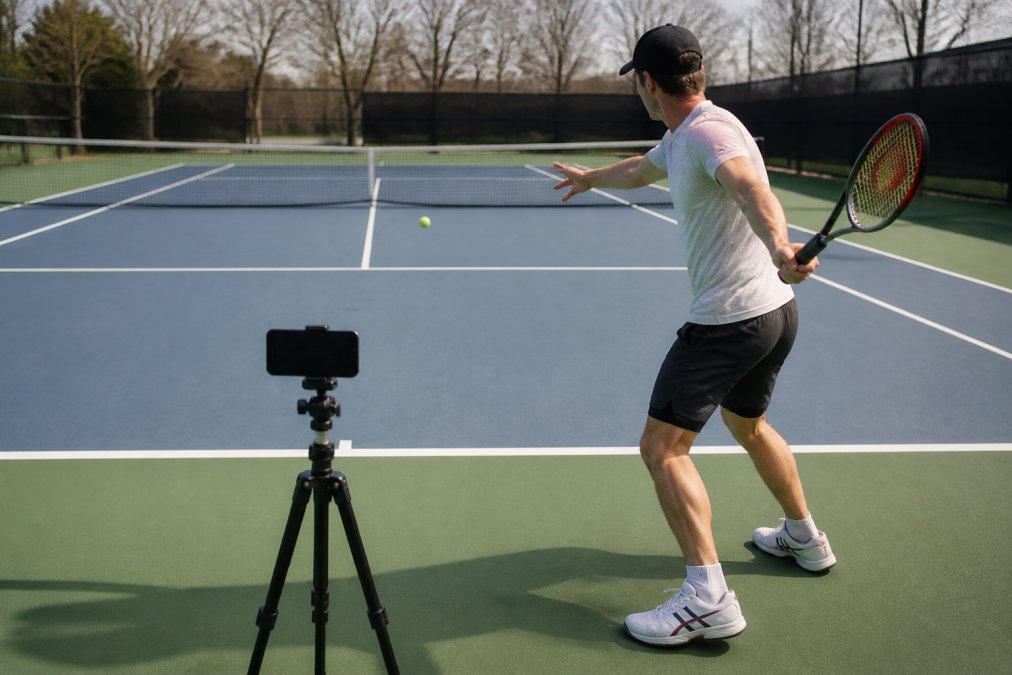
First, film yourself consistently from a stationary angle. Use a tripod and smartphone, position the camera perpendicular to your stroke direction, and capture multiple attempts of the same shot. Consistency in filming angle matters because your coach needs to see the same view repeatedly to track progress. Inconsistent angles make analysis harder and feedback less precise.
Second, submit videos on a regular schedule, weekly is ideal, bi-weekly minimum. Coaches can only help you if they’re seeing your actual technique. Sporadic submissions mean sporadic feedback, which means slower progress. Treat video submission like a scheduled coaching session, not something you do when you feel like it.
Third, implement the feedback immediately. When your coach identifies a technical issue and prescribes drills, do those drills that week. Don’t wait. The longer you practice the old pattern, the harder it is to reprogram. Neurologically, your nervous system encodes movement patterns through repetition, and old patterns are stubborn.
Fourth, track your own progress visually. Save your video submissions over time and compare them. You’ll see technical changes that feel subtle during practice but are obvious when you watch the progression. This visual feedback is motivating and helps you understand what "correct" actually feels like in your body.
Fifth, use the written feedback as a reference guide. Read it multiple times. Most coaches write feedback once, and players read it once. Re-read it before you practice. Internalize the specific cues. Reference them while you’re drilling so the cues become automatic.
Sixth, be honest about what you’re trying to improve. If you’re working on your serve, focus on your serve. Don’t try to fix your forehand, backhand, footwork, and mental toughness simultaneously. Online coaching works best when it’s targeted. Narrow your focus to one specific skill, master it, then move to the next.
Seventh, recognize the limitation of online coaching early. If you’re preparing for serious tournament competition, add in-person coaching or live play coaching at some point. Online coaching builds the technical foundation. Live coaching validates that it’s working and teaches you how to execute that technique under pressure.
The question "Is online tennis coaching actually effective?" has a nuanced answer: it’s effective for what it’s designed for, systematic technical skill development, and ineffective for what it’s not designed for, real-time correction during live match play and pressure-situation coaching.
The players who see results are those who understand this distinction and use online coaching as a tool for targeted skill improvement, not as a substitute for the full coaching experience. Crunch Time Coaching delivers on the promise of online coaching by combining personalized technical feedback with a structured curriculum designed to force skill integration. The platform works best for competitive players who are willing to do the work, filming consistently, implementing feedback immediately, and drilling until the correction becomes automatic. If you’re looking for transformation without effort, online coaching will disappoint. If you’re willing to be disciplined about the process, it delivers measurable improvement faster than generic online lessons or sporadic private coaching.
Frequently Asked Questions
Is online tennis coaching actually effective for beginners?
Online tennis coaching works best for players with foundational knowledge and the ability to self-correct. Beginners benefit more from in-person instruction to establish proper grip, stance, and footwork early. However, intermediate and advanced players see strong results from online coaching when it includes video analysis and personalized feedback. The key is matching the coaching method to your current skill level and learning style.
How does video analysis improve tennis performance?
Video analysis lets you see the gap between what your stroke feels like and what it actually looks like. Frame-by-frame breakdowns reveal swing path errors, timing issues, and footwork inconsistencies that feel invisible during play. This visual feedback accelerates the learning curve because your brain can map the correction directly to the video evidence. Studies show players who review their own video footage improve faster than those relying on verbal feedback alone.
Can you learn proper tennis technique through online lessons if you're returning to the sport after years away?
Yes, but with conditions. Adults returning after 10+ years can rebuild technique through online coaching if the program includes systematic progression and regular video submission for feedback. Your muscle memory helps, but bad habits often return without correction. Online coaching works if you're committed to filming your strokes, following structured drills, and being honest about your current level. Hybrid models (online plus occasional in-person sessions) often work best for players rebuilding from scratch.
What's the main difference between online tennis coaching and free YouTube lessons?
Free YouTube lessons provide general instruction but no personalized feedback on your specific technique. Online coaching platforms deliver frame-by-frame analysis of YOUR strokes, corrective drills tailored to your problems, and a progression system designed around your goals. You also get accountability through submission schedules and real-time adjustments. The difference is the same as watching a generic fitness video versus working with a trainer who sees your form and corrects it.
This article was written using GrandRanker