
Table of Contents
- Why Footwork Matters in Tennis
- Master the Tennis Split Step Technique
- Tennis Agility Drills for Adults
- Tennis Movement Drills Without a Racket
- Lateral Movement Exercises for Court Coverage
- Progressive Drill Progression Plans for Adults
- Common Footwork Mistakes to Avoid
- Conclusion
Last Updated: August 23, 2026
Why Footwork Matters in Tennis
Your footwork determines everything on the court. It’s the foundation that separates players who execute strokes consistently from those who struggle with timing and positioning. Without proper footwork, even technically sound swings fall apart under pressure.
Most adult players neglect footwork because it’s not flashy. Yet footwork allows you to hit from the right position, recover after striking, and react to your opponent’s next shot. When your feet are wrong, your entire kinetic chain collapses.
Court positioning and movement determine your success rate far more than raw power. Players with excellent footwork reach balls others consider unreachable, recover faster, and maintain better balance throughout their stroke. This is why tennis footwork drills for adults should be non-negotiable in your training regimen.
When you commit to footwork training, your confidence increases because you know you can get to the ball. Your consistency improves from striking stable positions. Your injury risk drops because you’re not overextending to compensate for poor positioning.
Footwork is the invisible foundation that makes every other skill work. Without it, even great technique fails under match pressure.
Master the Tennis Split Step Technique
The split step is the single most important footwork movement in tennis. It’s the explosive hop you perform just as your opponent makes contact with the ball, positioning your body to move explosively in any direction.
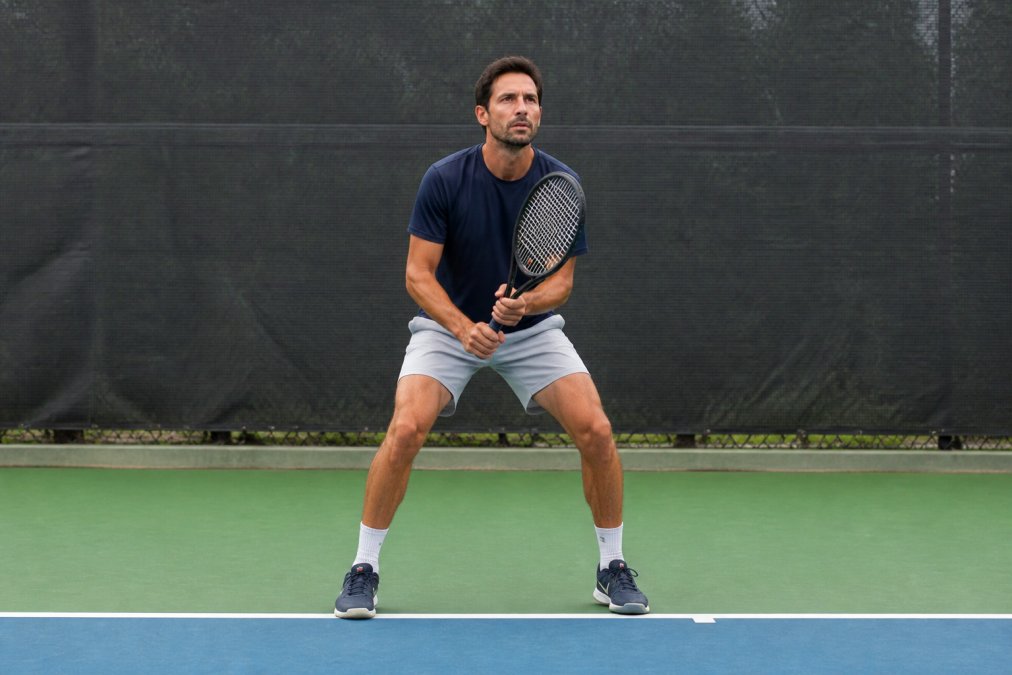
The mechanics of an effective split step
The split step puts your body in a state of readiness. When timed correctly, you land just as your opponent strikes the ball. Your feet are shoulder-width apart, knees slightly bent, weight on the balls of your feet (apta.org). Your center of gravity is lowered, allowing faster acceleration in any direction.
Timing is critical. Land just as your opponent makes contact. Your arms should be up in a ready position, not hanging at your sides. The split step itself is a small, controlled hop that shifts your weight and prepares your legs for explosive movement.
Common split-step mistakes and how to fix them
Many adult players land too late, still descending when they need to accelerate. Focus on landing exactly when your opponent’s racket makes contact with the ball.
Another common error is landing with weight too far back on your heels, which slows your first step. Instead, land with weight on the balls of your feet, ready to push off in any direction. Your knees should be bent enough that you feel tension in your legs, the coiled spring position.
Some players make the split step too big. A small hop is sufficient. The goal is to break your momentum and reset your body position, not to launch yourself.
Practice your split step without a ball first. Get the timing and position automatic, then add the complexity of reacting to actual shots. Muscle memory for this movement is everything.
Tennis Agility Drills for Adults
Agility work develops your ability to change direction quickly while maintaining balance. This allows you to accelerate laterally, decelerate smoothly, and transition between directions without losing your center of gravity.
Ladder drills for foot speed and coordination
Agility ladder drills improve foot speed and coordination simultaneously. Place an agility ladder on the court and move through it with both feet in each square, then progress to single-foot movements.
The key is speed without sacrificing form. Your knees should stay bent, your core engaged, and your posture upright. Controlled speed beats reckless speed every time.
Here’s a progression for ladder drills:
-
Two feet in each square – Move laterally through the ladder, placing both feet in each square. Complete 3 passes, rest 30 seconds, repeat for 5 sets.
-
Single-foot forward – Step with one foot per square, moving forward through the ladder. Complete 3 passes per foot, rest 30 seconds, repeat for 4 sets.
-
Lateral single-foot – Move laterally with one foot leading, stepping into each square. Complete 3 passes each direction, rest 30 seconds, repeat for 4 sets.
-
High-knee drive – Move forward through the ladder, driving your knee up with each step. Complete 3 passes, rest 30 seconds, repeat for 4 sets.
These drills take 15-20 minutes total. Do them twice per week, focusing on quality over speed. Your foot speed will improve noticeably within 3-4 weeks.
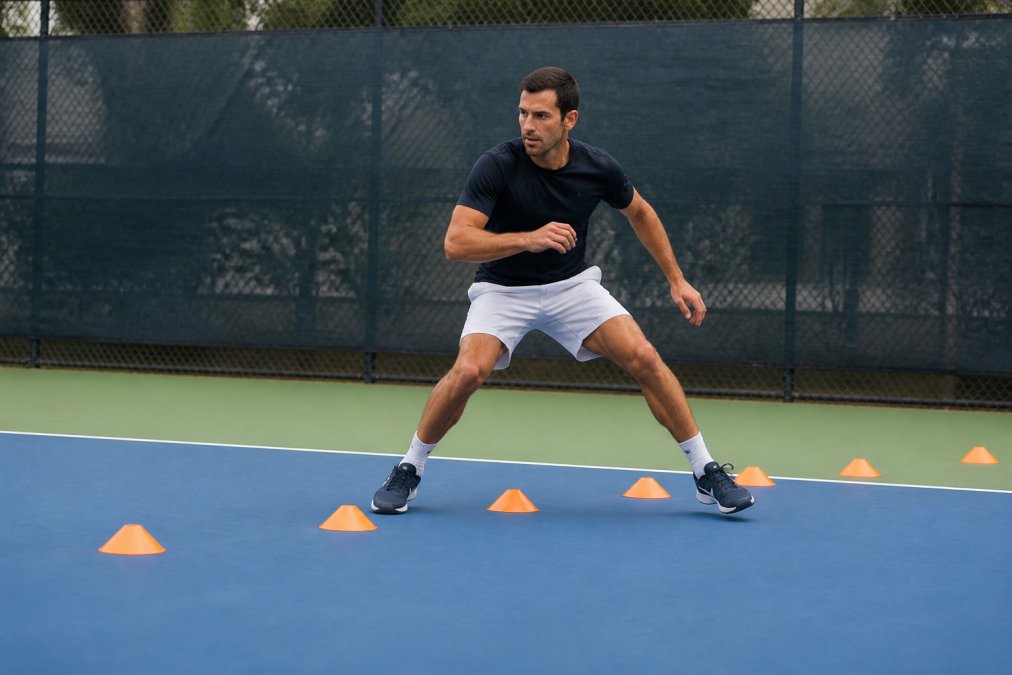
Cone drills for change of direction
Cone drills train your ability to change direction explosively while maintaining balance. Set up cones in patterns that require you to accelerate, decelerate, and change direction.
Figure-8 cone drill: Place two cones about 15 feet apart. Run a figure-8 pattern around them, focusing on smooth transitions. Complete 5 passes, rest 60 seconds, repeat for 4 sets.
T-drill: Place three cones in a T shape. Sprint forward to the top cone, shuffle laterally to one side cone, shuffle to the opposite side cone, then backpedal to the starting point. Complete 5 passes, rest 60 seconds, repeat for 4 sets.
5-10-15 drill: Set up cones at 5, 10, and 15 feet. Sprint to the 5-foot cone and back, then to the 10-foot cone and back, then to the 15-foot cone and back. Complete 5 passes, rest 90 seconds, repeat for 3 sets.
Focus on deceleration control. The ability to stop quickly and change direction is more important than raw speed.
Tennis Movement Drills Without a Racket
Racket-free drills let you focus entirely on footwork and movement without the distraction of hitting the ball.
Shadow swing drills for rhythm and timing
Shadow swings combine footwork with stroke mechanics without a ball. You perform your complete stroke, split step, movement, and swing as if hitting an actual shot. This builds the rhythm and timing that transfers directly to match play. manage joint discomfort.
Stand at the baseline. Perform a split step, move to your right, and execute a complete forehand swing in one fluid motion. Your footwork should set up your stroke, not feel like separate movements (peer-reviewed research).
Complete 20 shadow swings per stroke type (forehand, backhand, serve). Rest 30 seconds between sets. Do this drill twice per week, focusing on smooth, coordinated movement.
Recovery step patterns and court positioning
After you hit a shot, you must recover to a neutral court position. Recovery step patterns train you to move efficiently back to center court after hitting.
Practice this sequence:
- Start at the baseline center
- Split step as if receiving a serve
- Move right and perform a forehand swing
- Take recovery steps back to center
- Repeat to the left side
- Complete 10 cycles (5 right, 5 left)
Rest 30 seconds and repeat for 4 sets. Focus on smooth transitions from your stroke back to your ready position.
Lateral Movement Exercises for Court Coverage
Lateral movement is the most important type of court movement for adults. Most points are won or lost based on your ability to move side-to-side efficiently.
The lateral shuffle is your primary movement for short distances. Your feet stay relatively close together as you shuffle sideways, keeping your center of gravity stable. Practice lateral shuffles along the baseline: shuffle 10 feet to the right, then 10 feet to the left. Complete 5 passes each direction, rest 30 seconds, repeat for 4 sets.
The crossover step is used for longer lateral movements. Your outside foot crosses in front of your inside foot, allowing you to cover more ground quickly. Practice crossover steps by sprinting laterally 20 feet, then backpedaling to your starting position. Complete 5 passes each direction, rest 60 seconds, repeat for 3 sets.
Combine these movements in a court coverage drill. Set up cones along the baseline at 0, 10, 20, and 30 feet from center. Start at center, shuffle to the 10-foot cone, backpedal to center, sprint to the 20-foot cone, backpedal to center, then sprint to the 30-foot cone and backpedal to center. Complete 4 passes, rest 90 seconds, repeat for 3 sets.
The goal is to develop muscle memory and proprioception that allows you to move confidently in any direction.
Progressive Drill Progression Plans for Adults
Progressing your tennis footwork drills systematically ensures you’re building skills in the right order. A structured progression builds from foundation movements to game-speed execution.
Week 1-2: Foundation building
The first two weeks focus on establishing proper technique and building muscle memory for basic movements. You’re not working at high intensity.
Perform these drills three times per week, with at least one rest day between sessions:
Session structure:
- 5-minute warm-up (light jogging, dynamic stretches)
- Split step practice without movement (20 reps)
- Agility ladder drills (basic two-foot pattern, 3 sets of 3 passes)
- Lateral shuffle drills (10 feet each direction, 3 sets of 5 passes)
- Shadow swings (15 per stroke type, 2 sets)
- 5-minute cool-down
This takes approximately 20-25 minutes. Focus on quality and consistency, not intensity.
Week 3-4: Speed and intensity
Now you’re adding complexity and speed to the foundation you’ve built. Your nervous system has established the basic patterns.
Perform these drills three times per week:
Session structure:
- 5-minute warm-up
- Split step with directional movement (react to coach’s call, 20 reps)
- Ladder drills (progress to single-foot patterns, 4 sets of 3 passes)
- Cone drills (T-drill, 4 sets of 5 passes)
- Lateral movement with acceleration (shuffle, then sprint on command, 3 sets of 5 reps)
- Shadow swings with footwork (20 per stroke type, 3 sets)
- 5-minute cool-down
This session takes 25-30 minutes. You should feel challenged but not exhausted.
Week 5-6: Game-speed integration
In the final phase, you’re bringing all these movements together at match speed, practicing under conditions that simulate actual play.
Perform these drills three times per week:
Session structure:
- 5-minute warm-up
- Split step with ball feed (coach or partner feeds balls, you move and hit, 20 reps)
- Ladder drills at maximum speed (4 sets of 3 passes)
- Cone drills with sprint finishes (5-10-15 drill, 4 sets)
- Game-simulation footwork (coach calls shots, you move and shadow swing, 10 minutes)
- Recovery step practice with actual shots (10 cycles, 4 sets)
- 5-minute cool-down
This session takes 30-40 minutes. You should feel fatigued but not injured.
After six weeks, reassess your court movement. You should notice improved confidence, better positioning, and faster reactions. The key is consistent progression, small improvements every week add up to significant changes over months.
Do not progress too quickly. Many adult players push too hard in weeks 1-2 and burn out. Patience with the foundation phase pays dividends later. Also, stop immediately if you feel sharp pain in your knees, ankles, or hips. Footwork drills can aggravate existing injuries if done incorrectly.
Common Footwork Mistakes to Avoid
Adult players make predictable footwork errors that limit their improvement.
Starting your movement too early is the most common error. You see your opponent preparing to hit and start moving before they make contact. The fix is simple: wait for the split step moment, then react.
Moving with your weight on your heels forces you to shift your weight forward before you can accelerate. Keep your weight on the balls of your feet throughout your movement.
Taking steps that are too large slows you down. Shorter, quicker steps allow faster acceleration and deceleration. You’ll cover more ground faster with more frequent smaller steps.
Failing to recover to center court after hitting is a silent killer. Make recovery steps automatic. After every shot, your next movement should be back toward the center of the court.
Neglecting to adjust your stance based on the incoming shot limits your ability to hit quality shots. Practice adjusting your stance, open, closed, or neutral, based on the ball’s location and your court position.
Ignoring balance during movement leads to inconsistent shots and injury risk. Your balance should be maintained throughout your footwork. If you’re stumbling or lunging, your footwork pattern is wrong.
Your footwork is the foundation that makes every other skill work. Without consistent, efficient movement, even technically sound strokes fail under match pressure. These tennis footwork drills for adults build the movement patterns you need to execute your game confidently and consistently.
The progression from foundation work through game-speed integration takes time, but it’s time well invested. Most adult players see noticeable improvements in court confidence and consistency within 4-6 weeks of structured footwork training (peer-reviewed research). The key is consistency, three quality sessions per week beats sporadic intense training every time.
At Crunch Time Coaching, we’ve built our entire program around the principle that footwork determines everything. Our step-by-step daily lessons guide you through progressive footwork development, and our in-person training camps let you work directly with our coaching team to refine your movement patterns. Whether you’re returning to competitive tennis after years away or pushing to reach a higher level, footwork training is where transformation begins. Reserve your spot today and start building the movement foundation that will elevate your entire game.
Frequently Asked Questions
How can I improve my footwork in tennis as an adult?
Start with foundational drills like the split step and lateral shuffles, performed 3-4 times per week. Focus on balance and center of gravity before adding speed. Shadow swings without a racket help develop rhythm without the pressure of hitting. Progression matters: spend 2 weeks on basics, then add intensity and court coverage drills. Most adults see noticeable improvement in 4-6 weeks of consistent practice.
What are some good footwork drills for tennis?
Effective drills include ladder work for foot speed, cone drills for change of direction, shadow swings for timing, and recovery step patterns for court positioning. Split-step practice builds explosiveness and reaction time. Lateral movement exercises improve court coverage. Combine these into a structured progression plan that starts with stationary work, then adds movement, then integrates game-speed scenarios. Video-based visual cues help you track form improvements over time.
How often should adults practice tennis footwork drills?
Three to four sessions per week is optimal for adults balancing training with recovery. Each session should last 20-30 minutes focused on footwork. This frequency allows your body to adapt and build muscle memory while preventing overuse injuries. On off days, light shadow swings or mental visualization can reinforce technique. Consistency matters more than intensity, steady practice over weeks builds lasting improvements in court movement and agility.
Can footwork drills help prevent tennis injuries in older players?
Yes. Proper footwork reduces stress on joints by improving balance, weight transfer, and deceleration control. Drills that emphasize center of gravity and dynamic movement strengthen stabilizer muscles. Age-specific modifications like slower tempos and extended recovery periods between drills keep intensity manageable. Focus on the split step and lateral movement to build proprioception and reaction time, which reduce falls and awkward movements that cause injury.
This article was written using GrandRanker