
Table of Contents
- What Makes a Personalized Tennis Training Camp Different
- Program Overview and Training Philosophy
- Adult Tennis Training Camps: Finding the Right Fit
- Tennis Camp Duration and Intensity: What to Expect
- How to Choose a Tennis Academy Based on Your Goals
- Skill-Level Assessment and Post-Camp Development
- Boarding vs. Non-Boarding Options and Logistics
- Measuring Success: Objective Metrics That Matter
- Frequently Asked Questions
Last Updated: September 1, 2026
What Makes a Personalized Tennis Training Camp Different
A personalized tennis training camp tailors instruction to your specific skill level, goals, and learning style rather than forcing you into a one-size-fits-all group format. Generic camps cycle through the same drills for everyone. A personalized approach identifies exactly where your game breaks down, your serve consistency, footwork under pressure, or mental toughness in tiebreakers, and builds a training plan around that specific weakness.
The best programs use a detailed skill evaluation that measures your current stroke mechanics, court positioning, competitive patterns, and physical conditioning before day one. This baseline becomes your reference point. Every training session tracks progress against it with video analysis and measurable metrics. You’re not guessing whether you’re improving; you’re watching it happen.
The personalized model also means flexibility. You’re not locked into a rigid curriculum designed for someone else’s timeline. If your serve needs three weeks of focused work, that’s what you get. If your footwork improves faster than expected, the program adjusts. This adaptive approach is why competitive players, especially adults returning to the game or those stuck on a performance plateau, see faster, more sustainable results than they would in traditional group settings.
Program Overview and Training Philosophy
Crunch Time Coaching operates on a core principle: world-class instruction combined with personalized feedback creates measurable transformation. The “Totally Obsessed” coaching methodology delivers step-by-step daily lessons designed specifically for your current level and goals, whether mastering your serve in a week or sharpening footwork for consistency.
The training philosophy emphasizes technical precision before match application. You’ll work on stroke mechanics and biomechanics before applying those mechanics under pressure in competitive scenarios. This sequencing matters. Many players skip the technical foundation and wonder why their consistency breaks down in matches.
High-performance training combines court work with physical conditioning. Your footwork won’t improve if your legs fatigue in the third set. Your serve won’t hold up under pressure if your shoulder stability isn’t there. The best programs integrate strength work, agility drills, and endurance conditioning alongside stroke development.
Post-camp development planning separates programs that create lasting change from those that deliver temporary momentum. After intensive training, most players plateau within weeks without a structured continuation plan. The strongest programs provide clear progression pathways: which drills to maintain, which to advance, how often to practice each element, and how to measure progress toward your goals.
Adult Tennis Training Camps: Finding the Right Fit
Finding the right camp as an adult requires clarity on your specific situation. Are you returning after years away? Competing in a league? Training for tournament play? Each scenario demands different camp structures and intensities.
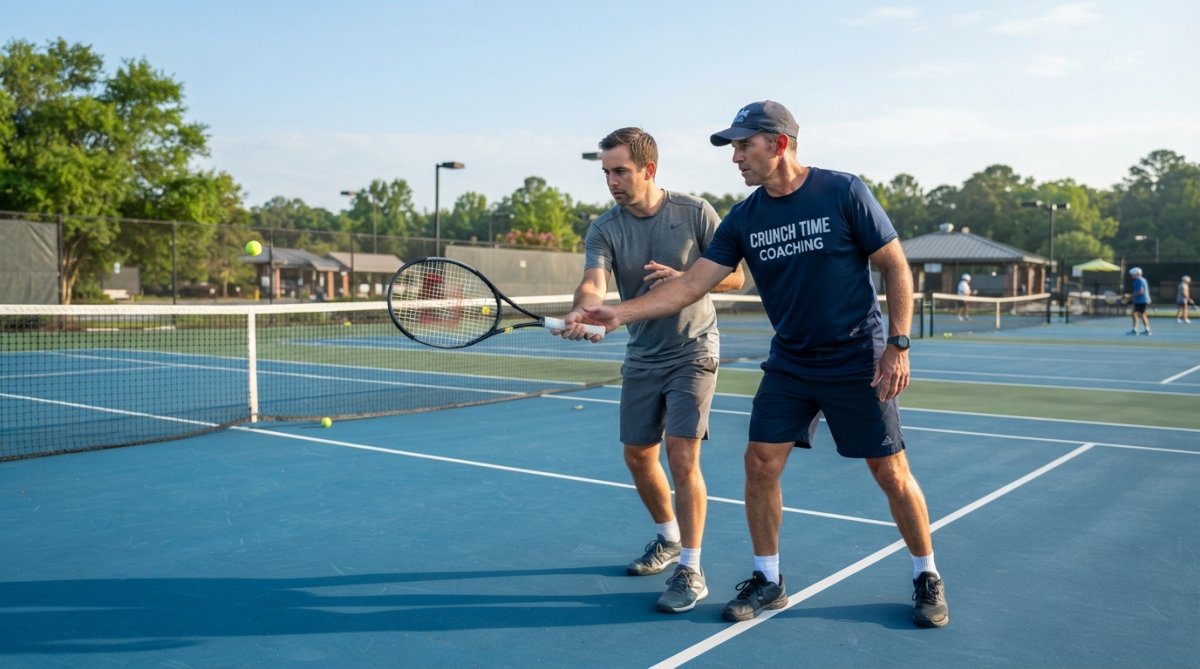
Adult-specific programs acknowledge that your body works differently than a junior’s. Recovery takes longer. Injury prevention matters more. Your schedule is less flexible. The best adult camps build in rest days, focus on sustainable technique rather than explosive power, and offer flexible scheduling options.
Crunch Time Coaching differentiates itself through exclusive in-person training camps paired with world-class step-by-step daily lessons. The focus is transformation, mastering your serve in a week, sharpening footwork for consistency. For adults, this combination of online personalized coaching and hands-on intensive sessions creates continuity. You have structured guidance before, during, and after camp.
Tennis Camp Duration and Intensity: What to Expect
Tennis camp duration ranges from weekend intensives to multi-week immersions. A weekend camp, typically 2-3 days, works for skill refinement or tactical adjustments. You’re not building a new serve from scratch in 48 hours.
Week-long camps hit the intensity sweet spot for most adult players. Five days of focused training allows time for skill building with enough repetition that changes stick. Your body adapts. Your nervous system begins encoding new movement patterns. By day five, you’re ingraining, not just learning.
Multi-week programs, 10 days to 3 weeks, suit players preparing for specific tournaments or making significant technical overhauls. If your footwork needs fundamental rebuilding, one week isn’t enough. Longer camps allow for periodization: early sessions build foundation, middle sessions add intensity and complexity, final sessions emphasize competitive application.
Intensity varies by program and your current level. Beginner-focused camps might run 3-4 hours daily. Intermediate camps often include 5-6 hours of court time plus conditioning. Advanced competitive camps push toward 6-8 hours daily, combining court work, physical training, mental conditioning, and video analysis (usta.com).
Recovery days matter. The strongest programs build in lighter days or complete rest days, especially in multi-week formats. Your muscles adapt during rest, not during training (peer-reviewed research). A program that runs full intensity every single day creates fatigue, not improvement.
How to Choose a Tennis Academy Based on Your Goals
Choosing an academy requires starting with specificity: what exactly do you want to improve, and by when?
If your goal is serve improvement, you need a program with dedicated serve-focused curriculum and video analysis. Crunch Time Coaching’s explicit focus on “transform your serve in a week” signals that serve mechanics get concentrated attention. performance training gear.
If competitive match play is your goal, look for programs that integrate tactical development and match scenarios.
If you’re returning to tennis after years away, you need a program that acknowledges your body’s current state and builds progressively.
If you’re stuck on a performance plateau, you need personalized coaching that identifies exactly what’s holding you back.
Consider facility quality and coaching credentials. Pro-level facilities with well-maintained courts and certified instructors matter. But the strongest indicator is whether the program has a clear assessment framework and post-camp development plan. Without these, you’re paying for a week and hoping something sticks.
Skill-Level Assessment and Post-Camp Development
The skill-level assessment separates quality programs from average ones. Before day one, you should complete a comprehensive evaluation measuring your current stroke mechanics, court positioning, consistency patterns, and competitive tendencies. This baseline becomes your reference point.
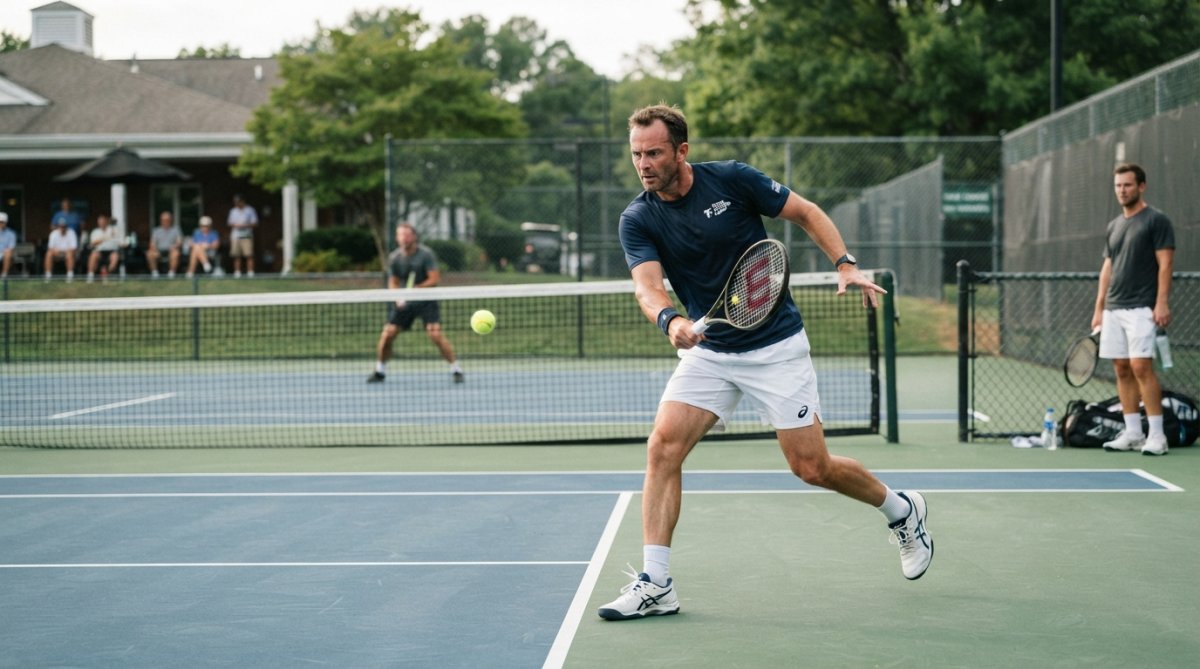
Video analysis is essential. Watching your serve in slow motion reveals mechanical flaws that feel invisible in real time (peer-reviewed research). A coach analyzing frame-by-frame can identify exactly where your weight transfer breaks down or where your racket path deviates from optimal. This visual feedback accelerates learning faster than verbal cues alone.
Post-camp development planning determines whether your investment compounds or dissipates. The strongest programs provide explicit continuation plans: which drills to perform daily, which to do 3x weekly, which to phase in after 4 weeks. They specify court time requirements, conditioning frequency, and how to progress intensity without regressing technically.
Objective success metrics matter here. Instead of vague goals like “improve my game,” you need measurable targets: “increase first-serve percentage from 58% to 68%” or “reduce unforced errors in baseline rallies by 25%.” After 4 weeks of post-camp training, you should see measurable movement toward these targets.
Boarding vs. Non-Boarding Options and Logistics
Boarding camps include accommodations, meals, and evening programming, creating an immersive environment where you’re focused entirely on tennis. You’re not commuting or distracted by home responsibilities. This intensity accelerates learning. The tradeoff is cost and inflexibility.
Non-boarding camps offer flexibility. You attend training sessions and return home for the evening. For adults with family or work obligations, non-boarding often makes more sense logistically.
Crunch Time Coaching’s hybrid approach combines intensive hands-on sessions with online personalized coaching. This solves the logistics problem. You can attend camps when your schedule allows without losing continuity.
Consider also facility location and travel requirements. A local or regional option eliminates travel friction. A program closer to home might be more practical if travel logistics are complicated.
Measuring Success: Objective Metrics That Matter
Success in a personalized tennis training camp shouldn’t feel vague. You need measurable outcomes that prove you actually improved.
First-serve percentage is the most concrete metric for serve improvement. If you started at 55% and finished at 68%, that’s measurable progress. Tracking this weekly before, during, and after camp shows whether your investment worked.
Unforced error reduction in specific situations matters more than raw error count. How many unforced errors do you hit in baseline rallies? In pressure situations? These context-specific metrics reveal whether your consistency actually improved.
Match results provide the ultimate metric. How many matches did you win before camp? How many after? If you won 4 matches in your league before camp and 7 after, that’s proof.
Video comparison is underrated. Have your serve filmed before camp, mid-camp, and post-camp. Watch them side-by-side. Your mechanics should visibly improve. Your footwork should look more efficient.
The strongest camps provide all of these metrics. They measure serve percentage, error rates by situation, match results, and technical progression. Without this measurement framework, you’re hoping you improved rather than knowing you did.
Choosing a personalized tennis training camp requires matching your specific goals to a program’s training philosophy, assessment framework, and post-camp support structure. The difference between a camp that creates lasting transformation and one that delivers temporary momentum comes down to whether they identify your exact limitations, address them with focused intensity, and provide clear progression pathways afterward. Crunch Time Coaching’s combination of world-class step-by-step daily instruction, specialized challenge-based curriculum, and exclusive in-person training camps creates the continuity and personalization that competitive players need to break through plateaus. Reserve your spot today and start tracking measurable progress toward your highest competitive potential.
Frequently Asked Questions
What should I look for in a personalized tennis training camp?
Prioritize certified instructors with documented experience in your skill level, a clear training philosophy that matches your goals, and a coach-to-player ratio that enables individualized feedback. Look for camps offering video analysis, stroke mechanics instruction, and tactical development. Verify that the program includes post-camp development plans so your progress continues after the intensive training ends. Ask about success metrics they track, wins, UTR improvement, or specific skill benchmarks, to understand how they measure results.
How do personalized tennis camps differ from standard group clinics?
Personalized camps provide tailored training programs based on your specific skill gaps, competitive goals, and playing style. Unlike group clinics with fixed curriculum, personalized camps offer one-on-one instruction, individualized feedback on your footwork and serve, and adaptive drills targeting your weaknesses. This focused approach accelerates skill acquisition and addresses technical issues that generic group sessions miss. You also receive customized tactical development for match play rather than general tips applicable to everyone.
Is a personalized tennis training camp worth the investment for adult players?
Yes, especially for competitive adults stuck on a performance plateau or returning after years away. Personalized coaching provides objective technical analysis and mental toughness development that self-teaching through videos cannot replicate. Adults benefit from structured skill assessment, hands-on correction of ingrained bad habits, and competitive environment exposure. The ROI comes through faster tournament wins, injury prevention through proper mechanics, and measurable improvement in specific shots like your serve or footwork consistency.
How do I evaluate the coaching methodology of a tennis academy?
Ask about their stroke mechanics framework, whether they teach modern tennis techniques or older methodologies. Request information on their training philosophy: do they emphasize high-performance conditioning, creative shot development, or tactical match play? Look for academies using video analysis, player assessment frameworks, and evidence-based drills. Check if coaches hold recognized certifications and have competitive playing backgrounds. Request references from recent adult campers to verify that the methodology actually produces results for your age group and skill level.
What is the difference between a boarding tennis academy and a daily training camp?
Boarding academies provide full-day immersion with accommodation, meals, and evening activities, typically lasting a week or longer. This intensive environment maximizes court time and allows coaches to monitor recovery and conditioning. Daily training camps let you stay nearby and attend sessions without overnight commitment, offering flexibility for working adults. Boarding suits players seeking total focus and rapid skill transformation; daily camps work better for those balancing tennis with job or family commitments. Both can deliver results, the choice depends on your schedule and learning preference.
This article was written using GrandRanker