
Table of Contents
- Online Tennis Instruction vs Personal Coaching: Which Gets You Better Results?
- Quick Comparison: Online Platforms vs In-Person Pros
- Cost of Tennis Lessons: Subscription vs Hourly Rates
- Tennis Video Analysis Services: How Remote Feedback Works
- The Benefits of Private Tennis Lessons You Can’t Get Online
- Where Online Instruction Wins: Consistency and Mental Game
- The Hybrid Model: Combining Online Drills with Court Time
- How to Choose: Questions That Decide Your Path
- Frequently Asked Questions
Last Updated: September 4, 2026
Online Tennis Instruction vs Personal Coaching: Which Gets You Better Results?
Every competitive player hits the same wall: you practice hard, but your serve breaks down in the third set and your footwork feels slow. The debate between online tennis instruction vs personal coaching has shifted.
Neither format is universally better. Online instruction excels at consistency, structured daily repetition, and mental game work. Personal coaching delivers immediate physical correction and real-time feedback.
Below, we break down the mechanics of remote video analysis, and why the hybrid model is becoming the standard.
The best path forward isn’t choosing between online instruction and personal coaching. It’s building a system that uses both where each is strongest, which is exactly what the data on skill acquisition supports.
Quick Comparison: Online Platforms vs In-Person Pros
In-person coaching is the gold standard for live technical correction, while online platforms win on structure, frequency, and cost per session.
Here’s what each format actually delivers:
| Factor | Online Instruction | In-Person Coaching |
|---|---|---|
| Real-time correction | Limited, depends on live sessions | Immediate, hands-on |
| Cost structure | Subscription, flat rate | Hourly, pay-per-session |
| Training frequency | Daily, self-directed | Weekly, scheduled |
| Technique analysis | Video submission, frame-by-frame | Live observation |
| Mental game coaching | Strong, structured curriculum | Varies by coach |
| Court time required | Minimal for drills, needed for application | Always included |
A marketplace like TeachMe.To’s coach directory shows the typical structure for local private lessons, which run pay-per-session and emphasize live court access. The trade-off is straightforward: you pay more per hour for the physical presence, but you get instant feedback on form correction and footwork patterns that a camera angle might miss.
Cost of Tennis Lessons: Subscription vs Hourly Rates
The cost of tennis lessons is where online instruction separates itself most clearly from traditional coaching. Private instruction through local marketplaces typically starts around $40 per hour, according to TeachMe.To’s published coach rates, and that rate climbs fast for coaches with strong credentials or tournament experience. But the raw hourly rate is a misleading metric. The real question isn’t what you pay per hour, it’s what you pay per improvement milestone.
The Cost-Per-Milestone Framework
A common pattern is the ‘plateau trap.’ A player takes one lesson per week for three months, spending roughly $480 (12 weeks at $40/hour), to fix a specific flaw, say, a serve that consistently nets on the ad side. A single weekly lesson often isn’t enough to rewire a deeply ingrained motor pattern; the player practices incorrectly on their own for the other six days, reinforcing the old habit.
Subscription-based online coaching flips that model. Instead of paying per session, you pay a flat recurring rate for daily instruction, structured drills, and a curriculum you can follow on your own schedule. Let’s look at the math for a standard 12-week improvement cycle:
| Cost Factor | In-Person (1x/week) | Online Subscription (Daily) |
|---|---|---|
| Sticker Price | $40/session | Pricing depends on quantity, dates, and delivery |
| Total Cost (12 weeks) | $480 | Pricing depends on quantity, dates, and delivery |
| Training Touches | 12 (1 per week) | 84 (1 per day) |
| Cost per Training Touch | $40 | Pricing depends on quantity, dates, and delivery |
| Likelihood of Habit Change | Low (spaced practice) | High (daily reinforcement) |
This table illustrates the core economic advantage of online instruction: it delivers a higher volume of deliberate practice per dollar. The American Council on Exercise guidance on skill acquisition notes that deliberate practice in shorter, more frequent sessions is often more effective than longer, less frequent training blocks for developing motor skills. Therefore, the cost-per-improvement-milestone is often significantly lower with a structured online program, even if the player also books a monthly in-person ‘check-up’ session to ensure they’re on the right track.
The Hidden Cost of In-Person: Travel and Scheduling
The hourly rate is only the visible cost. For a suburban player, the true cost of a private lesson includes:
- Travel Time: An average round trip to a club can be 30-45 minutes. That’s time not spent practicing.
- Court Fees: Many coaches charge extra for court rental if you don’t have a club membership, adding $10-$20 to the session cost.
- Opportunity Cost: A fixed weekly lesson time often conflicts with work or family schedules, leading to missed sessions and wasted money.
Online instruction eliminates these friction points. The ‘court’ is your driveway, a public park wall, or a practice court you book at your convenience. Travel time saved can be redirected into daily drills.
The cheapest option is only cheap if you actually use it. An online subscription you never open costs more than a private lesson you attend every week. Be honest about your discipline level before you commit. If you know you won’t practice between sessions, the hourly model might actually be the better investment despite the higher rate.
The ROI of the Hybrid Model
For the serious competitor, the most cost-effective path is rarely a single method. A hybrid approach, a monthly in-person session for live correction paired with a daily online subscription, often yields the fastest results. This is less than three private lessons but provides daily structured training and a monthly live checkpoint.
Tennis Video Analysis Services: How Remote Feedback Works
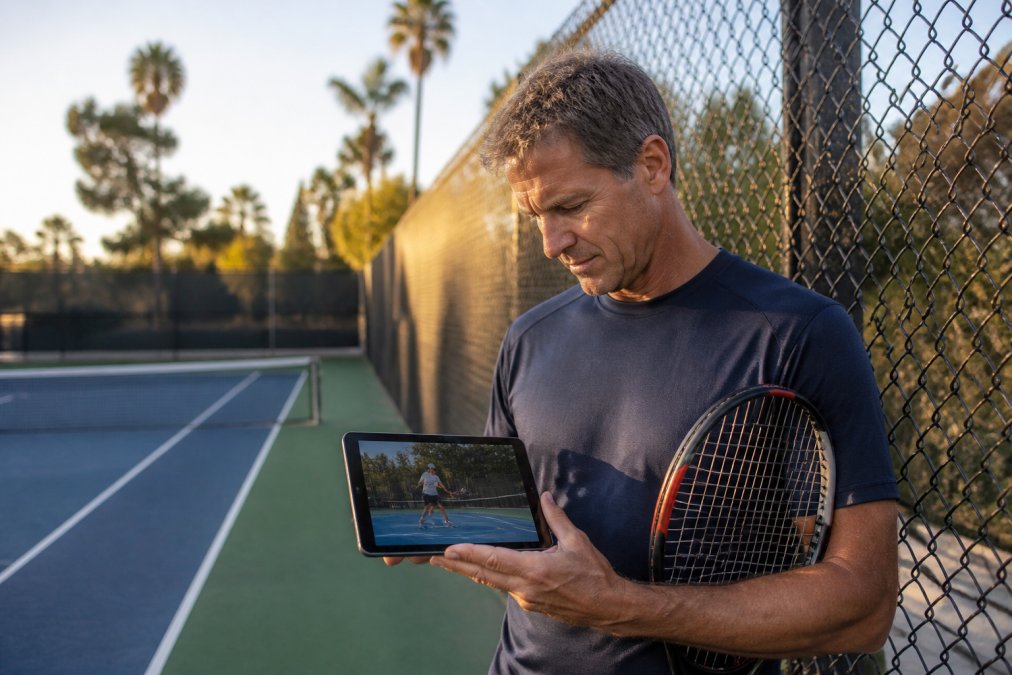
Tennis video analysis services work by having you film your strokes from specific angles, upload the footage, and receive frame-by-frame breakdowns of your mechanics. The skepticism is fair: how does a coach on a screen see what’s wrong with your serve? Modern video analysis is more precise than live observation in several ways, but only if you capture the footage correctly. The single biggest reason remote coaching fails isn’t the analysis, it’s poor video quality.
The Setup: What You Need to Get It Right
Players often film from a bad angle, with poor lighting, or from a distance that makes the ball and contact point impossible to see. To get a useful analysis, replicate a standard setup.
- Camera Position: Place your camera on a tripod at court level, not above it. The ideal position is directly behind the baseline for serves and at the side of the court, perpendicular to the net, for groundstrokes. This gives the coach a clear view of your swing path, contact point, and follow-through.
- Frame Rate and Resolution: Most modern smartphones are sufficient, but you must ensure the camera is set to record at 60 frames per second (fps) or higher. Standard 30 fps can blur the racquet head during fast swings, making frame-by-frame analysis useless. Set your phone to its highest resolution (4K if available) to allow for digital zoom on the contact point.
- Lighting and Background: Film with the sun behind the camera, not behind you. A backlit player appears as a silhouette, obscuring the racquet path. A plain background, like a fence or wall, is better than a busy one with trees or other players, which can confuse the video compression and make the ball harder to track.
- The ‘One-Second’ Rule: After you hit the ball, hold your finish position for a full second. This allows the coach to check your balance and follow-through, which are critical indicators of weight transfer and swing efficiency.
The Feedback Loop: What to Expect and How to Speed It Up
The limitation of video analysis is the feedback loop. With in-person coaching, you hit, get corrected, and hit again within seconds. With video submission, you film, send, and wait. That delay matters for some corrections and not for others: technical proficiency in stroke mechanics improves well through video review, but reactive adjustments like footwork patterns during live points need real-time correction.
To make the loop faster, most serious online platforms use a structured submission format. Instead of sending a 10-minute rally video, you submit specific drills, for example, 10 serves from the deuce side, 10 from the ad side, and 5 shadow swings. This allows the coach to compare across sessions and track progress against a baseline.
Don’t just film your best shots. Film the misses, the shanks, and the double faults. The coach needs to see the error pattern, not just the highlight reel, to diagnose the root cause of your inconsistency.
The Biomechanical Advantage of the Lens
A coach reviewing footage can pause at the trophy position, slow down your racquet drop, and compare your contact point frame by frame. Video analysis allows for biomechanical review at a level of detail impossible during a rally, for example, using on-screen angle tools to measure shoulder rotation at the peak of your toss or knee bend at contact. This quantitative data is a unique value of the remote format that even the best in-person coach cannot provide without expensive motion-capture equipment.
The Benefits of Private Tennis Lessons You Can’t Get Online
The benefits of private tennis lessons center on one irreplaceable element: real-time physical correction. When your footwork is late or your racquet face is open at contact, an in-person coach sees it instantly and can physically guide you through the correct movement pattern.
That tactile element matters more as you age. For players over 40, a coach can spot compensation patterns that develop when your body doesn’t move the way it did at 25, adjusting your technique to protect your shoulder or knees before injury develops, something no video review can do because the feedback isn’t immediate enough.
Private lessons also provide accountability. When you’ve booked and paid for an hour of court time, you show up and work. The structure of a scheduled lesson with a real person who knows your game creates a training rhythm many players struggle to replicate on their own.
Where Online Instruction Wins: Consistency and Mental Game
Online instruction wins decisively on two fronts: training consistency and the mental side of competition. These are the areas where the traditional model has always been weakest, because they require daily repetition rather than weekly sessions.
Consistency matters because skill acquisition is cumulative. A daily 20-minute online drill on your serve motion builds muscle memory far faster than a weekly hour-long lesson where you spend most of the time retrieving balls. The American Council on Exercise guidance on skill acquisition notes that deliberate practice in shorter, more frequent sessions is often more effective than longer, less frequent training blocks for developing motor skills.
The mental game is where online instruction has quietly become superior. Tiebreaker collapses, second-serve yips, and derailing self-talk are not technical problems, they’re patterns that need daily rewiring. A structured online curriculum can deliver daily mental toughness exercises, visualization routines, and match play strategy frameworks between technical drills. Most private coaches touch on the mental side occasionally but lack the time or structure to build it into every session.
The best online instruction treats the mental game as a trainable skill, not an afterthought, a genuine advantage for players whose results are held back by what happens between their ears, not by their strokes.
The Hybrid Model: Combining Online Drills with Court Time
The hybrid model combines daily online instruction for technique and mental training with periodic in-person sessions for real-time correction and match play. This is the approach we’ve built at Crunch Time Coaching, and it’s the answer for players who want the consistency of digital training without losing the tactile benefits of live coaching.
The structure: you follow a daily online curriculum with video instruction, drills, and mental game work. Your serve mechanics get broken down through video analysis, and you practice the corrected motion daily. Then, weekly or monthly, you get on court with a coach who watches you apply those changes in live play, corrects the inevitable drift, and works on footwork patterns that need real-time feedback.
This model also solves the cost problem. Instead of paying hourly rates for every training touch, you pay a subscription for the daily work and invest in private lessons only for the elements that genuinely require a live coach. The USTA’s player development resources emphasize that consistent, well-structured training is the foundation of improvement, and the hybrid model delivers that consistency at a fraction of the cost of full private instruction.
If you’re building a hybrid schedule, film your practice sessions on court and send them to your online coach for analysis. This closes the gap between your daily drills and your weekly live sessions, giving you a feedback loop that rivals full-time private coaching.
How to Choose: Questions That Decide Your Path
The right choice depends on your current level, your budget, and the specific gap in your game that’s costing you matches. Answer these four questions honestly, and the path forward becomes clear.
What’s actually holding you back? If a coach immediately identifies a stroke mechanic flaw or footwork issue, in-person instruction is the fastest fix. If you already know your flaws but can’t fix them or stay consistent, online instruction’s daily structure will serve you better.
How much court time do you realistically have? Players who can get on court two or more times per week benefit most from private coaching. Those limited to one session or less should prioritize online instruction for daily reps.
What does your budget support? Private lessons at $40 per hour or more add up fast. Online subscriptions are typically far more affordable per training touch, but they demand self-discipline.
Are you training for competition or fitness? League and tournament players need the tactical development and mental game training that structured online programs excel at. Recreational players may be better served by the social and physical aspects of private lessons.
For competitive players who want a structured, high-intensity regimen covering technique, footwork, and the mental game, the answer increasingly points to online instruction as the foundation, supplemented by periodic in-person work. Crunch Time Coaching built our platform around that model, with step-by-step daily lessons designed to transform your serve in a week and a challenge-based curriculum that keeps you progressing.
Choosing between online tennis instruction and personal coaching doesn’t have to be a compromise. The players who improve fastest treat them as complementary tools, using daily online instruction to build consistency and mental toughness, then applying those skills on court with a live coach for real-time correction. At Crunch Time Coaching, our ‘Totally Obsessed’ coach delivers the daily structure and specialized curriculum you need, plus exclusive in-person training camps when you’re ready to test your skills live. Reserve your spot today and start building the game you’ve been chasing.
Frequently Asked Questions
Are private tennis lessons worth it?
Private lessons deliver immediate physical correction that video can’t match, which makes them worth it for players fixing specific mechanical flaws. The trade-off is cost and frequency. Most players can afford one lesson per week at best, which slows skill acquisition. Online tennis instruction offers daily structured feedback for a similar monthly cost, giving you more repetitions and faster habit formation. For players with a clear technical issue, a few private sessions mixed with online drills often produces the best results.
How much should a private tennis lesson cost?
Private tennis lesson pricing depends on your market, the coach’s credentials, and session length. Hourly rates typically vary, and many coaches offer package deals that lower the per-session cost. When comparing, factor in court fees and travel time, which add to the real expense. Online tennis instruction platforms often cost less per month than two private sessions, providing daily lessons instead of one weekly hour. Evaluate what you get per dollar: frequency of feedback, structured curriculum, and access to the coach.
Can you effectively learn tennis technique through online video courses?
Yes, for most technical elements, video-based instruction works when the curriculum is structured and you commit to deliberate practice. The key is a feedback loop. Watching a lesson is passive; recording your strokes and submitting them for review creates active learning. Tennis video analysis services let coaches break down your serve or forehand frame by frame, highlighting issues you cannot see from your own perspective. This approach builds technical proficiency and consistency, especially when you practice the drills daily rather than weekly.
How is online instruction different from free YouTube tennis videos?
Free videos give you general advice for a broad audience. Online instruction platforms offer a structured curriculum, daily lessons, and personalized feedback based on your specific stroke mechanics and skill level. A coach reviews your video submission and tells you what to fix next, creating a feedback loop that generic tutorials lack. You also get a training path that builds progressively, so you are not jumping between random tips. The accountability and individualized curriculum are what you pay for.
This article was written using GrandRanker