
Table of Contents
- Why Consistency Wins Matches (And How to Build It)
- The 7 Best Tennis Drills for Consistency, Ranked
- Tennis Rally Drills for Intermediate Players: Adding Directional Control
- How to Reduce Unforced Errors in Tennis: The Mental Reset Routine
- Solo Drills: Consistency Training Without a Partner
- Build a Tennis Practice Plan for Consistency That Sticks
- Common Mistakes That Kill Your Consistency
- Final Word: Pick Two Drills and Commit for 30 Days
- Frequently Asked Questions
Last Updated: September 6, 2026
Every tennis player knows the feeling: you dominate a rally for fifteen shots, only to dump a routine forehand into the net. Consistency separates competitive players from recreational ones, yet it is often the most neglected part of practice. Tennis drills for consistency are the most direct way to lower your unforced error count and build rally tolerance. Repetition with purpose beats aimless hitting.
Most players practice trying to hit winners; the best players practice keeping the ball in play. The drills below are ranked by how quickly they translate into match results, and each targets a specific breakdown in your game.
Why Consistency Wins Matches (And How to Build It)
Unforced errors decide more matches than winners do. A player who sustains a rally for ten shots while forcing their opponent to hit an extra ball wins more points than the player going for broke on shot three. Consistency is a skill that responds to structured training.
The foundation of consistency is reproducing the same swing path and follow-through under pressure. That requires repetition with feedback, not mindless hitting. Footwork patterns, recovery position, and your split step determine whether you arrive at the hitting window in balance.
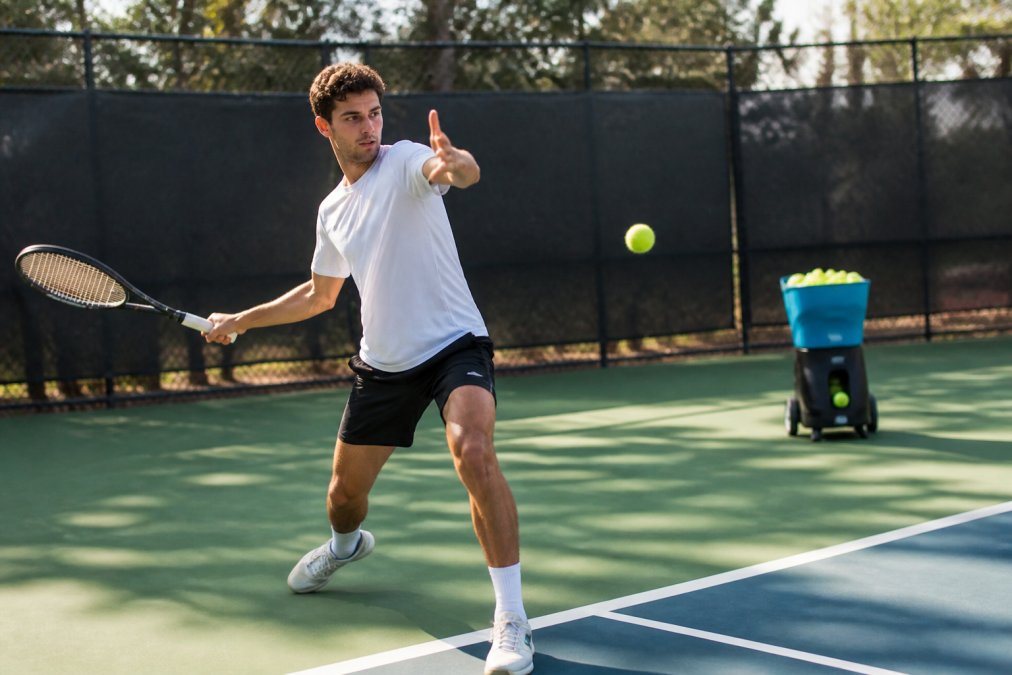
Consistency drills must be progressive. Hitting ten balls cross-court from the center mark is easy; doing it while your opponent moves you side to side is hard. The drills below build from simple rally work to pressure-based scenarios.
The 7 Best Tennis Drills for Consistency, Ranked
These seven exercises are sequenced so each builds on the previous drill. Start at the top and work down as your consistency percentage improves, completing each with a controlled ball trajectory and minimal unforced errors.
1. Cross-Court Rally: The Foundation of Rally Tolerance
The cross-court rally is the most important drill for consistency because it develops rhythm, footwork, and net clearance simultaneously. Two players stand in the ad court and hit cross-court forehands or backhands, keeping every ball inside the singles sideline and past the service line.
How to run it:
- Start with a 10-shot rally goal, counting only shots that land past the service line
- Reset to zero on any unforced error, not on a forced error from a good shot
- Alternate between forehand and backhand cross-court rallies every 5 minutes
- After 20 clean rallies, add movement by having one player shift the ball slightly wider each shot
The key metric is your consistency percentage: clean rallies divided by total attempts. Getting above 85 percent transforms your match play (PubMed).
A common mistake is hitting with too much pace on this drill. The goal is rhythm and net clearance, not power. Use 60-70 percent of your maximum pace and focus on brushing up the back of the ball to create margin over the net ([usta.com](https://www.usta.com/en/home/improve/tips-and-instruction.html)).
2. The Target Zone Grid: Precision Under Pressure
Once you can sustain a rally, you need to direct it. The target zone grid places four cones in the corners, and your goal is to hit specific zones on command while maintaining rally length. This develops the directional control that turns a neutral rally into an attacking one.
How to run it:
- Place a target (cone, towel, or chalk mark) in each corner of the court, just inside the lines
- Your partner feeds you a ball, and you call your target before you hit
- Hit 10 balls to the forehand corner, then 10 to the backhand corner
- Progress to calling targets only after your split step, forcing quicker shot selection
Scoring rewards accuracy and consistency: 3 points for hitting the target zone, 1 for landing in the court but missing the zone, 0 for an error.
3. The 20-Ball Challenge: Building Rally Length
The 20-ball challenge is the ultimate test of rally tolerance because it removes the safety net of resetting after a few shots. Sustain a single rally of 20 consecutive shots without an unforced error, with every ball clearing the net by a comfortable margin.
How to run it:
- Rally with your partner from the baseline, alternating forehands and backhands
- Count every shot that lands in the court, regardless of who hits it
- If the rally breaks down before 20, start over from zero
- Once you hit 20, extend the goal to 30, then 50
This drill exposes technical weaknesses immediately. If your backhand breaks down at shot 14, you know where to focus next. Many players find their concentration lapses around shots 10-15.
Tennis Rally Drills for Intermediate Players: Adding Directional Control
Intermediate players often sustain long exchanges but lack the ability to construct points. The following tennis rally drills for intermediate players focus on intentional shot placement and tactical thinking that turns consistency into a weapon.
Inside-Out and Inside-In Patterns
The inside-out forehand is the highest-percentage attacking shot in tennis, and practicing it in a rally context builds confidence and court coverage. One player sets up in the ad court and hits inside-out forehands to their partner’s backhand corner, then follows with an inside-in forehand down the line.
How to run it:
- Player A feeds a short ball to Player B’s forehand side
- Player B runs around the backhand and hits an inside-out forehand cross-court
- Player A returns the ball deep to the backhand, and Player B hits an inside-in forehand down the line
- Alternate roles every 10 repetitions
The pattern teaches you to recover to the center after each shot. Your recovery position determines whether you can handle the next ball.
The ‘Aggressive Margin’ Drill
Most players miss when increasing pace because they aim too close to the lines. The aggressive margin drill teaches you to hit with intent while keeping targets safely inside the court: aim 3-4 feet inside the lines rather than on them. building consistent habits.
How to run it:
- Set up two targets in each corner, one at the intersection of the lines and one 3 feet inside
- Alternate hitting aggressive shots to the “margin” target and conservative shots to the “line” target
- Track how many aggressive shots land in versus errors
- The goal is to find the pace at which your aggressive margin shots land in consistently
The biggest mistake in this drill is reverting to old habits once you start missing. If your consistency percentage drops, you are hitting too hard. Dial the pace back until you find the aggressive margin that keeps you in the point while still pressuring your opponent.
How to Reduce Unforced Errors in Tennis: The Mental Reset Routine
How to reduce unforced errors in tennis is as much mental as technical. Most errors come in clusters because players carry frustration from one missed shot into the next point. A structured reset routine clears your mind between points and prevents the negative spiral.
The Between-Points Ritual
Professional players all have a between-points routine because it signals that the previous point is over. Your routine should take 10-15 seconds and include a physical, visual, and tactical reset (peer-reviewed research).
How to build your ritual:
- Turn your back to the net and take two deep breaths
- Visually trace the strings of your racket to reset your focus
- State your tactic for the next point out loud or in your head (“cross-court forehand, then attack the short ball”)
The ritual interrupts the emotional loop that follows an error. Without it, frustration carries into the next point and footwork gets lazy, leading to another error.
Practice With a ‘Reset Cue’
A reset cue is a word or phrase that triggers your mental reset instantly, such as “bounce” before you serve or “ready” as you settle into your split step. It becomes a conditioned response that snaps you back to the present.
Incorporate the reset cue into practice by saying it out loud after every point, win or lose. This builds the habit so it is automatic during match play, reducing unforced errors in tight moments like tiebreakers and break points.
Solo Drills: Consistency Training Without a Partner
Not every practice session happens with a partner, and solo consistency training is an underused tool. A wall or ball machine provides the repetition to groove your swing path and build rally tolerance on your own schedule.
Wall drills for consistency:
- Hit 50 forehands against a wall, aiming for a target zone about 3 feet above the net line
- Repeat with backhands, tracking how many shots land in your target zone
- Alternate forehand and backhand for 20 consecutive shots without a miss
- Move closer to the wall to force quicker preparation and a more compact swing
Ball machine drills for consistency:
- Set the machine to feed alternating forehands and backhands at a moderate pace
- Focus on hitting every ball cross-court to a target zone
- Increase the feed speed only after you achieve 90 percent consistency at the current pace
- Add movement by setting the machine to oscillate side to side
The advantage of solo drills is complete control over variables. You can isolate your backhand, work on footwork, and repeat shots until automatic. Many players find focused solo work valuable.
Build a Tennis Practice Plan for Consistency That Sticks
A tennis practice plan for consistency requires structure, not just a collection of drills. Allocate time deliberately across rally tolerance, directional control, and mental reset work. The sample session below balances all three in a 60-minute block.
Sample 60-Minute Session
| Time Block | Activity | Focus | Goal |
|---|---|---|---|
| 0-10 min | Dynamic warm-up + mini tennis | Footwork patterns, split step | Raise heart rate, groove contact point |
| 10-25 min | Cross-court rally drill | Rally tolerance, net clearance | 20 clean rallies without error |
| 25-40 min | Target zone grid | Directional control | 70% accuracy on called targets |
| 40-50 min | 20-ball challenge | Building rally length | Complete 20-shot rally |
| 50-60 min | Mental reset practice | Between-points ritual | Execute reset cue after every point |
Track Your Consistency Percentage
Track your consistency percentage across every drill and session; over weeks of training, it should climb steadily.
Note your percentage for each drill in a training log. If your cross-court rally percentage is stuck, your technique or shot selection needs adjustment. If it is climbing, your practice is working.
Common Mistakes That Kill Your Consistency
Several recurring errors undermine players trying to build consistency. Recognizing these patterns is the first step to fixing them.
Hitting too flat: Flat shots have less net clearance and are more sensitive to timing errors. Add topspin to create a higher ball trajectory and a larger margin for error.
Ignoring footwork: Consistency starts with your feet. If you are late to the ball, you will compensate with your arm, and that produces errors. Focus on small adjustment steps and arriving at the hitting window early.
No recovery position: Hitting a good shot means nothing if you are out of position for the next one. Recover to the center of the court after every shot, even in practice.
Practicing without focus: Hitting balls aimlessly reinforces bad habits. Every shot in practice should have a target and a purpose. If you catch yourself zoning out, reset and refocus.
Consistency is built through deliberate practice, not just court time. The drills force you to track your errors, adjust your targets, and build the mental routines that carry over to match play.
Final Word: Pick Two Drills and Commit for 30 Days
The mistake most players make is trying to do everything at once. They attempt all seven drills in a single session, do none well, and abandon the approach after a week. Instead, pick two drills that address your biggest weakness and commit to them for 30 days.
If your problem is unforced errors from the baseline, start with the cross-court rally and the 20-ball challenge. If you can sustain rallies but cannot direct them, focus on the target zone grid and inside-out patterns. Track your consistency percentage every session and you will see measurable improvement within a month.
Our step-by-step daily lessons are built around this philosophy: targeted repetition with expert feedback. Our challenge-based curriculum helps players sharpen footwork, improve consistency, and develop the mental toughness that wins tight matches. Whether you are returning after years away or pushing through a plateau, structured practice is a path to a higher level of play.
Frequently Asked Questions
What are the best tennis drills for consistency for intermediate players?
The best tennis drills for consistency at the intermediate level focus on directional control and rally tolerance. Start with the cross-court rally drill, aiming to hit 10 consecutive shots past the service line. Then progress to the inside-out and inside-in patterns to practice changing direction without increasing errors. Track your consistency percentage each session and aim to improve it before adding more power.
How do I stop making unforced errors in tennis?
Most unforced errors come from poor shot selection and rushed footwork, not bad technique. Use the ‘aggressive margin’ approach: aim for targets 3-5 feet inside the lines instead of painting them. Practice your between-points reset ritual to clear your head after a mistake. A simple breathing cue and a specific target for the next point will help you focus on the process rather than the last error.
How often should I practice these consistency drills?
For measurable improvement, run these drills 3-4 times per week for 20-30 minutes per session. Consistency is built through repetition, but quality matters more than volume. If you only have one court session, dedicate the first 30 minutes to focused drills before free play. Players who log their consistency percentage weekly typically see meaningful gains.
Can I improve my tennis consistency without a practice partner?
Yes. Use a ball machine to simulate rally depth, or practice against a wall focusing on your swing path and follow-through. The ’20-ball challenge’ works solo with a basket of balls: feed yourself and count how many land past the service line. You can also work on footwork patterns and split steps without a ball to build the movement habits that support consistency.
Consistency is not about playing it safe; it is about playing with controlled aggression and a margin for error. The players who win matches are not the ones who hit the most winners, but the ones who make the fewest unforced errors. Pick your two drills, commit to the process, and watch your game transform. Reserve your spot with Crunch Time Coaching today and get the personalized guidance you need to make these drills work for your game.