
Table of Contents
- Why Your Tennis Serve Ball Toss Is Inconsistent
- The 4 Most Common Tennis Serve Toss Mistakes
- Serve Toss Mechanics: Position, Height, and Trajectory
- 5 Tennis Serve Toss Drills for Repeatable Accuracy
- How to Practice Tennis Serve Toss at Home
- Controlling the Toss in Wind and High-Pressure Points
- Conclusion: Build a Serve You Can Trust
- Frequently Asked Questions
Last Updated: September 9, 2026
A consistent tennis serve ball toss is the difference between a reliable first serve and a double fault under pressure. Most recreational players spend hours on their swing mechanics while ignoring the toss, even though it dictates everything that follows. The serve is the only shot in tennis where you have complete control over the starting position, yet many players give that advantage away with an erratic release. Below you will find fixes that can help transform serves.
The harsh truth is that fixing your tennis serve ball toss requires identifying why it breaks down, not just practicing more. A toss that drifts, spins, or lands short creates rushed contact points and lost rhythm. This guide covers the most common mistakes, the correct toss mechanics, and five drills you can run today to build accuracy you can trust when the score tightens.
Why Your Tennis Serve Ball Toss Is Inconsistent
Most players assume an inconsistent toss is a coordination problem. In practice, it is usually a sequencing problem where the tossing arm and the hitting arm are not working as one unit. When your arms separate at different speeds or your knees extend before the release point, the ball goes somewhere unpredictable.
The tennis serve ball toss is a vertical projection that should rise along a fixed path in front of your body. Any lateral movement in your tossing shoulder, any bend in your elbow, or any premature wrist action changes that path. Think of your tossing arm as a guide rail. If the rail wobbles, the ball follows the wobble.
Another overlooked culprit is grip pressure. Players who squeeze the ball tightly recruit forearm muscles that create spin on release. That spin makes the ball drift mid-flight, which is why the toss looks fine at the start but lands in the wrong spot. A relaxed, open hand produces a clean flight with no unwanted rotation.
The 4 Most Common Tennis Serve Toss Mistakes
Before you can improve, you need to know what is going wrong. These four mistakes account for nearly every erratic toss, and each one has a specific fix.
- Palming the ball creates spin and an inconsistent release point.
- Dropping the tossing arm too early pulls your shoulder down and changes the toss trajectory.
- Tossing too far in front or behind forces you to chase the ball instead of swinging through it.
- Changing toss height with the score destroys rhythm because your contact point shifts every point.
Mistake 1: Palming the Ball Instead of a Fingertip Release
The most common tennis serve toss mistake is holding the ball in the palm of your hand. A palm grip forces you to use your whole arm to launch the ball, which introduces wobble and spin. The correct technique is a fingertip release, where the ball rests lightly on your fingertips and leaves your hand with no rolling motion.
Your fingers should act like a platform, not a claw. When you lift your arm, the ball should leave your hand naturally at the top of the motion because your arm stops moving upward. You should never actively throw the ball. If the ball leaves your hand with backspin or sidespin, you are rolling it off your fingers, which will make it drift off course.
Mistake 2: Dropping the Tossing Arm Too Early
Many players bring their tossing arm down the moment they release the ball. This common tennis serve toss mistake pulls the shoulder down and shortens the entire arc of the motion. The result is a toss that lands lower and closer to your body than you intended, forcing an awkward swing.
Keep your tossing arm extended upward until your hitting arm makes contact with the ball. This extended position keeps your shoulders level and your body coil intact. If you watch professional servers, their tossing hand stays high and pointed at the ball well after contact. That is not accidental, it is a mechanical anchor that keeps the whole kinetic chain aligned.
Serve Toss Mechanics: Position, Height, and Trajectory
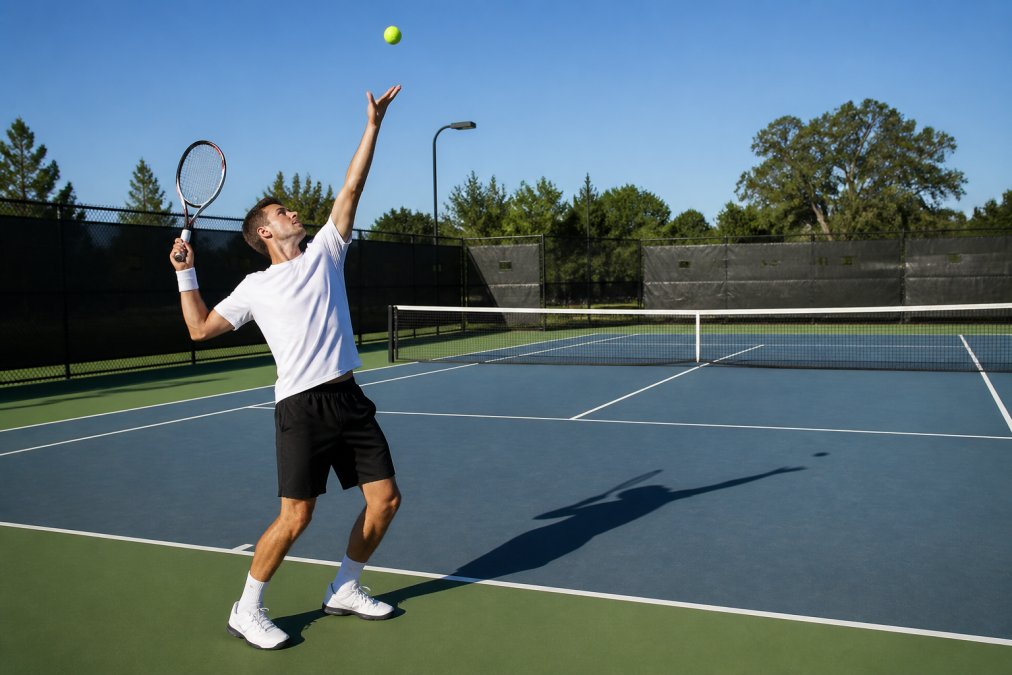
The ideal tennis serve ball toss combines three variables: where the ball lands relative to your body, how high it peaks, and the path it travels. Get these three right and you have a platform for a repeatable serve. Get one wrong and you will compensate with your swing, which is where inconsistency creeps in.
Your toss should travel in a straight line upward, not in an arc toward the court. Players who toss in an arc are effectively throwing the ball forward, which means they have to chase it. A true vertical toss uses gravity to bring the ball back down to your contact point, which is more reliable under pressure.
Where Should the Toss Land Relative to Your Body?
For a flat or slice serve, the ball should land roughly a foot in front of your baseline and slightly to the right of your front foot for a right-handed player (usta.com). For a kick serve, the toss should sit slightly behind your head. This placement lets you hit up and over the ball to generate topspin.
A useful check is to let the ball drop to the ground without swinging. If it lands on your shoe or behind you, your toss is too far back. If it lands two feet into the court, it is too far forward. The toss point of contact should feel like you are reaching up to meet the ball at full extension, not leaning sideways to retrieve it.
How High Above Your Contact Point Should the Ball Go?
The ball should peak roughly six to twelve inches above your ideal contact point (usta.com). This height gives the ball a moment of pause at the top, which allows you to time your swing and explode upward into contact. A toss that barely clears your racket forces you to rush, while a toss that flies three feet above your head creates an awkward pause that kills your rhythm.
Toss height also affects your consistency under fatigue. When you are tired, your legs do less work, so the same toss height feels different. Keeping your toss in a repeatable range, rather than varying it with your energy level, protects your serve when matches go long.
5 Tennis Serve Toss Drills for Repeatable Accuracy
Drills are where improvement actually happens. These five tennis serve toss drills isolate the toss from the rest of the serve so you can build muscle memory without the distraction of hitting the ball.
- The Fingertip Balance Drill: Hold the ball on your fingertips and practice your full toss motion without releasing it. This builds the muscle memory for a stable, spin-free platform.
- The Landmark Target Drill: Place a target on the court and toss the ball repeatedly, aiming for the same landing spot every time.
- The No-Swing Toss Drill: Toss the ball and let it drop. Catch it or let it bounce, and check where it lands relative to your body.
- The Shadow Toss Drill: Perform your full service motion without a racket, focusing purely on the toss and your arm staying extended.
- The Rhythm Toss Drill: Toss the ball to a metronome or a consistent internal count, building a repeatable tempo.
The Fingertip Balance Drill
This is a drill that can help players who struggle with spin on the toss. Hold the ball in your fingertips and raise your arm in your normal toss motion, but do not let the ball leave your hand. Hold the position at the top for two seconds, then lower your arm.
The goal is to feel how stable your hand and arm are when the ball is balanced on your fingertips. If the ball wobbles or you have to grip it tighter to keep it steady, you have found your problem. Repeat this ten times before you ever hit a serve, and you will notice a cleaner release immediately.
The Landmark Target Drill
Pick a specific spot on the court, such as a line intersection or a ball mark, and toss the ball so it lands on that spot every time. This tennis serve toss drill trains both accuracy and consistency because it gives you a measurable target instead of a vague sense of where the ball went.
Start with ten tosses and count how many land within a racket length of your target. Once you can hit that zone eight out of ten times, move the target and repeat. This drill translates directly to match play because it trains your toss to be independent of the pressure of the moment.
How to Practice Tennis Serve Toss at Home
You do not need a court to improve your toss. How to practice tennis serve toss at home starts with finding a space with a ceiling high enough to allow a full toss, such as a garage or a basement. Mark a spot on the floor to stand on, then run the fingertip balance drill and the landmark target drill using a small mat or a piece of tape as your target.
The key to home practice is repetition without a racket. Toss the ball one hundred times a day with correct mechanics, and you will rewire your muscle memory faster than hitting serves on a court. Film yourself from the side with your phone to check that your arm stays straight and the ball travels vertically.
You can also practice the rhythm of your toss while watching television or during a commercial break. The more you ingrain the toss as a separate, repeatable skill, the less it will waver when you combine it with your full serve. For players who want structured daily guidance, the step-by-step lessons from Crunch Time Coaching’s serve improvement program are designed to build this exact muscle memory in one week.
Controlling the Toss in Wind and High-Pressure Points
Wind is the great equalizer in tennis, and it exposes a weak toss immediately. In windy conditions, the common advice is to lower your toss height, which reduces the time the wind has to push the ball off course. A lower toss also forces you to hit the ball earlier, which can disrupt your timing, so practice this adjustment before you need it in a match.
The deeper issue is that many players change their toss mechanics entirely when they get nervous. Under pressure, the toss tends to get shorter and tighter because your muscles tense up. This is where toss consistency training pays off: if your toss is automatic, it will hold up when your nerves do not.
A useful psychological cue is to focus on the toss as a separate action from the serve. Tell yourself that the toss is the one thing you control completely, and give it your full attention. Players who obsess over the score tend to rush the toss, while players who slow down their toss rhythm tend to serve better in big moments. According to sports psychology research on pre-performance routines, consistent pre-serve routines help athletes manage anxiety and maintain performance under pressure.
| Toss Problem | Likely Cause | Quick Fix |
|---|---|---|
| Ball drifts left or right | Spin on release from palming | Use fingertip release |
| Toss lands too short | Dropping tossing arm early | Keep arm up until contact |
| Ball arcs into the court | Tossing forward, not vertical | Aim for straight vertical path |
| Toss varies with score | Changing mechanics under pressure | Use a fixed rhythm cue |
Conclusion: Build a Serve You Can Trust
A reliable tennis serve ball toss is not a gift, it is a skill built through correct mechanics and deliberate practice. Fix the four common mistakes, commit to the toss drills, and protect your toss in wind and pressure situations, and you will see your first-serve percentage climb. The players who win tight matches are not the ones with the biggest serves, they are the ones who can trust their toss to be in the same spot every single time.
At Crunch Time Coaching, our ‘Totally Obsessed’ coach delivers world-class, step-by-step daily instruction and a specialized challenge-based curriculum to empower competitive tennis players to achieve a higher level of play. Whether you are getting back into the game after years away or stuck on a plateau, our platform provides the personalized guidance to rebuild your toss mechanics and your confidence. Reserve your spot today and start serving with a toss you can trust.
Frequently Asked Questions
Why is my tennis serve toss inconsistent?
Most inconsistency comes from a palm release or an early drop of the tossing arm. When you release with your palm, each finger leaves the ball at a different time, sending it in random directions. Keep your tossing arm straight and lift from the shoulder. Release the ball from your fingertips as your arm reaches full extension. This simple change creates the same toss rhythm and toss path every time.
Where should I toss the ball for my serve?
The toss placement depends on the serve type. For a flat serve, toss slightly in front of your body and about six inches to the right of your tossing shoulder, so you make contact at full extension. For a slice serve, place the toss further right. For a kick serve, toss slightly behind your head. The key is consistent toss placement relative to your body, not the court lines.
What is the ideal height for a tennis serve toss?
Your toss should peak about six to twelve inches above your racquet’s contact point at full extension. It should never drop down into the strike zone. If the ball is too high, it loses speed and makes timing harder. If it’s too low, you lose power and may rush your motion. A consistent toss height lets you swing through contact without pausing or adjusting your rhythm.
How do I stop my tennis toss from drifting forward?
Drifting usually happens when you push the ball with your arm instead of lifting it. Practice the wall toss drill at home: stand a few feet from a wall, toss the ball up, and let it land beside you without hitting the wall. If it drifts forward, you are pushing. Keep your arm straight, use your shoulder like an elevator, and release from the fingertips. Repetition builds toss stability.