
Table of Contents
- What Rick Macci’s Academy Model Actually Delivers
- Coaching Philosophy Behind the Macci Method
- Who Thrives in a High-Volume Academy Setting
- Tennis Academy vs Private Lessons: Key Differences
- Benefits of Personalized Tennis Coaching for Competitive Players
- The Real Cost of Elite Tennis Academies
- Mental Toughness and Match Strategy: Where Each Model Wins
- Choosing a Coach: Assessment Criteria That Matter
- Frequently Asked Questions
Last Updated: September 11, 2026
What Rick Macci’s Academy Model Actually Delivers
Rick Macci built his reputation on developing junior champions through a high-volume academy model, and that model looks nothing like the personalized coaching most adult competitive players actually need. This guide from Crunch Time Coaching breaks down where each approach wins, where each falls short, and how to decide which fits your game in 2026.
Macci’s academy structure is built around repetition, group drilling, and volume. Players hit thousands of balls, drill in pods, and compete daily against peers of similar ability. The theory: enough reps under pressure will forge a competitor.
That works for a specific player type. It fails for others.
Here’s what most comparisons miss: the question isn’t which model is “better.” It’s which model matches your developmental stage, your schedule, and the specific skill you’re trying to fix.
Coaching Philosophy Behind the Macci Method
The Macci method leans on intensity and repetition over individualized correction. A player in that environment gets exposure to a proven developmental pathway and constant competitive pressure, but feedback is often delivered to the group rather than to the individual.
For a 12-year-old with elite aspirations and a full-time training schedule, that structure can accelerate skill acquisition fast. For a 47-year-old returning to the game after 15 years, the same environment can bury the specific technical flaw that’s costing them matches.
Macci’s approach also assumes volume. His academy model is designed around players who train daily. If you’re squeezing sessions around a full-time job, the philosophy doesn’t translate cleanly.
Who Thrives in a High-Volume Academy Setting
High-volume academies suit juniors with full-time training schedules, strong peer competition, and the physical capacity to absorb daily repetition. Adults with limited court time rarely fit that profile.
Three player types tend to do well in that environment:
- Juniors training five or more days per week with tournament schedules
- Players who respond well to competitive pressure and group energy
- Athletes whose primary need is match reps, not technical rebuilds
If you fall outside those categories, the academy model will likely cost you time and money without fixing the specific problem holding your game back.
The most common mistake adult players make is joining a high-volume program to fix a technical flaw. Repetition reinforces whatever technique you bring to the court. If your serve grip is wrong, a thousand more serves won’t fix it.
Tennis Academy vs Private Lessons: Key Differences
The core difference between a tennis academy and private lessons comes down to feedback frequency and individual attention. An academy spreads a coach’s attention across a group; private lessons concentrate it on one player’s specific mechanics.
That distinction matters more than most players realize.
Instructional Methodology and Feedback Frequency
In a group academy, a coach might watch your forehand for a few points before rotating to the next player. In a one-on-one session, every ball gets observed. That difference compounds over months.
The USTA player development resources outline how elite junior pathways blend group training with individual technical work, precisely because group volume alone doesn’t correct mechanics.
Training Intensity and Long-Term Development
Academies deliver higher raw volume. Private instruction delivers higher correction density. Which matters more depends on whether you’re building a skill from scratch or refining one you already own.
For long-term development, most competitive players eventually need both. The mistake is assuming one replaces the other.
Benefits of Personalized Tennis Coaching for Competitive Players
The biggest benefit of personalized tennis coaching is targeted correction of the specific flaw limiting your results. A private coach sees your footwork, your grip, your recovery patterns, and your decision-making in real time, then adjusts instruction to match.
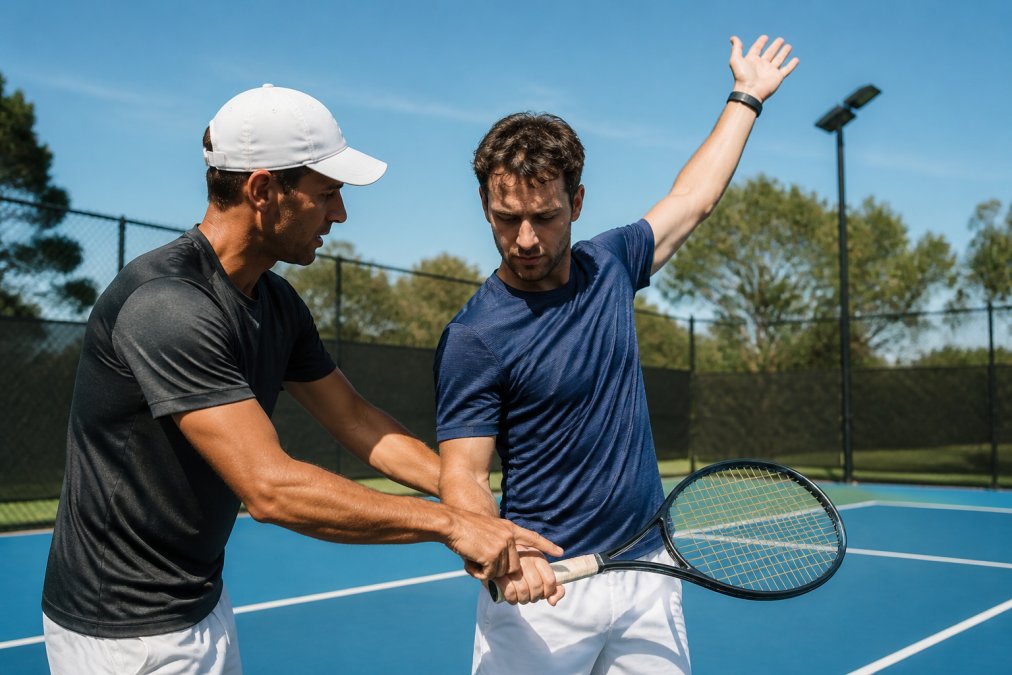
For adults over 40, that targeting matters even more. Generic drilling doesn’t account for reduced recovery time or old injuries. Individualized feedback lets a coach modify load, footwork patterns, and stroke mechanics to fit your body.
Crunch Time Coaching was built around this exact gap. The platform pairs step-by-step daily lessons with a specialized challenge-based curriculum, so players work on specific skills rather than generic drills.
Three benefits stand out:
- Faster correction of technical flaws because feedback is immediate and specific
- Programming adjusted to your body, schedule, and injury history
- Mental conditioning work tailored to your actual match patterns, not generic advice training equipment alternatives.
Record your serve from behind and from the side during a match, not just in practice. Most players’ technique breaks down under scoreboard pressure, and that’s the version worth fixing.
The Real Cost of Elite Tennis Academies
Most comparisons stop at sticker price. The useful comparison is cost per corrected flaw, total spend divided by the number of specific technical or tactical problems you actually fixed.
Elite academies price on full-time staffing, facilities, housing, and daily programming, which is why they run on boarding or full-time enrollment models rather than drop-in sessions. Tuition varies widely by program length, housing tier, and coaching level, so confirm current rates directly with each academy. The structural point holds regardless of the exact number: you are paying for volume and environment, not for individualized correction.
Here is the framework that actually answers the question for a competitive adult:
1. Define the problem in one sentence. “My second serve double-faults under pressure” is a fixable target. “I want to get better” is not. Academies sell the second; personalized coaching sells the first.
2. Count the correction events. In a group session, a coach might deliver two or three individual technical corrections to you across two hours. In a private lesson, that number is closer to dozens. Multiply by sessions per month and you have a rough correction-density figure you can compare across programs.
3. Divide total monthly spend by correction events. A month of group training at a high-volume academy might cost less per court hour but far more per individual correction. A block of private lessons costs more per hour but concentrates the spend on the flaw that is costing you matches.
4. Weight by transfer to match play. Corrections you can rehearse under scoreboard pressure are worth more than corrections delivered in a low-stakes drill line. Ask any program how they bridge practice corrections into match conditions.
5. Track the trend, not the session. A coach or program that cannot show you measurable change across four to six weeks is not delivering return, regardless of reputation.
USTA player development resources frames long-term development around deliberate, individualized skill work layered onto competitive play, not volume alone. That framing is the honest test for any academy spend.
The most expensive program is not the one with the highest tuition. It is the one where you spend a year and still cannot name the specific flaw you fixed.
For a junior training daily with tournament ambitions, the academy environment can justify its cost because match reps and peer pressure are themselves the developmental product. The mistake is applying one model’s math to the other model’s player.
Mental Toughness and Match Strategy: Where Each Model Wins
Academies win on competitive exposure. Personalized coaching wins on tactical specificity and on the feedback loop that turns exposure into skill.
The mechanism matters more than the slogan. Mental toughness in competitive tennis is built through structured pressure with immediate debrief, not just more pressure (PubMed). An academy gives you more tiebreakers, which is valuable, but the lesson often ends when the set does. A private coach can pause, name the pattern (“you shortened your backswing at 5-4 and started guiding the ball”), and rehearse a specific alternative in the next session.
That is the difference between accumulating pressure and converting it into a repeatable response.
For match strategy, the gap widens. A group coach cannot track opponent tendencies across a tournament weekend. A personal coach can build a game plan around your actual patterns, your first-serve percentage by court side, your break-point conversion, your tendency to overhit on the run. That is where modern personalized coaching has moved well past the traditional on-court description most comparisons still use.
Where technology changes the equation. Video analysis and shot-tracking tools are now standard in serious personalized programs. A coach can record a set, tag the points where your technique broke down, and show you the frame where your grip shifted. Data tracking across sessions turns “you seem tighter in tiebreakers” into a measurable trend you can attack. Group academies can adopt these tools too, but the review time per player is the bottleneck, one coach reviewing footage for twelve juniors cannot deliver the same depth as one coach reviewing footage for one player.
A practical split for competitive adults:
- Use academy or group play to generate live pressure and match reps.
- Use personalized sessions to debrief that pressure with video, identify the specific breakdown, and rehearse the fix.
- Re-test in the next competitive setting and track whether the pattern changed.
After any match, write down the score of the game where you felt tightest and the shot you avoided. Bring that note to your next private session. A coach with that specific input can build a targeted pressure drill in minutes; a coach without it is guessing.
Neither model owns mental toughness outright. The academy supplies the pressure; personalized coaching supplies the interpretation and the correction. Players who plateau usually have one without the other.
Choosing a Coach: Assessment Criteria That Matter
Choosing the right coach comes down to five criteria: feedback specificity, experience with your player profile, communication style, willingness to adjust programming, and whether they track your progress over time.
Use this checklist before committing:
- Does the coach watch you play a full set before prescribing changes?
- Can they explain why a technical adjustment works, not just what to change?
- Do they have experience coaching adults with your injury history or schedule constraints?
- Do they adjust the plan when you’re not improving, or repeat the same drills?
- Do they track measurable progress across sessions?
A coach who fails three or more of those isn’t the right fit, regardless of reputation.
| Model | Feedback Frequency | Best For | Main Trade-off |
|---|---|---|---|
| High-volume academy | Group-level, periodic | Juniors training daily | Little individual correction |
| Private lessons | Constant, one-on-one | Adults fixing specific flaws | Higher cost per hour |
| Hybrid online + in-person | Scheduled, targeted | Busy competitive adults | Requires self-discipline |
The right model isn’t the most prestigious one. It’s the one that matches your developmental stage, your available court time, and the specific skill you need to fix.
Most competitive players plateau because their training doesn’t match their actual problem. If your serve has been broken for two years, or you keep losing tiebreakers, more volume won’t fix it. Targeted correction will.
Crunch Time Coaching was built for exactly this: step-by-step daily lessons and a challenge-based curriculum that forces specific skill work. If you’re ready to stop drilling in circles and start fixing the flaw that’s costing you matches, reserve your spot today.
Frequently Asked Questions
Is Rick Macci a good coach?
Rick Macci has coached multiple Grand Slam champions and is widely recognized for his work with junior players. His academy-style approach emphasizes high-volume repetition and technical refinement. Whether he is a good fit depends on your goals: players who need individualized feedback on specific weaknesses may benefit more from personalized coaching, while those seeking a structured group environment may prefer an academy model.
What is the difference between academy-style training and personalized coaching?
Academy training groups players by level and follows a standardized curriculum with limited one-on-one time. Personalized coaching tailors every session to your specific technical gaps, footwork patterns, and match strategy. The benefits of personalized tennis coaching include faster skill acquisition and individualized feedback, while academies offer more hitting partners and competitive match play. Your developmental stage should guide the choice.
How much does personalized tennis coaching cost compared to elite academies?
The cost of elite tennis academies typically includes tuition, housing, travel, and tournament fees, which adds up quickly. Personalized coaching pricing depends on session frequency, coach credentials, and whether you choose online or in-person formats. Rather than comparing sticker prices alone, calculate cost per hour of individualized attention. Many players find private or hybrid coaching delivers more focused improvement per dollar spent.
Can online tennis coaching provide the same results as in-person academy training?
Online coaching cannot replicate live hitting sessions, but it excels at technical analysis, mental conditioning, and tactical awareness through video review and daily structured lessons. For players who already have hitting partners, online personalized instruction fills the gap by providing expert feedback on serve mechanics, footwork, and match strategy. Combining online coaching with periodic in-person camps often produces the best results.