
Table of Contents
- Why Lateral Movement Matters in Tennis
- Understanding the Mechanics of Lateral Movement
- Essential Tennis Agility Drills for Court Coverage
- Improving Tennis Reaction Time and Anticipation
- Strength and Conditioning for Explosive Lateral Movement
- Progressive Training Plan: From Beginner to Advanced
- Injury Prevention and Recovery for Lateral Movement
- Frequently Asked Questions
Last Updated: September 18, 2026
Why Lateral Movement Matters in Tennis
Lateral movement tennis is the foundation of court dominance. Without it, you’re always reacting late, always out of position, always defending.
The best players move better and cover more ground, they’re in position before the ball arrives. Most amateur players plateau here: they’ve mastered strokes and strategy, but their feet betray them with poor footwork and slow recovery.
At Crunch Time Coaching, we empower competitive tennis players to achieve a higher level of play. Below, we’ll show you exactly how to build lateral movement that translates to match wins.
Below, we’ll show you exactly how to build lateral movement that translates to match wins.
Understanding the Mechanics of Lateral Movement
Lateral movement tennis depends on three mechanics: the ready position, the split step, and explosive push-off.
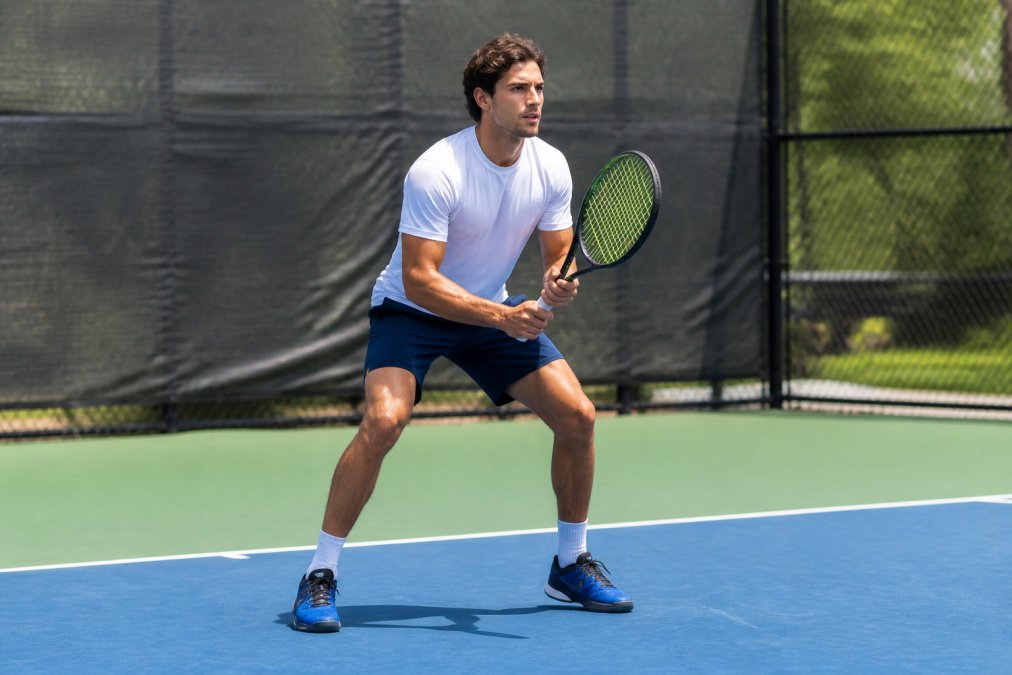
The Ready Position and Split Step Technique
The ready position starts with feet shoulder-width apart, knees bent, weight on the balls of your feet, and center of gravity low and forward. As your opponent makes contact, execute a small hop and land with feet slightly wider than shoulder-width. This resets your weight and prepares your muscles to fire in any direction. Timing is critical: split step right as the ball leaves your opponent’s racket, not before or after. Most players skip this or do it too late, which is what separates quick players from slow ones.
Push-Off and Center of Gravity
Push-off generates power: one leg drives hard into the court after your split step lands, propelling you sideways. Keep your knees bent to maintain a low center of gravity and allow quicker adjustments. The kinetic chain matters, power starts in your legs, transfers through your core, and reaches your upper body. A broken chain means wasted movement and slower lateral speed.
Essential Tennis Agility Drills for Court Coverage
Agility drills build the neuromuscular patterns your body needs for court coverage. During a match, your body must know what to do automatically.
Skater Hops and Lateral Mini Hurdle Runs
Skater hops mimic lateral push-off: hop side to side, landing on one leg at a time, for 30 seconds. Do three sets with 60 seconds rest between. Lateral mini hurdle runs build the same pattern with obstacles, set up five cones three feet apart and step over each one with high knees and controlled movement. Both drills train your nervous system to fire quickly and build the foundation for match-speed lateral movement.
Slide Board Training
The slide board forces your body to work against friction while moving laterally. Put on slide socks, push one foot out to the side, and let your other leg catch you, essentially skating across the board. The resistance builds strength in your inner and outer thighs and stabilizer muscles, making your push-off more powerful. Do three sets of 30 seconds with rest between. The resistance builds strength in your inner and outer thighs and stabilizer muscles, making your push-off more powerful. Do three sets of 30 seconds with rest between.
Improving Tennis Reaction Time and Anticipation
Reaction time is partly genetic, but anticipation is entirely learnable. The best players read their opponent’s body position, shoulder rotation, and racket path to predict ball direction before contact. This cuts your reaction time in half because you’re already moving before the ball leaves the racket.
Building Anticipation Through Pattern Recognition
Practice by calling out where you think the ball is going before your opponent hits it. You’ll be wrong often at first, but your pattern recognition improves over time.
Focus on three key reads:
Shoulder and hip rotation. Aggressive shoulder rotation generates more pace and commits to a direction earlier. Shoulders opening toward the sideline suggest a cross-court shot; closed shoulders suggest down-the-line.
Racket preparation. Higher backswings signal topspin or elevated shots; lower, compact preps suggest slices or flat drives.
Foot positioning. Loading weight onto the back foot and stepping into the court signals aggressive shots; neutral or sideways steps signal defensive shots.
Video Analysis for Self-Coaching
Video analysis reveals blind spots invisible during play. Record practice points and matches from behind the baseline or sideline, then slow the video to 50% or 25% speed using your phone’s built-in player or free apps like Coach’s Eye or Dartfish Express.
Watch for split step timing (landing as the ball leaves their racket), first step direction (push off the inside foot to save 0.1-0.2 seconds), recovery position (reset to center court, not the sideline), and anticipation accuracy (identify opponent cues that trigger early movement). Review 10-15 minutes of video twice weekly, focusing on one element per session. This deliberate practice accelerates improvement far faster than drilling without feedback.
Court Surface and Reaction Demands
Hard courts demand faster reactions and earlier, more explosive split steps. Clay courts give you more time but demand better anticipation and more precise footwork over longer distances.
Reactive Drill Progression
Have a partner point left or right randomly; you explode that direction at full speed for 30 seconds, rest 60 seconds, repeat five times, twice weekly. Progress by adding a 0.5-second delay before you move. Combine reactive drills with match play focused entirely on footwork, aim to reach the ball early on 70%+ of opponent shots by week four.
Strength and Conditioning for Explosive Lateral Movement
Lateral movement tennis demands explosive power. Your muscles must generate force quickly and repeatedly.
Resistance Bands and Force Production
Loop a resistance band around both legs just above the knees. Stand with feet hip-width apart, squat slightly, and step out to one side against the band resistance. Do three sets of 12 reps on each side with 60 seconds rest between. The constant tension builds force production specifically for lateral motion. The constant tension builds force production specifically for lateral motion.
Building the Kinetic Chain
Build core stability with 45-second plank holds (three sets), leg strength with single-leg squats (five reps per leg, three sets), and hip strength with lateral lunges (10 reps per side, three sets). Do this routine twice weekly on non-match days paired with your agility drills.
Progressive Training Plan: From Beginner to Advanced
A structured plan beats random drills. Your body adapts to progressive challenges.
Weeks 1-2: Foundation and Technical Proficiency
Focus on perfect technique. Speed doesn’t matter yet.
Do the ready position and split step drill daily. Stand in ready position. Execute five split steps. Rest. Repeat five times.
Add skater hops three times weekly. Three sets of 30 seconds. Focus on control, not speed.
Do resistance band work twice weekly. Three sets of 12 reps on each side.
This foundation phase builds the neural patterns. Your nervous system learns the movements.
Weeks 3-4: Building Speed and Dynamic Balance
Now add speed. Your technique is solid. Push harder.
Increase skater hop duration to 45 seconds. Three sets. Rest 60 seconds between.
Add slide board work twice weekly. Three sets of 30 seconds.
Do single-leg squats twice weekly. Five reps on each leg. Three sets.
Add lateral mini hurdle runs once weekly. Three sets of the full line.
Your body is moving faster now. Your dynamic balance improves.
Weeks 5-8: Game-Speed Transitions and Court Positioning
Integrate everything into match-like scenarios.
Do all drills at full intensity. Skater hops. Slide board. Hurdle runs. Resistance bands.
Add reactive drills.
Injury Prevention and Recovery for Lateral Movement
Lateral movement stresses your knees, ankles, hips, and groin in ways that linear movement does not. The constant side-to-side loading, rapid direction changes, and explosive push-offs create injury patterns that require specific prevention strategies.
Common Lateral Movement Injuries and Prevention
Lateral ankle sprains are the most common injury. Prevention requires ankle stability work: single-leg balance drills three times weekly (30 seconds, progressing to eyes closed or unstable surfaces), and ankle strengthening with resistance bands (15 reps plantarflexion and dorsiflexion on both feet, three times weekly).
Warm-Up Protocol for Lateral Movement Sessions
Warm up for 8-10 minutes before every lateral movement session: light cardio (0-3 min), dynamic stretching (3-5 min), movement-specific activation at 50% intensity (5-8 min), and court-specific footwork at 75% intensity (8-10 min). Skipping warm-up increases injury risk by 50%+.
Cool-Down and Recovery Protocol
Cool down for 5-7 minutes: light movement (0-2 min) and static stretching (2-7 min, 30 seconds per stretch). Perform hamstring, hip flexor, calf, quad, groin, and hip/glute stretches. Static stretching increases flexibility and signals your nervous system to shift into recovery mode.
Foam Rolling and Myofascial Release
Foam roll your legs twice weekly on non-training days, spending 60-90 seconds on calves, outer thighs, inner thighs, quads, and glutes. Use a standard foam roller (13 inches, medium density), avoid rolling over bone or joints, and pause for 10 seconds on tender spots.
Recovery Days and Load Management
Do not perform high-intensity lateral movement drills more than three times weekly. On off days, do light movement like easy walking or gentle stretching. A common pattern is high-intensity Monday, moderate Tuesday, high-intensity Wednesday, light Thursday, high-intensity Friday, off Saturday, light Sunday.
When to Seek Professional Help
Sharp, acute pain means stop immediately and rest 2-3 days. Muscle soreness (dull ache 24-48 hours after training) is normal DOMS. Pain that worsens during a session or lingers more than a week is a red flag requiring professional evaluation.
Frequently Asked Questions
How does the split step technique improve my lateral movement in tennis?
The split step technique synchronizes your footwork with your opponent’s racket contact, allowing you to react faster and move laterally with better explosive power. By timing a small hop as your opponent strikes the ball, you reset your center of gravity and prepare your legs to push off in any direction. This reduces reaction time significantly and improves your court coverage, especially during baseline rallies where multi-directional movement is critical.
What’s the fastest way to improve lateral speed and agility for tennis?
Combine sport-specific drills like skater hops and slide board work with resistance band training 3-4 times per week. These target the lateral force production needed for explosive movement. Pair them with anticipation drills that train your eyes to read your opponent’s positioning early.
Can I improve my lateral movement in tennis if I’m over 40 or returning to the sport after years away?
Yes. Lateral movement improvement depends on consistent, progressive training rather than age. Start with foundational footwork drills and bodyweight exercises to rebuild proprioception and dynamic balance. Gradually add resistance bands and intensity over 4-6 weeks. Focus on deceleration control and proper technique before speed.