
Table of Contents
- Why the Backhand Slice Matters in Your Game
- Master the Backhand Slice Grip Fundamentals
- The Mechanics of a Consistent Backhand Slice
- Essential Tennis Slice Backhand Drills for Consistency
- Common Backhand Slice Mistakes and How to Fix Them
- Mental Visualization and Focus Cues for Slice Consistency
- How Equipment Impacts Your Backhand Slice
- Frequently Asked Questions
Last Updated: September 19, 2026
Why the Backhand Slice Matters in Your Game
The backhand slice is one of the most valuable shots in competitive tennis, both a defensive weapon that keeps opponents from attacking and an offensive tool that wins points outright. Most players struggle with consistency because they don’t understand the fundamentals.
A consistent tennis backhand slice requires proper grip, body mechanics, and footwork. Master these three elements and you’ll hit deeper slices with better control; skip them and you’ll float balls that opponents attack.
A reliable slice opens up court positioning, forces opponents into uncomfortable positions, and lets you control rally tempo instead of just reacting.
Players with a strong backhand slice practice the mechanics deliberately, understand why each part matters, and drill specific scenarios until the shot becomes automatic under pressure.
The backhand slice is not a defensive-only shot. Use it to approach the net, to change pace, or to push opponents back. The best players hit offensive slices that land deep and short, forcing weak returns.
Master the Backhand Slice Grip Fundamentals
Continental Grip Positioning
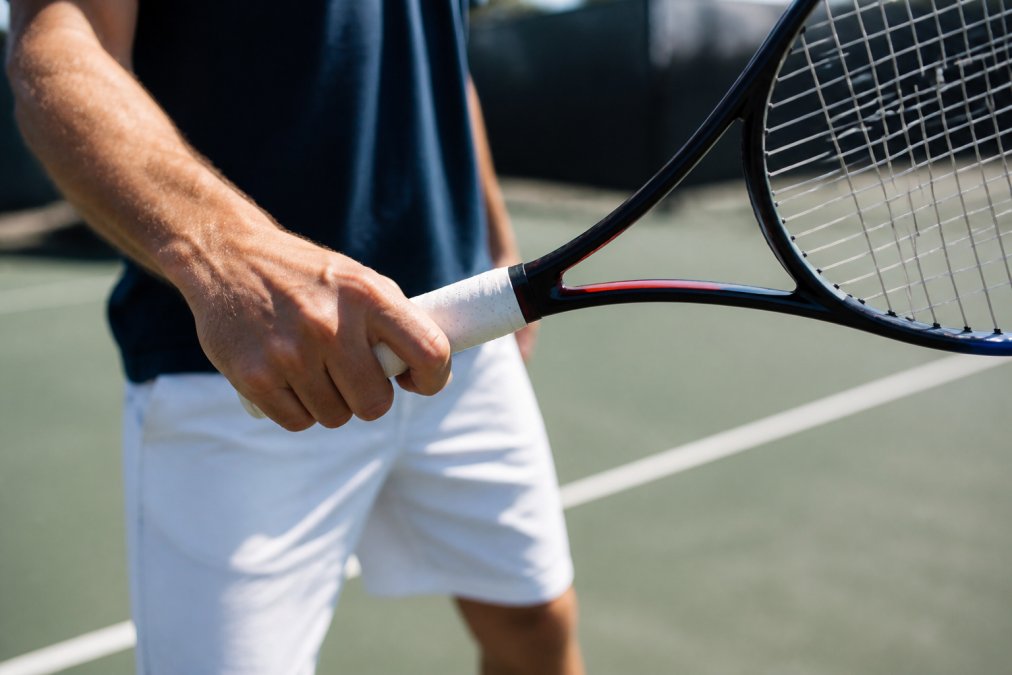
The continental grip is the foundation of a consistent tennis backhand slice. Your thumb and index finger form a V pointing toward your right shoulder (for right-handers), positioning the grip between Eastern backhand and Eastern forehand.
Hold your racket with the face perpendicular to the ground. Place your index finger’s base knuckle on bevel 2, with your thumb wrapping underneath for stability. This closed-face positioning generates the backspin that makes the shot effective.
Avoid gripping too tightly, which restricts wrist movement and reduces touch. Hold the racket firmly but relaxed, keeping your forearm loose.
The continental grip naturally closes the racket face, creating backspin when you swing down and through the ball. This keeps the ball low and unpredictable, making it difficult for opponents to attack.
Wrist Stability and Hand Placement
Wrist stability separates good slice hitters from great ones. Your wrist must stay firm throughout the stroke without collapsing or rotating, producing consistent contact and reliable depth.
Keep your wrist neutral at address, not bent forward or backward, so your hand and forearm form a straight line from elbow to fingertips. Maintain this alignment throughout the stroke; any rotation changes the racket face angle and sends the ball off target.
Your non-dominant arm plays a crucial role in stability. Keep it up and across your body to help rotate your shoulders and maintain balance. As you swing forward, it helps decelerate the racket, preventing over-rotation and keeping your wrist locked.
Hand placement matters: index finger on bevel 2, middle finger wrapped naturally, thumb underneath for support. This gives maximum control without sacrificing power.
The Mechanics of a Consistent Backhand Slice
Shoulder Rotation and Racket Path
The backhand slice starts with shoulder rotation. Turn your shoulders perpendicular to the baseline, front shoulder toward the net, back shoulder toward the sideline, to load your upper body with energy.
Your racket path determines slice quality. Start with the racket up near shoulder height with a slightly closed face. Swing down and through the ball with a downward motion, not level or upward, to create backspin.
The vertical swing path is critical. Many players swing horizontally, producing a flat slice with no spin. Brush down the back of the ball to create the underspin that makes the shot effective.
Your shoulder rotation drives the racket path. Rotate your shoulders as you swing to generate racket head speed and consistency; your arm extends naturally as your shoulders turn.
Keep your elbow close to your body, within a foot of your torso. A wide elbow position reduces control and limits last-moment adjustments.
The backhand slice is fundamentally a downward swing with shoulder rotation. Get these two elements right and consistency follows naturally.
Contact Point and Racket Face Angle
Contact point determines slice depth and consistency. Hit the ball at the peak of its bounce or slightly before; early contact gives you more options for placement and spin.
Your contact point should be one foot in front of your hip. Forward contact lets you direct the ball; contacting too far back loses control.
The racket face angle at contact must be closed, the top of the racket leans forward. The amount of closure determines spin: slightly closed produces a flatter slice, more closed produces heavier backspin.
For a consistent tennis backhand slice, maintain a consistent contact point on the racket strings by hitting the sweet spot every time. This requires footwork that positions you correctly; reaching or crowding causes misses.
The racket face angle controls ball trajectory: a more closed face sends the ball lower (ideal for approach shots and defensive slices), while a less closed face produces higher trajectory for deep-court slices.
Weight Transfer and Follow-Through
Weight transfer powers your slice. Start with your weight on your back foot and shift forward as you swing. By contact, your weight should be moving toward the net to generate racket head speed.
Step into the ball with your front foot to transfer energy from your legs to your upper body. The best slices come from your whole body working together, not just your arm.
Your follow-through completes the stroke and ensures consistency. After contact, let your racket continue moving forward and down in a smooth, shorter motion than a forehand, indicating commitment to the shot.
The follow-through also maintains balance by naturally decelerating your body, preventing over-rotation and allowing quick recovery for the next shot.
Essential Tennis Slice Backhand Drills for Consistency
Depth Control Drill: The Baseline-to-Service-Box Progression
This drill teaches depth control. Start at the baseline and hit slices landing in the service box on the opposite side for 10 repetitions.
Move back one step and hit slices landing at the baseline for 10 repetitions. Move back again and repeat. This progression trains muscle memory for different depths.
Work on three distinct depths, short (service box), mid-court (between service line and baseline), and deep (near baseline), for two weeks each. This builds match-play consistency and lets you adjust based on opponent position.
Aim for 8 out of 10 slices landing in your target zone before moving to the next depth. This ensures real consistency, not random hitting.
A common mistake is trying to hit all three depths in the same session. Focus on one depth until you master it. Then move to the next. Mixing depths too early creates confusion and slows your progress.
Footwork Consistency Drill: Open Stance Positioning
Proper footwork creates consistent contact points. Set up in an open stance with feet parallel to the baseline and shoulders rotated, letting you adjust quickly to different ball heights.
Have a partner feed balls at different heights. The open stance lets you reach wide balls without losing balance and hit slices from inside the court.
Practice stepping forward with your front foot while keeping your back foot planted and adjusting stance width based on ball distance.
Match-Play Drill: Defensive and Offensive Slice Scenarios
This drill simulates real match situations. Have a partner hit balls at you; you respond with slices and decide whether to slice again or attack.
Common Backhand Slice Mistakes and How to Fix Them
Floating Balls and Loss of Depth
Floating balls happen when your slice lacks backspin, sitting up high and inviting attack. This usually comes from incorrect racket face angle or an upward swing path.
Inconsistent Contact Points
Inconsistent contact points produce unreliable slices. This usually means your footwork is poor and you’re not positioning yourself correctly for each ball.
Poor Recovery Footwork After the Slice
Many players hit a good slice but get caught out of position. After hitting your slice, recover quickly by moving back toward the center of the court.
The split step is the most important footwork element after hitting your slice. Master this timing and you’ll recover faster for every shot.
Mental Visualization and Focus Cues for Slice Consistency
Mental preparation separates consistent players from inconsistent ones. Before hitting a slice, visualize the ball landing in your target area with the correct trajectory and bounce.
How Equipment Impacts Your Backhand Slice
Your racket choice affects slice consistency. Most players benefit from a racket between 10 and 11 ounces, heavier rackets generate more power but require more control effort, while lighter rackets are easier to control but produce less power.
Frequently Asked Questions
What is the ideal grip for a backhand slice?
The continental grip is the foundation for a consistent backhand slice. Position your base knuckle on bevel 2 of the racket handle, with your thumb running diagonally across the grip. This grip allows you to angle the racket face downward naturally, creating the underspin needed for depth and control. Maintain firm wrist stability throughout the stroke to prevent the racket face from opening up at contact.
How do you keep a backhand slice low and consistent?
Low, consistent slices depend on three factors: racket face angle, contact point, and weight transfer. Keep the racket face slightly closed at contact, and hit the ball at or slightly below the apex of its bounce. Transfer your weight forward into the shot rather than pulling back, and maintain a vertical swing path with a downward trajectory. Practice the baseline-to-service-box drill to develop touch and depth control.
What are the most common mistakes when hitting a backhand slice?
The biggest mistakes are incorrect grip (using an eastern or semi-western instead of continental), hitting the ball too high or late, and failing to transfer weight forward. Many players also neglect recovery footwork after the slice, leaving them out of position. A floating ball usually signals that your racket face opened too much at contact or you didn’t maintain a downward swing path. Focus on these three areas to eliminate inconsistency.
How should your footwork differ for a backhand slice compared to a topspin backhand?
The backhand slice often uses an open or neutral stance to allow quick recovery, while a topspin backhand typically requires a closed stance for power. For the slice, step in with your outside foot and keep your weight moving forward through contact. Your recovery step should be quick and lateral, positioning you to either approach the net or reset to baseline. This footwork pattern keeps you balanced and ready for the opponent’s next shot.