
Table of Contents
- Why Home Serve Drills Matter for Accuracy
- 1. Master Tennis Serve Toss Drills Without a Court
- 2. Trophy Position and Shadow Swing Technique
- 3. How to Fix Tennis Serve Mechanics with Wall Practice
- 4. Leg Drive and Weight Transfer Drills
- 5. Tennis Serve Consistency Tips Through Target Practice
- 6. Equipment-Free Indoor Drills for Rhythm and Timing
- 7. Self-Correction and Mental Visualization for Accuracy
- Quick Reference: 7 Best Tennis Serve Drills for Accuracy at Home
- Frequently Asked Questions
Last Updated: September 21, 2026
Why Home Serve Drills Matter for Accuracy
The difference between a reliable serve and one that crumbles under pressure comes down to repetition in controlled conditions. Tennis serve drills for accuracy aren’t just about hitting harder, they’re about building consistency through targeted, repeatable movements that train your body to find the same contact point every time.
At home, 15 minutes of focused practice can often outperform an hour of casual court hitting. At home, you control variables: the same toss, stance, and rhythm without waiting for a court or retrieving balls. This article breaks down seven practical tennis serve drills you can implement immediately in your living room, garage, or backyard.
The biggest mistake players make is drilling without a clear endpoint. Pick one drill, commit to 50 repetitions, then move on. Quality reps beat random practice every time.
1. Master Tennis Serve Toss Drills Without a Court
Your toss is the foundation of everything. A toss that drifts three inches left or right forces compensations throughout your entire kinetic chain.
The Toss Consistency Foundation
Stand in your normal serving stance. Hold the ball at chest height with your non-dominant hand. Release it straight up, aiming for a point roughly 12-18 inches above your extended arm’s reach. The ball should have zero forward or backward spin, pure vertical lift. Catch it in the same hand. Do this 20 times in a row without a miss.
You feel immediately when the toss drifts. After 50 reps, your nervous system recalibrates. The muscle memory locks in the correct release angle and height.
Toss-Only Progression
Once you can nail 50 straight tosses, add complexity. Toss the ball, then take one step forward before catching it. This teaches you that a good toss stays on track even when your body moves. Next: toss, take two steps, catch. Then add a shoulder rotation mid-flight, mimic your serve motion without the racket in hand.
The final progression: toss the ball, complete a full shadow swing motion, and catch it. Your arm should finish high and across your body.
A perfect toss that’s two inches too far forward forces you to reach, collapsing your service motion. Spend a week on toss work alone, it pays dividends for months.
2. Trophy Position and Shadow Swing Technique
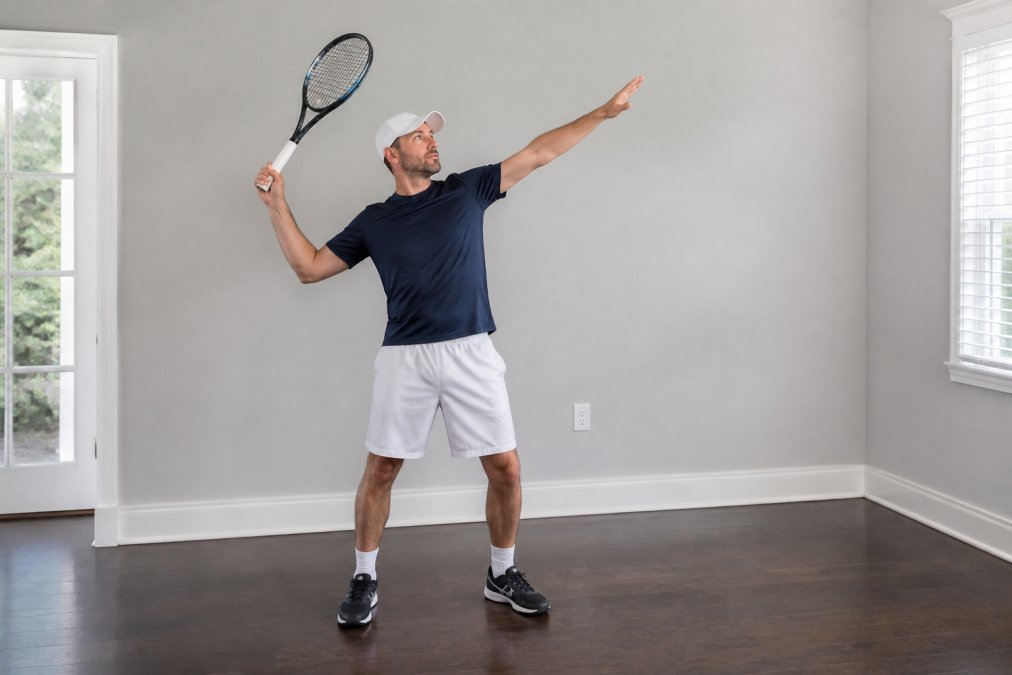
The trophy position is where power lives. If your arm isn’t loaded correctly, elbow high, racket behind your head, shoulders rotated, you’ve already lost 30% of your potential racket head speed.
Stand in your serving stance. Load into the trophy position: both arms up, left arm extended for balance, right arm bent with the racket head pointing down behind you. Your shoulders should feel rotated, your weight on your back foot. Hold this for two seconds.
Now execute the serve motion in slow motion. Extend your left arm down as you drive your legs upward. Your right arm whips through the contact zone. Your body rotates toward the net. Complete the follow-through with your right arm crossing your body. Do 20 slow-motion swings, then 20 at normal speed, then 20 at match speed.
The beauty of shadow work is that you remove the variable of the ball. You’re purely training the motor pattern. After 100 shadow swings, your nervous system has internalized the rhythm and timing.
3. How to Fix Tennis Serve Mechanics with Wall Practice
Wall practice is the most underrated tennis serve drill available. You stand 8 to 12 feet from a wall and serve toward it. The wall returns the ball immediately, forcing you to reset and serve again. This builds rhythm naturally because the wall dictates the pace.
Start with your toss and serve motion. Hit the wall at a comfortable height. The ball bounces back. Reset your stance and serve again. Do 20 serves in a row. Count how many hit the wall without going wide or long.
The progression is simple: move further back. Once you can hit 18 out of 20 from 12 feet, move back to 15 feet, then 18 feet, then 21 feet, which approximates the distance to the service box from the baseline. Each distance forces you to adjust your power and placement without overthinking it.
Wall practice teaches you contact point consistency. A ball that hits low on the wall means you’re making contact too low. A ball that goes high means you’re hitting up too much. This feedback loop is invaluable.
Serving into a wall can damage drywall or siding. Use a garage wall, a concrete wall, or a backboard specifically designed for this. One broken window is expensive feedback.
4. Leg Drive and Weight Transfer Drills
Power in the serve comes from the ground up. Your legs initiate the motion. Your core transfers that energy. Your arm finishes it. Most players focus on arm speed and ignore the foundation.
Stand in your serving stance with feet shoulder-width apart, back foot slightly behind your front foot. Do a small squat, bending your knees about 15 degrees. This is the loading phase. Then explode upward, driving through your legs as if you’re jumping. Your heels should leave the ground. This is the weight transfer. Maintaining this explosive vertical drive requires supple joints, which you can prepare by incorporating dynamic warm up exercises into your routine to ensure your hips are ready for the full range of motion.
Do 20 reps of this squat-to-jump motion without a ball or racket. Then add the full serve motion: load into the squat, explode upward while driving your right arm up toward the sky, extend your left arm for balance, and complete the serve motion. Do 10 serves focusing purely on leg drive.
Most players discover that their arm was doing too much work. When legs drive properly, the serve becomes easier and more powerful simultaneously.
5. Tennis Serve Consistency Tips Through Target Practice
Accuracy without targets is guesswork. Create three target zones on a wall or fence: one high (above head height), one middle (eye level), one low (waist height). Alternatively, tape boxes on the wall representing different service boxes.
Serve 10 balls to the high zone. Count how many hit it. Then 10 to the middle zone. Then 10 to the low zone. This forces your brain to adjust placement between serves.
The progression is distance. Start 15 feet from the wall. Complete three rounds of 10 serves to each zone. Then move to 18 feet, then 21 feet. At 21 feet, you’re approximating match distance. The accuracy you build transfers directly to the court.
Keep a simple log: date, distance, target zone, percentage hit. After two weeks, you’ll see improvement. After a month, the gains compound.
Players who struggle with placement, they hit hard but can’t control where the serve lands. Target practice teaches the micro-adjustments needed for precision.
6. Equipment-Free Indoor Drills for Rhythm and Timing
Not every drill requires a wall, target, or ball. Rhythm and timing drills work with just your body and a racket.
The first is the rhythm count. Serve in slow motion while counting: “one” (load), “two” (toss), “three” (trophy position), “four” (extension), “five” (contact), “six” (follow-through). Do this 20 times. The count forces a consistent tempo.
Next, add music.
7. Self-Correction and Mental Visualization for Accuracy
The final piece of home serve training is the mental game. You can drill mechanics perfectly, but if your mind isn’t locked in during match points, accuracy falls apart.
The players who improve fastest aren’t the ones with perfect technique. They’re the ones who notice what’s wrong, fix it immediately, and visualize success before each attempt. Build these habits now.
Quick Reference: 7 Best Tennis Serve Drills for Accuracy at Home
| Drill | Focus | Reps per Session | Best For |
|---|---|---|---|
| Toss-Only Work | Ball release and consistency | 50-100 | Building foundation |
| Shadow Swings | Trophy position and rhythm | 50-100 | Groove mechanics without ball |
| Wall Practice | Contact point feedback | 20-30 serves | Immediate rhythm building |
| Leg Drive Squats | Weight transfer and power | 20-30 reps | Fixing weak serves |
| Target Practice | Placement accuracy | 30 serves (10 per zone) | Directional control |
| Rhythm Counts | Timing and tempo | 20 serves | Consistency under pressure |
| Visualization + Execution | Mental preparation | 10-20 serves | Match-point readiness |
Home serve practice doesn’t require perfect conditions or expensive equipment. What it requires is focus and progression. Start with toss drills. Master shadow swings. Build accuracy through wall and target work. Then layer in the mental game. After consistent practice, you can see measurable improvement in match play.
Frequently Asked Questions
How can I practice my tennis serve at home without a court?
Use shadow swings, wall practice, and toss drills in any room with 8-10 feet of ceiling height. Focus on ball toss consistency, trophy position holds, and weight transfer without hitting a ball. Wall practice against a garage or basement wall builds contact point accuracy. These drills develop the kinetic chain and rhythm that transfers directly to court play, even without full-court space.
What are the best drills to improve tennis serve accuracy?
Target practice with service boxes, shadow swing repetitions, and leg drive progressions build accuracy fastest. Start with the continental grip and trophy position drill, then add toss consistency work. Progress to wall practice focusing on placement zones (T, body, wide). Mental visualization combined with self-correction feedback loops helps lock in the correct swing path and contact point for reliable placement.
How long does it take to improve tennis serve consistency?
Consistent daily practice of these drills can produce noticeable improvement. Players often see gains in toss consistency and rhythm relatively quickly. Mastering the full kinetic chain from leg drive through follow-through takes focused repetition. The timeline depends on your starting point and practice frequency, but equipment-free indoor drills allow daily practice without court access.
Can you practice tennis serves against a wall?
Yes. Wall practice builds contact point accuracy and follow-through consistency without needing a full court. Practice 6-8 feet from a wall, focusing on pronation and racket head speed through the contact zone. Wall drills help identify swing path flaws and develop the extension and balance needed for placement. This method works well for fixing serve mechanics and building confidence before court play.