
Table of Contents
- What Are Tennis Serve Grip Types and Why They Matter
- The Continental Grip: The Gold Standard for Serving
- Eastern and Semi-Western Grips: Alternatives and Trade-Offs
- Grip Pressure and Tension: The Often-Overlooked Element
- Tennis Serve Pronation Technique and Grip Rotation
- How to Transition to a Continental Grip
- Grip Type Comparison Table and Selection Guide
- Conclusion: Mastering Your Serve Grip for Competitive Play
- Frequently Asked Questions
Last Updated: October 3, 2026
What Are Tennis Serve Grip Types and Why They Matter
The way you hold your racket fundamentally determines everything about your serve. Your grip controls the racket face angle at contact, dictates how much pronation your wrist can generate, and either enables or prevents the biomechanics needed for different serve types. At Crunch Time Coaching, we guide dedicated tennis enthusiasts stuck on a performance plateau, and the grip is often where the breakdown starts.
Most players don’t realize they’re using the wrong grip because they’ve never learned what “right” looks like. A proper grip allows your wrist to snap through the contact point, your forearm to pronate naturally, and your racket head to stay on the correct plane throughout the motion.
A continental grip positions the racket face perpendicular to the ground at contact, essential for flat and slice serves. An eastern or semi-western grip closes the racket face, altering spin and trajectory. Your grip choice determines whether you hit a heavy kick serve with topspin, a flat serve with maximum speed, or a slice serve that dives away.
Understanding tennis serve grip types explained is the first step toward serving with intention rather than habit.
The Continental Grip: The Gold Standard for Serving
The continental grip is used by nearly every professional tennis player on the serve. Called the “hammer grip” because your hand position resembles holding a hammer, it’s non-negotiable for a reliable, competitive serve.
Place the base knuckle of your index finger on the first bevel of the racket handle. Your palm sits slightly behind the handle, creating a neutral position that allows maximum wrist flexibility. Your thumb wraps underneath for stability, and your remaining fingers curl naturally around the grip. This position unlocks the biomechanics of pronation, wrist snap, and racket head speed.
With a continental grip, your forearm can pronate through the contact point, generating racket head speed and spin. Flat serves become faster and more consistent, slice serves curve naturally, and kick serves develop heavy topspin. The continental grip is the foundation for all three serve types because it’s the only grip that permits full pronation without compensation.
A common mistake is gripping too tightly. Tension restricts pronation and slows racket head speed. The grip should be firm enough to control the racket, but loose enough that you could open your hand at contact without dropping it.
Eastern and Semi-Western Grips: Alternatives and Trade-Offs
Some players use an eastern backhand grip or semi-western grip for serving to hit heavier topspin. These grips shift your racket face angle and change pronation mechanics.
Eastern backhand grip places your index knuckle on the second or third bevel, closing the racket face slightly. This makes topspin easier but flat serves harder. You lose the versatility of the continental grip.
Semi-western and western grips rotate your hand further clockwise, closing the racket face more. Players generate tremendous topspin on kick serves, but flat serves become nearly impossible. You gain topspin at the cost of versatility and consistency.
The real issue with non-continental grips on the serve is that they force compensation in your wrist and arm. If your grip closes the racket face, your wrist has to work harder to keep the ball in the court on flat serves. Your pronation path becomes less efficient because your hand position already rotates the racket. Over time, this compensation leads to inconsistency and increased injury risk. Professional players stick with the continental grip because it’s the most efficient position for all serve types.
Grip Pressure and Tension: The Often-Overlooked Element
Grip pressure is the invisible variable that separates serves that feel effortless from serves that feel forced. Finding your neutral grip pressure for racket head speed is not about squeezing harder. It’s about understanding where tension lives in your hand and forearm, and releasing it.
Most players grip the racket too tightly. They think a firm grip means control, but tension in your fingers actually restricts pronation and slows your racket head speed. Your forearm muscles are responsible for pronation, not your grip. Your grip’s job is to hold the racket, nothing more. A light grip, one where you could open your hand at contact without dropping the racket, allows your forearm to rotate freely through the contact point.
The right grip pressure feels almost loose at address. Your fingers wrap around the handle with just enough tension to prevent slipping. Your palm sits neutral, not squeezed. As you begin your serve motion, this light grip remains constant through the acceleration phase. At contact, your grip tightens slightly to stabilize the racket, but by then your pronation is already happening at maximum speed.
Tennis Serve Pronation Technique and Grip Rotation
Pronation is the outward rotation of your forearm, and it’s the engine of your serve. How the continental grip enables wrist snap and pronation is by positioning your hand so your forearm can rotate without restriction. When your hand is in the continental position, your forearm can pronate 180 degrees or more through the contact point, which is what creates racket head speed.
Your wrist snap is not a wrist movement, it’s the result of pronation. As your forearm rotates outward, your wrist naturally flexes forward, and your racket head whips through the contact point. This happens at the end of your pronation, not at the beginning. The continental grip allows this sequence to happen naturally because your hand position doesn’t fight the rotation.
Flat serves, slice serves, and kick serves with proper pronation all rely on the same biomechanical principle: your forearm rotates, your wrist snaps, and your racket head accelerates. The difference between serve types is not the grip or the pronation, it’s the angle of your racket face at contact and the path of your pronation.
| Serve Type | Racket Face Angle | Pronation Path | Best Grip |
|---|---|---|---|
| Flat Serve | Perpendicular to ground | Neutral pronation | Continental |
| Slice Serve | Slightly open | Pronation with external rotation | Continental |
| Kick Serve | Closed | Pronation with supination follow-through | Continental |
How to Transition to a Continental Grip
Transitioning from a forehand grip to the continental grip is a process, not an instant switch. Your muscle memory is strong, and your body will resist the new position at first.
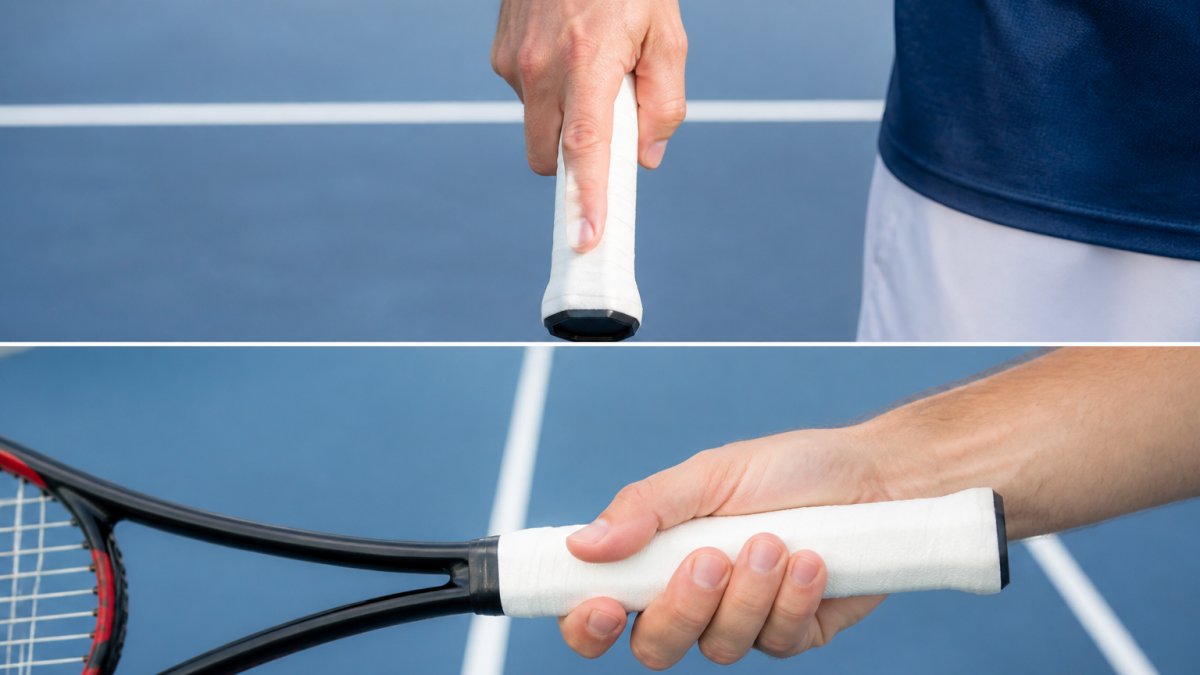
Start by holding your racket in a forehand grip at rest. Slowly rotate your hand clockwise until your index knuckle lands on the first bevel. This is the continental grip.
Next, practice your serve motion with the continental grip at half speed. Don’t worry about hitting the ball yet. Focus on the feel of pronation with your hand in this new position.
Once the motion feels natural at half speed, hit serves at 75% power. You’ll likely hit the ball long or into the net at first. This is expected.
Finally, increase to full power and full intensity. Your serve will feel different from what you’re used to, but it will be faster, more consistent, and easier to control.
Common grip mistakes beginners make and how to fix them usually fall into three categories. First, too much tension. If your serve feels forced, loosen your grip. Second, wrong finger position.
Grip Type Comparison Table and Selection Guide
Choosing the right grip depends on your serve goals and your current skill level. Here’s how the major grip types compare across key criteria:
| Grip Type | Best For | Pronation Ease | Flat Serve Power | Spin Potential | Consistency | Learning Curve |
|---|---|---|---|---|---|---|
| Continental | All serve types | Excellent | Excellent | Excellent | Excellent | Moderate |
| Eastern Backhand | Topspin serves | Good | Poor | Good | Good | Moderate |
| Semi-Western | Heavy topspin | Good | Very Poor | Excellent | Fair | Steep |
| Western | Extreme topspin | Fair | Impossible | Maximum | Poor | Very Steep |
The continental grip is the universal choice because it’s the only grip that optimizes all serve types equally. If you’re building a competitive serve, start here. If you’re already using a different grip and seeing results, consider transitioning to continental to unlock additional speed and consistency.
Conclusion: Mastering Your Serve Grip for Competitive Play
Your serve grip is the foundation of every serve you hit. The continental grip is the gold standard because it enables pronation, wrist snap, and racket head speed without compensation. Grip pressure matters as much as grip type, tension kills speed and consistency.
The challenge most players face is breaking old habits. Your forehand grip feels natural because you’ve used it for thousands of shots. Switching to continental requires patience and faith in the process.
According to research from the American Sports Medicine Institute, proper grip technique reduces shoulder and wrist injury risk in tennis players.
The biomechanics of the wrist and forearm during pronation have been documented extensively in tennis biomechanics research published by the International Tennis Federation, showing that pronation speed increases by 15-20% when grip position allows full forearm rotation without compensation.
For players transitioning grips, coaching resources from the United States Tennis Association recommend a minimum of 21 days of deliberate practice to establish new muscle memory, with daily repetition of the grip position at rest before adding serve motion.
Frequently Asked Questions
What is the most effective grip for serving in tennis?
The continental grip, also called the hammer grip, is the most effective serve grip for competitive players. It positions your hand perpendicular to the racket face, enabling proper wrist snap, pronation, and racket head speed. This grip works for flat serves, slice serves, and kick serves, making it the standard choice for players seeking serve consistency and power across all serve types.
What are the continental grip benefits compared to other grips?
The continental grip benefits include greater wrist mobility, improved pronation mechanics, and the ability to hit multiple serve varieties from the same grip. Unlike eastern or semi-western grips, the continental allows your forearm and wrist to rotate freely through the contact point. This reduces the need to adjust your grip between serves, improving serve consistency and reducing injury risk from repeated grip adjustments.
How do I transition to a continental grip if I’ve been using a forehand grip?
Start by placing your index knuckle on the second bevel of the racket handle, positioning your palm perpendicular to the strings. Practice the grip statically first, then with slow-motion serves before hitting at full speed. With consistent practice, players can adapt. Expect initial discomfort and lower power output temporarily, but serve consistency improves significantly once the grip becomes automatic.
Can you serve with a forehand grip, or is the continental grip required?
Technically, you can serve with a forehand or semi-western grip, but you’ll sacrifice pronation and wrist snap, limiting your power and serve variety. The continental grip is essential for competitive play because it enables the biomechanics professionals use: proper wrist snap, full pronation, and the ability to hit flat, slice, and kick serves without grip changes. Recreational players may function with other grips, but competitive progression requires the continental grip.
What is grip pressure and how does it affect my serve?
Grip pressure is how firmly you hold the racket handle during your serve. Excessive tension restricts wrist mobility and reduces racket head speed, while too loose a grip reduces control. Aim for a neutral pressure: firm enough to control the racket through contact, loose enough to allow your wrist and forearm to rotate freely. Many players hold too tightly out of anxiety; relaxing your grip pressure often increases both power and consistency.
What is tennis serve pronation and why does grip matter?
Tennis serve pronation is the rotation of your forearm and wrist that occurs after contact with the ball, creating topspin and additional racket head speed. The continental grip is essential for proper pronation because it aligns your hand to allow full forearm rotation through the contact point. Without this grip, your wrist and forearm mechanics are compromised, limiting pronation effectiveness and reducing your ability to hit aggressive serves with control.
Why is the continental grip essential for a proper serve?
The continental grip is essential because it positions your hand to enable all the biomechanics of a professional serve: the ball toss, wrist snap, pronation, and follow-through. It allows your racket face to be perpendicular at the start, making contact adjustments easier across different serve types. The grip also reduces the index knuckle and palm placement adjustments needed between serves, improving consistency and reducing repetitive strain injuries.