
Table of Contents
- Master the Tennis Serve Toss Technique
- Build Your Serving Foundation: Grip, Stance, and Setup
- Develop a Repeatable Serving Motion and Rhythm
- Tennis Serve Drills for Consistency
- How to Stop Double Faults and Build Serve Reliability
- Your Tennis Serve Practice Routine
- Transfer Serve Consistency to Match Play
- Frequently Asked Questions
Last Updated: October 4, 2026
Master the Tennis Serve Toss Technique
The tennis serve toss is the foundation of a consistent tennis serve. Get this right and everything else becomes easier. Get it wrong and you’ll chase problems all season long.
Your toss controls the entire serve, determining contact point, power, and repeatability. Most players spend 90% of practice time on their swing and 10% on their toss. That’s backwards.
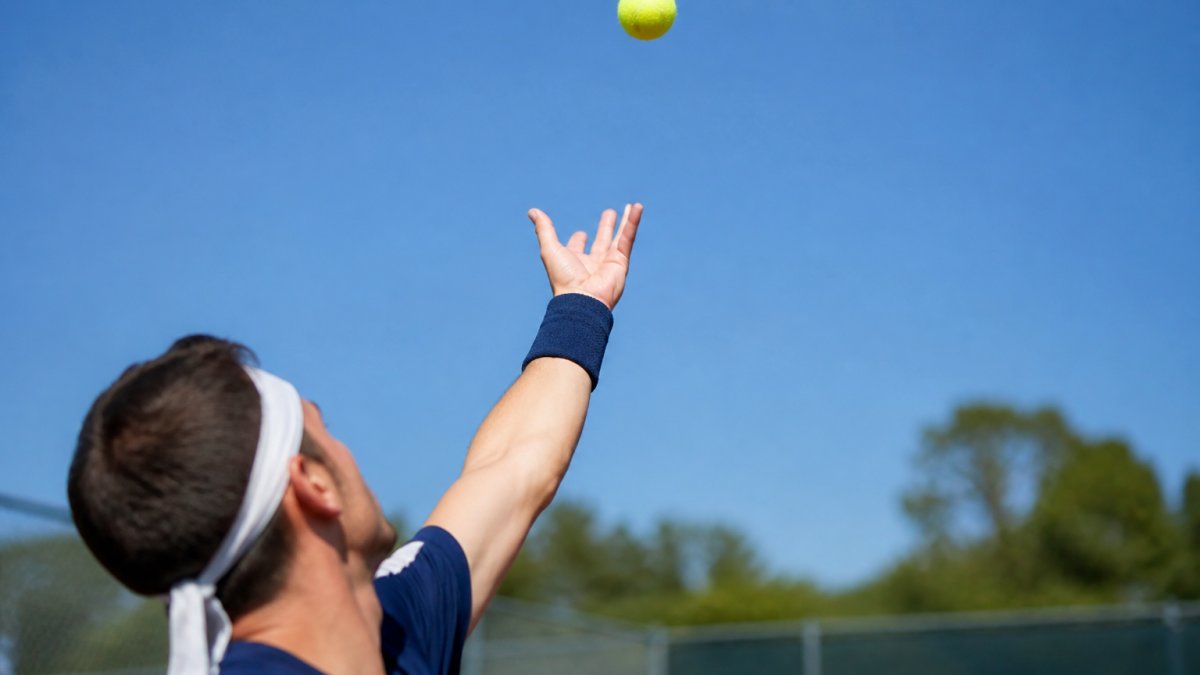
Release and Fingertip Control
Release the ball from your fingertips, not your palm. Your fingers should open naturally as the ball rises, like you’re setting it free rather than throwing it.
Here’s what matters most:
- Release from your fingertips only
- Let gravity do the work, don’t toss upward with force
- Keep your arm straight during release
- Release at about waist height
- The ball should float upward smoothly
A clean fingertip release, without tight gripping or wrist flicks, produces a predictable, repeatable toss.
Practice your toss without hitting. Toss 20 balls in a row and catch them at the peak. You should catch every one in the same spot. This drill takes 3 minutes and fixes more serves than hours of swing work.
Toss Height and Placement
Your toss should peak at about 6 inches above your extended racket arm, the sweet spot for power and control.
Your toss should land slightly in front of you and slightly to the right (for right-handers), where you generate maximum power and spin.
Key placement targets:
- Peak height: 6 inches above your fully extended arm
- Horizontal position: 12-18 inches in front of your baseline foot
- Vertical position: directly above the court, not toward the net
- Consistency: every toss lands in a 12-inch circle
Draw a small circle where your ideal toss peaks and toss 10 balls. Most competitive players land 8 out of 10 or better inside the circle.
Build Your Serving Foundation: Grip, Stance, and Setup
Your grip, stance, and setup determine whether your body can generate power efficiently.
The Continental Grip
The continental grip is the standard for the serve, the only grip that allows you to hit flat serves, slice serves, and kick serves with the same hand position.
Hold the racket like you’re shaking hands with it. Your index knuckle should sit on bevel 2 of the racket handle (the top-right bevel when the racket face points up). Your thumb sits on bevel 1 (the left bevel).
Why the continental grip matters:
- Allows pronation naturally (your forearm rotates through contact)
- Works for all serve types with no adjustment
- Reduces arm strain and injury risk
- Matches how professional players serve
Many recreational players use an Eastern grip because it feels more natural, but this limits spin serves and forces grip changes between serves, killing consistency.
Starting Stance and Court Position
Stand sideways to the baseline with your feet shoulder-width apart, back foot near the baseline and front foot pointing toward the net post. This position loads your legs and core for power.
Your weight starts on your back foot and shifts forward through the serve, creating momentum and power without relying only on your arm.
Court position basics:
- Stand 3-4 feet from the sideline (not at the center mark)
- Feet shoulder-width apart
- Back foot near baseline
- Front foot angled toward the net post
- Knees slightly bent, ready to load
Standing closer to the sideline opens up the court and gives better angles to the deuce box, the ideal position for most players.
Develop a Repeatable Serving Motion and Rhythm
A repeatable serving motion separates consistent servers from those who struggle with double faults.
Trophy Position and Backswing
The trophy position, where your arm bends and your racket points up behind your head, is the transition point between backswing and forward swing. Get here consistently and the rest flows naturally.
Your backswing should be relaxed and natural, a drop from the ready position that happens as you load your legs, not a conscious swing backward.
Trophy position checklist:
- Elbow bent at about 90 degrees
- Racket pointing up behind your head
- Shoulders rotated fully (back shoulder toward net)
- Knees loaded and ready to extend
- Weight still on back foot
A relaxed drop is faster and more repeatable than a forced swing.
Contact Point and Pronation
Contact the ball at the highest point you can reach for the best angle into the service box and most margin for error.
Pronation is the rotation of your forearm through contact, your palm faces up at contact, then rotates down as you follow through. This creates spin, stability, and shoulder protection.
Contact point priorities:
- Reach as high as possible (extend your legs)
- Contact slightly in front of your body
- Pronate through the contact (forearm rotates)
- Finish with your racket across your body
- Momentum carries you into the court
Start pronation just before contact and complete it after the ball leaves your strings for a powerful serve.
Timing and Rhythm Flow
Your serve has a rhythm that connects your toss, backswing, forward swing, and contact into one smooth motion. Master it and your consistency improves dramatically.
Most serves follow this rhythm:
- Toss the ball up (1 count)
- Load your legs as the ball rises (1 count)
- Drop into trophy position (1 count)
- Accelerate through contact (1 count)
- Follow through across your body (1 count)
The key is finding YOUR rhythm and repeating it exactly every serve.
Your rhythm is your consistency. If your rhythm changes, your serve changes. Practice the same rhythm 100 times in a row until it becomes automatic.
Tennis Serve Drills for Consistency
Structured drills build muscle memory and confidence for a consistent tennis serve. Random practice doesn’t transfer to matches.
Target-Based Accuracy Drills
Set targets in each service box using cones, towels, or tape lines. Aim at a specific target for every serve to build accuracy.
Start with large targets (6-foot square), then progress to smaller targets (3-foot square) once you’re hitting 8 out of 10, then match-size targets.
Target drill structure:
- Deuce box target: hit 10 serves
- Ad box target: hit 10 serves
- Wide deuce box: hit 10 serves
- Wide ad box: hit 10 serves
- Body serve (center): hit 10 serves
Most competitive players hit 65-75% of serves in the box during practice, and 55-65% in actual matches.
Repetition and Serve Routine Building
Hit serves with purpose, not just volume. Quality practice beats volume.
Develop a serve routine: take two steps back, bounce the ball twice, take a deep breath, look at your target, and serve. Use this exact routine for every practice and match serve, it becomes automatic under pressure. Maintaining this ritual anchors your focus during critical points, providing a reliable mental framework for overcoming sports self-doubt when the match intensity rises.
A serve routine reduces anxiety, improves consistency, builds confidence, and transfers to match play.
Practice this routine 50 times per session until it becomes unconscious.
How to Stop Double Faults and Build Serve Reliability
Double faults kill matches. Building serve reliability means understanding why you miss and fixing the root cause.
Troubleshoot Your Miss Patterns
Track where your serves land when they miss. Most players have one consistent miss pattern. Fix that one miss and your consistency jumps 20-30%.
Common miss patterns and fixes:
| Miss Pattern | Likely Cause | Fix |
|---|---|---|
| Ball lands long | Toss too high or too much power | Lower toss height by 2-3 inches |
| Ball lands short | Not reaching high enough | Extend legs more, reach higher |
| Ball lands wide | Toss too far to the side | Move toss 6 inches closer to center |
| Ball in net | Hitting down too much | Brush up on the ball, not down |
Second-Serve Strategy and Confidence
Your second serve should be reliable, not weak. Hit a second serve with spin that you trust.
A kick serve (topspin serve) is the most reliable second serve, the spin pulls the ball down into the box even when you hit it hard.
Second-serve strategy:
- Hit a kick serve with topspin
- Aim for the center of the service box (biggest target)
- Focus on getting it in, not hitting an ace
- Build a 90%+ first-serve percentage on your second serve
- Trust your serve under pressure
Practice your second serve as much as your first serve. Your second serve determines whether you hold serve under pressure.
If you’re hitting double faults in matches, your second serve is the problem. Practice your second serve 50% of your serving time, not 20%. This single change fixes most double-fault problems.
Your Tennis Serve Practice Routine
A structured practice routine builds consistency faster than random practice. Here’s how to organize your serve practice for maximum improvement.
Daily Practice Structure
Spend 15-20 minutes on your serve daily: warm-up tosses (3 min), grip and stance check (2 min), serve motion drills (5 min), target-based serves (7 min), and second-serve practice (3 min). Do this 5 days per week for dramatic improvement in 4 weeks.
Tracking Serve Consistency and Progress
Track your first-serve percentage, second-serve percentage, and accuracy to identify what’s working and what needs improvement.
Keep a simple log of date, first/second serve percentages, aces, double faults, and notes. Review weekly for patterns and progress.
Progress benchmarks:
- Week 1-2: expect 50-60% first-serve percentage
- Week 3-4: expect 60-70% first-serve percentage
- Week 5-8: expect 70-80% first-serve percentage
- Week 9+: expect 75-85% first-serve percentage
Most players reach 75%+ first-serve percentage after 8 weeks of consistent practice. This is enough to compete at a high level.
Transfer Serve Consistency to Match Play
Practice consistency doesn’t automatically transfer to match play. You need to practice under pressure to build true consistency.
Practice serves in competitive situations, tiebreakers and practice matches, to teach your body to serve the same way when it counts.
Progressive pressure practice:
- Week 1-2: practice serves with no pressure (just count makes/misses)
- Week 3-4: practice serves in tiebreaker situations (first to 7 points)
- Week 5-6: practice serves in practice matches (keep full match score)
- Week 7+: play competitive matches (league or tournament play)
Our step-by-step daily lessons take you from fundamentals to match-ready consistency.
Building a consistent tennis serve takes time and structure, but it’s absolutely achievable.
The serve is your most important shot. Develop consistency here and you’ll win more matches, feel more confident, and enjoy tennis more.
Reserve your spot with Crunch Time Coaching today and get access to our step-by-step serve curriculum.
Frequently Asked Questions
How often should I practice my tennis serve to build consistency?
Aim for at least 3-4 days per week of focused serve practice, with 100-150 repetitions per session. Quality matters more than volume, controlled, mindful repetitions with feedback build muscle memory faster than mindless hitting. Most players see noticeable improvement within 2-3 weeks of consistent daily practice, though mastering serve reliability typically takes 6-8 weeks of structured work.
Where should I toss the ball for a consistent tennis serve?
Place your toss at a 45-degree angle in front of your body, about 12-18 inches ahead of your baseline position and slightly inside the sideline. The ball should peak at full arm extension (about 8-10 feet high for most players). Consistency in toss placement is the single biggest factor in serve reliability, practice tossing without hitting until you can place 10 consecutive tosses in the same spot.
Why is my serve not consistent, and how do I fix it?
Inconsistent serves usually stem from a poor toss, unstable stance, or rushed rhythm. Start by isolating your toss, practice 50 tosses daily without hitting. If your toss is solid, check your stance for balance and your grip for tension. Film yourself or have a coach watch for timing issues between your toss and backswing. Most consistency problems disappear once you eliminate one of these three variables.
How can I stop double-faulting in tennis?
Double faults happen when your first serve is too aggressive or your second serve lacks confidence. On your second serve, prioritize getting the ball in play over power, aim for 80-85% of your maximum effort. Practice your second serve as much as your first; many players neglect it. Use a target-based drill: hit 20 second serves into a specific service box corner and track your success rate. Build confidence through repetition and acceptance that second serves win points through consistency, not speed.