
Table of Contents
- The Biomechanics of a Powerful Tennis Serve
- Tennis Serve Toss Placement for Consistency and Power
- How to Increase Tennis Serve Speed Through Kinetic Chain Sequencing
- Tennis Serve Power Drills for Measurable Gains
- Serve Accuracy and Power Drills for Match Play
- Building Strength and Preventing Shoulder Injury
- Troubleshooting Your Serve by Player Profile
- Frequently Asked Questions
Last Updated: October 6, 2026
The Biomechanics of a Powerful Tennis Serve
A powerful serve starts with understanding how your body generates and transfers force through the racket. Power comes from sequencing, not arm strength alone.
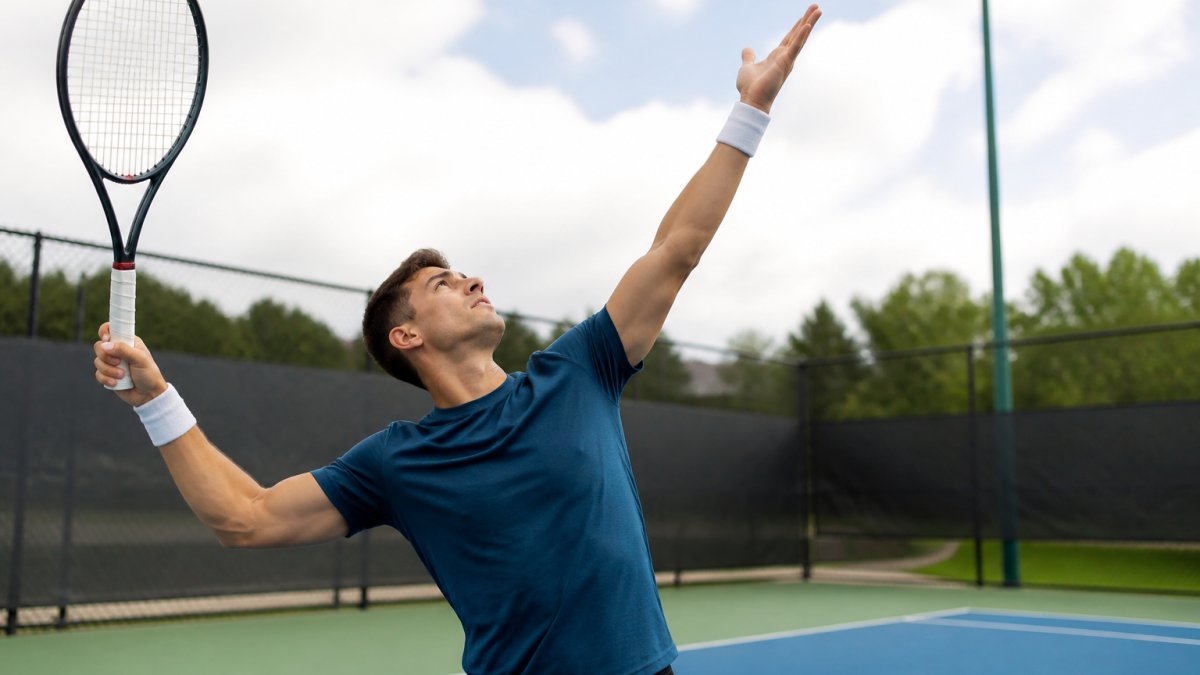
A powerful serve requires precise coordination between your lower body, core, and upper body. The continental grip and trophy position form the foundation; skip these, and no leg drive will generate consistent power.
Continental Grip and Racket-Face Control
The continental grip is non-negotiable for advanced tennis serve techniques for power.
Many players grip too tightly, which kills wrist snap and reduces racket-head speed. Hold the racket with firm but relaxed fingers so your wrist accelerates through the contact zone naturally.
The continental grip also positions your hitting arm correctly for the trophy position: elbow higher, shoulder rotating more efficiently, forearm pronating through contact without interference.
Trophy Position and Shoulder Alignment
The trophy position is where most power is either created or lost.
Shoulder alignment determines how much your torso can rotate and how efficiently that rotation transfers to your arm.
From trophy position, acceleration depends on three factors: how much your hips have rotated ahead of your shoulders, the separation between lower and upper body, and your upward extension.
Tennis Serve Toss Placement for Consistency and Power
The toss is the most overlooked element in developing advanced tennis serve techniques for power. A poor toss forces compensations throughout your motion; a perfect toss lets your body execute the same motion every time.
Your toss should land 12-18 inches in front of your baseline, slightly above your full reach, letting you extend upward and forward into contact.
Ball-Toss Height and Release Point
Consistency in toss height separates reliable servers from unreliable ones.
Many players release too low (waist height) or too high (above the head). A low release requires excessive upward acceleration; a high release reduces control.
The ball should peak just as you reach maximum upward extension at contact. If it’s still rising when you hit it, you’re tossing too high; if you’re reaching down, too low.
Correcting Common Toss Errors
The most common toss error is side-to-side drift, forcing you to reach across your body or step out of position.
Another frequent mistake is releasing with too much spin, making the toss unpredictable.
Some players toss too far forward, forcing them to step into the court and disrupting balance and timing. Toss 12-18 inches in front of the baseline, not 3 feet.
How to Increase Tennis Serve Speed Through Kinetic Chain Sequencing
Racket-head speed is the primary driver of serve power. You don’t generate it from your arm alone, you sequence your lower body, core, and upper body in the correct order.
The kinetic chain works like a whip: legs start the motion, hips accelerate next, shoulders follow, then arm, then wrist. Each segment accelerates faster than the one before it. Skip a segment or reverse the order, and power drops dramatically.
Hip and Torso Rotation for Acceleration
Your hips initiate the serve motion. As you load into trophy position, your hips are coiled, weight on your back foot.
Many players rotate shoulders and hips simultaneously, eliminating the acceleration advantage. Instead, drive your hips first, let them reach near-maximum rotation, then rotate your shoulders.
Torso rotation generates significant racket-head speed. As your shoulders rotate, your arm lags behind.
Leg Drive and Upward Extension
Leg drive initiates the entire sequence. From your loaded position, push through your back foot and drive upward, extending your legs fully by contact.
Finish on the balls of your feet with legs extended.
Upward extension also improves accuracy: extending upward means hitting the ball at the peak of your reach, where you have maximum control over the racket face.
Arm Acceleration and Pronation at Contact
Your arm accelerates last in the kinetic chain.
Pronation is the final speed generator. As your arm extends, your wrist pronates, accelerating your racket face through the contact zone. It happens naturally with a continental grip and proper loading, don’t force it.
Many players try to generate speed from the arm alone. Instead, focus on sequencing: legs drive, hips rotate, shoulders rotate, arm extends, wrist pronates.
Tennis Serve Power Drills for Measurable Gains
Isolated drills build the specific movements that generate power. Rather than practicing full serves endlessly, break the serve into components and drill each one. This approach builds consistency and power faster than full-serve practice alone.
Progressive Drill Sequence with Coaching Cues
Next, practice the trophy position without the ball, holding it one second.
Next, add shoulder rotation: from the hip-rotated position, rotate your shoulders toward the net while your arm lags behind.
Finally, add arm acceleration: from the stretched position, extend your arm and pronate your wrist, snapping through contact.
Once you’ve drilled each component, practice full serves with proper sequencing to reinforce the pattern.
Common Corrections and How to Fix Them
If your toss drifts sideways, your release arm is rotating. Keep your arm perfectly vertical throughout the release.
If your serve lacks power, your kinetic chain is breaking down, most commonly, shoulders rotating before hips.
If your serve is inconsistent, your toss is inconsistent. Spend 10 minutes daily on toss drills.
If your shoulder hurts, you’re likely forcing pronation or rotating your shoulder excessively.
Serve Accuracy and Power Drills for Match Play
Power means nothing without accuracy, a 120 mph serve into the net loses the point. Developing advanced tennis serve techniques for power requires equal attention to placement and consistency under pressure.
Flat Serve, Slice Serve, and Topspin Variations
The flat serve uses a continental grip with minimal wrist angle at contact, racket face nearly perpendicular to the ground, generating maximum speed with minimal spin.
The slice serve uses the same grip but contacts the ball with a glancing motion, racket face cutting outside-in to impart sidespin and curve the ball away from the returner.
Tactical Serve Placement Under Pressure
Match play requires serving under pressure, in tiebreaks, at break points, with the match on the line.
Prepare for pressure by practicing under pressure. Play practice sets where you must win your serve to win the set.
During match play, focus on your routine rather than the outcome.
Serve to a target. Rather than “the deuce box,” aim for a specific spot, outside corner, T-line, body.
Building Strength and Preventing Shoulder Injury
Power development requires strength, but strength without proper mechanics causes injury. The shoulder joint is mobile and relatively unstable, making it vulnerable to overuse injury when serving incorrectly or without adequate conditioning.
Core and Leg Strengthening Exercises
A strong core transfers energy from your legs to your arm. Weak core muscles force your arm to generate power independently, overloading your shoulder.
Perform planks 45-60 seconds, three times per week.
Rotational exercises build the specific strength for hip and shoulder rotation.
Leg strength drives the entire serve motion. Perform squats, lunges, and calf raises, strong legs let you drive upward with power, initiating the kinetic chain.
Shoulder Mobility and Safe Training Frequency
Shoulder mobility prevents injury by letting your shoulder move through its full range of motion safely, tight shoulders are injured shoulders.
Daily: arm circles (20 forward, 20 backward), sleeper stretches (30 seconds per side), and cross-body shoulder stretches (30 seconds per side).
Listen to your shoulder. Pain is a warning signal: if it hurts during serving, stop immediately.
Troubleshooting Your Serve by Player Profile
Different players face different serve challenges, a player returning after time away has different issues than one with a broken serve. Understanding your specific challenge lets you address it directly.
Returning to Tennis After Time Away
If you haven’t played seriously in months or years, your serve will feel unfamiliar, your muscles remember the pattern, but timing and sequencing have deteriorated.
Start with toss drills and trophy position work.
Gradually increase effort over 2-3 weeks; by week 3 you should be comfortable at 80-90% effort.
The consistent finding: consistency first, power second. Rebuild your serve rhythm before chasing speed.
Fixing a Broken Serve and Building Consistency
A “broken” serve has lost consistency, feels unstable, or produces unpredictable results.
Identify the breakdown by filming your serve and comparing it to video from when it was working.
Most commonly, the toss has drifted.
If your toss is fine, check your grip pressure. Tension in your grip hand travels up your arm, disrupting your serve motion.
Mental Toughness in High-Pressure Situations
Mental toughness is the ability to execute your serve under pressure.
Build mental toughness by practicing under pressure. Play practice sets where your serve determines the outcome.
During match play, focus on your routine.
Accept that some serves will miss, even the best servers miss 15-20% of first serves.
Developing a powerful serve requires understanding biomechanics, drilling specific movements, and building the strength to execute consistently.
Frequently Asked Questions
How can I add more power to my tennis serve?
Power comes from coordinating your entire body through the kinetic chain. Start with your legs driving upward, rotate your hips and torso explosively, then accelerate your arm through contact. A continental grip, consistent ball toss, and relaxed grip pressure all contribute. Practice the trophy position to load energy, then transfer it sequentially through your body rather than trying to muscle the serve with just your arm.
What is the most important technique for a powerful tennis serve?
The kinetic chain sequence is most critical. Your legs generate initial power through hip rotation, your torso continues the acceleration, and your arm finishes the motion. Without proper sequencing, you lose power and risk shoulder injury. Many players try to generate power from their arm alone, which limits speed and causes inconsistency. Mastering the chain transforms your serve.
How does toss placement affect serve power and accuracy?
Toss placement determines your contact point and body alignment. A toss slightly in front of you and to the right (for right-handers) lets you rotate fully and hit through the court. A toss too far behind limits your hip rotation; too far to the side sacrifices power. Consistent toss placement is foundational, it’s harder to generate power and accuracy if your starting point changes every serve.
How can I improve my serve speed without losing accuracy?
Build power through technique, not just effort. Focus on relaxed grip pressure and smooth motion rather than tension. Progressive drills teach your body to accelerate smoothly while maintaining control. Serve variations like flat, slice, and topspin serve different purposes, a flat serve generates maximum speed for first serves, while slice and topspin offer placement options. Video analysis helps identify timing issues that cost accuracy.
What drills help increase tennis serve power most effectively?
Progressive drills build power safely. Start with shadow serves to groove motion, then add a ball. Serve-and-split drills teach rhythm and recovery. Target-based drills (serving to specific boxes) build consistency alongside power. Medicine ball rotations and single-leg squats strengthen the kinetic chain off-court. The most effective approach combines on-court technical work with targeted strength training.
I’m returning to competitive tennis after years away, can I realistically master my serve in a week?
You can groove better motion, fix major flaws, and feel noticeable speed gains. However, mastery, consistency under match pressure, tactical variation, and injury-free repetition, takes longer. Progress accelerates when you have clear cues and progressive drills.
How do I know if my serve technique is actually improving or if I’m just getting lucky?
Track measurable metrics: serve speed (use a radar gun or app), consistency (serves in out of 10 attempts), and placement accuracy (serves to specific zones). Video analysis reveals timing and sequencing flaws. Consistent improvement across multiple serves and match situations indicates real progress. Lucky serves are inconsistent; improved technique shows up repeatedly under pressure.
Is online coaching effective for fixing serve technique, or do I need in-person lessons?
Online coaching works when the coach uses video analysis and clear, actionable cues. You record serves from multiple angles, the coach identifies specific flaws (toss placement, timing, grip pressure), and you implement corrections. In-person sessions offer real-time feedback and hands-on correction, which accelerates learning. Many players benefit from both: online coaching for frequent feedback and in-person sessions for intensive skill refinement.