
Table of Contents
- Why Double Faults Happen and How to Diagnose Your Problem
- Step 1: Fix Your Serve Motion and Racquet Speed
- Step 2: Master How to Improve Second Serve in Tennis
- Tennis Serve Toss Drills to Build Muscle Memory
- Tennis Serve Consistency Drills: From Practice to Match Play
- Managing Tennis Serve Anxiety and Match Pressure
- Common Mistakes to Avoid When Fixing Your Serve
- Conclusion: Your Path Forward
- Frequently Asked Questions
Last Updated: October 8, 2026
Why Double Faults Happen and How to Diagnose Your Problem
Learning how to stop double faults in tennis is essential because they cost you points. They cost you matches.
A double fault happens when both your first and second serves miss the service box. But the reason behind each miss tells a different story. Some players struggle with mechanics. Others struggle with their mind. Knowing which one is your problem changes everything about how you fix it.
Common fault patterns and what they reveal
Your serve faults follow patterns. These patterns reveal the root cause.
Faults that sail long (past the baseline) usually mean one of two things. The racquet speed is there, but the trajectory is wrong.
Faults that land in the net signal a different problem.
Faults that miss wide (left or right of the service box) usually point to a toss placement issue. Your toss drifts, and your body follows it.
Faults that happen only on the second serve are almost always mental. Your mechanics don’t suddenly break down. Your confidence does.
Identifying whether your issue is mechanical or mental
Here’s the test: Can you hit your serve in practice with consistency?
If yes, your problem is mental. You can execute the motion. Match pressure breaks your focus. We’ll address that in the mental section below.
If no, your mechanics need work. Your toss is unreliable, your arm tension is high, or your contact point shifts. These are fixable through targeted drills and repetition.
The fastest way to know: serve 20 balls in practice with no pressure. Count how many go in. Then serve 20 balls while a friend watches and keeps score. If your percentage drops significantly, it’s mental.
Step 1: Fix Your Serve Motion and Racquet Speed
Your serve motion has three critical phases: the toss, the backswing, and the acceleration to contact. A breakdown in any one of these causes double faults.
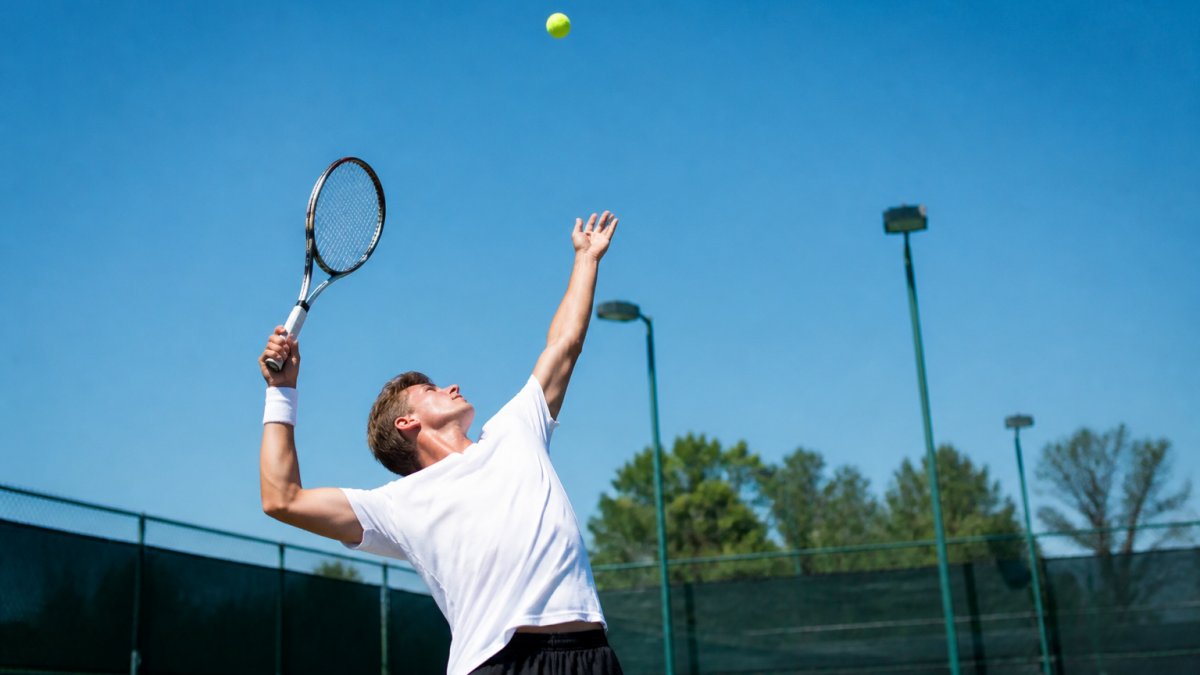
Relax your serving arm to maintain consistent velocity
Tension kills your serve. A tight arm can’t accelerate smoothly. It also can’t repeat the same motion twice in a row.
Here’s what happens: You get nervous. Your shoulder and arm tighten. Your racquet can’t move as fast.
The fix is simple but requires practice: Keep your serving arm relaxed from the moment you start your motion until after you make contact.
Check yourself: Your arm should feel loose, not rigid. Your grip should be firm but not white-knuckle tight.
A common drill is the “arm drop.” Hold your racquet at shoulder height. Let your arm fall naturally at your side.
Many players tighten their arm because they think it adds power. It doesn’t. Relaxation allows faster acceleration. A loose arm moves faster than a tight one.
Adjust your toss placement and timing
Your toss controls everything. A bad toss forces you to adjust mid-motion. Adjustments break consistency.
The ideal toss lands about 12-18 inches in front of your body and slightly to the right (for right-handed players).
Many players toss too high. A high toss gives you time to think, which sounds good but isn’t. Thinking introduces doubt. A toss at the right height keeps your motion on rhythm.
Practice your toss without hitting. Toss 20 balls and catch them at the contact point. Do this every day. Your hands will learn the exact release point and height without the pressure of hitting.
Step 2: Master How to Improve Second Serve in Tennis
Your second serve is the most important serve you hit. It determines whether you hold your service game.
Build a reliable second serve target and spin selection
Most players hit their second serve with fear. They slow it down and hope it lands in.
Instead, commit to a target and a spin type.
Kick serve target: Aim for the T (the intersection of the center line and the service line).
Slice serve target: Aim for the outside corner of the service box. The slice moves sideways and stays low.
Flat serve target: Aim down the T or the inside corner. It’s faster than your kick or slice but riskier.
Pick one target. Hit 50 serves to that target in practice. Track how many land in.
Trade power for consistency and net clearance
This is the hardest mental shift for competitive players. Your second serve doesn’t need to be a winner. It needs to land in and set up your next shot.
Reduce your racquet speed by about 20-30% compared to your first serve. This slower speed gives you more control and more margin for error over the net.
A slower second serve that lands in is infinitely better than a fast second serve that lands out.
Tennis Serve Toss Drills to Build Muscle Memory
The toss is the foundation. If your toss is inconsistent, your serve will be too.
Repetition-based drills for toss consistency
Drill 1: Toss and Catch (5 minutes daily)
Toss the ball 30 times and catch it at the contact point. Don’t hit. Just toss and catch. Your hands will memorize the exact release point.
Drill 2: Toss to Targets (10 minutes, 3x per week)
Place cones or tape marks on the court at your ideal toss landing point. Toss 20 balls and try to land them on the mark.
Drill 3: Serve with Eyes Closed (5 minutes, 2x per week)
After warming up, hit 10 serves with your eyes closed after the toss.
Progressive practice targets and measurable checkpoints
Start with low-pressure targets. Build up to match-pressure targets.
Week 1: Toss consistency only. 30 tosses daily. Goal: 25+ out of 30 land in the target zone.
Week 2: Toss + first serve. 50 first serves. Goal: 40+ out of 50 land in.
Week 3: Mix first and second serves. 50 total serves (25 first, 25 second). Goal: 35+ out of 50 land in.
Week 4: Serve under pressure. Have a friend keep score. Play a practice set. Track your first-serve percentage and double-fault count.
Tennis Serve Consistency Drills: From Practice to Match Play
Consistency in practice doesn’t guarantee consistency in matches. You need to train under pressure.
Building a progressive practice plan with measurable targets
Your practice plan has four phases. Each phase builds on the last.
| Phase | Duration | Focus | Success Target |
|---|---|---|---|
| Foundation | 2 weeks | Toss and basic motion | 35/50 serves in |
| Acceleration | 2 weeks | Adding racquet speed | 38/50 serves in |
| Pressure | 2 weeks | Serving under score | 40/50 serves in |
| Match | Ongoing | Serving in real matches | 60%+ first-serve percentage |
Spend 2 weeks on each phase. Don’t rush. Consistency comes from repetition, not speed.
Track your numbers daily. Write down how many serves landed in. This data tells you whether you’re improving or regressing. Adjust your practice based on the numbers, not your feelings.
Match-simulation drills under pressure
Once you’ve built a solid foundation, add pressure.
Drill: Serve for Points
Serve against a practice partner. Play out the point. Keep score. Play to 10 points. Track your first-serve percentage. Aim for 60%+.
Drill: Tiebreak Serving
Serve in a practice tiebreak (first to 7 points). This is the highest-pressure serving situation. Your serve must hold up.
Drill: Consecutive Holds
Serve four games in a row. You must hold all four games (win your service games). If you lose one, start over. This builds mental toughness.
Managing Tennis Serve Anxiety and Match Pressure
Mental pressure is real. It affects your serve more than any other shot.
Mental routines and trusting your serve motion
A mental routine is a pre-serve ritual that calms your mind and prepares your body.
Your routine might look like this:
- Take a deep breath
- Bounce the ball three times
- Look at your target
- Serve
The routine doesn’t matter. Consistency matters. Do the same routine every serve, in practice and in matches. Your brain learns to trust the motion because it’s familiar.
Trust your motion. You’ve practiced it thousands of times. Your body knows what to do. Your job is to get out of the way and let it happen.
Overthinking during the serve is the fastest way to double fault. If you find yourself thinking about your toss or your arm position mid-serve, you’ve already lost. Trust the work you’ve done in practice.
Match-day tactics for tiebreakers and high-pressure moments
In tiebreakers, every point matters. Your serve becomes even more important.
Tactic 1: Commit to your second serve
In a tiebreak, you can’t afford to double fault. Slow down your second serve. Land it in. Hold your serve. This wins tiebreaks.
Tactic 2: Serve to strength
If your kick serve is your best second serve, use it on every second serve in the tiebreak. Don’t mix it up. Consistency wins.
Tactic 3: Take a deep breath between points
Pressure builds when you rush. Slow down. Take a breath. Reset your mind. This simple act drops your heart rate and steadies your serve.
Common Mistakes to Avoid When Fixing Your Serve
These mistakes will slow your progress or reverse it.
Mistake 1: Changing too many things at once
Pick one thing to fix. Your toss, or your arm relaxation, or your contact point.
Mistake 2: Not tracking your data
If you don’t measure, you don’t know if you’re improving.
Mistake 3: Practicing without a target
Mindless serving doesn’t build consistency. Every serve should have a target.
Mistake 4: Expecting instant results
Consistency takes time. You’re building new muscle memory. This takes weeks, not days. Stay patient. Trust the process.
Mistake 5: Abandoning your second serve in matches
Your second serve is your safety net. Don’t abandon it under pressure. Commit to it.
Conclusion: Your Path Forward
Understanding how to stop double faults in tennis means recognizing they are fixable. They’re not a permanent flaw. They’re a symptom of either a mechanical breakdown or a mental one. Identify which one is yours. Then follow the drills and progressions above.
Our step-by-step daily lessons break the serve down into manageable pieces. You’ll master your toss, build arm relaxation, and develop the mental toughness to serve under pressure. Our specialized challenge-based curriculum gives you measurable targets and real accountability.
Frequently Asked Questions
Why do I keep double faulting in tennis?
Double faults usually stem from one of three causes: mechanical issues (poor toss placement, tension in your serving arm, or inconsistent racquet speed), mental pressure (loss of confidence leading to over-caution), or mismatched serve strategy (trying to hit too hard on the second serve). Diagnosing which applies to you is the first step. If your first serve goes in consistently but your second serve misses, your issue is likely second-serve technique or confidence. If both serves miss regularly, check your toss and arm tension.
What drills help reduce double faults?
Toss drills and second-serve consistency drills are most effective. Start with 50 tosses daily without hitting, focusing on the same release point each time. Progress to serving 10 consecutive second serves into the box, then 20, then 30. Add match pressure by serving in tiebreaker scenarios (alternate first and second serves, track your percentage). Practice these drills 3-4 times weekly for measurable improvement within 2-3 weeks.
How can I stop getting nervous when serving in tennis?
Tennis serve anxiety improves through mental routine and trust built by repetition. Before each serve, use a consistent pre-serve ritual: take a breath, bounce the ball a set number of times, and visualize a successful serve. The key is trusting your motion rather than overthinking mechanics during the point. Practice your second serve under simulated match pressure (tiebreaker scenarios, audience, or recording yourself) so that high-stress moments feel familiar. Confidence grows when your body has executed the motion thousands of times.
How can I improve my tennis serve toss?
Your toss is the foundation of consistency. Practice 50 tosses daily without a racquet, releasing the ball at the same height and angle every time. The toss should land about 12-18 inches in front of you and slightly to the right (for right-handed servers). Film yourself to verify consistency. Common errors include tossing too high, too far forward, or with spin. Once your toss is repeatable, your serve motion becomes automatic, reducing tension and double faults.
American Tennis Association guidelines on serve mechanics
Sports psychology research on performance under pressure
Biomechanics of the tennis serve from the Journal of Sports Sciences