
Table of Contents
- What Remote Tennis Stroke Analysis Actually Does
- How to Record Tennis Strokes for Analysis
- Tennis Serve Video Analysis: Identifying Mechanical Errors
- Tennis Video Analysis Tools and Platforms
- Real Benefits of Remote Analysis vs. In-Person Coaching
- The Remote Analysis Workflow: From Recording to Feedback
- Measuring Progress Through Video Analysis
- When Remote Analysis Works Best (and When It Doesn’t)
- Frequently Asked Questions
Last Updated: October 10, 2026
What Remote Tennis Stroke Analysis Actually Does
Remote tennis stroke analysis is the process of submitting video footage of your strokes to a coach or analysis platform for detailed feedback without in-person instruction. The coach reviews your swing mechanics, footwork, positioning, and shot selection from the video, then provides written or video-based corrections tailored to your specific technique issues.
This approach transforms how competitive players improve. Instead of waiting weeks for an in-person lesson, you can film your serve or groundstroke today and receive actionable feedback within days. The coach identifies technical errors in your kinetic chain, racket path, contact point, and body rotation, the mechanical details that determine whether your shot lands consistently or goes sideways.
What makes remote analysis different from generic YouTube coaching is specificity. A coach analyzing YOUR footage sees YOUR footwork patterns, YOUR timing issues, and YOUR serve placement tendencies. That personalized assessment beats generic technique videos because it addresses the exact problems holding you back.
How to Record Tennis Strokes for Analysis
Filming usable footage requires more thought than just pointing your phone at the court. Poor camera angles, bad lighting, or shaky video makes it impossible for a coach to assess your mechanics accurately. The technical requirements are straightforward, but skipping them wastes both your time and your coach’s.
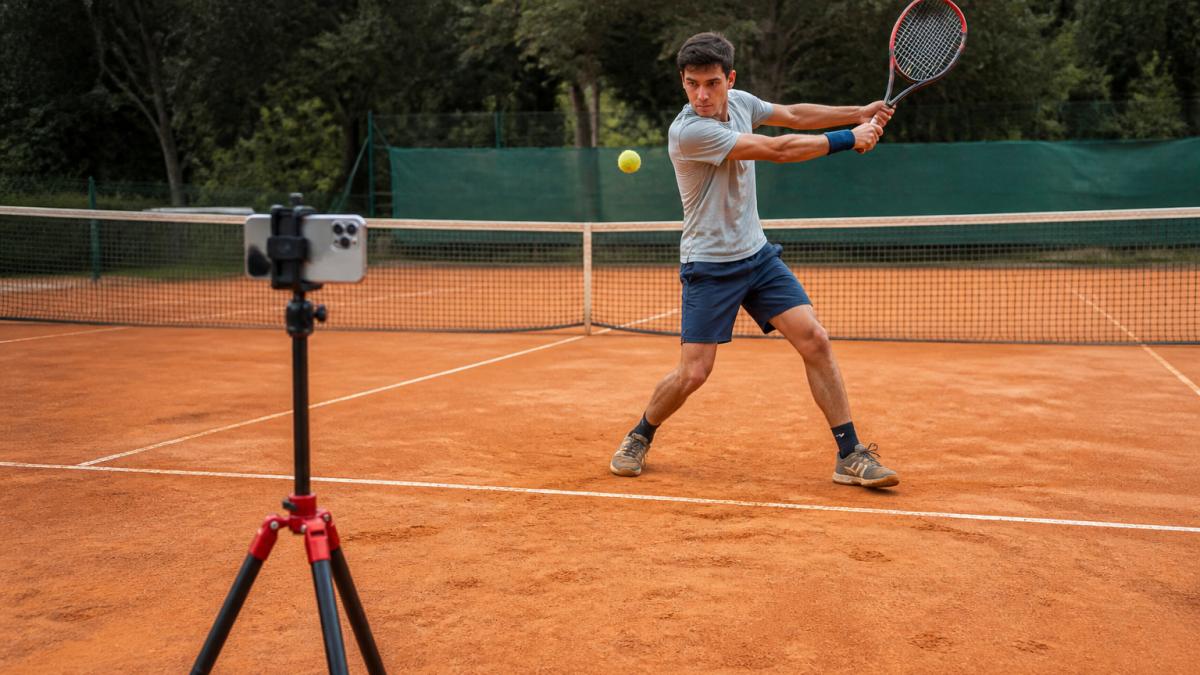
Filming at Home vs. On Court
On-court filming captures your stroke in match conditions, movement patterns, court positioning, and tactical decisions all show up. You’re hitting against a real opponent or ball machine, which means your footwork and recovery are authentic. The downside: you need court access, and filming while playing is logistically harder.
Home filming (drills in your driveway or against a wall) gives you controlled conditions and easier camera setup. You can repeat the same stroke multiple times from the same angle, which helps a coach spot consistency issues. The trade-off is that home drills don’t show how you perform under pressure or against live opponents.
For most players, a mix works best. Film serves and groundstrokes in both settings. On-court footage shows tactical awareness and match-relevant positioning. Home drills reveal mechanical consistency or inconsistency in a controlled environment.
Technical Requirements for Usable Footage
Your phone camera is sufficient, but setup matters. Position the camera at net height, perpendicular to your stroke path (side view for forehands and backhands, behind the baseline for serves). This angle shows your body rotation, leg drive, and racket-face angle, the mechanical details coaches need to see.
Lighting is critical. Film in daylight or well-lit indoor courts. Shadows across your body hide footwork and arm position. If filming at home, position yourself so sunlight comes from the side, not behind you or directly overhead.
Steady footage beats shaky video. Use a tripod, phone holder, or have someone film while standing still. Shaky camera work makes it hard to analyze contact point and follow-through.
Include multiple angles when possible. One side-view video shows your swing plane and body rotation. A front-view or back-view video reveals different mechanics. Multiple angles give your coach a complete picture.
Capture 5-10 repetitions of the same stroke. This shows whether you’re consistent or whether mechanical issues appear randomly. A single serve or forehand tells almost nothing about your actual technique.
Tennis Serve Video Analysis: Identifying Mechanical Errors
The serve is the stroke most players film first because it’s the most controllable and the most technical. Video analysis reveals errors in leg drive, shoulder rotation, toss consistency, and racket acceleration that are invisible in real-time play.
Common serve errors show up clearly on video. A toss that drifts forward or sideways forces you to reach or contort your body to hit it, that’s a mechanical inefficiency that costs speed and control. Video shows this instantly. Weak leg drive appears as minimal knee bend or weight transfer; you’ll see your body staying upright instead of exploding upward.
A coach analyzing your serve footage looks for the kinetic chain, the sequence of energy transfer from your legs through your core to your arm. If that sequence breaks down, your serve lacks power or consistency. Video makes that breakdown visible.
Serve placement errors also emerge. Are your first serves landing in the box consistently, or are they going wide or long? Video shows the ball’s trajectory and where it lands relative to the service box. That’s measurable feedback you can’t get from feel alone.
Tennis Video Analysis Tools and Platforms
Several platforms and tools support remote stroke analysis. Some are coaching marketplaces where you submit footage to independent coaches. Others are software platforms with AI-driven feedback or motion-capture analysis.
Coaching platforms typically work like this: you upload video, a coach reviews it, and you receive written feedback or a video response within 24-48 hours. The coach’s expertise and turnaround time vary by platform and coach.
Specialized tennis analysis software uses video playback tools that let coaches draw lines on your footage to highlight swing path, body angles, and contact points. Some tools include slow-motion playback, frame-by-frame analysis, and measurement overlays.
AI-driven analysis platforms attempt to identify technical errors automatically using computer vision. These tools can flag issues like poor footwork or incomplete follow-through without a human coach. The advantage is speed and lower cost.
At Crunch Time Coaching, we emphasize that the best analysis combines video evidence with personalized coaching insight. Software tools are useful for self-assessment, but a coach who understands your specific goals, playing style, and physical limitations provides feedback that actually improves your game.
Real Benefits of Remote Analysis vs. In-Person Coaching
Remote analysis offers genuine advantages that in-person coaching doesn’t, and honest limitations that matter.
Accessibility and Convenience
Remote analysis removes geographic barriers. You don’t need a coach in your city or time to travel to a lesson. A player in a rural area can work with a top-level coach anywhere. You film on your schedule, submit when ready, and receive feedback without coordinating schedules.
This is genuinely valuable for players with limited local coaching options or those juggling work and family. The convenience factor alone makes remote analysis more sustainable for long-term improvement than occasional in-person lessons.
The trade-off: a coach can’t feel your swing or adjust your body position in real-time. They can’t watch you hit live and make immediate corrections. Remote feedback is asynchronous, you get analysis after the fact, which means you’re working from notes or video rather than live guidance.
Cost and Turnaround Time
Remote analysis typically costs less than in-person coaching per session. You’re paying for analysis time, not travel time or facility rental. A single remote analysis might cost a fraction of an hourly lesson.
Turnaround varies. Some coaches respond within hours; others take several days. This delay matters if you’re preparing for a tournament and need immediate feedback. In-person coaching gives you instant corrections; remote analysis gives you corrections you implement at your next practice session.
For consistent improvement over months, remote analysis is cost-effective. For urgent pre-tournament refinement, in-person coaching often works better.
Privacy and Video Data Handling
When you submit video to a coach or platform, you’re sharing footage of yourself. Privacy concerns are legitimate. Some platforms store video indefinitely; others delete it after analysis. Some coaches might share your footage (with permission) as a teaching example or case study.
Before submitting footage, clarify how the coach or platform handles your video. Will they keep it? Can they use it in marketing? Do they encrypt it in transit and at rest? These details matter, especially if you’re submitting footage regularly.
In-person coaching avoids this issue entirely, no video is shared or stored anywhere.
The Remote Analysis Workflow: From Recording to Feedback
Understanding the workflow helps you submit footage that actually gets useful analysis.
Start by identifying what you want analyzed. “Fix my serve” is too vague.
Film multiple angles and repetitions as described above. Include at least one full-court view so the coach sees your positioning and court awareness, not just your arm swing.
Submit your footage through the coach’s or platform’s preferred method. Include a written description of what you want analyzed and any context (your current level, recent changes you’ve made, injuries or physical limitations).
Wait for feedback. Turnaround is typically 24-72 hours depending on the coach’s workload.
Review the feedback carefully. A good coach explains not just what’s wrong, but why it matters and what to do about it.
Implement the feedback in your next practice session. This is the critical step, analysis without implementation is just information. Practice the correction deliberately for at least a week before expecting results.
Film again after implementing changes. This shows whether your adjustment worked and whether new issues emerged.
Measuring Progress Through Video Analysis
Video is objective evidence. You can see whether your serve toss improved, whether your backhand follow-through is more complete, whether your footwork is more consistent. This beats relying on feel or match results alone.
Compare footage from different weeks. Does your contact point look more consistent? Is your weight transfer more complete? Are your serves landing in the box more often? These are measurable changes you can track.
Some coaches provide written assessments that track progress over time. They note specific improvements and remaining issues, creating a record of your development. This is more reliable than memory or feel.
The risk: video can show mechanical changes that don’t translate to better match results. You might improve your serve motion but still struggle in tiebreakers if your mental game is weak. Video analysis is powerful for technique, but technique alone doesn’t win matches.
When Remote Analysis Works Best (and When It Doesn’t)
Remote analysis works best for players with clear, specific technical problems.
It works for players with limited access to quality coaching. If your city has few good coaches, remote analysis opens doors that wouldn’t otherwise exist.
It works for players willing to do the work. Analysis without practice implementation is worthless. If you’re committed to deliberate practice based on the feedback, remote analysis delivers results.
Remote analysis doesn’t work well for players who need real-time adjustment. If you’re preparing for a tournament in two weeks and need immediate feedback, waiting 24-48 hours between submissions slows progress.
It doesn’t work for players with complex, multi-faceted problems. If your issue is partly technical, partly mental, and partly tactical, a coach who can’t see you play live will miss important context.
It doesn’t work if you’re unwilling to implement feedback. Analysis is only useful if you practice the corrections deliberately. Passive consumption of feedback changes nothing.
Remote analysis is a tool, not a replacement for all coaching. It’s exceptionally useful for technical refinement when you have access to a skilled coach and the discipline to implement feedback consistently.
Frequently Asked Questions
What is remote tennis stroke analysis?
Remote tennis stroke analysis uses video footage of your strokes submitted to a coach who reviews it and provides written or video feedback without being present on court. The coach examines mechanics like racket path, body rotation, footwork, and contact point to identify technical errors and suggest corrections. This method works for forehands, backhands, serves, and groundstrokes, making it accessible to players training independently or between in-person sessions.
How do I record tennis strokes for analysis?
Record from a side angle perpendicular to your stroke at net height to capture the full swing path and body mechanics. Use a smartphone or camera on a stable tripod, shoot in good natural light, and film at least 5-10 repetitions of each stroke. For serves, capture the full motion from setup through follow-through. Avoid filming into the sun, and ensure the entire court and your body are visible in the frame. Submit the clearest footage to your coach.
Can video analysis help improve my serve?
Yes. Tennis serve video analysis reveals specific mechanical issues: improper leg drive, poor weight transfer, incorrect racket-head lag, or inconsistent contact point. A coach can spot these errors from footage and provide step-by-step corrections tailored to your swing. Many players improve serve consistency and power by addressing one or two key mechanics identified through video feedback, though results depend on practice frequency and your starting point.
Is remote tennis stroke analysis as effective as in-person coaching?
Remote analysis excels at identifying technical errors and providing visual feedback, but lacks real-time correction and hands-on adjustment. It works well for players with solid fundamentals seeking refinement, but beginners may benefit more from in-person guidance. Remote analysis also cannot address timing issues under match pressure or provide immediate tactical feedback during play. Many competitive players combine both: remote analysis for detailed stroke work and occasional in-person sessions for reactive coaching.