
Table of Contents
- 1. Establish Clear Hand Signals Before the Tiebreak Starts
- 2. Master Doubles Tennis Middle Ball Communication
- 3. Agree on Serving Strategy for Tiebreakers
- 4. Call Points and Scores Loudly and Consistently
- 5. Communicate Between Points to Reset and Regroup
- 6. Practice Doubles Tennis Communication Drills
- 7. Repair Miscommunication and Partner Conflict on the Fly
- Conclusion
- Frequently Asked Questions
Last Updated: October 12, 2026
1. Establish Clear Hand Signals Before the Tiebreak Starts
Before the tiebreak begins, you and your partner need a shared language. Hand signals are the foundation of effective doubles tiebreak communication, letting you coordinate without alerting opponents to your strategy.
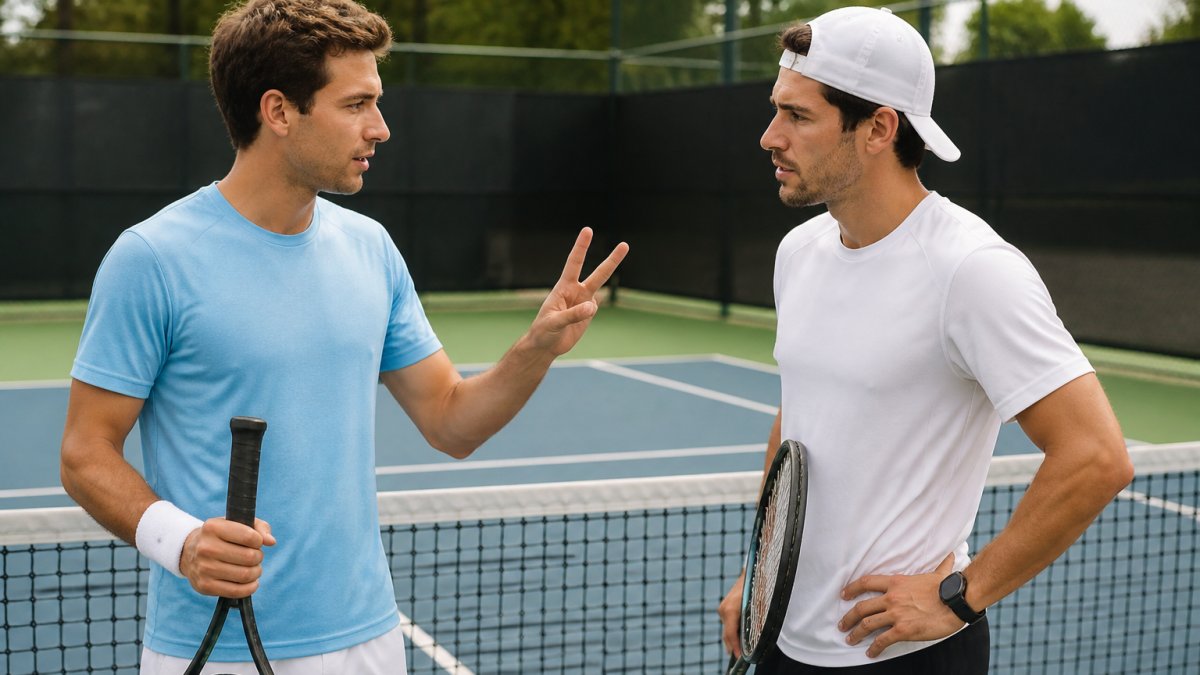
Agree on three basic signals: one for poaching, one for staying back, and one for switching sides. A closed fist might mean “I’m poaching,” an open hand “stay in your lane,” and a point to the court where you want your partner positioned. Keep them visible to your partner but not obvious to opponents.
Keep your signals simple and consistent. The more complex your hand language, the more likely miscommunication happens when pressure peaks. We recommend testing your signals during warm-ups before every tiebreak so they feel automatic.
Test these signals in practice and casual rallies first. By the time the tiebreak arrives, your partner should recognize a closed fist from the baseline without thinking. Clear signals prevent the worst doubles tiebreak communication mistake: assuming your partner knows what you’re about to do.
Establish signals for different court positions too. When serving, your net partner needs to know if you’re aiming wide or down the T. When returning, the net player should signal whether they’ll poach or hold.
2. Master Doubles Tennis Middle Ball Communication
The middle ball is where most doubles points are won or lost. When a ball lands near the center line, one partner assumes the other will take it, both back off, and the ball drops untouched. This is the costliest breakdown in doubles tiebreak communication.
Establish a clear rule before the tiebreak: the player whose forehand is closer takes it, or whoever calls “I’ve got it” first owns the ball. Decide beforehand, not in the moment, during a tiebreak, indecision costs points.
When the middle ball arrives, call immediately and loudly. “Mine!” or “I’ve got it!” must be audible over crowd noise and your partner’s own focus. Don’t whisper. Don’t assume.
If your partner calls the middle ball, trust them completely. Don’t shadow or second-guess. Back away and prepare for the next shot, one player takes it, the other resets.
Practice middle ball communication in drills before tournament play. Hit balls down the center line repeatedly and call them out. Many players feel awkward calling loudly at first, but the tiebreak is not the time to overcome that hesitation.
The player with the better angle to the middle ball should take it, and they should announce it loudly. No hesitation. No overlap. One player, one ball, one call.
3. Agree on Serving Strategy for Tiebreakers
Serving strategy changes in a tiebreak, where pressure is concentrated and every point matters equally. Before it starts, discuss which partner has the stronger serve and who serves first.
In doubles tiebreak scoring, serves alternate between partners: the first server serves one point, then each of the return team’s servers serves one point, then the original server serves again. This rotation means you’ll both serve multiple times.
Identify your stronger server, who should aim to hold serve on their points, especially early, a break shifts momentum dramatically. Discuss this openly; there’s no shame in acknowledging one partner has a more reliable serve.
Plan your serving targets before the tiebreak. Agree on two or three placements and stick to them, consistency matters more than variety, and a committed pattern is harder to break than scattered shots.
Avoid double faults at all costs in a tiebreak. One double fault can be the margin between winning and losing. If nerves affect your first serve, consider taking more pace off it and aiming for a higher first-serve percentage. A safe serve that lands is better than a risky one that doesn’t.
Agree beforehand on what happens if the stronger server falls behind, so you’re not debating during the tiebreak.
4. Call Points and Scores Loudly and Consistently
Confusion about the score kills momentum. In a tiebreak, points accumulate quickly. One player thinks it’s 4-3. The other thinks it’s 3-4. Suddenly, you’re playing the wrong point.
Designate one partner as score keeper, usually the player on the right side of the court. After every point, that player announces it loudly: “3-2, serving.” This simple routine prevents catastrophic miscommunication.
The score keeper calls the score after every point, not just when it changes. If it stays 3-2, call “3-2, serving” again. Repetition builds certainty and eliminates doubt.
Use a consistent format: “3-2, serving” tells your partner the score and who serves next; “4-4, returning” means you’re tied and about to return. This rhythm becomes automatic.
At critical points like 6-5, emphasize it: “6-5, serving” or “6-5, returning.” The next point could decide the tiebreak, and loud, clear communication keeps you both mentally present.
5. Communicate Between Points to Reset and Regroup
The 25 seconds between points is your communication window. Walk toward your partner, make eye contact, and say something encouraging or tactical.
After a lost point, resist blame and reset instead: “Next point, we target their weaker side” or “Their return is struggling. Let’s serve wide.” Positive, forward-looking statements keep momentum on your side.
Between points, check your partner’s mental state. If they look defeated, lift them up: “You’ve got this. We’re still in control.” If tense, calm them: “Stay relaxed. One point at a time.” Reading your partner’s emotions is part of advanced doubles tiebreak communication.
Adjust strategy between points if something isn’t working. If serve placement isn’t landing, say “Let’s try serving down the T instead.” If poaching isn’t working, say “Stay back on the next point.” These micro-adjustments often determine tiebreak outcomes.
Never criticize between points, save analysis for after the match. During the tiebreak, stay connected, positive, and focused. Your partner is your ally, not your judge.
Partners who struggle with frustration during tiebreaks should establish a specific reset phrase beforehand. Something like “Next point” or “Here we go” that signals a mental reset without requiring detailed conversation.
6. Practice Doubles Tennis Communication Drills
Communication improves with practice, you can’t expect flawless doubles tiebreak communication if you’ve never drilled it. Build these drills into your regular routine.
Drill 1: Silent Signals
Play a full set with only hand signals, no talking. This forces clear, readable signals, and you’ll quickly discover which ones work. After the set, discuss what worked and what didn’t.
Drill 2: Score Calling
Play practice tiebreaks where one partner calls the score after every single point, no exceptions. This trains the score keeper to stay focused and the other partner to trust the information. Play five or six in a row to build the habit.
Drill 3: Middle Ball Chaos
Hit balls directly at the center line repeatedly, and partners must call and take them. The goal is eliminating hesitation and overlap, after 20 middle balls, the calling should be automatic.
Drill 4: Pressure Simulation
Play practice tiebreaks where you’re down 3-6 and must win the next seven points or lose. This creates realistic pressure, and you’ll discover which signals and calls hold up and which crumble.
Track your communication quality during these drills: how many middle balls were called clearly, how often you overlapped, how often you misunderstood a signal. This data tells you what to focus on.
7. Repair Miscommunication and Partner Conflict on the Fly
Miscommunication happens, a signal gets missed, a score gets called wrong, a middle ball lands and both partners back off. The tiebreak doesn’t stop while you sort it out, so fix it and move forward.
When miscommunication happens, acknowledge it quickly and move on: “Sorry, I didn’t see your signal. I’ve got it next time.” That takes two seconds, then refocus on the next point. Don’t dwell or blame.
If your partner seems frustrated, address it directly between points: “I know I missed that call. Let’s reset.” A brief acknowledgment often diffuses tension and shows you’re committed to fixing it.
Avoid blaming language during the tiebreak. “You should have called that” creates conflict; “Let’s make sure we’re both calling middle balls next time” is collaborative and more likely to get a positive response.
If a real conflict emerges, use your timeout wisely. Sit down, breathe, and talk calmly: “I think we’re both trying to take the middle ball. Let’s agree: forehand side takes it.” This resets your agreement and prevents further conflict.
Partners often have different communication styles, one loud and aggressive, the other quiet and reserved. Adapt: the loud player dials it back slightly, the quiet player speaks up more. Meet in the middle.
Never let a tiebreak disagreement become a match-ending conflict. The match will end in a few minutes anyway. Protect your partnership. You’ll play together again. A tiebreak is temporary. Your partnership is long-term.
Conclusion
Doubles tiebreak communication separates winning teams from losing ones. Clear hand signals, middle ball protocols, serving strategy alignment, loud score calling, between-point resets, practice drills, and conflict resolution are the seven pillars of championship doubles tennis.
The best doubles partners communicate like they share a single mind, anticipating and trusting each other. That synchronization doesn’t happen by accident, it comes from deliberate practice and clear agreements.
At Crunch Time Coaching, our step-by-step daily lessons and specialized challenge-based curriculum help you build these habits into your game. When pressure peaks in a tiebreak, the teams with the strongest communication win. Reserve your spot today and learn how to dominate doubles tiebreaks through world-class coaching and hands-on training that elevates your mental toughness and technical precision on the court.
Frequently Asked Questions
How should doubles partners communicate during a tennis tiebreak?
Effective doubles tiebreak communication combines three elements: agreed-upon hand signals before play begins, clear verbal calls for every point and score, and brief between-point conversations to reset strategy. Partners should establish who covers the middle ball, confirm serving order and rotation, and use simple one-word calls like ‘Mine’ or ‘Yours’ to avoid confusion. Consistent communication reduces errors and builds confidence under pressure.
What signals can doubles partners use before a serve in a tiebreak?
Common pre-serve signals include pointing to indicate poaching direction, holding up fingers to signal the target (wide or down the T), and tapping the racket to confirm readiness. Partners should agree on 2-3 simple signals before the tiebreak and practice them during warm-up. The server initiates the signal, and the net player confirms with a nod or tap. This prevents miscommunication and ensures both players know the game plan for each point.
How do you avoid confusion over who takes the middle ball in doubles tiebreaks?
Establish a clear middle-ball rule before the tiebreak: either the net player always poaches, the server’s partner takes it, or the player moving fastest gets it. Call ‘Mine’ or ‘Yours’ immediately when the ball is hit toward the middle. If both players go for it, the net player should retreat and let the baseline player take it. Assign one person as the ‘middle-ball authority’ for that tiebreak so decisions are instant and consistent.
What should doubles partners say between points in a tiebreak?
Between points, keep communication brief and positive. Say the current score, confirm the next server, and offer one tactical adjustment: ‘We’re serving wide next point’ or ‘Stay in on the return.’ Use encouragement like ‘Good job’ or ‘Let’s go’ to maintain composure. Avoid blame or lengthy analysis. Partners should also check in after losing a point: ‘That’s on me’ or ‘Next one.’ This keeps focus forward and prevents frustration from building.