
Table of Contents
- Low Impact Tennis Court Movement Exercises for Seniors: How to Start
- Senior Tennis Warm-Up Exercises to Do Before You Step on Court
- Tennis Footwork Drills for Seniors: Low-Impact Ways to Move Better
- Low-Impact Balance Exercises for Older Adults on the Court
- Your Senior Tennis Conditioning Program: A 20-Minute On-Court Session
- Modifications for Arthritis, Joint Replacements, and Limited Mobility
- How to Monitor Pain, Recover, and Know When to Stop
- Conclusion
- Frequently Asked Questions
Last Updated: October 13, 2026
Low Impact Tennis Court Movement Exercises for Seniors: How to Start
Low impact tennis court movement exercises for seniors are drills that build footwork, balance, and leg strength without pounding your joints.
Here at Crunch Time Coaching, we work with players in their 40s, 50s, and beyond every week.
This guide walks you through a full routine you can start this week. You will learn a warm-up, footwork drills, balance work, and a 20-minute on-court session.
Most senior tennis players lose court coverage for one reason: they stop training movement. The good news is you can rebuild it.
Low impact does not mean low effort. You can build real court speed with controlled steps, lunges, and balance work. Your joints just need a gentler path to get there.
Senior Tennis Warm-Up Exercises to Do Before You Step on Court
Senior tennis warm-up exercises prepare your hips, ankles, and shoulders for movement. A proper warm-up raises blood flow and wakes up the muscles you are about to use. Skip it, and your first hard step becomes your first injury risk.
Spend 8 to 10 minutes on this routine before you play:
- Leg swings: 10 per leg, front to back, holding a fence for support
- Arm circles: 10 forward, 10 backward, small to large
- Hip circles: 8 each direction, hands on hips
- Walking knee hugs: 10 steps, pulling each knee gently to your chest
- Ankle rolls: 10 each foot, slow and controlled
- Torso twists: 10 each side, feet shoulder-width apart
The Cleveland Clinic guide to dynamic stretching explains why movement-based warm-ups beat static stretching before activity. Save the long holds for after you play.
Tennis Footwork Drills for Seniors: Low-Impact Ways to Move Better
Tennis footwork drills for seniors build the same movement patterns as power drills, minus the pounding. You still train lateral movement, reaction speed, and court coverage. You just do it with control instead of impact.
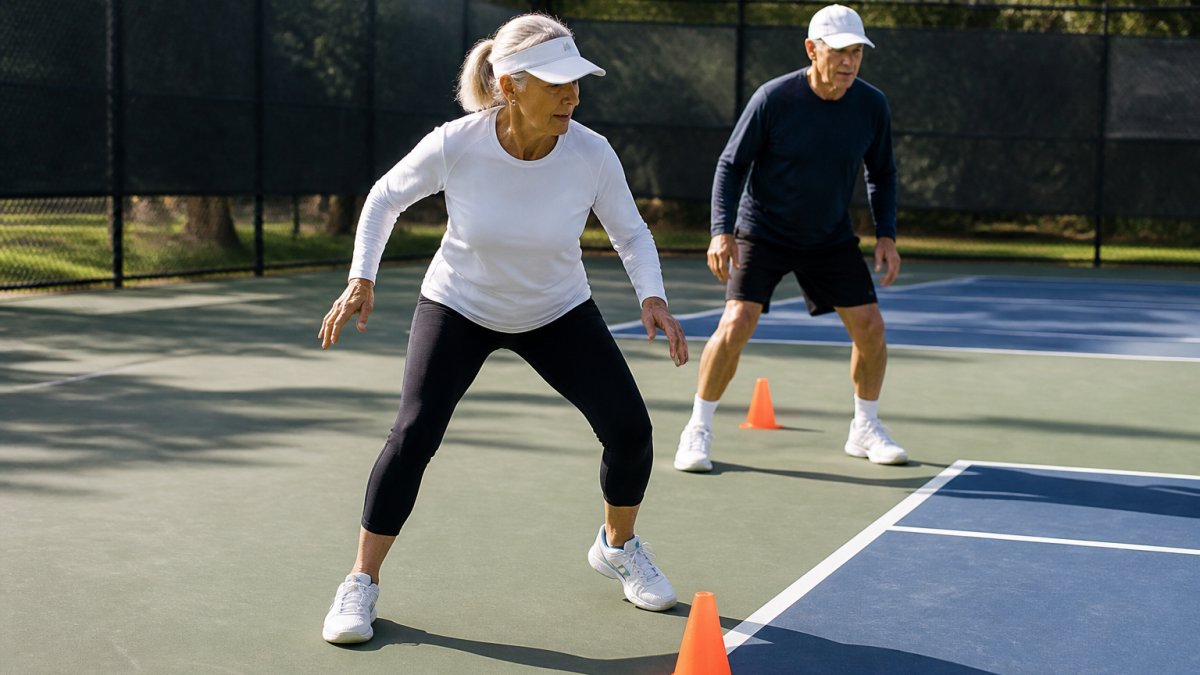
Lateral Fast Feet Without Jumping
Lateral fast feet train quick side-to-side movement. The low-impact version keeps one foot on the ground at all times.
How to do it:
- Place two cones 3 meters apart
- Stand in the middle in a ready position
- Shuffle right to the cone, touch it, shuffle left
- Stay low, knees bent, chest up
- Go for 20 seconds, then rest 40 seconds
- Repeat 4 times
No jumping. No hard landings. Just smooth, quick feet.
Lunges and Squats for Court Coverage
Lunges and squats build the leg power behind every wide ball you chase down. They also protect your knees when done with control.
- Forward lunges: 8 per leg, step out, lower slowly, push back
- Reverse lunges: 8 per leg, step back, keep front knee over ankle
- Side lunges: 8 per side, push hips back, keep the trailing leg straight
- Bodyweight squats: 10 reps, sit back like you are lowering into a chair
The American Council on Exercise guide to lunge form notes that controlled lunges train balance and stability along with strength. That combo is exactly what court coverage demands.
Do your lunges and squats on the court, not just in the gym. Your body learns the surface, the footing, and the angles you actually play on. The transfer to match play is far better.
Low-Impact Balance Exercises for Older Adults on the Court
Low-impact balance exercises for older adults cut fall risk and sharpen recovery. Balance is the quiet skill behind every split step and every change of direction. Lose it, and you lose confidence on court.
Try these three drills:
- Single-leg stand: Hold 20 seconds per leg, near a net post for support
- Single-leg reach: Stand on one leg, tap a cone in front, to the side, and behind
- Weight shifts: Shift side to side slowly, pausing 2 seconds on each leg
Do them barefoot on a safe surface first. Then move to the court in your shoes.
Never do balance drills on a wet or cracked court surface. A slip during balance work can cause a fall that sets you back months. Check the court before every session.
Your Senior Tennis Conditioning Program: A 20-Minute On-Court Session
A senior tennis conditioning program works best as a short, repeatable session. Twenty minutes, three times a week, builds more than one long session you dread. The plan below is a complete, progressive on-court routine with exact durations, repetitions, and rest, plus low-impact substitutions for every drill so you never have to jump, bound, or land hard.
Court Setup Before You Start
- Pick a clean, dry hard court or clay court with no cracks, loose grit, or wet patches.
- Use the service boxes and singles sidelines as your distance markers instead of cones when possible, they are fixed, visible, and free of trip hazards.
- If you use cones, place them flat and no more than 3 meters apart so you never have to sprint to reach them.
- Keep a net post, fence, or sturdy chair within arm’s reach for balance support.
- Wear court shoes with good lateral support and non-marking soles. Running shoes tip on hard lateral cuts.
The 20-Minute Session
| Block | Time | What You Do | Rest |
|---|---|---|---|
| Warm-up | 5 min | Leg swings, hip circles, ankle rolls, easy side shuffles | None |
| Footwork | 5 min | Lateral fast feet, 4 rounds of 20 sec | 40 sec between rounds |
| Strength | 5 min | Lunges and squats, 2 rounds | 60 sec between rounds |
| Balance | 5 min | Single-leg stands and reaches, 2 rounds | 30 sec between rounds |
Block-by-Block Detail
Warm-up (5 minutes). Move continuously, no rest.
Footwork (5 minutes). Lateral fast feet: shuffle 3 meters right, touch, shuffle 3 meters left, touch. Stay low with knees bent and chest up.
Strength (5 minutes). Two rounds of: 8 forward lunges per leg, 8 reverse lunges per leg, 8 side lunges per side, 10 bodyweight squats. Rest 60 seconds between rounds.
How to Progress Week by Week
- Weeks 1-2: Do the session at half volume, 2 rounds of footwork, 1 round of strength, 1 round of balance.
- Weeks 3-4: Full volume as written above.
- Weeks 5-6: Add 5 seconds to each footwork interval and 2 reps to each strength set.
- Weeks 7+: Add a third strength round or extend the session to 25 minutes.
Stop while you still feel good, not when you are exhausted. If a session leaves you sore for more than two days, drop back one progression step.
Skip the session entirely if the court is wet, icy, or covered in debris. A slip during a shuffle or lunge can cause a fall that sets you back months. Check the surface before every session.
Modifications for Arthritis, Joint Replacements, and Limited Mobility
Modifications for arthritis, joint replacements, and limited mobility let you train without flare-ups. The drill stays the same. The range, speed, and support change. Most competitors list exercises for older players but skip the practical regressions that make them usable for someone with a replaced hip or an arthritic knee. This section fills that gap.
General Rules for Any Modification
- Reduce range of motion before you reduce repetitions. A shallow lunge done 10 times beats a deep lunge done 3 times.
- Slow the tempo. Take 2 seconds to lower and 2 seconds to push back up.
- Add support. A net post, fence, sturdy chair, or walking stick counts.
- Warm up longer than you think you need, 12 to 15 minutes instead of 8 to 10.
- If a joint feels sharp pain, stop the drill. Muscle effort is fine; joint pain is not.
Arthritis
- Shrink the range of motion on lunges and squats to whatever feels comfortable, often a quarter squat or a short step.
- Slow the tempo and warm up longer before any footwork.
- Do strength work earlier in the session while joints are fresh, not at the end.
- On flare-up days, swap footwork for seated leg extensions and ankle pumps.
Knee Replacement
- Skip deep lunges entirely. Use shallow squats and short step-ups instead.
- Hold a chair or net post for balance on every single-leg drill.
- Avoid pivoting on the replaced knee. Turn with small steps instead.
- Check with your surgeon or physical therapist before adding any lateral shuffling.
Hip Replacement
- Avoid deep hip flexion, no knee-to-chest pulls, no deep squats, no high knee hugs.
- Avoid fast direction changes early on. Build straight-ahead walking and side-stepping first.
- Use a chair for support on all balance work.
- Follow your surgeon’s precautions on hip flexion angles; most restrict bending past 90 degrees for the first several weeks.
Limited Mobility
- Start seated. Do seated leg swings, seated ankle rolls, and seated torso twists before standing.
- Use a walker, cane, or chair as your support base for standing drills.
- Reduce distances, 1 meter instead of 3, and add repetitions as tolerance improves.
- Practice the movement pattern slowly before adding any speed.
Stop-or-Modify Guidance
Use this simple check before and during every session:
- Before: If a joint is swollen, warm to the touch, or painful at rest, skip the session or do only the seated warm-up.
- During: If pain rises above 3 out of 10, stop the drill and switch to a supported or seated version.
- After: If soreness lasts more than 48 hours, drop back one progression step next session.
- Any time: Sharp, stabbing, or radiating pain means stop and see a doctor or physical therapist before your next session.
Always clear a new program with your doctor or physical therapist first. The National Institute on Aging exercise guidance stresses matching activity to your current ability, then building slowly.
A modification is not a step backward. It is the version of the drill your body can repeat three times a week for years. That is what actually builds court movement.
How to Monitor Pain, Recover, and Know When to Stop
Pain monitoring and recovery decide whether you improve or break down. Muscle effort is fine. Sharp joint pain is not.
Use this simple scale:
- 0 to 2 out of 10: Normal training effort, keep going
- 3 to 4 out of 10: Ease off, reduce range or reps
- 5 or higher: Stop the drill and rest
After each session, stretch gently, drink water, and give yourself a rest day between hard sessions. If pain lasts more than a few days, see a doctor before your next session.
Consistency beats intensity. Three short sessions a week will do more for your court movement than one brutal workout that leaves you sore for days.
Conclusion
Staying quick on court after 50 is a challenge, but it is one you can train for. The drills in this guide rebuild your footwork, balance, and leg strength without wrecking your joints.
At Crunch Time Coaching, we help players just like you sharpen footwork and improve consistency with step-by-step daily lessons.
Ready to move better and win more points? Reserve Your Spot Today with Crunch Time Coaching.
Frequently Asked Questions
What are low-impact tennis court movement exercises for seniors?
Low-impact tennis court movement exercises for seniors are drills that build footwork, balance, and court coverage without jumping or heavy joint loading. Examples include lateral fast feet between cones, forward and reverse lunges, side lunges, and single-leg balance holds. These movements mimic the side-to-side and forward-back patterns you use in a match while keeping impact on your knees and hips manageable.
How can older adults improve their tennis footwork safely?
Start with a dynamic warm-up that includes leg swings, hip circles, and ankle rotations. Then practice tennis footwork drills for seniors at half speed before adding pace. Use cones or chalk marks to guide lateral movement, keep steps short and controlled, and rest 30 to 60 seconds between sets. Progress by increasing duration or speed, not by adding jumps.
How long should a senior tennis movement workout last?
A typical session runs 20 to 30 minutes, including a 5-minute warm-up, 15 to 20 minutes of footwork and balance work, and a short cool-down. If you are new to conditioning, start with 15 minutes and add 5 minutes per week. The goal is consistent, moderate effort, not exhaustion. Stop early if you feel sharp pain or lose your balance repeatedly.
What balance exercises can help with tennis movement?
Single-leg stands, heel-to-toe walking, and lateral weight shifts with a hold are effective low-impact balance exercises for older adults. On court, try standing on one foot while tossing a ball against a wall, or shifting weight side to side in a split step position. These train the stability you need to change direction without falling.