
Table of Contents
- Step 1: Define Your Competitive Goals and Skill Level
- Step 2: Search for a Competitive Tennis Coach Through Clubs and Directories
- Step 3: Evaluate Tennis Coach Credentials and Qualifications
- Step 4: Tennis Coach Questions to Ask During Your First Conversation
- Step 5: Use a Trial Lesson Evaluation Checklist
- Step 6: Consider Online Tennis Coaching for Flexible Training
- Step 7: Spot Tennis Coach Red Flags and Know When to Switch
- Conclusion
- Frequently Asked Questions
Last Updated: October 15, 2026
Step 1: Define Your Competitive Goals and Skill Level
Finding the right competitive tennis coach starts with knowing exactly what you want to achieve. A clear goal turns a vague search into a focused one.
So what does competitive tennis coach actually mean for you? It depends on where you are and where you’re headed.
What ‘Competitive’ Means for Different Player Goals
Competitive tennis is not one destination. It’s a range. Your goal decides which coach fits.
- League player: Wants consistent match wins and fewer unforced errors
- Tournament player: Needs point construction, mental toughness, and match play
- Junior competitor: Chases rankings, college recruitment, and long-term development
- Adult returner: Rebuilding a game after years away from serious play
A coach who builds top juniors may not be the best fit for an adult returning to league play. Match the coach to the goal, not the other way around.
Write your goal in one sentence before you search. “I want to win my 4.0 league matches” is a better filter than “I want to get better.”
Step 2: Search for a Competitive Tennis Coach Through Clubs and Directories
The fastest route to a qualified coach runs through clubs, facilities, and online directories. Each source has trade-offs.
Start with your local tennis club or facility. Pros there already know the player pool, the courts, and the competition level. Ask the head pro for a referral. A coach referral from someone who has watched you play beats any online listing.
Online directories widen the net. You can filter by location, availability, and specialty. But listings tell you very little about teaching style or results.
Here’s how the two compare:
| Source | Best For | Watch Out For |
|---|---|---|
| Tennis club or facility | Local match play, court access | Limited coach variety |
| Online directory | Wide search, filters | Unverified profiles |
| Coach referral | Trusted fit | Smaller pool |
| Community groups | Real player feedback | Mixed quality |
A common mistake is picking the first name on a directory page. Treat directories as a starting list, not a verdict.
Step 3: Evaluate Tennis Coach Credentials and Qualifications
Tennis coach credentials tell you whether someone has the training to teach safely and well. They don’t guarantee a great fit, but they filter out the unqualified fast. The key move most players skip is verification: a credential you can’t confirm is just a claim.
The Four Credentials That Actually Matter
1. Coaching certification. Recognized certifying bodies in the United States include the USPTA (United States Professional Tennis Association), PTR (Professional Tennis Registry), and the ITPA (International Tennis Performance Association). Each issues tiered certifications, so ask which level the coach holds and when it was last renewed. Certifications typically require continuing education to stay current.
2. Background check and safeguarding compliance. Any coach working with minors should have a current background check and be trained in athlete safety. The U.S. Center for SafeSport maintains a centralized disciplinary database, and many clubs and national programs require SafeSport training for coaches who work with juniors. Ask directly: “Are you SafeSport certified, and when was your last background check?”
3. Liability insurance. Independent coaches should carry their own liability coverage. If they coach at a club, the club may cover them, but confirm which policy applies when you book a private lesson off-site.
4. References you can actually reach. Ask for two or three references from players at your level, not just the coach’s star students. Then call them. Ask what changed in their game, how the coach handled a plateau, and whether they’d rehire.
How to Verify Each One
| Credential | Where to Confirm |
|---|---|
| USPTA certification | USPTA member lookup on uspta.com |
| PTR certification | PTR member directory on ptrtennis.org |
| SafeSport training | SafeSport central database |
| Liability insurance | Request a certificate of insurance directly |
| Background check | Ask for the date and provider; clubs often keep records |
What to Ask Before You Commit
- Which certifying body issued your certification, and what level?
- When did you last renew, and what continuing education have you done?
- Are you SafeSport certified? When was your last background check?
- Do you carry your own liability insurance?
- Can you share two references from players at my level?
Certification alone won’t make a coach right for you. But a coach with no verifiable credentials, no insurance, and no references is a risk you don’t need to take.
If a coach can’t or won’t produce proof of certification, insurance, or a background check, treat that as a hard stop, especially for junior players.
Step 4: Tennis Coach Questions to Ask During Your First Conversation
The right tennis coach questions to ask reveal more in ten minutes than a resume ever will. Ask them before you book a lesson.
Start with communication. A good coach explains technique in plain language. Ask how they break down a stroke and how they give feedback during a lesson.
Then move to fit and logistics:
- How do you adapt your teaching to different skill levels?
- What does a typical lesson look like for a player at my level?
- How do you measure progress, and how often do we review it?
- What’s your availability, and do you offer private or group lessons?
- How do you handle the mental side of competition?
Pay attention to how they answer, not just what they say. A coach who asks about your goals before pitching a package is listening. One who talks only about themselves is not.
Record your first conversation notes. Patterns in what a coach emphasizes, technique, fitness, or mental game, tell you where their strengths really lie.
Step 5: Use a Trial Lesson Evaluation Checklist
A trial lesson is your best tool for judging fit. Use a structured checklist so emotion doesn’t cloud the decision.
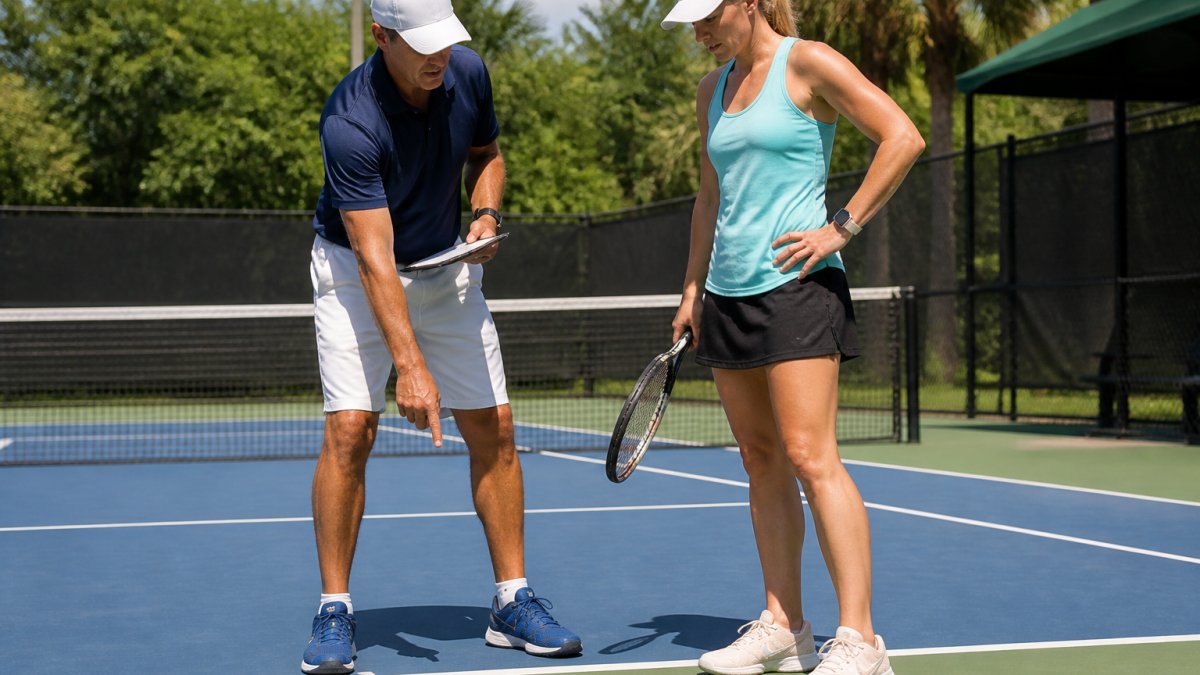
The Trial-Lesson Scorecard
Score each item from 1 to 5 during and right after the session:
- Coach explained technique clearly
- Feedback was specific, not generic
- Drills matched my skill level
- Session felt personalized to my game
- Coach adjusted the plan when I struggled
- Communication style felt motivating
- I left with one clear thing to practice
Add your scores up. Anything under 25 points out a weak fit, no matter how good the coach’s reputation is.
This checklist also protects you from a common trap. Players often confuse a fun, high-energy session with real coaching. Fun matters, but progress matters more.
Set a Baseline Before You Start
A trial lesson tells you about fit. It doesn’t tell you whether the coaching is working. For that, you need a baseline you can measure against. Ask your coach to run a simple assessment in the first or second session:
- Serve percentage: Hit 50 first serves and 50 second serves. Record how many land in.
- Rally consistency: Count how many cross-court forehands you can hit in a row before an error.
- Movement: Time a standard spider drill or side-to-side shuffle and note the result.
- Match results: Log your win-loss record in league or practice matches over the next 30 days.
Write the numbers down. Without a baseline, “I feel better” is the only feedback you’ll have.
Benchmarks to Track Every 4 to 6 Weeks
Re-run the same assessments on a regular cadence. Most coaches find that meaningful change shows up over four to six weeks of consistent work, not one session. Track:
| Metric | What to Watch |
|---|---|
| First-serve percentage | Steady climb or plateau |
| Unforced errors per set | Should trend down |
| Rally length | Should trend up |
| Match win rate | Should improve at your level |
| Movement times | Should hold or improve |
If nothing moves after six weeks of regular lessons and practice, that’s a conversation. Either the plan needs to change or the coach isn’t the right fit.
Questions to Ask After the Trial
- What did you see in my game that I should work on first?
- What’s the one thing you want me to practice before our next session?
- How will we measure whether this is working?
- When should we review progress together?
A coach who can answer these clearly is coaching. A coach who can’t is just feeding balls.
Keep a simple training log, date, drill, metric, note. Six weeks of entries will tell you more about a coach than any resume.
Step 6: Consider Online Tennis Coaching for Flexible Training
Online tennis coaching has moved from novelty to a real option for competitive players. It fits busy schedules and adds daily structure between in-person lessons.
Video review lets a coach see your footwork, serve, and technique through a screen. You send clips, they break down the flaws and send back fixes. For players who can’t train daily with a local pro, this keeps development moving.
The trade-offs are honest. Online coaching can’t replicate live ball feeding or real match pressure. It works best as a companion to in-person lessons, not a replacement.
If your schedule is tight or your local options are thin, a hybrid approach makes sense. Combine weekly in-person sessions with online feedback between them. That’s the model we build at Crunch Time Coaching: step-by-step daily lessons paired with hands-on in-person training camps.
Competitive adults who train on a tight schedule and need daily structure between in-person sessions.
Step 7: Spot Tennis Coach Red Flags and Know When to Switch
Tennis coach red flags are easy to miss when you’re eager to improve. Learn them now so you don’t waste a season.
Watch for these warning signs:
- No certification or background check
- Same drills for every player, regardless of level
- Vague feedback like “just hit it better”
- No plan or progress tracking
- Pushes expensive packages before understanding your goals
- Ignores the mental side of competition
- Makes you feel worse after every session
One bad lesson isn’t a reason to leave. A pattern is. If three sessions in a row leave you confused or discouraged, that’s your signal.
Switching coaches feels awkward, but staying too long costs you progress. A good coach will respect a player who knows what they need. Give clear feedback first. If nothing changes, move on.
Conclusion
Finding a competitive tennis coach comes down to fit, not fame. The right coach matches your goals, explains technique clearly, and tracks your progress with real benchmarks. Most players settle too fast and lose months to a bad match.
At Crunch Time Coaching, we built our platform for players who refuse to settle. Our step-by-step daily lessons are designed to transform your serve in one week and sharpen your footwork for consistency. Our challenge-based curriculum and in-person training camps push you to a higher level of competitive play.
Reserve Your Spot Today and start training with a coach who’s as obsessed with your progress as you are.
Frequently Asked Questions
What should I look for in a competitive tennis coach?
Look for a coach with certifications such as USPTA or PTR, experience coaching competitive players at your level, and a teaching style that adapts to your goals. Ask about their background, communication approach, and whether they offer a trial lesson. A good fit means they explain techniques clearly, provide personalized feedback, and have a plan for your development.
What questions should I ask a tennis coach before hiring them?
Ask about their certifications, experience with players at your skill level, teaching philosophy, and how they measure progress. Inquire about session structure, availability, and whether they offer online coaching options. Also ask for references and how they handle match-play strategy. These tennis coach questions to ask help you gauge if they can meet your competitive needs.
Are private tennis lessons worth it for competitive players?
Private lessons provide focused attention on your technique and strategy, which can accelerate improvement for competitive players. They allow the coach to tailor drills to your specific weaknesses. While group lessons offer peer practice, one-on-one sessions are better for fine-tuning serve mechanics or footwork. Many players combine both for well-rounded development.
Can online tennis coaching help improve match performance?
Online tennis coaching can improve match performance by providing video analysis, personalized drills, and mental strategy sessions. It offers flexibility for players who travel or have busy schedules. However, it works best when combined with in-person practice. Platforms that offer structured feedback and challenge-based curriculum can help you track progress and address specific weaknesses.