
Table of Contents
- Why a Stretching Routine for Tennis Elbow Prevention Matters
- What You’ll Need Before You Start
- A Tennis Elbow Warm-Up Routine Before You Play
- Forearm Stretches for Tennis Players: The Core Routine
- Tennis Elbow Prevention Exercises That Build Tendon Strength
- Tennis Elbow Recovery Exercises: Progression by Pain Level
- Racquet, Grip, and Stroke Fixes That Cut Elbow Load
- Common Mistakes and When to See a Clinician
- Frequently Asked Questions
Last Updated: October 21, 2026
Why a Stretching Routine for Tennis Elbow Prevention Matters
Lateral elbow pain shows up slowly. You finish a match, feel a dull ache on the outside of your elbow, and shrug it off.
A consistent stretching routine for tennis elbow prevention is the cheapest insurance against that slide: eight minutes to keep the forearm flexible and protect the tendon.
Tennis elbow is an overuse injury of the tendons attaching your forearm muscles to the bony bump outside your elbow. Repetitive wrist extension, the motion behind every backhand and serve, loads those tendons until load outruns recovery.
Below: warm-up, stretches, strengthening, and the technique fixes that cut load at the source.
Stretching manages flexibility. It does not build tendon capacity. The players who stay pain-free pair stretching with slow strengthening work.
What You’ll Need Before You Start
You need almost nothing: a wall, a table edge, a towel, and a light dumbbell cover the entire routine.
- A flat surface at hip height, like a counter or table
- A small towel or rolled shirt
- A light dumbbell, or a filled water bottle
A few ground rules before your first rep:
- Start slowly. Tendons dislike sudden load.
- Stretch to tension, not pain. A sharp twinge means back off.
- Breathe. Holding your breath tightens everything you are trying to relax.
If your elbow is already sore, clear the routine with a clinician before you start. More on red flags later.
A Tennis Elbow Warm-Up Routine Before You Play
A tennis elbow warm-up routine takes five minutes and raises tissue temperature before you ask it to work. Skip it, and your first ten backhands become the warm-up. The sequence matters: blood flow, then dynamic range of motion, then light loading that mimics your strokes’ wrist extension. Do this before every session:
- Easy movement (60 seconds) – jog in place or side shuffle to raise your core temperature.
- Arm circles – 10 forward, 10 backward, each arm, small and controlled.
- Wrist turns – rotate palms up and down 15 times at a conversational pace.
- Gentle wrist flexion and extension – 10 reps each direction, no resistance, short of end range.
- Forearm rotation – palm up, then palm down, 10 times, elbow pinned to your side.
- Band or towel curls – 15 slow reps with the lightest band you own.
- Shadow swings (60 seconds) – 10 forehands, 10 backhands, 5 serves at half speed. This is the step most players skip, and it bridges warm-up to actual stroke load.
Keep the pace easy. The goal is blood flow, not fatigue. If your forearm feels tired before you hit a ball, you did too much.
Dynamic Wrist and Forearm Prep
Dynamic prep moves the joint through its range of motion under light control. Unlike static holds, it does not temporarily reduce power output, so it belongs before you hit and static stretching after. Try this two-minute sequence mid-warm-up:
- Wrist circles, 10 each direction
- Palm-down to palm-up rotations, 15 reps
- Light towel squeezes, 10 reps
Finish with a few easy shadow swings. Your forearm should feel warm, not tired.
Do the dynamic prep, then your first serves. Most elbow trouble starts in the first five minutes of hitting, before the tendon is ready. If you only have three minutes, cut the arm circles and shadow swings before you cut the wrist and forearm prep.
Post-Play Cool-Down (The Other Half of Prevention)
Warm-up gets the tissue ready; cool-down helps it recover. After your last point, spend three minutes on static holds while the tissue is still warm:
- Wrist extension stretch, 30 seconds each side
- Wrist flexion stretch, 30 seconds each side
- Forearm rotation, 10 slow reps each direction
This is also the best time to note how your elbow felt during play. A quick 0-10 rating before and after each session builds the pattern data you will use to adjust load.
Forearm Stretches for Tennis Players: The Core Routine
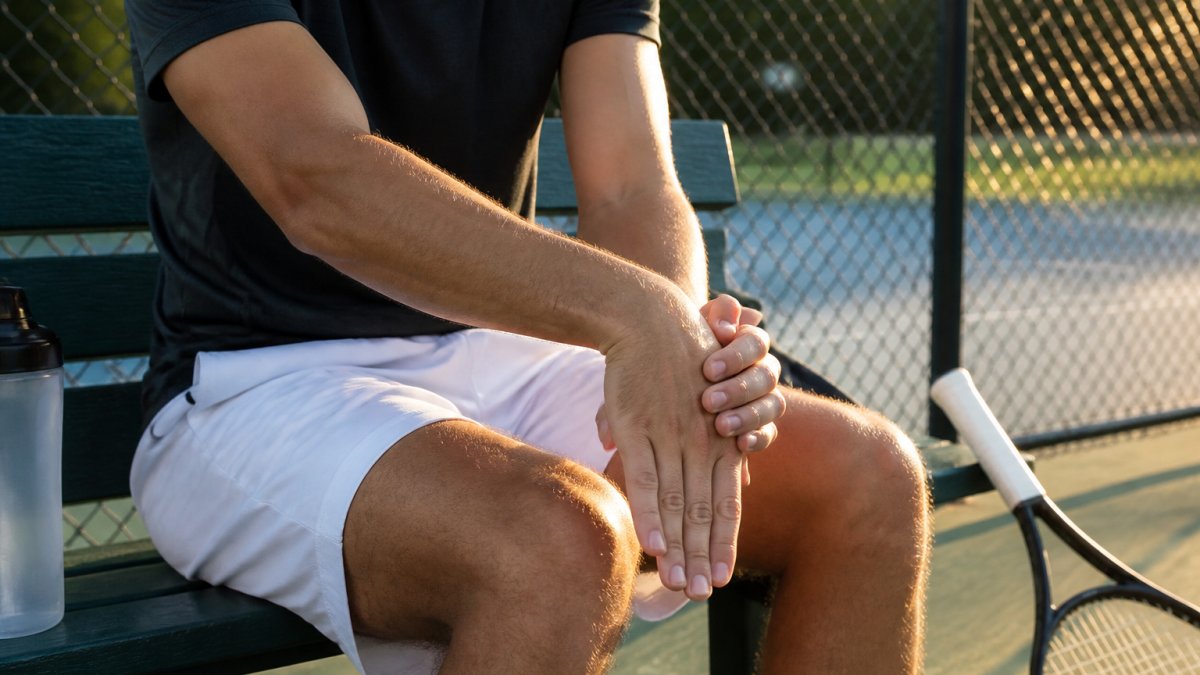
Forearm stretches for tennis players target two muscle groups: the wrist extensors on the outside of the forearm and the flexors on the inside. Both matter, but extensors carry most of the tennis elbow load.
Wrist Extension Stretch
This is the anchor stretch for lateral elbow pain, lengthening the extensor muscles that attach at the painful spot.
How to do it:
- Straighten your affected arm in front of you, palm facing down.
- Let the wrist relax and drop.
- Use your other hand to gently pull the hand down and toward you.
- Hold for 15 to 30 seconds. You should feel a pull along the top of the forearm.
- Relax, then repeat three times.
Keep the elbow straight the whole time. Bending it steals the stretch.
Wrist Flexion Stretch
The mirror image, and just as important. Tight flexors change how your wrist moves through the swing.
- Straighten the affected arm, palm facing up.
- Let the hand drop toward the floor.
- With your other hand, gently pull the fingers down toward your forearm.
- Hold 15 to 30 seconds. Repeat three times.
Expect a stretch along the inside of the forearm. Stop if you feel pinching in the wrist itself.
Forearm Rotation and Wrist Turns
Rotation drills restore full forearm range of motion, protecting the elbow during serves and topspin strokes.
- Bend your elbow to 90 degrees, palm facing up.
- Slowly rotate the palm down, then back up. That is one rep.
- Do 10 to 15 slow reps.
- Add a light dumbbell only when the movement is pain-free.
Keep the elbow pinned to your side. The forearm does the work, not the shoulder.
Tennis Elbow Prevention Exercises That Build Tendon Strength
Tennis elbow prevention exercises work by loading the tendon, not just stretching it. Stretching alone does not build capacity. Slow, controlled resistance does.
The gold standard is the eccentric wrist extension:
- Rest your forearm on a table, palm down, holding a light dumbbell.
- Use your other hand to help lift the weight up.
- Lower it slowly over three to five seconds using only the affected arm.
- Do two to three sets of 10 to 15 reps, every other day.
Start light. An irritated tendon needs weeks of gradual load, not a heroic first session.
Add these over time:
- Wrist curls with a light dumbbell, palm up
- Forearm pronation and supination with a small weight
- Towel or ball squeezes for grip endurance
Jumping straight to heavy dumbbells is the most common mistake we see. Sore tendons get worse, players quit the program, and the elbow never builds capacity.
Tennis Elbow Recovery Exercises: Progression by Pain Level
Tennis elbow recovery exercises should match your pain, not your ambition. The right stage depends on what your elbow does during and after activity, not how long it has been sore.
| Stage | Entry Criterion | Focus | Example Work | Progression Rule |
|---|---|---|---|---|
| 1. Calm | Pain with daily tasks (lifting a cup, gripping a door handle) | Reduce irritation | Isometric wrist extension holds, 30-45 seconds, 3-5 reps, twice daily; gentle range-of-motion | Move on when daily tasks are pain-free for 3 consecutive days |
| 2. Rebuild | Pain only with tennis or heavy gripping | Reintroduce load | Eccentric wrist extension, 1-2 lb dumbbell, 2 sets of 10-15, every other day | Move on when eccentrics are pain-free during and 24 hours after |
| 3. Reload | Minimal pain, fear of relapse | Build capacity | Heavier eccentrics (3-5 lb), wrist curls, pronation/supination with weight, grip work | Move on when you can complete 3 sets of 15 with no next-day flare |
| 4. Maintain | Pain-free | Prevent recurrence | Full warm-up before play, strengthening twice weekly, post-play stretches | Stay here; drop back a stage if pain returns |
A simple rule: if pain climbs during a session and stays up the next day, drop back a stage. If it settles within 24 hours, progress. Track a 0-10 rating before and after each session; patterns show up faster than memory.
Stage 1 in Practice: Calming the Tendon
Isometrics are the workhorse here. Forearm on a table, palm down, press the back of your hand against your other hand or a fixed surface. Build to about 50 percent of maximum effort and hold 30-45 seconds. Do 3-5 reps, twice daily; the goal is steady tension, not movement. Pair this with gentle range-of-motion: wrist turns and slow flexion-extension, 10 reps each, no resistance, everything short of pain.
Stage 2 in Practice: The Eccentric Anchor
The eccentric wrist extension is the most studied loading exercise for this condition and the bridge from calm to capacity:
- Rest your forearm on a table, palm down, holding a 1-2 lb dumbbell.
- Use your other hand to help lift the weight up.
- Lower it slowly over three to five seconds using only the affected arm.
- Do two to three sets of 10 to 15 reps, every other day.
Stage 3 in Practice: Adding Variety
Once eccentrics are pain-free, add these one at a time so you know what is working:
- Wrist curls with a light dumbbell, palm up
- Forearm pronation and supination with a small weight
- Towel or ball squeezes for grip endurance
Range-of-motion work belongs in every stage. Gentle wrist turns and flexion-extension keep the joint moving without loading the tendon hard, and are safe even on a sore day.
Racquet, Grip, and Stroke Fixes That Cut Elbow Load
Equipment and technique decide how much force reaches your elbow.
Grip size. Too small or too large forces you to squeeze harder.
String tension. Lower tension softens the impact at contact; dropping a few pounds usually helps.
Grip pressure. Hold the racquet at about a three out of ten.
Stroke mechanics. Late contact and hitting with a bent, leading elbow load the tendon.
This is where coaching pays off.
Common Mistakes and When to See a Clinician
Most failed routines fail for the same reasons. Avoid:
- Stretching hard into pain instead of tension
- Skipping the warm-up and going straight to serves
- Stretching daily but never strengthening
Pain lasting more than a few weeks, swelling, numbness, or hand weakness needs a clinical assessment, as does pain that wakes you at night.
A physical therapist can confirm the diagnosis and rule out neck or nerve involvement. As general guidance from the American Academy of Orthopaedic Surgeons notes, most cases improve with non-surgical care, and a structured program beats rest alone.
For load management and return-to-play timelines, the American College of Sports Medicine is a solid reference point. And if you want to check your stroke mechanics against a proven model, the International Tennis Federation’s coaching resources cover technique fundamentals in detail.
Track your pain on a simple 0-10 scale before and after each session. Patterns show up fast, and they tell you more than how you feel on any single day.
Tennis elbow rarely comes from one bad shot. It builds from weeks of small loads your forearm was not ready for.
Crunch Time Coaching can help with that last part. Our daily step-by-step lessons sharpen your stroke technique, our challenge-based curriculum keeps you progressing, and our in-person training camps give you hands-on feedback.
Frequently Asked Questions
How long should you hold a tennis elbow stretch?
Hold each stretch for 15 to 30 seconds, then relax. Aim for three repetitions per stretch, per side, and keep the pull gentle rather than forcing the wrist further. Stretching should feel like a mild pull, not sharp pain. If you feel pain in the lateral elbow, back off the range of motion. Do this routine daily, and always start slowly before increasing how far you stretch.
Do stretches help tennis elbow, or do you need strengthening too?
Stretching restores range of motion and muscle flexibility, but it does not build tendon capacity on its own. For tennis elbow prevention, pair forearm stretches with tendon strengthening work such as light dumbbell eccentric exercise: 2 to 3 sets of 10 to 15 repetitions, lowering the weight slowly over 3 to 4 seconds. Stretching plus strengthening is the combination that holds up under repeated play.
Should you stretch before or after playing tennis?
Do dynamic wrist and forearm prep before you play, then save static holds for after. A tennis elbow warm-up routine with wrist turns, forearm rotation, and light grip work raises blood flow without lengthening a cold tendon. After play, run the wrist extension stretch and wrist flexion stretch while the tissue is warm. This split gives you the best of both without stretching a cold, stiff forearm.
What are red flags that mean you should see a clinician?
See a clinician if lateral elbow pain lasts more than a few weeks despite rest, if you have numbness or tingling into the hand, if grip strength drops noticeably, or if pain wakes you at night. Those signs point beyond simple tendon irritation and need an assessment. A physical therapist can confirm the diagnosis and build a tennis elbow recovery program matched to your stage.