
Last Updated: October 30, 2026
Quick Summary
Your serve toss is the one variable you fully control before contact, and consistency comes from a repeatable release rather than a perfect target point. Build a toss that peaks just above your highest fully extended racket reach, and keep the same release window across flat, slice, and kick serves so opponents cannot read it.
- Film your flat, slice, and kick tosses from behind; the ball should leave your hand from the same vertical window in all three.
- The flat toss lands slightly forward of your front foot and roughly in line with your hitting shoulder.
- The slice toss shifts a ball-width or two to the hitting side while keeping the same peak height as the flat.
- Body and wide serves should use the same toss as the flat or slice, with aiming done by swing path.
- Under the rules, you may catch or let a toss go without penalty as long as you have not swung at the ball.
Table of Contents
- Why Advanced Serve Toss Mechanics Decide Matches
- Tennis Serve Toss Height and the Ideal Release Point
- Tennis Serve Toss Placement for Flat, Slice, and Kick Serves
- Tossing Arm Position, Ball Release, and Full Extension
- Tennis Serve Toss Timing and Serve Rhythm
- Tennis Serve Toss Drills You Can Run Without a Partner
- Diagnosing Toss Errors, Match Conditions, and Video Analysis
- Build a Serve You Can Trust With Crunch Time Coaching
- Frequently Asked Questions
Why Advanced Serve Toss Mechanics Decide Matches
At Crunch Time Coaching, we tell every competitive player the same thing: your serve toss is the one variable you fully control before contact.
The evidence backs this up. A model published in An 8-Stage Model for Evaluating the Tennis Serve describes the serve as a chain of sequential segmental rotations, and it recommends a toss placed slightly lateral to the server’s overhead position so contact happens at roughly 100° of arm abduction.
Below, we break down the mechanics of a repeatable toss, then give you drills and diagnostic tools to fix yours.
The Biomechanics Behind a Repeatable Toss
Toss consistency is a product of a repeatable release, not a perfect target point. The hitting arm, legs, and trunk fire in sequence, and the tossing arm delivers the ball into that sequence at the same spot every time.
Players who chase a “perfect toss” as an isolated skill often freeze their motion; players who build a repeatable release pattern get a toss that holds up under pressure.
Tennis Serve Toss Height and the Ideal Release Point
The ideal serve toss height puts the ball at the top of your reach at full extension, with a slight margin so you meet it on the way down or at its apex.
Ball toss kinematics research on professional players has examined how toss kinematics differ across serve types, which confirms what we see on court: height is not one universal number.
A practical rule we give players: your toss should peak just above the highest point your racket head can reach with a fully extended arm.
Tennis Serve Toss Placement for Flat, Slice, and Kick Serves
Advanced players do not need one toss map. They need a family of toss maps that share a release window so the opponent cannot read the serve before contact. The toss changes in millimeters and centimeters, not in gross arm position. For a direct kick serve vs slice serve technique comparison, see our side-by-side breakdown.
The shared release window
Every serve type should launch from the same release height and basic arm path. What changes is the ball’s landing point relative to your front foot and hitting shoulder.
A useful checkpoint: film your flat, slice, and kick tosses from behind. The ball should leave your hand from the same vertical window in all three; the variation should show up in where the ball lands, not where it starts.
Flat serve: forward and through
The flat toss lands slightly forward of your front foot and roughly in line with your hitting shoulder, so the racket can drive through the ball on a near-vertical swing path. The ball should peak just above full extension and be met at or slightly past its apex. Too far forward and you chase it and lose the downward angle; too far back and you lose pace and hit long.
Slice serve: lateral offset, same height
The slice toss shifts marginally to the hitting side, typically a ball-width or two outside the flat landing point, while keeping the same peak height, letting the racket carve across the outside of the ball. The common advanced error is dropping toss height on slice serves to create angle; that shortens the contact window and produces a floating, spin-only serve that sits up for returners.
Kick serve: behind the head, but not behind your balance
The kick toss lands slightly behind the head and over the hitting shoulder, so you can brush up the back of the ball. The trap is tossing so far behind that the contact point moves behind the body’s center of mass, forcing you to arch and lose leg drive. At contact on a kick serve, your hitting shoulder should still be under the ball, not past it.
Body and wide serves: same toss, different swing intent
This is where advanced players separate from intermediate ones. The body serve and the wide serve should use the same toss as the flat or slice serve, with the change coming from swing path and contact point on the ball, not from a visibly different toss. If your body serve requires a different toss, you have telegraphed it. Practice hitting body and wide from an identical toss and let the racket do the aiming.
Disguise without sacrificing contact quality
Disguise is not about hiding the toss; it is about keeping the release window and early arm path identical.
Tossing Arm Position, Ball Release, and Full Extension
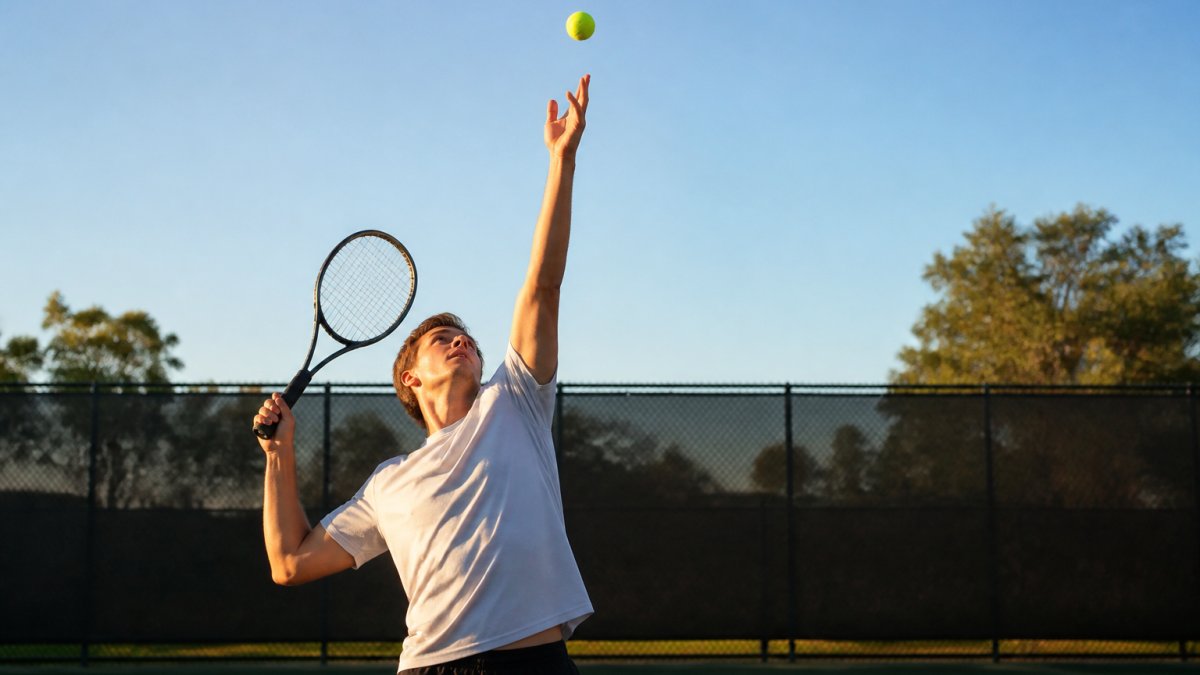
The release point is the quiet culprit behind most inconsistent tosses. For deeper advanced tennis serve techniques for power, including release and full extension, read our full article.
Tennis Serve Toss Timing and Serve Rhythm
Toss timing is the synchronization of your tossing arm with your leg drive and shoulder rotation. When the toss leaves your hand too early, your body arrives at contact late. Too late, and you decelerate to wait for the ball.
Tennis Serve Toss Drills You Can Run Without a Partner
- Toss-and-catch, no racket. Toss and catch the ball at full extension ten times. It must land back in your hand without you moving your feet.
- Wall release drill. Stand a racket length from a wall and toss so the ball peaks at the wall line. Ten reps, checking height consistency.
- Target toss. Place a racket cover on the ground in front of you and land the ball on it. This trains depth and laterality.
- Eyes-closed toss. Toss with eyes closed, then open and locate the ball. Builds feel for release point.
- Serve-motion toss. Full motion, no racket, catching the ball at contact height. Ties timing to the toss.
| Drill | What It Fixes | Reps |
|---|---|---|
| Toss-and-catch | Release point consistency | 10 |
| Wall release drill | Toss height control | 10 |
| Target toss | Depth and laterality | 10 |
| Eyes-closed toss | Feel for release | 8 |
| Serve-motion toss | Toss and serve timing | 10 |
Diagnosing Toss Errors, Match Conditions, and Video Analysis
Advanced players benefit from a diagnostic loop: measure the toss, connect the fault to a mechanical cause, correct it, and re-measure. For a focused fix-it guide with drills to correct drifting and inconsistent height, see how to improve tennis serve ball toss.
Objective checkpoints you can measure
You do not need a lab. A phone on a tripod and a few court markers will do.
Film from behind and from the side in the same session. One angle hides lateral drift; the other hides depth errors. You need both to diagnose accurately.
Advanced error diagnosis: fault to cause to correction
- Toss drifts laterally: Usually caused by opening the fingers early or by the tossing shoulder rotating before release. Correction: keep the palm facing up longer and delay shoulder rotation until the ball leaves the hand.
- Toss falls short and wide: Often a grip problem, not an aim problem. The hand opens too early and the fingers flick. Correction: release from the fingertips with a relaxed wrist and check that the arm finishes high, not across the body.
- Toss pulls behind the head on flat serves: Typically the result of the tossing arm decelerating before full extension. Correction: cue the tossing hand to finish above the ear and hold it there through contact.
Match-condition adaptations
- Into the sun: Lower the toss slightly and turn your shoulders so your non-hitting shoulder shields your eyes. Do not shorten the toss so much that you rush contact; the goal is to reduce the time you spend looking up.
- Into the wind: Toss closer to your body and slightly lower, and shorten your backswing so the ball does not get pushed back over your head. With the wind at your back, toss slightly higher and further forward to use the added pace.
- Crosswind: Toss marginally into the wind so the ball drifts back toward your contact point rather than away from it.
Rules and between-toss recovery
Under the rules, you may catch or let a toss go without penalty as long as you have not swung at the ball. Advanced players use this deliberately: if the toss feels wrong in the first few inches, catch it and reset rather than forcing a low-percentage serve.
Tennis serve toss masterclass on height, depth, and laterality frames toss control through those three dimensions rather than a single target point, which is exactly how we coach diagnosis. If you want to understand how personalized video analysis works and which tools to use, our personalized video analysis tennis guide covers the setup.
Build a Serve You Can Trust With Crunch Time Coaching
The serve is one of tennis’s most complex biomechanical movements, and no single toss prescription fits every player.
Crunch Time Coaching delivers step-by-step daily lessons, a challenge-based curriculum, and hands-on in-person training camps for competitive players. Learn more in our tennis coaching for competitive players guide.
Get started with Crunch Time Coaching and build a toss you can trust when the match is on the line. Reserve your spot today.
Frequently Asked Questions
How high should you toss the ball on a tennis serve?
Toss high enough that the ball peaks just above your maximum contact height and you meet it on the way down, not at the very top. For most advanced players that means a toss roughly 12 to 18 inches above where the racket strings will strike. A higher toss gives you time to complete the leg drive and shoulder rotation, but too high forces you to wait and lose rhythm. Film your serve and check whether contact happens at or just after the apex.
Where should the ball be tossed for a flat, slice, or kick serve?
Serve toss placement changes with intent. A flat serve toss sits slightly forward and to the right of the hitting shoulder for a right-hander, supporting contact at about 100 degrees of arm abduction according to an 8-stage serve model published in 2011. A slice toss moves slightly right of that line, and a kick serve toss lands closer to the head or slightly behind it so you can brush up the back of the ball. Keep the height consistent across all three and change only the lateral and depth position.
How can advanced players stop their serve toss from drifting?
Drift usually starts in the tossing arm, not the ball. Keep the arm straight from the shoulder through release and let the ball leave the fingertips rather than being flicked. A study of 15 professional male players found measurable differences in toss kinematics across serve types, which means some variation is normal. The fix is to pick one release point and one arm path, then rehearse it with toss-and-catch drills until the ball lands in the same spot ten times in a row.
What is the best way to release the ball during a tennis serve toss?
Release the ball at full extension of the tossing arm, letting it roll off the fingertips with the palm facing up or slightly inward. Do not open the hand early or snap the wrist. The hand should finish pointing toward where the ball is going, and the arm should stay up after release rather than dropping immediately. This keeps the release point repeatable and gives your hitting shoulder a stable reference to rotate around.
How does toss height affect serve timing and power?
Toss height sets the clock for the rest of the serve. If the toss is too low, you rush the leg drive and lose racket head acceleration. If it is too high, you wait at the top and your swing path flattens out. Matching toss height to your rhythm lets the legs, shoulder rotation, and racket acceleration fire in sequence, which is where serve pace actually comes from. Advanced players should treat toss height as a timing tool, not just a target.
How can you practice a consistent tennis serve toss without hitting the ball?
Toss-and-catch drills are the fastest way to build toss consistency. Stand at the baseline, toss to your contact point, and catch the ball with the hitting hand at full extension, without letting it drop. Do 10 reps and check whether the ball lands in the same spot each time. Add a target on the ground, then progress to tossing with your eyes closed for the last beat to feel the release. Five minutes of this before every serve session pays off faster than hitting extra serves.
Should the toss arm stay extended after releasing the ball?
Yes. Holding the tossing arm up after release does two things: it keeps your shoulder rotation from stalling and it gives your hitting arm a stable point to swing around. Many players drop the tossing arm too early, which pulls the chest open and sends the serve long or wide. Keep the arm up until the hitting shoulder comes through, then let it fold naturally into the follow-through. This is one of the simplest fixes for a serve that breaks down under pressure.
