
Last Updated: November 5, 2026
Quick Summary
Remote tennis training for intermediate players works because improvement comes from repetition, feedback and self-correction, and all three can happen at home. Players film a session, review it the same evening and return to the court the next morning. That loop of practice, review and correction is where skill actually changes.
- Film at 60 frames per second or higher, since 30 fps blurs the racket head at contact.
- Place the tripod at baseline height, about 4 to 5 feet off the ground.
- Hit 20 first serves to each of three targets and track how many land in the box.
- Compare clips against a reference and work on one error for a week at a time.
- Track one measurable weekly target, such as rally length or first-serve percentage.
Table of Contents
- Why Remote Tennis Training Works for Intermediate Players
- Choosing Between Live Remote Coaching, Video Review, and Self-Guided Training
- Setting Up Your Court, Camera, and Recording Workflow
- Tennis Drills for Intermediate Players to Build Stroke, Footwork, and Serve
- Using Video Analysis in Tennis Coaching to Find and Fix Your Errors
- A 6-8 Week Tennis Practice Plan for Intermediate Players
- Start Your Remote Training Program at Crunch Time Coaching
- Frequently Asked Questions
Why Remote Tennis Training Works for Intermediate Players
Remote tennis training for intermediate players works because the gains come from repetition, feedback and self-correction, and all three can happen at home. A 2024 study in Frontiers in Sports and Active Living on tactical and technical training in competitive tennis found that specific tactics training can improve players’ tactical knowledge and cognitive skills.
Intermediate players who already own the basic strokes often need structured practice and precise feedback more than another round of fundamentals. Remote training can deliver that without the travel time or fixed court bookings that often limit weekly sessions. Learn how remote stroke analysis works and what it covers.
Intermediate players usually hit a plateau because their strokes are functional but inconsistent under pressure. A 2025 study in ITF Coaching Review on adult beginner players in a modified tennis and pickleball program is useful context for adult players, though its participants were beginners, so its findings do not translate directly to intermediate play.
The biggest advantage is volume. A player can film a session, review it the same evening and return to the court the next morning. That loop of practice, review and correction is where skill actually changes.
Choosing Between Live Remote Coaching, Video Review, and Self-Guided Training
Live remote coaching, asynchronous video review and self-guided training can each suit a different stage of improvement. Live sessions give immediate correction, asynchronous review lets you work at your own pace, and self-guided work builds practice habits between lessons.
Live remote coaching can suit players with a specific problem, such as a serve that keeps breaking down or footwork that falls apart in long rallies.
Video review can suit players who train on their own schedule. You record a session and send the clip for review.
Self-guided training is the right starting point only if you already know your errors. Without a second set of eyes, players often reinforce the wrong movement for weeks. Pricing depends on quantity, dates and delivery, so check Crunch Time Coaching’s website for current options and a quote.
Setting Up Your Court, Camera, and Recording Workflow
A reliable setup needs a stable camera, a clear view of your full body and a consistent court position. The quality of the footage you send matters, so treat the recording step as part of the training, not an afterthought. Consistent footage also makes it easier to judge whether remote coaching fits your routine, much as online personal training depends on clear communication and a setup you can sustain.
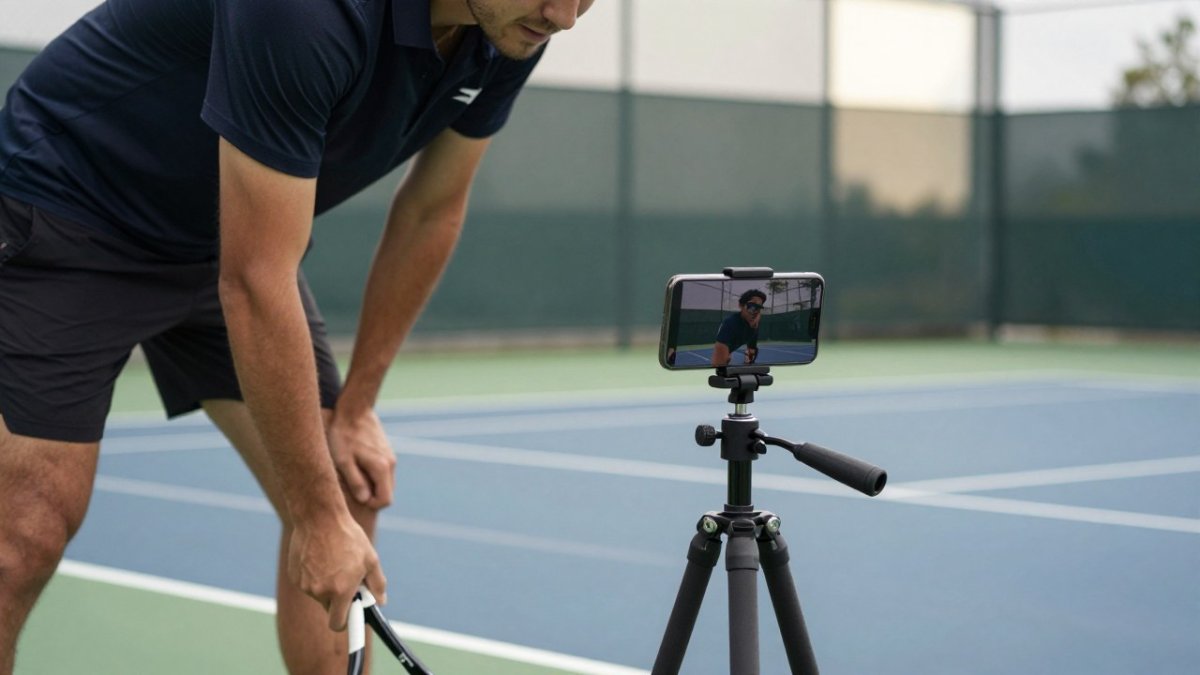
Equipment that actually matters. A smartphone made in the last several years shoots footage good enough for stroke analysis at 60 frames per second or higher; set the frame rate in your camera settings before you record, because 30 fps blurs the racket head at contact. A basic tripod or a phone clamp on a fence post beats a handheld shot every time.
Camera angles by purpose. Place the tripod at baseline height, about 4 to 5 feet off the ground. For groundstrokes, film from the side at the center service line so the coach can see shoulder turn, contact point and follow-through in one frame. For footwork and recovery, film from behind the baseline so split-steps and lateral pushes are visible. For the serve, a side view from the back fence shows the trophy position and leg drive, while a rear view shows toss location relative to the head. Keep the frame fixed for the entire session so clips are comparable week to week.
Lighting and court access. Shoot early morning or late afternoon when the sun is low and behind the camera rather than behind the player. Harsh midday sun blows out the player’s face and casts the ball in shadow.
Tennis Drills for Intermediate Players to Build Stroke, Footwork, and Serve
Effective drills for intermediate players target one skill at a time and build toward match-like conditions. Start with controlled repetition, then add movement and pressure.
Forehand and backhand consistency: Rally cross-court with a partner or a ball machine for 10 minutes, aiming for 20 consecutive balls over the net. Once that is stable, move the target to a 3-foot-wide zone near the baseline.
Footwork ladder: Set up cones in a rough square around the baseline and move through split-step, recovery and shadow swings. Complete three sets of 30 seconds with 30 seconds of rest.
Serve placement: Hit 20 first serves to each of three targets (wide, body and T), then track how many land in the box. Intermediate players often improve placement faster than power, so measure accuracy first.
For a deeper library of movement work, see our guide on best tennis footwork drills for beginners, which covers foundational patterns you can build on here.
Using Video Analysis in Tennis Coaching to Find and Fix Your Errors
Video analysis helps you see the difference between how a stroke feels and how it looks. Most intermediate players are surprised by what the footage reveals, such as an early shoulder turn or a racket drop that appears only on the backhand.
Compare your clips against a reference rather than trying to judge a single swing. Film a few strokes, identify one error and work on it for a week. Changing three things at once makes it impossible to know what helped.
A common mistake is reviewing footage only after a bad session. Schedule a short review after every practice block instead, so corrections stay fresh. Our suggestion is to keep a simple log: date, error spotted, drill used and whether the next clip shows improvement.
A 6-8 Week Tennis Practice Plan for Intermediate Players
A structured 6 to 8 week plan gives you a clear progression rather than random practice.
Weeks 1-2: Stroke consistency. Session A is cross-court rallying for 10 minutes per side, aiming for 20 consecutive balls over the net, then moving the target to a 3-foot-wide zone near the baseline. Session B is a ball-machine or partner feed working one stroke at a time, 40 balls per stroke, with a video review afterward. Session C is a live rally with a scoring goal, such as longest rally of the session. Benchmark to track: rally tolerance, meaning your median consecutive-ball count in a cooperative cross-court rally. A common pattern is for intermediate players to sit in the 8-15 range at the start; the goal by week 2 is a five-ball improvement.
Weeks 3-4: Footwork and recovery. Add the footwork ladder and shadow movement to every session. Session A is split-step and recovery patterns with cones around the baseline, three sets of 30 seconds with 30 seconds of rest. Session B is live-ball movement drills where a partner alternates deep and short feeds.
Weeks 5-6: Serve and return. Serve placement drills twice weekly: 20 first serves to each of three targets (wide, body and T), tracking how many land in the box. Return practice against a live serve, focusing on split-step timing and depth of the return. Benchmark: first-serve percentage in the target zone and return depth past the service line. Intermediate players often improve placement faster than power, so measure accuracy before adding pace.
Weeks 7-8: Match simulation. Play points with a scoring goal, record the best rallies and review them. Session A is baseline points only, Session B is serve-plus-one and return-plus-one patterns, Session C is a full set with a specific tactical goal such as attacking the short ball.
Workload and recovery. Adult intermediate players often add volume faster than their bodies adapt. Keep at least one full rest day between hard court sessions, warm up with dynamic movement rather than static stretching, and back off if elbow or shoulder soreness lasts more than 48 hours.
Track one measurable target each week, such as rally length or first-serve percentage, so progress is visible. For a fuller weekly breakdown, see our tennis training schedule for faster on-court movement.
The plan moves from stroke consistency to match simulation, with a weekly benchmark for each phase.
| Weeks | Focus | Benchmark to track |
|---|---|---|
| 1-2 | Stroke consistency | Rally tolerance; aim for a five-ball gain |
| 3-4 | Footwork and recovery | Balls reached in balance in a 20-ball rally |
| 5-6 | Serve and return | First-serve percentage in target zone |
| 7-8 | Match simulation | Unforced errors per set |
Start Your Remote Training Program at Crunch Time Coaching
Remote training works best when you commit to a plan, get feedback on your footage and measure progress each week. At Crunch Time Coaching, we offer step-by-step daily lessons, a specialized challenge-based curriculum and hands-on in-person sessions for players who want both. Compare our online coaching options with in-person training and learn how to choose the right online coach before you decide. Reserve your spot today and start building the skills your match results depend on.
Frequently Asked Questions
What are some good tennis drills for intermediate players?
Useful drills for intermediate players focus on the shots that break down under pressure. Cross-court rally drills build consistency on the forehand and backhand, while target practice, where you aim for a specific zone such as the corners or the service box, sharpens placement. Serve-and-return sequences train you to make the first two shots of a point reliable. Footwork ladders and split-step drills improve movement and recovery. Record each drill set so you can compare your footwork and contact point against your own earlier sessions, which shows whether the drill is actually changing your technique.
How can remote tennis coaching help an intermediate player improve?
Remote coaching helps intermediate players because it gives structured feedback on technique without requiring a local coach for every session. A coach can review video of your forehand, backhand, serve, and footwork, identify the specific pattern causing errors, and assign drills targeting that pattern. Remote programs also make it easier to practice consistently, which matters more than occasional lessons. Look for programs that give structured instruction and specific feedback, rather than generic lesson videos.
How often should intermediate players practice tennis?
Most intermediate players benefit from three to four sessions per week, split between technical work and live play. Two sessions focused on drills and stroke refinement, one session on match-play patterns such as point construction and shot selection, and one optional session of fitness-focused movement work covers the main areas. Keep sessions around 60 to 90 minutes, and avoid stacking hard technical sessions back to back, since fatigue degrades stroke mechanics. Adults returning to the sport or managing joint pain should build in extra recovery days.
Can you improve your tennis technique by recording yourself?
Yes. Recording yourself is one of the fastest ways to find technique problems you cannot feel while playing. Set the camera at waist height from the side for groundstrokes and the serve, and from behind the baseline for footwork and court positioning. Review the footage in slow motion and compare your contact point, racket path, and follow-through against a reference video of a strong player. Record at the same angle each week so you can measure real change over time.
How can intermediate players break through a tennis plateau?
A plateau usually means your current practice no longer challenges the weak area in your game. Identify the shot or pattern costing you the most points, using match footage to count unforced errors by shot type. Then change the practice: add a specific drill for that shot, increase the pressure through targets or point-play scenarios, and track results over four weeks.
How do you choose an online tennis course or remote coach?
Evaluate any online tennis course or remote coach on three criteria: whether they give feedback on your own video, whether the program has a clear progression from basic to advanced skills, and whether the coach has experience with intermediate players specifically. Ask how often you receive feedback and what format it takes. Pricing varies with the program format, session frequency, and whether in-person components are included, so check Crunch Time Coaching’s website or request a quote for current pricing.
