
Table of Contents
- Why Tennis Training for Players Over 40 Demands a Different Approach
- Build a Strength Foundation With Tennis-Specific Exercises
- Tennis Injury Prevention for Seniors: Proactive Strategies
- Tennis Mobility Exercises for Adults: Dynamic and Static Routines
- Recovery Protocols and Rest Days: The Competitive Edge
- Tennis Training Camps for Adults 2026: Accelerate Your Progress
- Mental Game and Pacing: Win Tiebreakers and Close Matches
- Conclusion
Last Updated: August 17, 2026
Why Tennis Training for Players Over 40 Demands a Different Approach
Tennis training for players over 40 isn’t just a scaled-down version of what younger players do. Your body has changed, recovery takes longer, and injuries linger. But these constraints force you to train smarter, and smarter training often produces better results than the high-volume grinding that works for 25-year-olds.
At Crunch Time Coaching, we’ve worked with competitive players over 40 who believed their best tennis was behind them. The difference comes down to three things: prioritizing strength and mobility over raw court time, managing load strategically, and building recovery protocols that stick.
According to research from the American College of Sports Medicine, adults over 40 who follow periodized strength training see measurable improvements in power output, joint stability, and injury resilience within 8-12 weeks. The key is specificity. Tennis-specific conditioning translates to tennis dominance.
This guide walks you through exactly how to structure tennis training for players over 40, from exercises that build a bulletproof foundation to recovery protocols that keep you playing week after week without breaking down.
Build a Strength Foundation With Tennis-Specific Exercises
Strength for tennis means generating power through your kinetic chain, stabilizing joints under explosive load, and maintaining that stability when exhausted in the third set. Most players over 40 skip strength work entirely. That’s the mistake that leads to injury.

Your strength foundation needs to address three areas: rotational power through your core and shoulders, lower body power for explosive movement, and joint stability through the rotator cuff and hip stabilizers. These work together as a system. When one fails, injury follows.
Resistance Band Work for Shoulder and Rotator Cuff Stability
Your rotator cuff stabilizes your shoulder through the explosive external rotation of the serve and the deceleration forces of the follow-through. Without it, your shoulder becomes a liability.
Resistance bands provide variable resistance that matches how your muscles actually work. Do this work 3-4 times per week, never on consecutive days.
External rotation at 90/90 position: Stand with your arm at shoulder height, elbow bent 90 degrees. Rotate your forearm backward against band tension, controlling both directions. Three sets of 15 reps per side.
Prone shoulder I-Y-T raises: Lie face-down on an incline bench. Perform three positions: arms straight overhead (I), arms at 45 degrees (Y), and arms out to the side (T). Use light band resistance for muscular endurance and proprioception. Three sets of 12 reps each position.
Band pull-aparts: Hold a band at chest height with arms extended. Pull the band apart by moving your hands outward in a controlled arc. This targets your rear deltoids and upper back, counterbalancing the forward-heavy posture of tennis. Three sets of 20 reps.
These exercises prevent the shoulder impingement and rotator cuff tendinitis that plague recreational players over 40.
Lower Body Power: Romanian Deadlifts, Jump Squats, and Sled Pushing
Your legs generate 60% of your power on court. Tennis demands explosive lateral movement, quick direction changes, and force generation from compromised positions.
Romanian deadlifts build posterior chain strength and hip hinge mechanics. Stand with feet hip-width apart, hinge at the hips keeping your back neutral and knees slightly bent. Lower until you feel a stretch in your hamstrings, then drive your hips forward to return. Three sets of 8 reps, twice per week.
Jump squats develop explosive lower body power. Descend into a squat, then explode upward, leaving the ground. Land softly and immediately descend into the next rep. Three sets of 6 reps, once per week.
Sled pushing builds functional leg strength without heavy joint stress. Push a weighted sled for 30-40 meters with challenging but controlled resistance. Three sets of 40 meters, once per week.
Do this work on non-consecutive days.
Core Stability and Functional Movement Patterns
Core stability maintains a stable trunk while your limbs move explosively. Tennis demands this constantly.
Pallof presses train anti-rotation stability. Stand perpendicular to a cable machine with the handle at chest height. Press straight out, resisting rotation. Three sets of 12 reps per side, twice per week.
Dead bugs teach spinal stability while limbs move. Lie on your back with arms extended toward the ceiling and knees bent at 90 degrees. Lower your right arm overhead while straightening your left leg, maintaining lower back contact with the floor. Three sets of 10 reps per side.
Bird dogs build unilateral core stability. On hands and knees, extend your right arm forward and left leg backward simultaneously. Hold for 2 seconds. Three sets of 12 reps per side.
Consistency over eight weeks produces measurable improvements in on-court stability and injury resilience.
Tennis Injury Prevention for Seniors: Proactive Strategies
Most players over 40 wait for injury to happen, then rehab it. That’s reactive. Tennis training for players over 40 demands proactive injury prevention, building resilience before problems emerge.
The injuries that plague players over 40 follow predictable patterns: tennis elbow, shoulder impingement, knee pain, and lower back strain result from accumulated load without adequate recovery, poor movement mechanics, and insufficient mobility. All three are preventable.
Load Management and Overuse Injury Prevention
Overuse injuries accumulate across weeks and months of training without proper load management. Your body has a capacity for work. Exceed it consistently, and injury follows.
Keep a simple training log. Record match play, practice intensity, and how your body feels. After two weeks, you’ll see patterns. Most players over 40 discover they can handle hard play twice per week plus one moderate session.
Periodization is your tool. Alternate between blocks of higher volume and lower volume. A simple pattern: three weeks of increased play, then one week of reduced volume with emphasis on mobility and strength work. This rhythm prevents the accumulation that leads to injury.
Joint Health and Tendon Resilience
Your tendons don’t adapt as quickly as they did at 25. Build tendon resilience through consistent, moderate loading. Eccentric work (the lowering phase of an exercise) is particularly effective.
Nordic curl protocol: Do 3 sets of 5 reps, twice per week. Have a partner assist you up to the top position. Lower yourself as slowly as possible over 5 seconds. The eccentric phase builds resilience and prevents many hamstring injuries in players over 40.
Joint health depends on mobility and stability working together. Combine mobility work with stability exercises, and your joints become more resilient.
Tennis Mobility Exercises for Adults: Dynamic and Static Routines
Mobility is active range of motion under control. Tennis demands mobility. You need to reach wide on court, rotate explosively through your trunk, and decelerate your arm after a 100-mph serve.
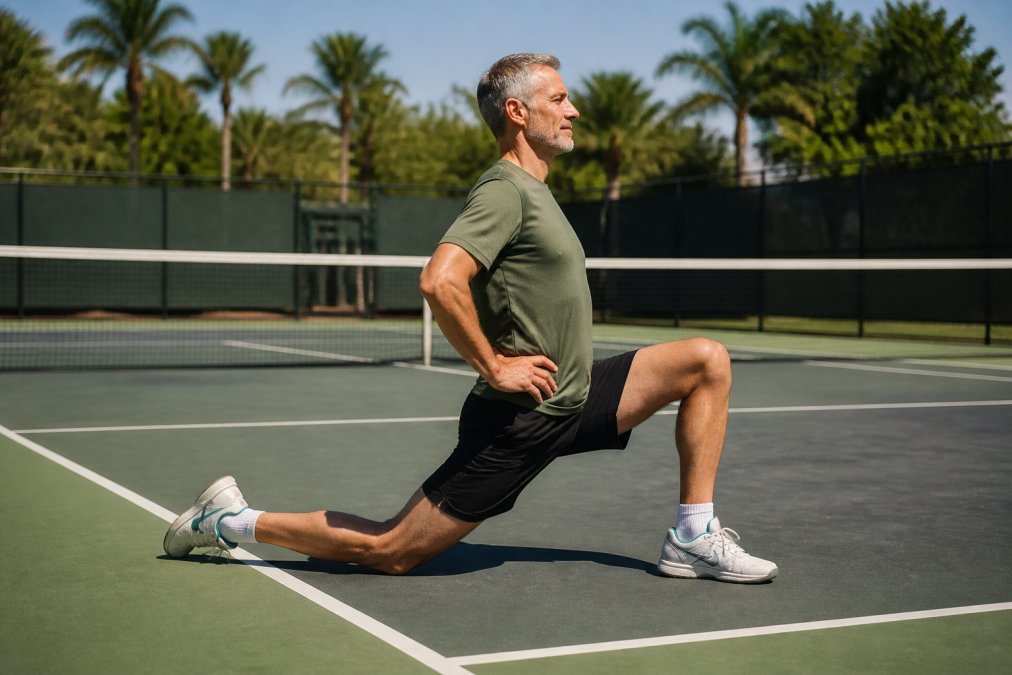
Hip Flexor Mobility and Proprioception Work
Tight hip flexors restrict your stride length, compromise lateral movement, and create lower back strain.
90/90 hip flexor stretch: Kneel on one knee with the other leg in front, knee bent at 90 degrees. Keep your trunk upright and lean forward slightly until you feel a stretch in the back of your front hip. Hold for 30 seconds. Three sets per side, daily.
Lateral lunge with reach: Step laterally into a wide stance. Shift your weight to the stepping leg, bending that knee while keeping the other leg straight. Reach your arm overhead toward the straight leg side. Three sets of 8 reps per side, twice per week.
Single-leg balance work: Stand on one leg with eyes open, then closed. Hold for 30 seconds per side. Progress on an unstable surface. Proprioception deteriorates with age unless trained. This maintains it and prevents ankle injuries.
Warm-Up and Cool-Down Protocols
Your warm-up prepares your nervous system, increases blood flow, and activates movement patterns you’ll use on court. A proper warm-up takes 12-15 minutes and should precede every session.
Dynamic warm-up sequence (12 minutes):
-
5 minutes easy movement: Light jogging, walking, or easy footwork drills.
-
Leg swings: 10 swings forward-back per leg, 10 swings side-to-side per leg.
-
Arm circles: 10 forward circles, 10 backward circles, with increasing range of motion.
-
Walking lunges with twist: 10 per side, rotating your trunk toward your front leg.
-
Inchworms: 10 reps. Walk your hands forward into a plank, then walk your feet toward your hands.
-
Tennis-specific movement: 2 minutes of shadow tennis, practice serve motion, footwork, and stroke mechanics.
Your cool-down is where static stretching belongs. After play, when muscles are warm, hold stretches for 30-60 seconds. Target hip flexors, hamstrings, chest, and shoulders. Cool-down takes 5-8 minutes and should follow every session. The 5 minutes you invest prevents the tightness that leads to restricted movement and injury.
Recovery Protocols and Rest Days: The Competitive Edge
Recovery is where adaptation happens. Your body doesn’t improve during training, it improves during recovery. Most players over 40 underestimate this. They play hard and expect their body to keep up. It won’t. Not without structured recovery.
Post-Match Recovery and Nutrition for Muscle Endurance
The 48 hours after a match are critical. This is when your body repairs damage and adapts to stress.
Cool down for 5-10 minutes with light walking. Your heart rate should drop gradually. Within 30 minutes of finishing, consume carbohydrates and protein. Your muscles are primed to accept nutrients. A simple option: banana with peanut butter, or chocolate milk. The ratio should be roughly 3:1 carbohydrate to protein.
Hydration matters throughout recovery. Drink enough that your urine is pale yellow. Dark urine means you’re dehydrated. Dehydration slows recovery and increases injury risk.
Sleep is non-negotiable. Aim for 7-9 hours per night. If you’re training hard, your body needs this time. Skimp on sleep, and you’ll see fatigue, decreased performance, and increased injury risk within days.
Active recovery on the day after a match accelerates adaptation. Light movement, walking, easy swimming, or gentle yoga increases blood flow without creating additional stress. Twenty to thirty minutes is enough.
Tennis Training Camps for Adults 2026: Accelerate Your Progress
Tennis training camps for adults 2026 combine on-court technical work with off-court strength and conditioning, mobility work, and mental game training. The best camps treat players over 40 as a special population, not just younger players moving slower.
Crunch Time Coaching offers in-person training camps specifically designed for competitive players over 40. These camps compress weeks of training into intensive days, combining technical instruction with conditioning work and recovery protocols. The advantage is personalized feedback on your technique, real-time adjustment based on how your body responds, and accountability from training alongside other serious players.
When evaluating tennis training camps for adults 2026, look for coaches with experience training older players, emphasis on injury prevention and mobility alongside technical work, periodized training that includes recovery days, and small group sizes that allow personalized attention.
Mental Game and Pacing: Win Tiebreakers and Close Matches
Your physical capacity is only half the battle. The mental game becomes more important as you age. You have less margin for error physically, so you need better decision-making mentally.
Pacing is your secret weapon. Most players over 40 try to out-rally younger opponents. That’s a losing strategy. Instead, dictate the pace. Hit your shots early in the rally when you have energy. Move your opponent around. In tiebreakers, where physical fatigue is highest, superior pacing and tactical awareness separate winners from losers.
Practice tiebreaker scenarios specifically. Play practice sets where every game is a tiebreaker. According to research on sports performance under pressure, specific scenario training produces measurable improvements in performance when those scenarios occur in real matches.
Visualization, pre-match routines, and managing self-talk all improve performance. Spend 10 minutes before each match visualizing specific scenarios: serving at 4-4 in a tiebreaker, returning a big serve at match point, recovering from a bad call.
The path forward is clear. Tennis training for players over 40 demands a different approach, one that prioritizes smart training over high volume, builds resilience before injury strikes, and combines physical preparation with mental sharpness. You’re not trying to play like a 25-year-old. You’re trying to play your best tennis as a 40-plus competitor.
Crunch Time Coaching specializes in this exact work. Our step-by-step daily lessons and in-person training camps are designed specifically for competitive players over 40 who refuse to accept that their best tennis is behind them. We focus on technical fundamentals, serve, footwork, consistency, while integrating the strength, mobility, and recovery protocols that keep you healthy and performing at your peak. Reserve your spot today and join players who are playing their best tennis after 40.
Frequently Asked Questions
Is it possible to learn tennis or improve significantly at 40 and beyond?
Yes. Players over 40 improve faster than beginners because they understand court positioning and strategy. Your advantage is experience; your challenge is recovery speed and joint resilience. A structured program that prioritizes strength, mobility, and load management allows you to close technical gaps and compete at higher levels. The key is training smarter, not harder, focusing on tennis-specific conditioning rather than general fitness.
What are the most common tennis injuries after 40, and how do I prevent them?
Tennis injury prevention for seniors centers on three areas: rotator cuff strain (from serves and overheads), knee and ankle stress (from lateral movement), and lower back pain (from core weakness and repetitive rotation). Prevent these by building rotator cuff stability with resistance bands, strengthening your core with functional movement patterns, and managing your training load, never double your court time in one week. Include rest days and post-match recovery protocols to allow joints and tendons to adapt.
How long does it take to see improvement in my serve or footwork?
Footwork and court positioning improvements appear within 2-3 weeks of consistent practice. Serve mechanics take longer, typically 4-6 weeks to groove a new pattern, though you'll feel changes in consistency and power within the first week. Recovery and mobility gains (reduced stiffness, better range of motion) show up in 1-2 weeks. Tournament-level wins depend on integrating all three: technique, fitness, and mental pacing. Most players see measurable competitive results within 6-8 weeks of structured training.
What makes online coaching effective for tennis if the coach can't see me in person?
Online coaching works through video submission and real-time feedback on specific strokes. You record your serve, footwork, or match footage, and the coach identifies biomechanical flaws, foot placement, racket lag, hip rotation, and prescribes targeted drills. Live video calls allow the coach to watch you execute those drills and correct form. The advantage is convenience and detailed analysis. In-person training camps add hands-on correction and high-intensity match play, but online coaching captures 80% of technical improvement when you follow the protocols consistently.
This article was written using GrandRanker