
Last Updated: October 28, 2026
Quick Summary
You need professional tennis footwork coaching when the same movement mistakes repeat every match, your split step timing stays off despite drilling, or you pass footwork drills but the problems return in matches. These signs show the issue is transfer, not fitness, and a coach diagnoses that in person.
- A 10% improvement in footwork can improve an overall tennis game by 100%.
- Most adult players training two to three times a week for 15 to 20 minutes notice footwork improvement within 4 to 6 weeks.
- Film one match before and one after a six-week trial to compare your first three steps.
- Score the four-point footwork diagnostic 0, 1, or 2 across two weeks of three sessions per week.
- Modern coaching favors anticipation and opponent cues over generic ladder drills.
Table of Contents
- Why Footwork Is the First Thing to Fix
- Sign 1: You’re Always Late to the Ball
- Sign 2: Your Tennis Footwork Mistakes Repeat Every Match
- Sign 3: Your Tennis Split Step Timing Is Off
- Sign 4: You Can’t Recover to Center Court
- How to Improve Tennis Footwork on Your Own First
- Tennis Footwork Drills That Reveal Whether You Need Help
- The Cost of Waiting: What Inefficient Movement Steals From You
- Frequently Asked Questions
Why Footwork Is the First Thing to Fix
Most players blame their strokes for a plateau. If you’re searching for signs you need professional tennis footwork coaching, this guide breaks down nine red flags that may point to a movement problem.
The case for fixing movement first is strong. According to Tennis Masterclass’s analysis of movement and match performance, a 10% improvement in footwork can improve an overall tennis game by 100%. That ratio explains why so many players stall despite clean mechanics: they’re arriving late, off balance, and reaching instead of loading.
Poor movement shows up as more than lost points. The Western New York Tennis resource on how footwork shapes preparation and recovery explains that footwork governs how early you reach the ball, your balance during the shot, and your readiness for the next one. For a deeper look at the downstream damage, see our breakdown of bad tennis footwork and what happens to your game.
Sign 1: You’re Always Late to the Ball
Lateness can be a sign of a movement problem. If you consistently arrive with your racket still traveling backward, consider whether your movement or swing may be contributing.
Watch for these patterns:
- You feel rushed on balls that should be routine
- Your contact point drifts backward and closer to your body
- You reach with your arm instead of moving your feet
- Short balls surprise you even when you read them early
Late contact can have different causes. Consider reviewing your movement and swing rather than assuming more swing repetitions will address it.
Sign 2: Your Tennis Footwork Mistakes Repeat Every Match
A mistake you make once is an error; one you make every match is a pattern. Repeated tennis footwork mistakes may be a reason to review your movement.
Common repeat offenders include:
- Standing upright through the shot instead of loading into the legs
- Crossing over on wide balls instead of using a lateral shuffle
- Drifting backward on deep balls rather than stepping in
- Flat-footed landings that kill your recovery steps
The Victoria University study on how expert and novice players perceive movement found that expert coaches see the serve as one holistic movement while novices fixate on isolated parts. The same gap applies to footwork: you can’t see your own patterns clearly, which is exactly why they persist.
Sign 3: Your Tennis Split Step Timing Is Off
Split step timing is one aspect of footwork. If yours is late, early, or missing, it may affect how you begin a point.
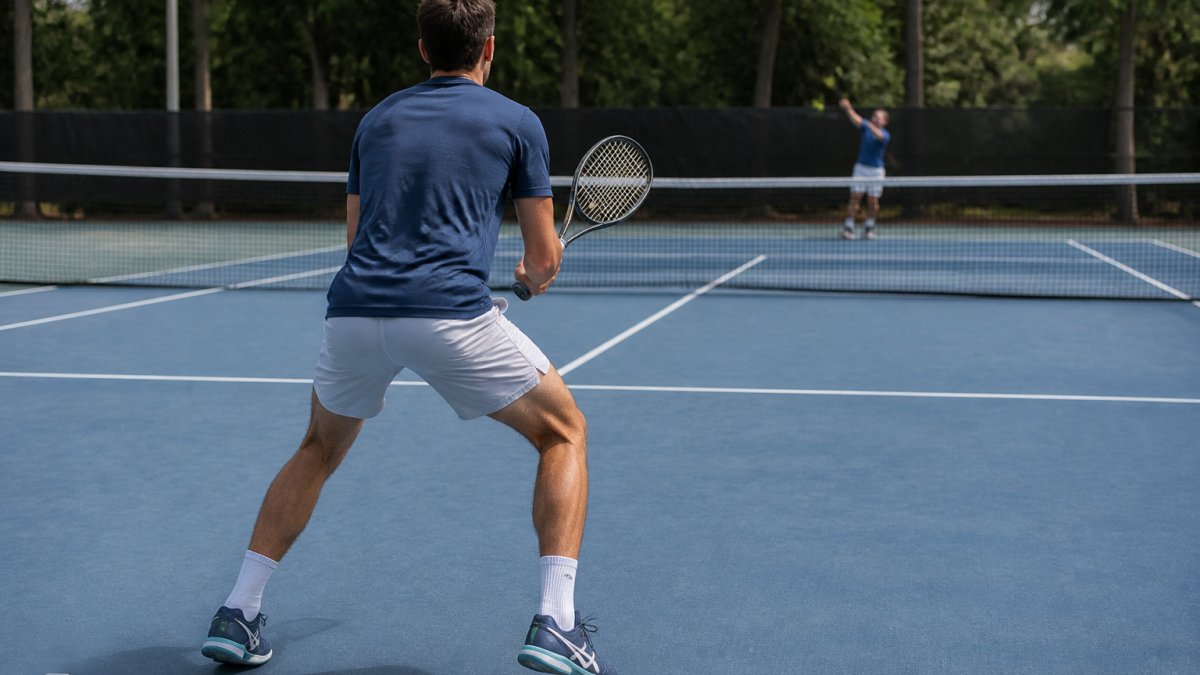
The split step is a small hop timed to land as your opponent makes contact. Land too early and you’re flat-footed when the ball leaves the strings; too late and you’re still airborne as it crosses the net. As coach Simon Konov of Perfect Tennis puts it:
“The split step is the glue that bonds your entire tennis game together.” — Simon Konov, Coach at Perfect Tennis (Perfect Tennis Episode 10, 2026)
Timing this correctly involves responding to cues as well as moving your feet. If you’ve drilled the hop and still mistime it in matches, you could review your technique and training.
Sign 4: You Can’t Recover to Center Court
Recovery is one part of footwork. The steps after contact are also worth considering.
Test yourself: after a wide forehand, can you get back to a neutral position before your opponent’s next shot? If the answer is usually no, your movement efficiency is leaking points. Recovery steps, court coverage, and center of gravity control all feed into this. The ITF Coaching Review on strength and conditioning for footwork patterns notes that footwork issues often stem from physical conditioning gaps rather than technique alone, which is why recovery drills need a real training plan behind them.
How to Improve Tennis Footwork on Your Own First
If you choose to self-train before seeking coaching, define what you want to assess before you start. You can test whether a change carries over to a real point.
Here is a six-week trial with pass/fail criteria. Use it to assess your movement during practice.
| Week | Focus | Session Length | Frequency | Pass Criteria |
|---|---|---|---|---|
| 1-2 | Split step timing and first step | 15 min | 2x per week | You land the split step as your opponent contacts the ball on 7 of 10 fed balls |
| 3-4 | Lateral movement and recovery steps | 20 min | 3x per week | You recover to a neutral position before the next feed on 7 of 10 wide balls |
| 5-6 | Reactive drills with a partner | 20 min | 3x per week | Your first step fires on the partner’s cue, not after the ball crosses the net, on 7 of 10 reps |
Those thresholds are deliberately modest. Most adult players who train two to three times a week for 15 to 20 minutes per session notice meaningful footwork improvement within 4 to 6 weeks, according to Bayview Village Tennis Camp’s training guidance.
When Self-Coaching Stops Working
You can use the following questions to review your progress after a six-week trial:
- You pass the drill but struggle in a match. Compare your split-step timing in practice and match play.
- The same error repeats across three or more matches. Note the recurring pattern and consider reviewing it.
- You cannot identify your own first step. If you cannot say, after watching video, whether your first step was a pivot, a cross-step, or a shuffle, you lack the perceptual frame to correct it. Expert coaches see movement as one holistic action while novices fixate on isolated parts, per the Victoria University study on how expert and novice players perceive movement, the same blind spot applies to your own feet.
- Your recovery is the bottleneck, not your first step. If you reach the ball but cannot reset, review your recovery movement and positioning.
- You have been at it for six weeks with no measurable change. Review what you have practiced and consider what to adjust.
Film one match from behind the baseline before you start the trial and one after. If the two videos look the same in the first three steps after your opponent’s contact, self-coaching has failed its audition, regardless of how the drills felt.
For a full progression you can follow at home, our guide on how to improve tennis footwork speed walks through split step timing, court positioning, and agility work step by step. Run the trial with the pass criteria above to review your progress.
Tennis Footwork Drills That Reveal Whether You Need Help
You can use drills to practice and track your movement. Run the four tests below for two weeks, record each session, and note the results.
The Four-Point Footwork Diagnostic
Score each test 0, 1, or 2 using the criteria below, then total after two weeks of three sessions per week.
- Reactive split step drill (timing test): Have a partner hold a ball and drop-step at random. Time your hop to their movement. Score 2 if you land as they move on 7 of 10 reps, 1 if you land late on 4 to 6, 0 if you are flat-footed or airborne on most reps.
- Cone recovery drill (reset test): Sprint to a wide cone, hit a shadow swing, recover to center. Count reps before your recovery slows by more than a step. Score 2 if you hold pace for 10 reps, 1 for 6 to 9, 0 for 5 or fewer.
- Lateral shuffle ladder (balance test): Shuffle through a ladder pattern without crossing your feet. Score 2 if you stay balanced at speed for the full pattern, 1 if balance breaks in the last third, 0 if you cross over or lose posture early.
- First-step reaction drill (explosion test): Start from a neutral stance and react to a partner’s hand signal. Count clean first steps in 30 seconds. Score 2 for 8 or more, 1 for 5 to 7, 0 for 4 or fewer.
Reading Your Score
Use this interpretation to review your scores:
- 8 to 10 total: Review your movement alongside any remaining tactical or stroke-related concerns.
- 5 to 7 total with one low test: Note the test with the lower score and review it alongside the drills above.
- 5 to 7 total with two or more low tests: Note the tests with lower scores and review them alongside your practice.
- 0 to 4 total: Review your results and consider what aspects of your movement to work on next.
A high score on the ladder test and a low score on the reactive split step are different results across the two drills. If that is your profile, note the difference when reviewing your practice.
Adult players can follow our tennis footwork drills for adults, covering split-step technique, lateral movement, and progressions. You can compare your movement in drills with your movement in matches.
The Cost of Waiting: What Inefficient Movement Steals From You
Footwork is one aspect to consider when reviewing your practice and match performance.
If you’re weighing whether structured footwork work is worth the investment, our analysis of whether tennis footwork training is worth the cost lays out the trade-offs. Our guide to finding a competitive tennis coach covers questions to consider when choosing a coach.
One more consideration: modern coaching has moved away from generic ladder drills toward focus-based work on anticipation and opponent cues, according to My Tennis Coaching’s analysis of current footwork training trends.
Crunch Time Coaching offers step-by-step daily lessons, hands-on in-person training sessions, and a challenge-based curriculum. The lessons and curriculum are designed to help sharpen footwork and improve consistency. Reserve Your Spot Today.
Frequently Asked Questions
How do I know if my footwork is actually the problem and not my technique?
Late contact, off-balance swings, and repeated unforced errors often trace back to movement, not the swing itself. If you arrive at the ball late or hit from a stretched position, your groundstrokes will break down regardless of technique. A simple test: film a match and count how often you contact the ball behind your front hip. Consistent late contact points to footwork, and professional tennis footwork coaching can confirm it with a proper assessment.
How often should I practice tennis footwork drills to see improvement?
Beginners typically notice meaningful footwork improvement within 4 to 6 weeks of consistent training, according to Bayview Village Tennis Camp (2026). Their guidance recommends two to three sessions per week at 15 to 20 minutes per session. That volume builds muscle memory without overtraining. If you follow that schedule for six weeks and still feel late to the ball, the issue is likely movement pattern quality, not frequency, which is where coaching helps.
Can online tennis footwork coaching really fix my movement through a screen?
Yes, if the coach asks for the right footage. A side-angle and behind-angle video of you rallying shows split step timing, recovery steps, and court positioning clearly enough to diagnose patterns. What you cannot get from free videos is feedback tied to your specific habits. Professional tennis footwork coaching reviews your footage and prescribes corrections for your movement, not a generic drill list. Crunch Time Coaching builds this into its step-by-step daily lessons.
What are the most common tennis footwork mistakes that signal I need coaching?
The repeat offenders are a late or missing split step, standing tall instead of loading into the shot, crossing feet on lateral movement, and drifting instead of recovering to center. Each one raises your unforced error count. When you can name the mistake but cannot stop making it after weeks of drills, that gap between knowing and doing is the clearest sign you need professional tennis footwork coaching to rebuild the pattern.
