
Table of Contents
- Why Footwork Speed Determines Your Court Dominance
- Master the Split Step Technique for Explosive First Movement
- Build Lateral Movement and Court Coverage
- Tennis Agility Drills to Sharpen Your Movement
- Tennis Footwork Exercises at Home Without Court Access
- Footwork for Different Playing Styles and Court Surfaces
- Build Your Progressive Training Plan
- Conclusion
Last Updated: August 19, 2026
Why Footwork Speed Determines Your Court Dominance
The difference between winning and losing often comes down to footwork. Your ability to move quickly across the court, adjust position in milliseconds, and recover after each shot directly determines how many balls you can reach and how well-positioned you’ll be when hitting them. Footwork speed isn’t about running fast in a straight line. It’s about explosive first-step quickness, rapid lateral movement, precise weight transfer, and the ability to decelerate and change direction without losing balance. The good news: footwork speed is trainable and responds directly to focused, progressive training.
Master the Split Step Technique for Explosive First Movement
The split step is the foundation of every explosive first movement in tennis. It’s the small jump you take just as your opponent makes contact with the ball, positioning your body to move explosively in any direction.
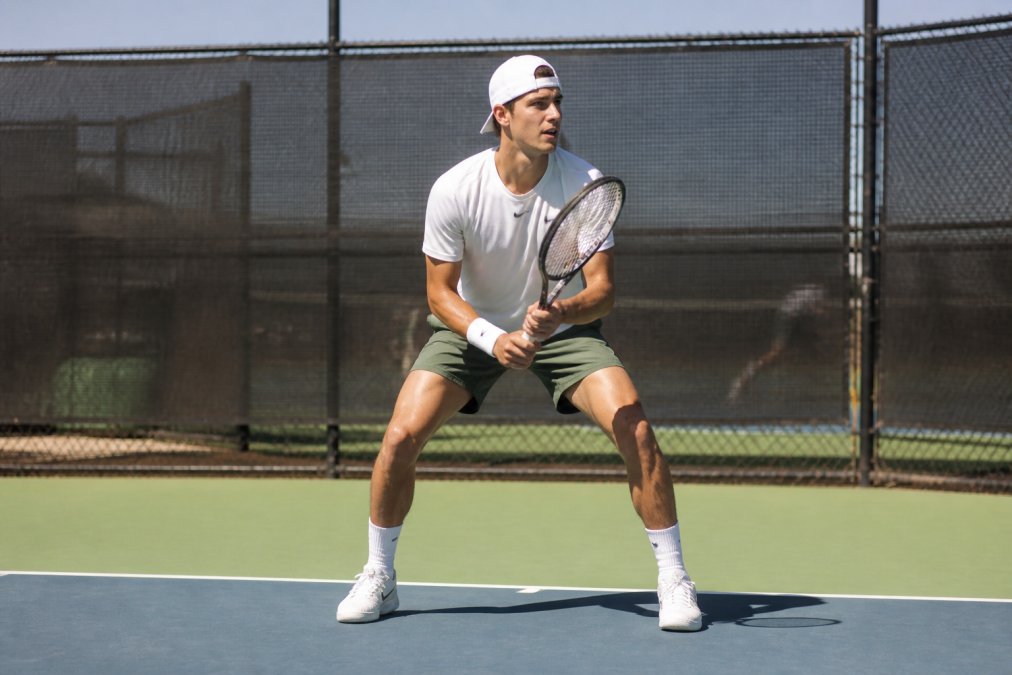
The split step works because it loads your muscles with elastic energy, lowers your center of gravity, and breaks your momentum so you can redirect it in any direction with maximum acceleration. Land on the balls of your feet with immediate knee bend, distributing weight evenly across both feet. This neutral position enables explosive movement in any direction. Common errors, committing too early, landing flat-footed, or overshooting the jump, slow your reaction.
The timing and rhythm of the split step
Execute your split step as your opponent’s racket makes contact with the ball. The rhythm follows three phases: the jump (small, controlled), the suspension (brief moment in the air), and the landing (on the balls of your feet with immediate knee bend). Practice this timing against a ball machine or with a partner, focusing on landing at the exact moment the ball leaves your opponent’s racket.
Common footwork errors that slow your reaction
Landing flat-footed loses the elastic energy that powers explosive movement. Committing your weight to one side before the split step completes leaves you off-balance. Overshooting the split step creates unnecessary air time that delays your landing. Keep the split step small and controlled, just enough to load your muscles and reset your position.
Build Lateral Movement and Court Coverage
Lateral movement translates footwork speed into actual court dominance. It’s built on two principles: taking short steps and maintaining perfect weight transfer throughout the sequence.
Short steps versus long strides is where most players make their biggest mistake. Long strides feel faster but commit your weight and momentum in one direction. Short steps keep your center of gravity stable, your weight neutral, and your momentum controllable, allowing you to stop, start, or change direction with minimal wasted motion. Professional players take small, rapid steps when moving laterally, they’re executing controlled movement that prioritizes direction change over pure speed.
Short steps versus long strides: finding your rhythm
During baseline rallies, move with consistent, controlled steps that keep you balanced. Your feet should move in rhythm with the incoming ball. Practice moving side to side on the baseline without a ball, focusing on small, consistent steps. Your feet should move quickly while your upper body stays relatively still and your center of gravity stays low.
Weight transfer and balance during direction changes
Weight transfer is the engine of footwork speed. As you move laterally, your weight transfers from one foot to the other in continuous rhythm. During direction changes, maintain a "loaded" position where your outside leg (farther from the direction you’re moving) carries most of your weight. This loaded position allows you to push off that leg and accelerate in the opposite direction instantly.
Tennis Agility Drills to Sharpen Your Movement
Agility drills train your nervous system to execute rapid changes of direction while maintaining balance and control.
Speed ladder footwork patterns
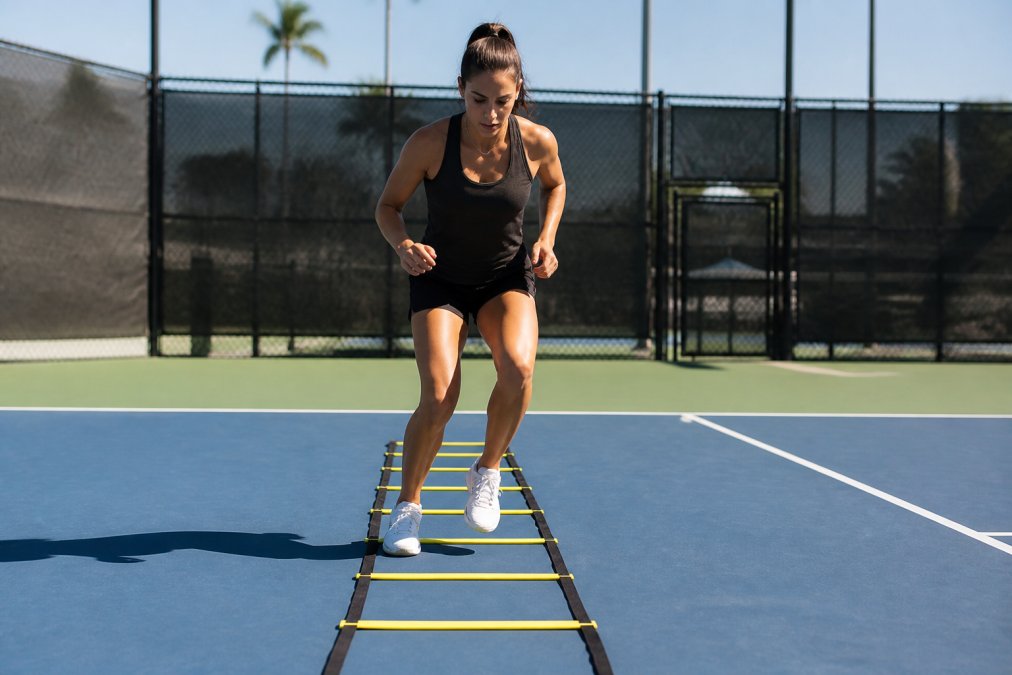
The speed ladder is one of the most effective tools for improving foot speed and coordination. A speed ladder is a flat ladder laid on the ground with rungs spaced about 18 inches apart. The one-foot-in-each-box pattern trains rapid foot placement and coordination. The lateral shuffle mimics baseline rallies.
Perform each pattern for 20-30 seconds, rest for 30 seconds, and repeat for 3-5 sets. Move as quickly as possible while maintaining perfect foot placement. Speed without control doesn’t improve your on-court movement.
Cone drills for change of direction
The T-drill trains acceleration, deceleration, lateral movement, and direction change. Set up four cones in a T shape: one at the start, one 10 feet forward, and two 5 feet to the left and right of the forward cone. Sprint forward, shuffle laterally to the left cone, shuffle back to the right cone, and sprint back to the start. Perform 5-8 repetitions, rest for 60 seconds, and repeat for 3 sets.
Shadow swinging and reaction drills
Shadow swinging trains your footwork speed and movement patterns in a tennis-specific context. Stand at the baseline and imagine your opponent hitting shots to different sides. Execute your split step, move laterally with short steps, and execute a shadow swing. Continue for 2-3 minutes, varying the imagined shots.
Reaction drills involve a partner who points or calls out directions, and you respond with explosive movement in that direction. Continue for 30-45 seconds, rest, and repeat for 3-4 sets.
Tennis Footwork Exercises at Home Without Court Access
You don’t need a court to improve your footwork speed. Many effective footwork exercises can be performed in a small space.
Plyometric movements are explosive exercises that train your muscles to produce maximum force in minimum time, directly improving your ability to accelerate and change direction on court.
Plyometric movements for explosive power
Box jumps train explosive power in your legs. Find a sturdy box or step 12-24 inches high. Jump onto the box with both feet, landing softly and sticking the landing. Step down. Repeat for 8-10 repetitions, rest, and perform 3 sets.
Single-leg hops train balance, coordination, and explosive power while mimicking single-leg movements on court. Stand on one leg and hop forward, backward, and laterally. Perform 10 hops in each direction on each leg. Rest and repeat for 3 sets.
Lateral bounds train lateral acceleration and power. Stand with feet shoulder-width apart. Explosively push off your left leg and bound to the right, landing on your right leg. Immediately push off your right leg and bound back to the left. Continue for 30 seconds. Rest and repeat for 3-4 sets.
Jump rope trains foot speed, coordination, and explosive power. Jump rope for 30 seconds with rapid, controlled jumps. Rest for 30 seconds. Repeat for 10 rounds.
Dynamic warm-up routines for footwork preparation
A proper warm-up prepares your muscles and nervous system for explosive footwork. Leg swings prepare your hip flexors and hamstrings. Stand on one leg and swing your other leg forward and backward for 10 repetitions, then perform lateral swings for 10 repetitions on each side. optimize training performance.
Walking lunges activate your quadriceps, hamstrings, and glutes. Walk forward, stepping into a lunge position, lowering your hips until your back knee nearly touches the ground. Push back to standing and step forward with the other leg. Perform 10 lunges on each leg.
Inchworms train core stability and shoulder mobility. Start standing upright, bend forward and place your hands on the ground, walk your hands forward into a plank position, then walk your feet forward toward your hands, returning to standing. Repeat for 10 repetitions.
A complete dynamic warm-up takes 5-10 minutes and should include leg swings, walking lunges, inchworms, and light jogging or jumping jacks. Perform this warm-up before every training session or match.
Footwork for Different Playing Styles and Court Surfaces
Footwork isn’t one-size-fits-all. Your footwork strategy should adapt to the court surface and your playing style.
Hard courts are faster surfaces where the ball bounces higher and faster. Your footwork should emphasize rapid lateral movement and quick direction changes. Your split step should be slightly earlier, and your lateral movement should be more explosive.
Clay courts are slower surfaces where the ball bounces lower and moves more slowly. Your footwork should emphasize longer movements and smoother transitions. You have slightly more time to react, so you can take longer strides.
Grass courts are the fastest surfaces, where the ball skids and bounces lower. Your footwork should be even more explosive and reactive than on hard court.
Adjusting your footwork for hard court versus clay
On hard court, your split step should be slightly earlier because the ball travels faster. Your lateral movement should be rapid and explosive. Your recovery footwork after hitting should be explosive because your opponent will have less time to prepare their shot.
On clay, your footwork should be smoother and more controlled. Your split step can be slightly later because you have more time. Your lateral movement can be longer and more flowing.
Movement patterns for baseliners versus serve-and-volley players
Baseliners spend most of their time at the baseline, moving laterally and occasionally adjusting to shot depth. Your footwork should emphasize lateral movement, rapid weight transfer, and explosive first-step quickness.
Serve-and-volley players move forward aggressively after serving, positioning themselves at the net to finish points with volleys. Your footwork should emphasize forward movement, rapid recovery steps at the net, and explosive lateral movement.
Build Your Progressive Training Plan
Improving your footwork speed requires consistent, progressive training. A progressive training plan starts with foundational movements and gradually increases in intensity and complexity.
Week 1: Foundation and Movement Patterns
Focus on learning proper footwork mechanics: the split step, lateral movement with short steps, and weight transfer. Perform speed ladder drills with basic patterns. Perform cone drills at 70% intensity. Include dynamic warm-ups before every session. Train 3-4 times per week, 20-30 minutes per session.
Week 2: Building Speed and Coordination
Increase the intensity of speed ladder drills and add more complex patterns. Increase cone drill intensity to 85%. Add shadow swinging and reaction drills. Include plyometric exercises 2 times per week. Train 4 times per week, 30-40 minutes per session.
Week 3: Sport-Specific Application
Apply footwork drills in tennis-specific contexts. Practice footwork patterns while hitting balls with a partner or ball machine. Perform cone drills that mimic court movement. Increase plyometric training to 3 times per week. Train 4-5 times per week, 40-50 minutes per session.
Week 4: Intensity and Testing
Increase the intensity of all drills. Perform speed ladder drills at maximum speed. Perform cone drills with competition. Perform plyometrics at maximum intensity. Test your improvement by measuring your court coverage and reaction time during match play. Train 4-5 times per week, 45-60 minutes per session.
After four weeks, reassess your footwork speed. You should notice measurable improvements in your court coverage, reaction time, and movement quality.
Week-by-week progression for measurable improvement
Progression is the key to continuous improvement. Each week should be slightly more demanding than the previous week. Track your progress by measuring specific metrics: the time it takes to complete a cone drill, the number of speed ladder repetitions you can perform in 30 seconds, or your court coverage during match play.
Recovery and injury prevention strategies
Footwork training is demanding on your legs, ankles, and knees. Foam rolling your legs after training reduces muscle tightness and improves blood flow. Spend 1-2 minutes on each leg, focusing on your calves, quadriceps, and hamstrings.
Stretching after training improves your range of motion. Perform static stretches for your hip flexors, hamstrings, calves, and quadriceps. Adequate sleep and nutrition support recovery. Aim for 7-9 hours of sleep per night and eat adequate protein. Listen to your body. If you experience pain during training, stop and rest.
Improving your footwork speed is one of the most direct paths to better match results. The techniques and drills covered here work because they target the specific movements you perform on court: explosive first-step quickness, rapid lateral movement, precise weight transfer, and explosive changes of direction.
The challenge is consistency. Most players understand that footwork matters, but few commit to the focused, progressive training required to actually improve it. At Crunch Time Coaching, our step-by-step daily lessons focus on exactly these footwork mechanics and drills, with progressive challenges that keep you improving week after week. Our world-class coaching helps you identify your specific footwork weaknesses and develop a personalized plan to address them. Reserve Your Spot Today and start transforming your court movement with expert guidance designed to get you results.
Frequently Asked Questions
What is the most important footwork technique to improve tennis footwork speed?
The split step is foundational. It resets your body's center of gravity and allows you to react explosively in any direction. Performed as your opponent makes contact with the ball, the split step puts you on the balls of your feet, ready to accelerate. Master this timing first, then layer in lateral movement and short adjustment steps. Players who neglect the split step sacrifice court coverage and reaction time regardless of how fast their feet are.
Can I practice tennis footwork exercises at home without a court?
Yes. Plyometric drills, dynamic warm-ups, speed ladder work, and shadow swinging all build foot speed and coordination without court access. Lateral lunges, jump squats, and directional shuffle drills strengthen the kinetic chain and improve acceleration. Home-based routines develop the explosive power and rhythm needed on court. Combine these with court-based cone drills and match play to apply your improved footwork under pressure.
How long does it take to see improvement in footwork speed?
Measurable improvements in reaction time and court coverage typically appear within 2-3 weeks of consistent training. Noticeable changes in match play, faster recovery steps, sharper direction changes, better court positioning, often take 4-6 weeks. Significant competitive advantage develops over 8-12 weeks of progressive drills and match application. Consistency matters more than intensity; three focused sessions per week outperforms sporadic intense workouts.
Does footwork speed matter if I have a strong serve?
Yes. Even serve-dominant players must move efficiently to finish points. Poor footwork forces you into uncomfortable positions for forehands and backhands, reducing power and accuracy. Fast footwork enables aggressive court positioning, allowing you to shorten points and dictate rallies. Strong serves win points; strong footwork wins matches by controlling the court and limiting your opponent's options.
This article was written using GrandRanker