
Last Updated: November 9, 2026
Quick Summary
A senior tennis player stretching routine for flexibility pairs a 10 to 15 minute dynamic warm-up before play with static stretches after play, holding each 30 to 60 seconds per muscle. Target the shoulder and rotator cuff first, then hips, hamstrings and thoracic spine, and adjust drills for stiff joints or balance concerns.
- Injury prevalence in older tennis populations rises to roughly 50%, so the routine must match the older body.
- The dynamic warm-up takes 10 to 15 minutes and runs from leg swings to a mini-tennis rally.
- Hold static stretches 30 to 60 seconds per muscle, per National Institutes of Health research.
- Run the cool-down within 15 minutes of your last point, while the tissue is still warm.
- If soreness still limits movement two days after a match, shorten the next session rather than stretch harder.
Table of Contents
- Why Senior Tennis Players Need a Stretching Routine Built for Their Body
- The Dynamic Warm-Up for Tennis Players That Replaces Static Stretching
- Tennis Stretches for Seniors: Upper Body and Rotator Cuff Work
- Tennis Mobility Exercises for Hips, Hamstrings, and Thoracic Spine
- Tennis Stretches After a Match: The Cool-Down That Speeds Recovery
- How Long to Hold Each Stretch and How Many Reps You Actually Need
- Equipment-Assisted Stretching When Your Hands or Shoulders Can’t Reach
- Build Your Routine With Coaching That Watches Your Movement
- Frequently Asked Questions
Why Senior Tennis Players Need a Stretching Routine Built for Their Body
A senior tennis player stretching routine for flexibility is not a scaled-down version of a junior warm-up. Injury prevalence in older tennis populations rises to roughly 50%, according to Hillcrest Tennis Camp’s comparison of injury rates across age groups, which is why the routine has to match the body doing the playing. For the full picture of staying injury-free as you age, see our tennis injury prevention for seniors guide.
What Changes After 40 and How It Affects Your Court Movement
Tissue elasticity drops. Joints stiffen. Recovery takes longer.
That means shorter strides, slower split steps, and a serve that loses height. The fix is consistency, not intensity. For a deeper look at adapting training as you age, see our guide to tennis training for players over 40.
The Dynamic Warm-Up for Tennis Players That Replaces Static Stretching
Static stretching before play is out, and for a senior player the reason is mechanical, not stylistic. A cold muscle held in a long static stretch temporarily reduces the stretch-shortening cycle’s ability to produce force, which is exactly the quality you need for a split step or a first serve. The United States Tennis Association’s guidance on dynamic warm-ups recommends actively preparing muscles for the explosive forces tennis demands, and that guidance matters more, not less, as tissue elasticity declines with age.
A dynamic warm-up for tennis players takes 10 to 15 minutes. The sequence below moves from ground contact to full-body rotation so each drill feeds the next:
- Leg swings – 10 per leg, front to back, then 10 per leg side to side, holding a fence or net post for balance
- Arm circles – 15 each direction, starting small and widening to full range
- Walking lunges – 10 steps, torso upright, back knee lowering only as far as comfort allows
- Lateral shuffles – 20 yards, staying low with a soft knee bend
- Torso twists – 10 each side, arms relaxed and hips stable
- Mini-tennis rally – 3 to 5 minutes from the service line, gradually lengthening the swing
Why the Order Matters More After 60
The first two minutes of a warm-up can be a higher-risk window for a senior player, because joints are still warming up and the stabilizing muscles around the knee and shoulder are not yet fully engaged. That is why the sequence starts with supported, low-amplitude movement (leg swings at a fence) and only progresses to loaded movement (walking lunges) once the hips and ankles have opened. Skipping the supported stage and jumping straight into lunges can increase the risk of a knee tweak before play begins.
Modifications for Stiff Joints, Arthritis, and Balance Concerns
Limited mobility is not a reason to skip the warm-up. It is a reason to adjust it, and the adjustments below keep the same movement patterns while removing the balance and impact demands that cause problems:
- Chair-assisted leg swings – stand side-on to a chair back and hold it with one hand; the chair replaces the fence when you are warming up indoors or on a crowded court
- Seated arm circles – perform them sitting on a bench if standing balance is unreliable, then repeat standing once you feel steady
- Shallow walking lunges – cut the depth in half and take a slightly wider step; the goal is hip warmth, not a deep stretch
Watch out: if a drill produces joint pain rather than muscular warmth, stop and substitute the seated version. Warmth that builds over two minutes is the signal to continue; a sharp pinch is the signal to change the drill, not to push through it.
To carry that mobility onto the court, our guide to low impact tennis court movement for seniors shows how to use it in points.
Tennis Stretches for Seniors: Upper Body and Rotator Cuff Work
Tennis stretches for seniors should target the shoulder first. The rotator cuff takes the most load on serves and overheads.
Try these:
- Cross-body shoulder stretch – hold 30 seconds per arm
- Sleeper stretch – 20 seconds per side
- Doorway chest stretch – 30 seconds
Arm care connects directly to elbow pain. Our stretching routine for tennis elbow prevention covers the forearm work that pairs with this.
Tennis Mobility Exercises for Hips, Hamstrings, and Thoracic Spine
Tennis mobility exercises restore the rotation your swing needs. The thoracic spine drives the serve. The hips drive the split step.
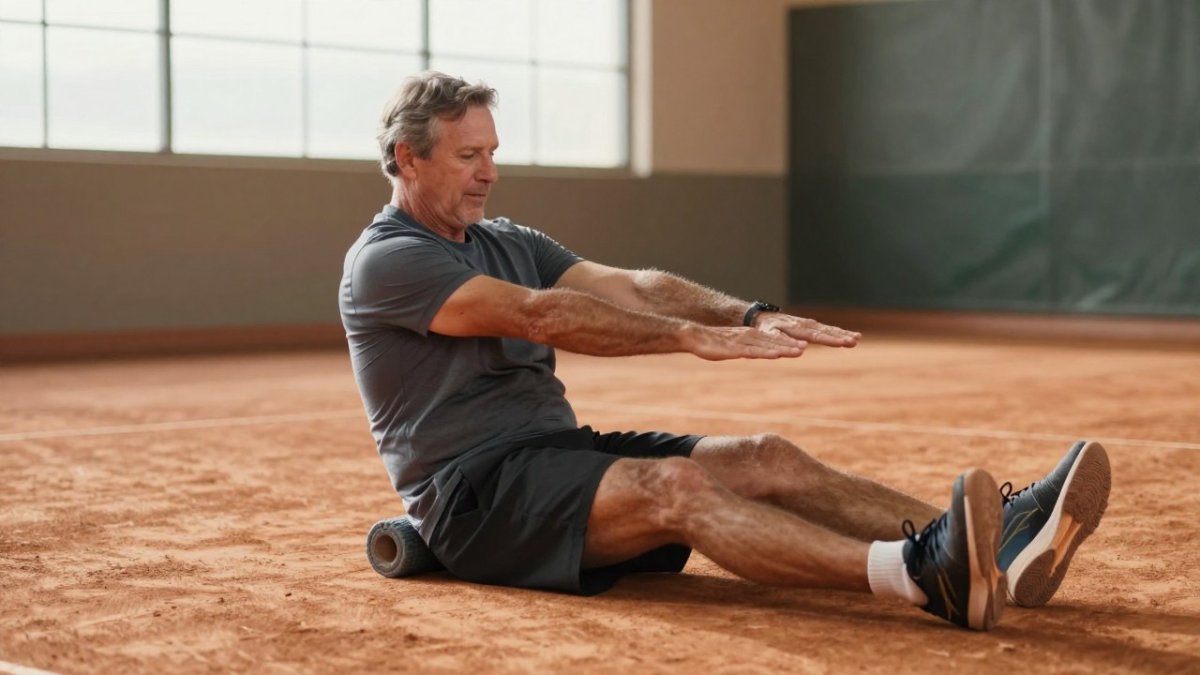
Build this three-part circuit:
- Thoracic spine rotation – 8 reps per side, seated or kneeling
- Hamstring stretch – 30 seconds per leg, standing or supine
- Hip flexor stretch – 30 seconds per side, half-kneeling
Modifications for Stiff Joints and Limited Range of Motion
Limited mobility is not a reason to skip the work. It is a reason to adjust it.
- Use a strap or towel when hands cannot reach
- Reduce hold time and add reps
- Stretch seated instead of standing
Tennis Stretches After a Match: The Cool-Down That Speeds Recovery
Tennis stretches after a match matter as much as the warm-up, and for a senior player the cool-down is where the age-specific work actually happens. Recovery time lengthens with age, and the post-match window is the one place in the routine where you can influence how the next 48 hours feel. A standard post-match static stretch holds 20-30 seconds, per More Physical Therapy’s injury prevention protocol, but the sequence and the surrounding habits matter as much as the hold time.
Run this cool-down within 15 minutes of your last point, while the tissue is still warm:
- Calf stretch – 30 seconds per leg, hands on a fence or net post
- Quadriceps stretch – 30 seconds per leg, holding a chair back if balance is uncertain
- Hamstring stretch – 30 seconds per leg, supine with a strap if hands cannot reach the foot
- Cross-body shoulder stretch – 30 seconds per arm
- Hip flexor stretch – 30 seconds per side, half-kneeling with a cushion under the down knee
- Thoracic spine rotation – 8 slow reps per side, seated, to unwind the rotation load from serves and overheads
Why the Cool-Down Is Different After 60
The mechanism is not mysterious: older muscle carries more connective tissue stiffness and clears metabolic byproducts more slowly, so the same match that leaves a 30-year-old mildly sore can leave a 65-year-old stiff for two days. That is why the senior cool-down should prioritize the two areas that take the most eccentric load in tennis, the calves and the hamstrings, and should finish with gentle rotation rather than a long, aggressive hamstring pull. Consistent application of these movements helps maintain the Vitalyns range of motion necessary to safely utilize a stretching strap for hamstrings.
Equipment-Assisted Recovery for Hands and Shoulders That Cannot Reach
A strap, towel, or resistance band extends your range without straining the shoulder, and the cool-down is where equipment earns its place because you are already fatigued:
- Supine hamstring stretch with a strap – loop the strap around the arch of the foot and use the arms to draw the leg toward you, keeping the knee softly bent
- Doorway chest stretch – place both forearms on the frame and step through gently; this opens the front of the shoulder without the reaching that a cross-body stretch demands
- Half-kneeling hip flexor stretch with a chair – rest the back foot on a chair seat if the half-kneel is too much for the knee
Watch out: pulling hard on a strap with a fatigued shoulder is how senior players turn a good stretch into an irritated rotator cuff. Let the band or strap do the work and keep the pulling arm relaxed.
The 48-Hour Recovery Rule
A cool-down is only half of the post-match protocol. The other half is what you do the next day: a 10-minute walk, a short mobility session, and enough hydration to support tissue repair. If soreness is still limiting your movement two days after a match, that is a signal to shorten the next session rather than to stretch harder, and it is worth mentioning to a physician or physical therapist who can assess whether the load is outpacing your recovery.
How Long to Hold Each Stretch and How Many Reps You Actually Need
Hold static stretches 30 to 60 seconds per muscle, per National Institutes of Health research on stretching recommendations. Range of motion gains appear with as little as 5 seconds, but longer holds build lasting flexibility.
| Stretch Type | Hold Time | Reps | When |
|---|---|---|---|
| Dynamic drill | 10 reps | 1-2 sets | Before play |
| Static stretch | 30-60 sec | 2-3 per side | After play |
| Short hold | 5-10 sec | 3-4 per side | Stiff days |
Equipment-Assisted Stretching When Your Hands or Shoulders Can’t Reach
Equipment-assisted stretching can help when reaching is difficult. A strap, towel, or resistance band can extend your range.
Use a strap for:
- Hamstring stretches while lying down
- Chest and shoulder openers
- Hip flexor work in a half-kneel
Watch out: pulling too hard on a strap strains the shoulder you are trying to protect. Let the band do the work, not your arm.
Build Your Routine With Coaching That Watches Your Movement
A routine only works if someone checks your form. Read is online tennis coaching actually effective to see how video analysis compares to in-person feedback.
Your flexibility will not improve by accident. It improves when someone watches your movement and corrects it. Crunch Time Coaching offers world-class coaching from a “Totally Obsessed” tennis coach, step-by-step daily lessons, and hands-on in-person training sessions built around your body and your game.
Frequently Asked Questions
Should senior tennis players stretch before or after playing?
Both, but the type of stretching changes. Before play, the USTA recommends dynamic warm-up movements that raise heart rate and take joints through their range of motion, not static holds. Save static stretching for after the match, when muscles are warm. A typical routine runs 10 to 15 minutes total. If you only have time for one, do the dynamic warm-up, because cold static stretching before explosive tennis movement does not prepare the tissue for the forces of a serve or a wide forehand.
How long should older adults hold a stretch?
Static stretches are commonly held for 30 to 60 seconds per muscle. For post-match work, 20 to 30 second holds are a common approach. Start at the lower end if you have stiff joints, add a few seconds each week, and stop short of any sharp pain. Two to three rounds per muscle group is enough; more is not better once the tissue is warm.
How can seniors stretch safely if they have stiff joints or a history of tennis elbow?
Use equipment to reduce the load on your hands and shoulders. A strap, towel, or resistance band lets you stretch the hamstring or calf without gripping hard, which matters if tennis elbow is flaring. Keep the thoracic spine and hip work gentle and controlled rather than forcing end range. The goal is consistent, pain-free range of motion, not maximum depth on any single stretch.
What is a good stretching routine for tennis players over 60?
Pair a short dynamic warm-up with a longer post-match sequence. Before play: leg swings, walking lunges, arm circles, and trunk rotations for 5 to 8 minutes. After play: a hamstring stretch, calf stretch, hip flexor stretch, and thoracic spine rotation, holding each 20 to 30 seconds for two rounds. Add rotator cuff work with a light band twice a week. Tennis mobility exercises for the hips and thoracic spine do the most for your court coverage, since those joints drive rotation on groundstrokes and the serve.
