
Table of Contents
- Why Tennis Injury Prevention Matters for Players 50 and Older
- Common Tennis Injuries in Older Adults and How to Recognize Them
- Tennis Warm-Up Exercises for Seniors: Building Your Pre-Match Routine
- Strength Training for Senior Tennis Players: Building Resilience
- Technique Modifications for Limited Mobility and Age-Related Changes
- Load Management and Cross-Training for Injury Prevention
- Recovery Strategies: Sleep, Nutrition, and Hydration for 50+ Athletes
- Mental Preparation and Cognitive Load Management
Last Updated: August 29, 2026
Why Tennis Injury Prevention Matters for Players 50 and Older
Tennis injury prevention for seniors is the difference between staying competitive and watching from the sidelines. At 50 and beyond, muscle tissue repairs more slowly, tendons lose elasticity, and joints experience cumulative wear. A rotator cuff injury that sidelines a 25-year-old for four weeks can keep a 55-year-old off the court for months (peer-reviewed research).
Crunch Time Coaching works with competitive players over 40 who refuse to accept decline as inevitable. The difference between those who maintain their edge and those who don’t is systematic attention to warm-up quality, strength conditioning targeted at age-related changes, technique modifications that preserve power while reducing joint stress, and recovery protocols designed for the 50+ athlete.
This guide walks you through the exact framework for tennis injury prevention for seniors. You’ll learn which injuries appear most frequently in older players and how to recognize early warning signs. You’ll build a warm-up routine that prepares your body for match intensity. You’ll strengthen the specific areas, rotator cuff, core stability, lower body proprioception, that keep you healthy and competitive. And you’ll discover how to modify your technique without sacrificing the game you’ve spent decades perfecting.
Common Tennis Injuries in Older Adults and How to Recognize Them
The injuries that affect senior tennis players cluster into a few distinct categories, each with recognizable warning signs.
Rotator cuff tendinopathy ranks as the most common shoulder issue in players over 50. Early warning signs include mild shoulder pain during or after play, particularly on the serving side. Pain typically subsides with rest but returns when you resume play.
Tennis elbow (lateral epicondylitis) develops from repetitive gripping and racket impact. Pain typically appears on the outer elbow and radiates down the forearm. Unlike rotator cuff issues, tennis elbow often worsens with continued play rather than improving with rest.
Lower back strain emerges from the explosive rotation required during serves and forehands. Back pain typically appears on one side and might be sharp during movement or dull and persistent.
Knee issues, particularly around the patellofemoral joint, develop from lateral movements and explosive deceleration. Pain appears inside the knee or around the kneecap.
Ankle sprains and chronic instability result from lateral movements. Older players often experience recurrent ankle issues because proprioception, the body’s ability to sense joint position and maintain balance, declines with age.
The pattern across all these injuries is the same: they start subtle. A minor ache after play or stiffness that improves with movement are your window to intervene. Addressing a minor rotator cuff irritation through targeted conditioning takes weeks. Waiting until pain becomes severe can mean months of recovery.
Tennis Warm-Up Exercises for Seniors: Building Your Pre-Match Routine
A proper warm-up for senior tennis players elevates core temperature and heart rate while mobilizing joints and activating stabilizer muscles that prevent injury. Your warm-up should take 12-15 minutes: 3-4 minutes of light aerobic activity, followed by dynamic stretching and mobility work, then movement preparation that activates the specific muscles you’ll use during play.
Dynamic Stretching and Mobility Work
Dynamic stretching involves moving through ranges of motion under control, rather than holding static positions. This approach increases blood flow, improves joint range of motion, and primes the nervous system for activity.
Include these dynamic stretches in your warm-up:
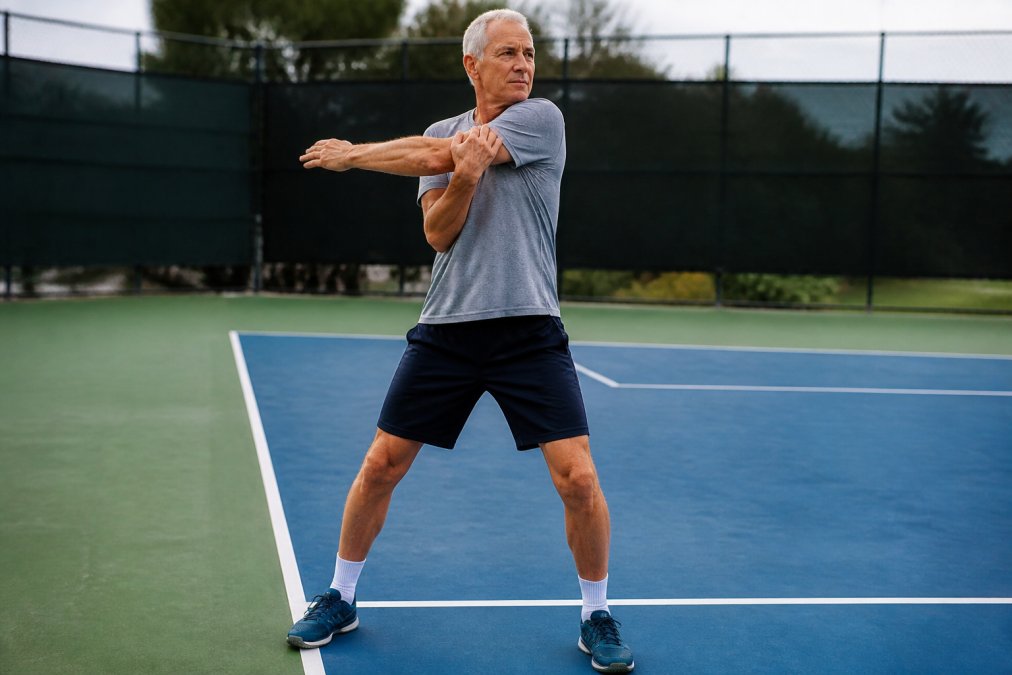
Arm circles and cross-body shoulder reaches: Extend your right arm across your body at shoulder height, using your left hand to gently pull the right elbow closer. Hold for two seconds and repeat on the opposite side. Perform 8-10 repetitions per side.
Torso rotations: Stand with feet shoulder-width apart, hands behind your head or crossed over your chest. Rotate your torso side to side through a comfortable range. Perform 15-20 rotations total.
Walking lunges with overhead reach: Step forward into a lunge position and reach both arms overhead. Perform 8-10 lunges per leg.
Leg swings: Hold onto the net post for balance. Swing your right leg forward and backward in a controlled motion, gradually increasing range. Perform 10 swings per direction, then repeat on the left leg.
Proprioception and Movement Preparation
Proprioception declines with age (the NIH). Tennis demands constant proprioceptive input as you move laterally, stop explosively, and change direction.
Single-leg balance drill: Stand on one leg for 20-30 seconds, maintaining upright posture. Repeat on the opposite leg. Progress by closing your eyes or performing arm movements while balanced.
Lateral shuffles: Move laterally across the court in a controlled shuffle, staying low and maintaining balance. Perform 2-3 passes across the court.
Mini-band lateral walks: Loop a resistance band around your legs just above the knees. Walk forward and backward with the band creating tension. Perform 15-20 steps in each direction.
Court movement patterns: Execute several slow-motion forehands, backhands, and serves using proper technique but minimal intensity.
Spend 5-6 minutes on these proprioceptive and movement-preparation exercises. The goal is activation and movement quality.
Strength Training for Senior Tennis Players: Building Resilience
Strength training for senior tennis players differs fundamentally from training younger athletes. You’re building resilience, the capacity of muscles, tendons, and joints to withstand repeated forces without breaking down.
Senior players need higher training frequency with lower volume per session. Aim for 3-4 sessions of 20-30 minutes spread throughout the week. This allows for better recovery while maintaining consistent stimulus on the muscles and connective tissues that prevent injury.
Core Stability and Rotator Cuff Conditioning
The core provides the foundation for every movement in tennis. A strong core transfers force efficiently from your lower body through your upper body during serves and strokes.
Plank variations: Begin with a standard plank, forearms on the ground, body in a straight line. Hold for 20-30 seconds. Progress to side planks (30 seconds per side) and plank rotations. Perform 2-3 sets of each variation, 2-3 times per week.
Dead bugs: Lie on your back with arms extended toward the ceiling and knees bent at 90 degrees. Slowly extend your right arm overhead while straightening your left leg. Return to start and repeat on the opposite side. Perform 10-12 repetitions per side, 2-3 sets, 2-3 times per week.
Pallof press: Using a cable machine or resistance band anchored at chest height, stand perpendicular to the anchor point. Hold the handle at chest level and press away from your body, resisting the rotational force. Perform 12-15 repetitions per side, 2-3 sets, 2-3 times per week.
Rotator cuff strengthening: Use light resistance (2-5 pound dumbbells or a resistance band).
-
External rotation: Lie on your right side with your right elbow bent at 90 degrees and tucked against your ribs. Rotate your forearm upward against resistance. Perform 15-20 repetitions, 2 sets per side, 3 times per week.
-
Prone I-Y-T raises: Lie face down on an incline bench or stability ball. Perform three positions: arms extended overhead (I), arms at 45 degrees from body (Y), and arms perpendicular to body (T). Use light weight or body weight. Perform 10-12 repetitions per position, 2 sets, 3 times per week.

Lower Body and Footwork Development
Lower body strength determines your ability to generate power, change direction, and maintain balance during lateral movements.
Single-leg squats or step-ups: Step up onto a 12-18 inch platform, driving through your front leg. Perform 10-12 repetitions per leg, 2-3 sets, 2-3 times per week.
Lateral lunges: Step laterally into a lunge position, keeping your chest upright. Push off to return to standing. Perform 10-12 repetitions per side, 2-3 sets, 2-3 times per week.
Calf raises: Rise up onto your toes, lifting your heels off the ground. Perform 15-20 repetitions, 2-3 sets, 3 times per week.
Emphasize control and consistency over heavy weight. Lighter resistance with higher repetitions (12-20 reps per set) builds muscular endurance and protects connective tissues better than heavy resistance with low reps.
Technique Modifications for Limited Mobility and Age-Related Changes
Rather than fighting age-related changes, modify your technique to work within your current capabilities while maintaining competitive effectiveness.
Adjusting Your Serve and Overhead Mechanics
The serve places tremendous stress on the shoulder. Many players over 50 experience shoulder pain because they maintain a technique designed for younger bodies.
Reduce the backswing arc: Shorten your backswing by bringing the racket up more directly, reducing the arc of motion. You’ll sacrifice some power, but you’ll reduce joint stress significantly.
Lower your toss height: Lower your toss to a height where your arm is nearly fully extended but not hyperextended. This reduces the range of motion required and decreases rotator cuff stress.
Adjust your foot position: Stand with your feet slightly wider apart and your front foot slightly more open toward the baseline. This reduces the amount of trunk rotation required.
Use a continental grip: The continental grip is more forgiving on the elbow and shoulder than a western grip. It requires less wrist snap to generate spin, reducing forearm and elbow stress.
Footwork Patterns and Movement Efficiency
Efficient footwork allows you to position yourself optimally, reducing the need for extreme reaching and lateral stretching.
Split step timing: Time your split step precisely to your opponent’s stroke. A well-timed split step positions you optimally for the next movement, reducing the distance you need to cover.
Small adjustment steps: Use several small adjustment steps rather than one large movement. This gives you more control, better balance, and reduces impact stress on your joints.
Court positioning: Position yourself deeper in the court than younger players typically do. This gives you more time to react and reduces the need for explosive lateral movements.
Load Management and Cross-Training for Injury Prevention
Load management means matching your training volume to your recovery capacity. At 50 and beyond, your recovery capacity is lower than it was at 30. Playing three competitive matches per week while also doing strength training may exceed your body’s ability to recover.
Calculate your weekly tennis load by multiplying match duration by intensity level (1.0 for casual play, 1.5 for competitive matches). Most players over 50 perform best with a total weekly load of 8-12 units, with at least one complete rest day per week.
Cross-training develops fitness while reducing the repetitive stress of tennis. Swimming, cycling, and rowing build cardiovascular fitness and muscular endurance without the impact forces of tennis. Perform 1-2 cross-training sessions per week, 30-45 minutes per session, at moderate intensity.
Consistency matters more than intensity for senior players. Playing tennis at moderate intensity three times per week with adequate recovery produces better long-term results than playing intensely twice per week with insufficient recovery.
Recovery Strategies: Sleep, Nutrition, and Hydration for 50+ Athletes
Recovery happens away from the court. Sleep, nutrition, and hydration are the three pillars of recovery for senior athletes.
Anti-Inflammatory Nutrition and Hydration Status
Prioritize foods rich in omega-3 fatty acids: fatty fish (salmon, mackerel, sardines), walnuts, flaxseeds, and chia seeds. Include colorful vegetables and fruits, berries, leafy greens, bell peppers, broccoli, which contain antioxidants that reduce exercise-induced inflammation.
Protein intake becomes increasingly important as you age. Consume 1.2-1.6 grams of protein per kilogram of body weight daily, distributed across 3-4 meals (the NIH).
Hydration status directly affects performance and recovery. Drink water consistently throughout the day. During play, drink 4-8 ounces of fluid every 15-20 minutes, depending on sweat rate and environmental conditions.
Active Recovery and Post-Match Protocols
Active recovery accelerates recovery by promoting blood flow and reducing muscle soreness. Immediately after play, perform 5-10 minutes of easy walking or light cycling to gradually lower heart rate. Then perform 10-15 minutes of static stretching, holding each stretch for 30-45 seconds.
Within 2-3 hours after play, perform a more comprehensive mobility session: foam rolling, dynamic stretching, and gentle yoga. Foam rolling increases blood flow and reduces muscle soreness. Roll each major muscle group for 60-90 seconds, moving slowly and pausing on tender areas.
Sleep is where adaptation happens. Most adults require 7-9 hours of sleep per night. Senior athletes benefit from 8-9 hours. Establish a consistent sleep schedule: go to bed and wake up at the same time every day, even on weekends.
Mental Preparation and Cognitive Load Management
The mental demands of tennis increase as you age because your physical capacity decreases. Mental fatigue contributes to physical injury. When you’re mentally tired, your attention narrows, your decision-making deteriorates, and your movement quality declines.
Develop a pre-match mental routine: 15-20 minutes before play, find a quiet space. Visualize executing your serves, forehands, and backhands with perfect technique. This mental rehearsal primes your nervous system and improves execution.
During play, focus on process rather than outcome. Instead of thinking "I need to win this point," think "I need to serve to the T and move forward." Process-focused thinking reduces anxiety, improves decision-making, and enhances performance.
Manage cognitive load by simplifying your tactical approach. Rather than executing multiple strategies, focus on 2-3 primary tactics. This reduces mental fatigue and allows you to focus on movement quality and injury prevention.
Tennis injury prevention for seniors isn’t about accepting decline, it’s about competing smart. The players who thrive past 50 are those who systematically address the factors that matter: mobility, strength, technique, load management, and recovery. At Crunch Time Coaching, we work with competitive players who refuse to let age limit their potential. Through step-by-step daily lessons and specialized challenge-based curriculum, you’ll learn exactly how to modify your game, strengthen the specific areas that matter, and build the resilience to compete at your highest level. Reserve your spot today and discover how world-class coaching transforms not just your technique, but your ability to play pain-free, year after year.
Frequently Asked Questions
Q: Is 70 too old to play competitive tennis?
A: No. Many players compete well into their 70s and beyond. Age-related physiological changes like sarcopenia (muscle loss) and reduced joint range of motion require specific conditioning, but they don't prevent competitive play. The key is adapting your technique to accommodate limited mobility, prioritizing strength training to maintain neuromuscular control, and managing load carefully. Proper warm-up, recovery, and technique modification allow older players to compete safely and effectively.
Q: What are the most common tennis injuries for players over 50?
A: Tennis elbow (epicondylitis), rotator cuff tendinopathy, and lower back strain are most common in older players. Knee issues from repetitive footwork and shoulder problems from overhead serve mechanics also occur frequently. These injuries develop from overuse, inadequate warm-up, poor biomechanics, and insufficient recovery time. Age-related loss of ligament elasticity and reduced proprioception increase injury risk. Addressing these through targeted strength training, technique adjustment, and load management significantly reduces occurrence.
Q: How long does it take to see results from injury prevention training?
A: Functional improvements in core stability and proprioception appear within 2-3 weeks of consistent training. Noticeable gains in rotator cuff strength and resilience typically emerge in 4-6 weeks. However, injury prevention is ongoing, it requires consistent warm-up, strength maintenance, and recovery protocols throughout your playing season. Results compound over months, with players reporting fewer injuries and longer pain-free playing windows when they maintain discipline with conditioning and technique work.
Q: Can seniors improve recovery time after matches?
A: Yes. Post-match recovery protocols specific to 50+ players include active recovery (light movement, not rest), anti-inflammatory nutrition, proper hydration status monitoring, and adequate sleep (7-9 hours). Stretching and foam rolling the day after matches aid recovery. Nutrition timing matters, consuming protein and carbohydrates within 30-60 minutes post-match supports muscle repair.
Q: What's the best warm-up routine for senior tennis players?
A: Start with 5 minutes of light movement (jogging, arm circles) to increase core temperature. Follow with dynamic stretching targeting hip flexors, hamstrings, and shoulders, never static stretching before play. Include proprioception drills (balance work, controlled lunges) to activate neuromuscular control. Finish with sport-specific movement: footwork patterns, shadow swings, and light rally practice. This 12-15 minute routine prepares muscles, increases joint range of motion, and reduces injury risk significantly more than skipping warm-up or doing only static stretching.
Q: How should seniors modify their serve to prevent shoulder injury?
A: Reduce back arching and excessive shoulder rotation, these strain the rotator cuff and increase epicondylitis risk. Keep your serve motion more compact, focusing on footwork and core rotation rather than arm strength. Ensure your grip size matches your hand (too large increases tendinopathy risk). Check racket tension, lower tension reduces shock absorption demands on your shoulder. Strengthen your rotator cuff and core stability before increasing serve intensity. Many older players find a flatter, more controlled serve reduces injury while maintaining effectiveness.
Q: What role does cross-training play in injury prevention?
A: Cross-training addresses muscular imbalances and prevents overuse injury by distributing load across different movement patterns. Swimming, cycling, and strength training develop cardiovascular fitness without repetitive tennis impact. Pilates and yoga improve core stability and flexibility, reducing back strain and improving proprioception. Aim for 2-3 cross-training sessions weekly alongside tennis play. This approach prevents the overuse patterns that lead to tendinopathy and muscular strain while building overall physical conditioning that supports tennis performance.
Q: How does hydration status affect injury prevention in older players?
A: Proper hydration maintains muscle elasticity, joint lubrication, and cognitive function, all critical for injury prevention. Dehydration reduces ligament elasticity and increases cramping risk, particularly in older players with reduced thirst sensation. Drink 16-20 ounces of fluid 2-3 hours before play, then 4-8 ounces every 15-20 minutes during matches. Electrolyte drinks during play lasting over 60 minutes help maintain neuromuscular control. Monitor urine color (pale yellow is ideal). Proper hydration status reduces injury risk and improves recovery significantly.
This article was written using GrandRanker