
Table of Contents
- The Continental Grip: Your Foundation for Spin
- Tennis Serve Toss Placement for Spin
- Brushing the Ball: The Key to Ball Rotation
- Wrist Snap and Forearm Pronation: Generating Racket Head Speed
- Tennis Serve Pronation Drills for Consistency
- Tennis Kick Serve Technique and Advanced Spin Types
- Common Mistakes That Kill Spin and How to Fix Them
- Mental Cues and Equipment Considerations for Maximum Spin
- Frequently Asked Questions
Last Updated: October 2, 2026
The Continental Grip: Your Foundation for Spin
The continental grip is non-negotiable if you want to add spin tennis serve power and control. This grip positions your hand on the racket handle so your base knuckle sits on the second bevel of the racket frame. It’s the only grip that allows your wrist and forearm to move freely enough to generate the racket head speed and pronation needed for heavy spin.
Here’s what makes the continental grip special for spin:
- Your palm faces slightly inward rather than straight down
- Your thumb sits underneath the handle for support
- Your fingers grip loosely, allowing wrist mobility
- The bevel alignment lets your racket face brush the ball naturally
Without this grip, your wrist locks up. Your forearm can’t pronate. Your serve stays flat.
The continental grip feels awkward at first, your muscle memory resists. Spend three to five minutes every practice session holding the racket in continental grip and swinging without a ball to build the feel.
Tennis Serve Toss Placement for Spin
How Ball Toss Height Affects Rotation
Your ball toss height controls how much time your arm has to accelerate. Too low forces a rushed motion; too high causes deceleration before contact.
For a topspin serve, toss the ball 12 to 18 inches above the point where you’d make contact on a flat serve.
Don’t toss too high and wait, that pause kills rhythm and racket head speed. The toss should arrive at contact just as your arm reaches maximum acceleration.
Lateral Toss Adjustments for Different Spin Types
Lateral toss placement changes which part of the ball you brush and the angle of your swing path.
For a kick serve, toss slightly behind your head and to your left (if you’re right-handed).
For a slice serve, toss further to the right and slightly forward. This angle lets you brush the outside of the ball, creating sidespin.
Toss placement is subtle, three to four inches changes everything.
Brushing the Ball: The Key to Ball Rotation
Contact Point and Racket Face Angle
Brushing means your racket strings contact the ball on an angled path, not flat. The angle determines spin direction; the speed determines spin amount.
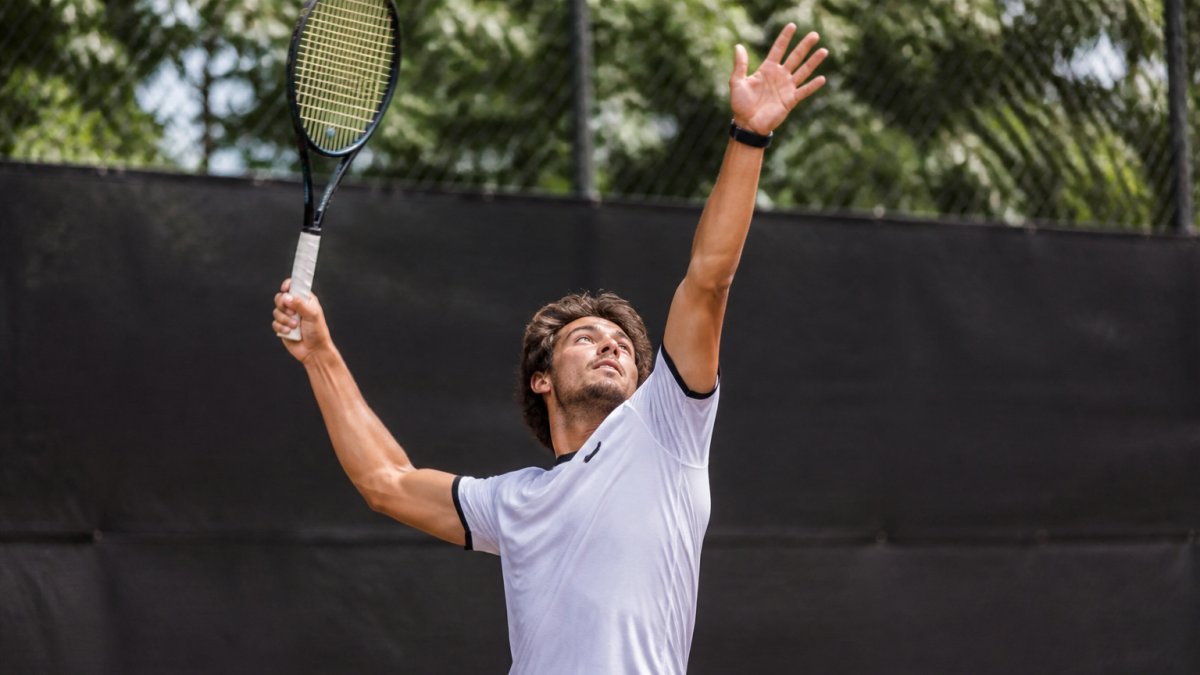
For topspin, your racket face should be closed at contact, brushing up the back of the ball at or slightly in front of your body, allowing vertical acceleration.
Continental grip puts you on the second bevel. Your wrist position at contact determines whether your face is closed (topspin) or open (slice).
Spin comes from brush angle and string bed orientation, not raw power. A 70 mph serve with perfect brush angle generates more spin than a 100 mph flat serve.
Swing Path and String Bed Orientation
For topspin, your swing path should be vertical or slightly diagonal (low to high, inside to outside) to brush up the back of the ball.
A closed string bed (face angled down) creates topspin; an open string bed creates slice. For a kick serve, your string bed closes during acceleration, then opens slightly at contact.
The kinetic chain drives your swing path: legs push, hips rotate, shoulders rotate, arm extends, wrist snaps. Each link builds on the previous one; if any breaks, spin disappears.
Wrist Snap and Forearm Pronation: Generating Racket Head Speed
Without wrist snap, racket head speed is limited. With proper pronation, you can significantly increase racket head speed.
Pronation starts in your shoulder. Your arm rotates externally during the backswing, then internally during the forward swing, with your palm facing forward by contact.
Pronation timing is critical. Complete most of your pronation in the last six inches before contact to maintain acceleration and correct racket face angle.
Here’s what proper pronation feels like:
- Your elbow leads the forward swing
- Your forearm stays relaxed, not tight
- Your wrist feels like it’s snapping inward and upward
- Your palm rotates from facing back to facing forward
- Your racket face closes through the contact zone
Most players grip too tight, which stops pronation.
Tennis Serve Pronation Drills for Consistency
Isolated Pronation Exercises
Pronation drill one: Arm circles with a racket, Hold a racket at the end of the handle and make small circles with the racket head.
Pronation drill two: Wall toss and pronation, Stand three feet from a wall and toss a ball underhand against it. Catch the bounce with a pronation snap, rotating your forearm forward.
Pronation drill three: Racket tap drill, Hold a racket in continental grip and tap the strings on your opposite palm with small pronation snaps. Build to 50 taps per set.
Do these drills regularly to make pronation automatic.
Full-Motion Serve Drills
Drill one: Slow-motion serves, Hit serves at 50 percent speed, focusing on pronation timing. Serve 20 balls, pausing between each to feel smooth forearm pronation through contact.
Drill two: Target serves with spin, Set cones in the service box and serve 10 balls to the T, 10 to the outside corner, and 10 to the body, focusing on spin and placement.
Drill three: Pressure serves, Serve 10 balls in a row and track how many land in the box with visible spin. Repeat daily and try to beat your previous percentage.
Tennis Kick Serve Technique and Advanced Spin Types
Kick Serve vs. Slice Serve: Trajectory and Placement Differences
A kick serve bounces high and kicks forward by brushing up and slightly left on the back of the ball (for right-handers), jumping above the opponent’s shoulder, devastating on clay and against players struggling with high bounces.
A slice serve bounces lower and moves sideways by brushing the outside of the ball, sliding away from the opponent, effective against baseline campers and players struggling with wide serves.
The kick serve requires more pronation and aggressive wrist snap; the slice serve requires less pronation but more lateral brush across the ball.
Disguising Your Serve and Footwork Mechanics
Disguising your serve means your opponent can’t tell which type is coming until the last instant, making it harder to return.
To disguise your serve, your toss placement and backswing must look identical for all three serve types.
Your stance and weight distribution should look the same for all serve types. Changing your stance based on serve type telegraphs your intention.
Footwork sequence: feet shoulder-width apart, weight on the balls of your feet, knees slightly bent. As you toss, shift weight to your back foot.
Common Mistakes That Kill Spin and How to Fix Them
Mistake one: Gripping too tight
A tight grip stops pronation. Your forearm muscles tense. Your wrist can’t snap.
Fix: Grip the racket firmly with your base knuckles.
Mistake two: Tossing too high or too low
An inconsistent toss creates an inconsistent contact point. Your swing path changes.
Fix: Toss to the same height every time. Practice tosses without hitting.
Mistake three: Starting the forward swing too early
Fix: Wait for your legs to finish their drive.
Mistake four: Not brushing the ball
Hitting flat instead of brushing creates no spin.
Fix: Focus on brush angle, not power.
Mistake five: Decelerating before contact
Fix: Accelerate through contact.
Mental Cues and Equipment Considerations for Maximum Spin
Mental cues help you execute the technical motion under pressure.
Effective mental cues for adding spin to your tennis serve:
- “Brush the ball” (reminds you to focus on angle, not power)
- “Pronate through contact” (reminds you to complete your wrist snap)
- “Elbow up” (reminds you to keep your arm extended and accelerating)
- “Loose grip” (reminds you to relax your forearm)
Use one cue per serve. Repeat it before each serve. Under pressure, your mind defaults to what you’ve practiced.
Equipment affects your ability to add spin tennis serve consistency and effectiveness. A heavier racket generates more racket head speed.
Crunch Time Coaching players often ask about equipment. The truth is simple: your technique matters 10 times more than your equipment.
String type also matters. Polyester strings grip the ball more than natural gut or synthetic strings.
Frequently Asked Questions
What is the best grip for adding spin to a tennis serve?
The continental grip is the foundation for generating spin on your serve. Position the base knuckle of your index finger on bevel 2 of the racket handle, with your thumb underneath. This grip naturally closes the racket face and allows your wrist and forearm to pronate through contact, creating the brush motion needed for topspin, slice, and kick serves. Without the continental grip, you cannot achieve the racket head speed and acceleration required for consistent spin.
How does the toss affect spin on a tennis serve?
Ball toss placement directly controls your ability to brush the ball and generate spin. For topspin, toss slightly forward and to the right (for right-handers), allowing you to brush up the back of the ball. For slice, toss further to the right, enabling a sidespin brush. For kick serves, toss higher and slightly behind your head. Toss height also matters: higher tosses give you more time to accelerate and build racket head speed, which amplifies rotation. Inconsistent toss placement forces compensations that destroy spin consistency.
What is the difference between a slice serve and a kick serve?
Both the slice and kick serve use sidespin, but they differ in trajectory and contact point. A slice serve is hit with a sideways brush, creating a lower trajectory that curves away from your opponent. A kick serve is hit with an upward brush combined with sidespin, producing a higher bounce and arcing trajectory. The kick serve requires a higher toss and more aggressive upward swing path. Slice serves are faster and lower; kick serves are slower, bounce higher, and are harder to predict. Both require the continental grip and pronation, but the toss placement and swing path determine which one you execute.
How can I improve my serve consistency using spin?
Spin actually improves consistency because it gives you a larger margin for error. A spinny serve has a higher net clearance and drops into the box more reliably than a flat serve. Focus on repeating your toss placement, maintaining your continental grip, and practicing pronation drills to build muscle memory. The kinetic chain, starting with footwork and body rotation, flowing through your shoulder, arm, and wrist, must work in sequence every time. Consistent toss and grip eliminate variables; pronation drills build the forearm strength needed to repeat the same brush motion under pressure.