
Table of Contents
- Match-Simulated Training Drills
- Tennis Match Play Strategy for Competitive Scoring
- Tennis Doubles Positioning Drills for Net Control
- Hand-Feed vs. Live-Ball Drills
- Tennis Practice Session Structure for Peak Performance
- Mental Toughness and Pressure Management
- Advanced Footwork and Consistency Patterns
- Conclusion
- Frequently Asked Questions
Last Updated: September 3, 2026
Match-Simulated Training Drills
Match-simulated training drills are the foundation of competitive tennis preparation. These high-intensity point construction drills force you to execute under pressure, exactly as you would in league play.
High-Intensity Point Construction
Start with a baseline-to-baseline cross-court rally where you and your partner exchange 5-6 balls before opening the court. The moment you hit a ball that lands inside the service box, you must attack it aggressively. This drill forces you to recognize opportunities mid-rally and execute an approach shot with conviction, eliminating hesitation that plagues live situations.
Add pressure by scoring: winner takes the point, error costs you a point. Play to 11 points, then switch roles. Progress the drill by requiring specific shot patterns, for example, hit three cross-court groundstrokes, then go down-the-line on the fourth. This builds shot selection under fatigue, exactly what happens in the third set of a close match.
Pressure Scoring Scenarios
Implement tie-break scoring in every drill: one player serves one point, then you switch servers. First to 7 points wins, win by 2. This format compresses pressure into short windows and forces consistency when it matters most.
Play multiple tie-breaks in succession. The mental fatigue of consecutive high-pressure situations mirrors what happens in a league match when you’re already tight from a close first set. Use no-ad scoring during practice sets: deuce is sudden death. One point decides it, forcing aggressive decision-making in critical moments rather than safe, defensive play.
Tennis Match Play Strategy for Competitive Scoring
Strategy without execution is theory. Execution without strategy is luck. Match play strategy means knowing exactly what shot to hit and when, and having drilled it enough that your body executes automatically when your mind is under pressure.
Tie-Break Dominance Drills
Tie-breaks decide league matches. Run a specific tie-break drill: you serve the first point, opponent serves the next two, you serve the next two, and so on. Play multiple tie-breaks consecutively and track your first-serve percentage, unforced error count, and winner count. After five tie-breaks, review the data to identify patterns: which serve speeds work, which returns break down under pressure, when you’re most likely to attack versus defend.
Program specific point sequences. For example: “Serve and volley on my first serve, stay back on my second serve.” Play an entire tie-break using only this strategy, then switch strategies. This builds tactical flexibility and shows you which strategies win under pressure.
The most overlooked element: serve placement in tie-breaks. Instead of serving down the T or wide on every first serve, commit to a pattern: T, wide, body, T, wide, body. This removes decision-making under pressure and forces your opponent to adjust mid-tie-break.
Shot Selection Under Pressure
Build a drill around critical moments. Start a point at deuce and play it out with live-ball feeding. The first player to win two consecutive points wins. Do this 10 times in a row. You’re playing high-use situations repeatedly.
Establish a personal rule: on the first deuce point, always hit a high-percentage cross-court shot. On the second deuce point, you can attack. This removes decision paralysis and forces you to trust your preparation. Track your shot selection data after 20 high-pressure points to identify patterns that work in actual matches.
Tennis Doubles Positioning Drills for Net Control
Doubles positioning determines match outcomes. Champions position themselves proactively, anticipating where the ball will go and positioning accordingly.
Net Transition and Court Coverage
Net transition is the moment you move from baseline to net after hitting an approach shot. This is where doubles points are won or lost.
Drill the split-step timing aggressively. After you hit your approach shot, your partner immediately moves toward the net to cover the middle. You follow one step behind. The moment your opponent strikes the ball, both of you perform a split-step simultaneously. This synchronized timing creates court coverage that’s nearly impossible to pass.
Practice poaching by crossing over to intercept your opponent’s return. Call “mine” or “yours” before your partner serves so you’re committed to a poach. Hesitation kills poaching opportunities. Run a drill where you serve-and-volley every first serve, with your partner staying back initially, then moving to the net after your first volley. This forces you to manage the transition point where control shifts between players.
Offensive Positioning at the Baseline
Position yourself one step inside the baseline with your weight forward. This aggressive baseline position allows you to attack short balls and still recover if your opponent lobs. Maintain constant small adjustments, tiny steps that keep you in attack position rather than standing flat-footed. faster workout recovery.
Drill specific offensive situations. Your partner hits a weak return and the opponent hits a short ball to your forehand. You must recognize this immediately and attack it aggressively to the net. Repeat this 20 times to make aggressive court positioning automatic.
Hand-Feed vs. Live-Ball Drills
Hand-feed drills build consistency by isolating technique. Your coach or partner feeds you balls at a consistent pace, allowing you to focus on footwork, stroke mechanics, and shot placement. Use hand-feed drills to work on specific weaknesses, performing 20-30 repetitions per stroke to build muscle memory.
Live-ball drills introduce variables: pace changes, spin variations, depth inconsistencies, and timing pressure. Your opponent controls the ball, forcing you to read faster, adjust footwork on the fly, and execute under real pressure. This is where you discover whether hand-fed consistency transfers to actual match situations.
The optimal practice structure alternates between both. Spend 15 minutes on hand-feed drills to groove a specific stroke, then 15 minutes on live-ball drills where your partner deliberately varies pace and spin. For league play preparation, emphasize live-ball drills in the final two weeks before matches. Your nervous system needs to adapt to the unpredictability of actual opponents.
Tennis Practice Session Structure for Peak Performance
How you structure your practice session determines whether you improve or plateau. Structured progression builds consistent advancement.
Warm-Up Routines for League Matches
Your warm-up determines your first-set performance. Arrive 45 minutes early and execute a specific protocol.
Begin with dynamic movement: 2 minutes of light jogging, high knees, and lateral shuffles (acsm.org). Follow with 5 minutes of hitting easy forehands and backhands cross-court, focusing on rhythm and timing. Progress to serve practice: 15 serves at 75% intensity focusing on placement, 5 down the T, 5 wide, 5 to the body. Then hit 5 serves at 90% intensity to build confidence in your power serve.
Finish with 3-5 competitive points against your opponent. Play out actual points with live scoring to transition your mind from practice mode to match mode. The warm-up should take 20-30 minutes total (usta.com). Rushing this costs you the first set; extending it beyond 30 minutes leads to fatigue before the match begins.
Progressive Intensity Progression
Your practice intensity must increase throughout the week leading to your match through strategic periodization.
Monday and Tuesday: Focus on technique and consistency with hand-feed drills and footwork work. Intensity is 60-70%.
Wednesday and Thursday: Introduce live-ball drills and tactical situations. Intensity increases to 75-85%.
Friday: High-intensity match-simulated drills with multiple tie-breaks and pressure scenarios. Intensity is 85-90%.
Saturday (match day): Light warm-up only. Intensity is 50-60%. Your body is fresh and ready.
This structure prevents overtraining while ensuring you’re sharp on match day.
Mental Toughness and Pressure Management
Mental toughness is the ability to execute your game plan when everything inside you wants to abandon it. Pressure creates doubt, doubt creates hesitation, and hesitation creates errors.
During practice, simulate match pressure intentionally by playing points where missing costs you something: you owe your partner a coffee, you have to run a lap, or you lose a privilege. This creates genuine stakes your nervous system responds to.
Develop a pre-point routine that becomes automatic. Before every serve, take two deep breaths, visualize your target, and commit to your serve placement. Before every return, watch your opponent’s toss and commit to your return target. This routine becomes your anchor when pressure rises.
Track your performance in pressure situations. After your league matches, review which points you won and which you lost to identify patterns. Do you lose points when you’re ahead? When you’re behind? This data reveals your mental vulnerabilities so you can drill those specific situations in practice.
Advanced Footwork and Consistency Patterns
Footwork is the foundation of every stroke. Advanced footwork builds rhythm, depth control, and directional control simultaneously.
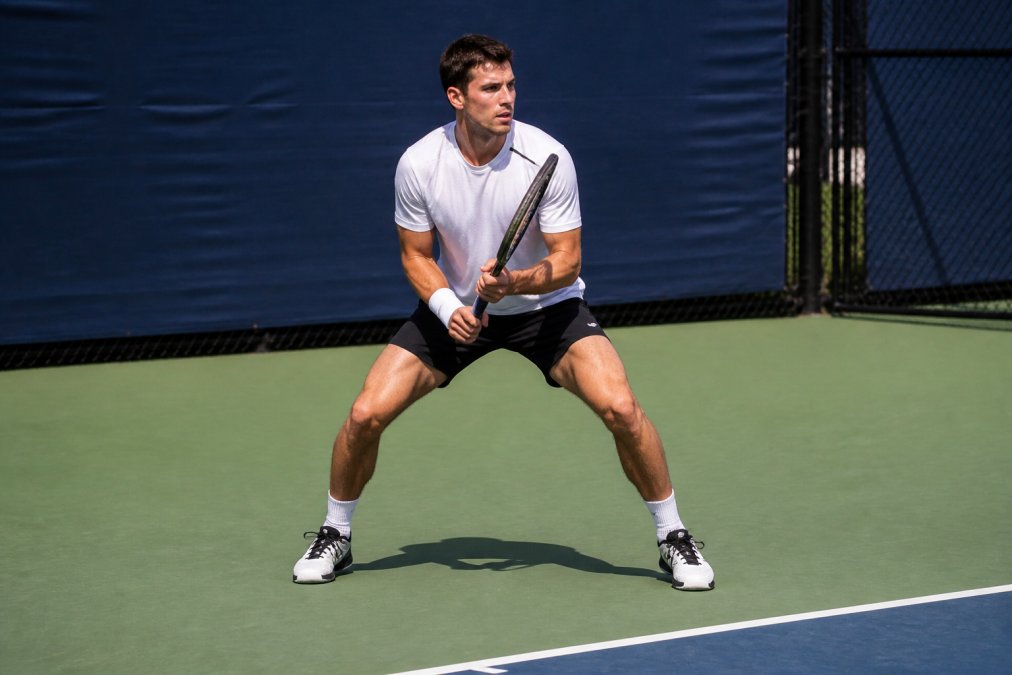
Split-Step Timing and Court Positioning
The split-step is the moment when both feet leave the ground simultaneously as your opponent strikes the ball. Timing is everything. Split-step too early and you’re off-balance; too late and you’re caught flat-footed. The optimal timing is the moment your opponent makes contact.
Drill this by having your partner hit balls while you focus exclusively on split-step timing. Hit 50 balls where your only goal is to split-step precisely when your partner makes contact. Once timing is automatic, add court positioning. After your split-step, move toward the ball using small adjustment steps rather than one large step. This allows you to adjust if the ball curves or spins unexpectedly.
Position yourself one step inside the baseline during rallies (apta.org). This aggressive positioning forces your opponent to hit harder and deeper to pass you.
Directional Control and Depth Consistency
Establish target zones on the court. Mark the cross-court area with cones, then mark the down-the-line area. Drill hitting 20 forehands cross-court into that zone, then 20 down-the-line. Track your accuracy: aim for 18 out of 20 into the target zone.
For depth consistency, establish two zones: deep (near the baseline) and mid-court (inside the service box). Drill hitting 10 forehands deep, then 10 mid-court, alternating between depths. This trains your nervous system to adjust depth based on tactical intention.
During matches, use depth variation tactically. Hit deep cross-court to move your opponent, then hit a shorter cross-court to bring them forward. This rhythm disruption creates errors. Most players plateau because they hit the same depth repeatedly; advanced players vary depth intentionally, forcing opponents to adjust constantly.
Conclusion
Advanced tennis drills for league play aren’t about hitting more balls. They’re about hitting the right balls under the right conditions with the right mental state. Match-simulated training, pressure scenarios, doubles positioning, footwork precision, and mental toughness drills work together to build the complete competitive player.
The difference between recreational players and league competitors isn’t talent, it’s preparation. Recreational players hope they’ll perform well. League competitors know they will, because they’ve drilled it hundreds of times.
Crunch Time Coaching transforms your game through world-class coaching, step-by-step daily instruction, and specialized challenge-based curriculum designed specifically for competitive tennis players. Our “Totally Obsessed” coach delivers hands-on training that sharpens your footwork for consistency, builds mental toughness under pressure, and elevates your competitive play to a higher level. Whether you’re mastering your serve, perfecting your doubles positioning, or breaking through a performance plateau, we provide the personalized guidance and intensive training camps that competitive players need.
Reserve Your Spot Today and start training like a champion.
Frequently Asked Questions
Q: How do you simulate match pressure in tennis practice?
A: Match-simulated training recreates competitive conditions by using live-ball drills with scoring, time pressure, and specific opponent patterns. Set up tiebreak scenarios, play first-to-10-points matches against opponents at your level, and practice high-intensity point construction where you must win consecutive points under fatigue. This approach trains your nervous system to perform when results matter, building consistency and mental resilience that transfers directly to league play.
Q: What’s the best way to structure a high-intensity tennis practice session?
A: Start with a dynamic warm-up including footwork patterns and light rallies (10 minutes). Progress to technical work on specific shots (15 minutes), then move into match-simulated drills with live-ball training at game-intensity (30-40 minutes). End with competitive scoring drills and a cool-down. This structure balances skill refinement with pressure adaptation, ensuring you develop both technique and the ability to execute under match conditions. Progressive intensity prevents plateaus and builds conditioning specific to league competition.
Q: How can I improve my consistency for league matches?
A: Consistency comes from repetition in realistic conditions. Use hand-feed drills to ingrain stroke mechanics, then transition to live-ball training where you control depth and directional consistency. Practice cross-court and down-the-line patterns from the baseline, focusing on rhythm and pace variation rather than power. Incorporate defensive lob drills and approach shot execution to build confidence in high-pressure moments. Track your unforced errors in match-simulated scenarios to identify patterns and adjust your shot selection accordingly.
Q: What are the best doubles drills for advanced league players?
A: Focus on net transition drills where one player approaches while the partner covers the net, practicing split-step timing and court coverage. Work on offensive positioning at the baseline, using cross-court and down-the-line patterns to move opponents and create opportunities for net advancement. Practice serve-and-volley combinations, defensive lob execution, and poaching scenarios. These drills build the court positioning awareness and anticipation needed to dominate doubles in league play.
This article was written using GrandRanker