
Table of Contents
- Quick Comparison: Best Online Tennis Coaching Programs
- How to Improve Tennis Serve Online
- Tennis Footwork Drills for Consistency
- Personalized Tennis Coaching Feedback
- Budget-Friendly vs. Premium Online Tennis Coaching
- Success Metrics and Progress Tracking
- Frequently Asked Questions
Last Updated: September 15, 2026
Quick Comparison: Best Online Tennis Coaching Programs
The best online tennis coaching programs combine structured video analysis, personalized feedback, and skill-specific drills that translate directly to match results. Crunch Time Coaching tops our list because its step-by-step daily lessons and challenge-based curriculum are built for competitive players who need measurable improvement, not just generic tips.
Most players searching for the best online tennis coaching programs are stuck on a plateau they can’t name. Their serve feels inconsistent. Their footwork breaks down in the third set. They’ve watched hundreds of free videos but never built a system around them. That’s the gap this guide addresses.
Below, we compare the platforms worth your time, with honest notes on pricing, strengths, and who each one actually fits. The programs here range from various coaching resources to premium subscriptions, and we’ll show you exactly how to evaluate them.
| Program | Starting Price | Best For | Standout Feature |
|---|---|---|---|
| Crunch Time Coaching | Contact for pricing | Competitive players wanting daily structure | Challenge-based curriculum with in-person camps |
The best online tennis coaching program is the one you’ll actually complete. Structure and accountability matter more than the size of the video library.
How to Improve Tennis Serve Online
Improving your tennis serve online starts with high-speed video analysis of your toss, swing path, and kinematic sequence, followed by targeted drills that rebuild the motion piece by piece. A serve doesn’t break overnight, and it won’t fix overnight either, but structured online coaching can rebuild it faster than random tips.
Most players approach serve improvement backwards. They chase power when the real issue is toss consistency or a rushed trophy position. Online platforms that use video analysis let you see what you can’t feel. That’s the difference between guessing and correcting.
At Crunch Time Coaching, the serve transformation follows a step-by-step daily progression. The program’s stated goal is transforming your serve in one week through daily instruction rather than one-off lessons. Whether that timeline fits your game depends on how much you practice, but the structure removes the guesswork.
A common mistake is working on the serve in isolation (Tennis Coaching & Organizing Tennis Programs). Serve technique connects to groundstrokes, footwork, and court positioning. Programs that treat the serve as part of a larger system produce better long-term results than those that don’t.
Film your serve from behind and from the side. Most players only film from one angle and miss half the problem, usually the toss or the leg drive.
Tennis Footwork Drills for Consistency
Tennis footwork drills for consistency focus on split-step timing, recovery patterns, and court positioning that keep you balanced through every shot. Consistency isn’t about hitting harder. It’s about arriving in the right place at the right time, over and over.
The best online tennis coaching programs build footwork into every lesson rather than treating it as a separate module. Drills like the spider drill, lateral shuffle patterns, and split-step timing exercises translate directly to match play. When your feet are set, your groundstrokes and net play improve automatically.
What most guides miss is that footwork drills without video feedback rarely stick. You need to see your movement patterns to correct them. Remote coaching platforms that offer swing analysis and movement review give you that feedback loop.
For players over 40, footwork work also serves as injury prevention (pubmed.ncbi.nlm.nih.gov). Tennis fitness and movement quality matter more as recovery times lengthen. Programs that respect this reality keep you on the court longer.
Personalized Tennis Coaching Feedback
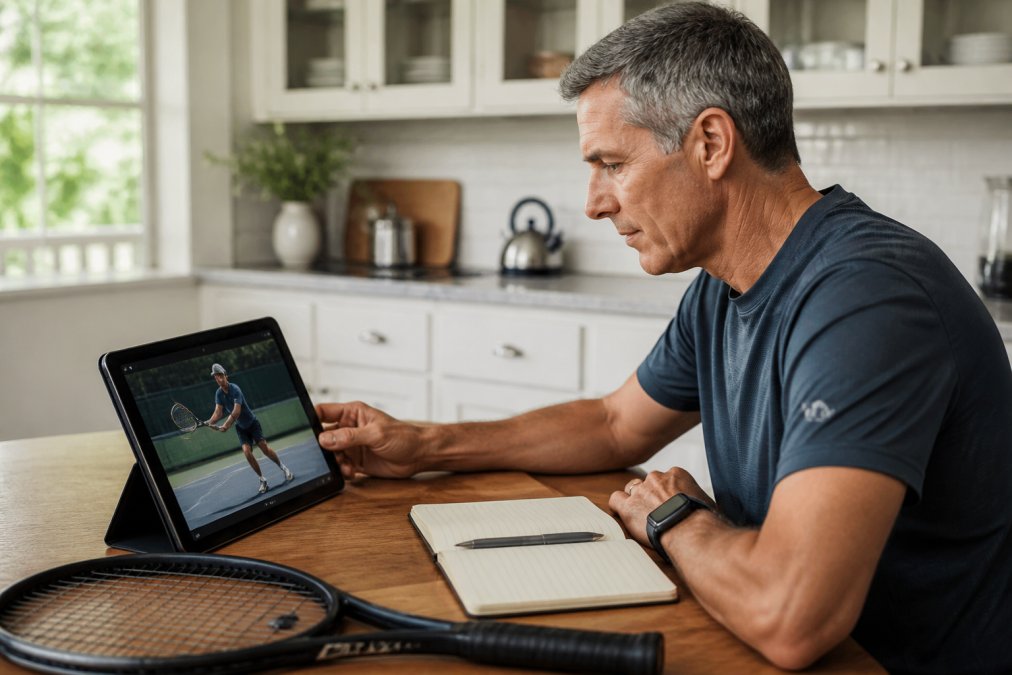
Personalized tennis coaching feedback is the element that separates real improvement from endless video watching. It means a coach reviews your stroke mechanics, match play, and tactical decisions, then tells you exactly what to change, and why. The difference between a video library and a premium program is almost always the feedback layer, not the size of the lesson catalog. Refining your technique through this iterative process mirrors the precision required when selecting appropriate pickleball equipment to ensure your gear supports your evolving skill set.
What a Real Feedback Loop Looks Like
The skepticism is fair. How does a coach see your footwork through a screen? The answer is a structured submission-and-review cycle, not a single upload. A working feedback loop has four stages:
- Capture, You film from at least two angles (behind and side) plus match footage, since match play reveals habits that practice hides.
- Submit, You upload clips with context: score, opponent style, what felt wrong, what you were trying to do.
- Analysis, The coach reviews frame-by-frame, flags the root cause (not just the symptom), and returns corrective cues tied to specific timestamps.
- Re-film, You record the corrected motion and resubmit so the coach can confirm the change stuck.
Skip stage four and you’re back to guessing. Most players who plateau with online coaching never close the loop, they collect diagnoses and never verify the fix.
How to Judge Feedback Quality Before You Pay
Not all feedback is equal. When evaluating any platform, ask these questions:
- Is it individualized or templated? Generic group comments don’t count. Look for notes tied to your specific strokes, your footage timestamps, and your match situations.
- What’s the turnaround? Some programs return notes quickly; others batch reviews weekly. Faster isn’t always better, but you should know the cadence before you commit.
- Is it video or text? A coach who draws lines on your clip or records a voice-over while pausing your swing usually communicates more than a paragraph of text.
- Does it address tactics, or only technique? Stroke mechanics are half the picture. The best feedback connects your forehand to your court positioning and shot selection.
Crunch Time Coaching approaches this through a challenge-based curriculum paired with in-person training camp opportunities. The combination matters: remote feedback builds the foundation, and hands-on sessions refine the details you can’t fix alone. Programs that blend both tend to produce faster corrections than either format on its own.
Submitting one video and expecting a full diagnosis is a mistake. Coaches need multiple angles and match footage to identify patterns rather than one-off errors. Send three clips across two sessions, not one clip from one rally.
The Feedback-to-Progress Link
Feedback only compounds if you track it. Log every cue you receive, the date you filmed, and whether the correction held in your next match. Over a season, that log becomes your improvement record, and it tells you whether the program is actually working or just keeping you busy. If you can’t point to a specific stroke that changed because of a specific piece of feedback, the loop isn’t closed yet.
Budget-Friendly vs. Premium Online Tennis Coaching
Budget-friendly online tennis coaching typically means free drill libraries and low-cost subscriptions, while premium tiers add personalized feedback, structured progression, and in-person access.
The Three Tiers, Honestly Compared
| Tier | Typical Monthly Cost | What You Actually Get | Best For | Trade-Off |
|---|---|---|---|---|
| Free | $0 | Drill libraries, eLearning modules, public instructional videos | Coaches, curious players, self-starters | No personal feedback, no progression plan |
| Mid-Range Subscription | Roughly $20-$40 | Structured video lessons, biomechanics breakdowns, some community access | Self-directed improvers who can hold themselves accountable | Limited or batched interaction with a coach |
| Premium | Varies by program and camp options | Personalized video feedback, daily or weekly structure, in-person camp access | Competitive players chasing measurable gains | Higher cost and time commitment |
The Price-to-Value Math Most Guides Skip
Matching the Tier to Your Commitment Level
Ask yourself three questions before choosing:
Budget and premium tiers aren’t quality tiers, they’re commitment tiers. Buy the level of accountability you’ll actually honor, and re-evaluate every season.
Success Metrics and Progress Tracking
Progress tracking is the accountability layer. If your program doesn’t give you a way to measure improvement, you’re relying on feel, and feel lies under pressure.
Frequently Asked Questions
How effective is online tennis coaching compared to in-person lessons?
Online tennis coaching can be highly effective for technical and tactical learning, especially when it includes video analysis and personalized feedback. Many players find that remote coaching offers more flexibility and access to specialized expertise they might not find locally. For stroke mechanics and footwork, video review allows coaches to identify issues that are hard to see in real time. However, in-person lessons remain valuable for immediate physical adjustments and live hitting. The best approach often combines both.
What should I look for in the best online tennis coaching programs?
Focus on programs that offer personalized tennis coaching feedback, structured curriculum, and clear skill progression. Look for video analysis features, a drills library for footwork and stroke mechanics, and opportunities for direct coach interaction. Check if the platform includes mental conditioning or tactical strategy training. Also consider your budget and whether the program offers a free trial or tiered pricing. The best online tennis coaching programs will align with your specific goals, whether that’s improving your serve, footwork, or match play.
Can online coaching help with tennis footwork drills for consistency?
Yes. Many online platforms provide detailed tennis footwork drills for consistency, including video demonstrations and progress tracking. These drills focus on court positioning, split-step timing, and recovery footwork. Coaches can review your movement patterns via uploaded video and suggest corrections. Consistent practice of these drills, combined with feedback, can lead to noticeable improvements in your on-court movement and shot consistency within weeks.
How long does it take to see results from online tennis coaching?
Results vary based on your starting level, practice frequency, and the quality of the program. Some players see improvements in specific strokes like the serve within a week of focused training. For footwork and consistency, noticeable gains often appear after 3-4 weeks of regular drills. Tactical and mental improvements may take longer, as they require match play application. The key is consistent practice and applying personalized feedback. Many programs offer progress tracking to help you measure improvement.
Are there budget-friendly online tennis coaching options?
Yes. Some platforms offer free tiers or lower-cost subscriptions. These provide solid technical instruction and drills. Premium programs may cost more but often include personalized feedback, live sessions, or in-person camps. When evaluating, consider the value of features like video analysis, coach access, and curriculum depth. Many programs offer monthly subscriptions, so you can try before committing long-term.