
Table of Contents
- Why Mental Toughness Separates Winners from the Rest
- 1. The Pressure Point Reset: Master Between-Point Composure
- 3. Tennis Visualization Techniques for Match Confidence
- 4. Pre-Match Mental Routine for Tennis: Build Your Competitive Edge
- 5. Tennis Breathing Exercises for Focus and Emotional Control
- 6. Positive Self-Talk and Performance Cues: Rewire Your Inner Dialogue
- 7. Building Your Weekly Mental Training Plan
- Frequently Asked Questions
Last Updated: October 20, 2026
Why Mental Toughness Separates Winners from the Rest
The difference between a tournament winner and a player stuck on a plateau isn’t always technique. Mental toughness in tennis separates those who crumble under pressure from those who thrive.
Your serve might be solid. According to research on sports psychology from the American Psychological Association, athletes who use structured mental training techniques report significantly higher performance consistency in high-pressure situations compared to those relying on technique alone.
The good news: mental toughness isn’t something you’re born with. Below are seven proven tennis sports psychology exercises competitive players use to strengthen their mental game.
Mental toughness is trainable. The players who dominate high-pressure moments aren’t naturally fearless, they’ve practiced managing their thoughts and emotions under stress.
1. The Pressure Point Reset: Master Between-Point Composure
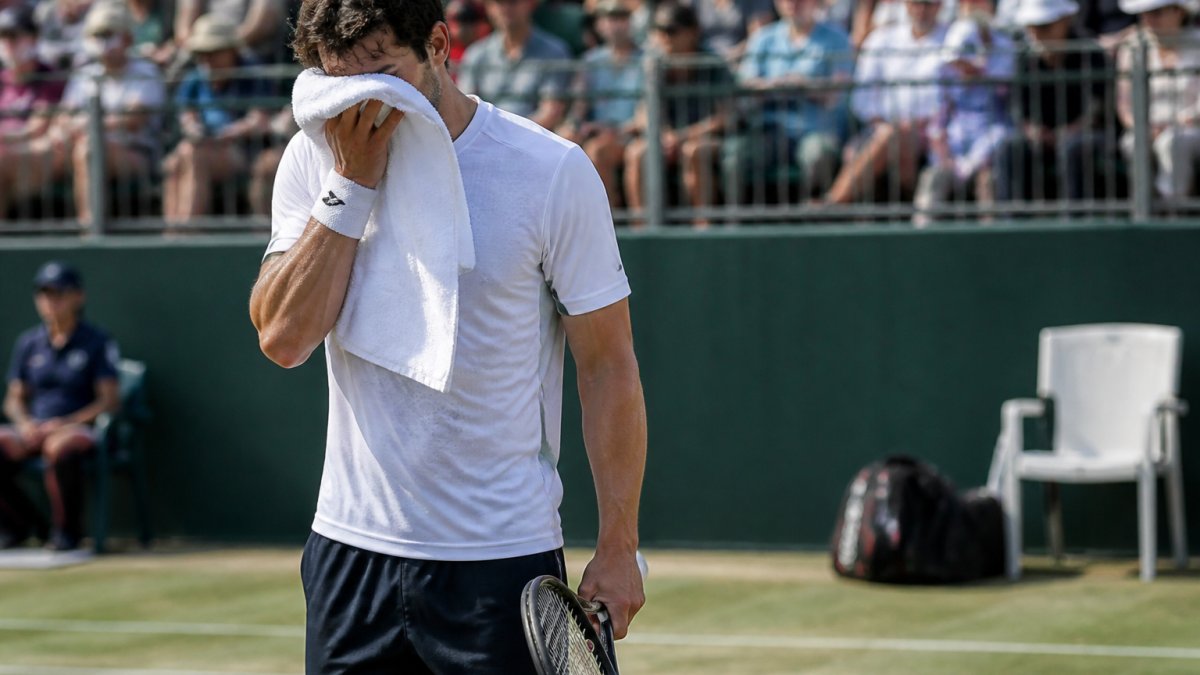
Between-point routines separate winners from everyone else. This is where you reset your nervous system, refocus your attention, and prepare for the next point with a clear mind.
(/tag/tennis-mental-toughness-drills/) in comfortable situations. You build it by practicing under pressure, then gradually increasing it. Pressure simulation drills train your mind to stay sharp when the stakes feel high.
Setting up your pressure drill
Design a practice drill that mimics match conditions. Here’s a simple version:
Play points to 5, but with a twist: if you lose a point, you restart at 0; if you win, you keep your score. One mistake costs you everything, and your opponent doesn’t face the same penalty, which adds psychological weight.
Play three sets of this drill, alternating who faces the penalty rule. Track your performance in each set.
Another variation: play a tiebreak to 7 points, but the loser of the tiebreak has to run sprints. The combination of physical fatigue and mental pressure mirrors match conditions more realistically than casual practice.
Tracking progress week to week
Document your results. After each pressure simulation drill, record:
- Points won under pressure vs. points won in neutral situations
- How your serve percentage changes when stakes are high
- Whether you made more unforced errors in high-pressure moments
Most players discover they perform worse under pressure initially. That gap narrows as you practice. When your performance gap shrinks, you’ve genuinely improved your mental toughness.
The most common mistake is practicing pressure drills alone. Playing against a competitor, even a practice partner, adds psychological pressure that solo drills can’t replicate. Push your partner to compete hard.
::: Developing this competitive intensity serves as a foundational habit for managing professional stress during high-stakes matches.
3. Tennis Visualization Techniques for Match Confidence
Visualization isn’t mystical. It’s mental rehearsal. Your brain activates similar neural pathways whether you physically execute a shot or vividly imagine it (Motor planning, imagery, and execution in the distributed motor network). The best tennis visualization techniques train your mind to see success before it happens.
The five-sense visualization protocol
Don’t just picture the ball going in. Engage all five senses:
- See the ball clearly. Watch it leave your racket, see the spin, watch it land in the exact spot you targeted.
- Feel the racket in your hand. Notice the grip pressure, the follow-through, the weight transfer in your legs.
- Hear the sound. The contact sound, your footwork on the court, maybe crowd noise if you’re imagining a match.
- Sense the court beneath your feet. The texture, the temperature, the slight give of the surface.
- Feel the emotion. Confidence, focus, or calm determination, whatever mental state you want during the actual match.
Run through three to five shots this way before matches. Spend 30-45 seconds per shot. Quality matters far more than quantity.
Adapting visualization for different match scenarios
Visualize the specific situations where you struggle. If tiebreaks destroy your confidence, spend visualization time on tiebreak scenarios. If you lose focus after winning a set, visualize staying sharp in the third set. Adapt to your opponent’s style too: against a serve-and-volley player, visualize returning aggressively and moving forward. Your brain begins to recognize patterns and prepares your body to respond.
4. Pre-Match Mental Routine for Tennis: Build Your Competitive Edge
A structured pre-match routine signals to your nervous system that it’s time to compete. It settles anxiety, builds confidence, and creates a mental state where you perform at your best.
The 30-minute pre-match sequence
Start 30 minutes before your match:
Minutes 0-5: Physical grounding. Walk around. Feel your feet on the ground. Do five minutes of light stretching or movement. This pulls your attention out of your head and into your body.
Minutes 5-15: Visualization. Find a quiet spot. Close your eyes.
Minutes 15-20: Positive self-talk. Repeat your personal performance cues (we’ll cover this in section 6).
Minutes 20-25: Strategic review. Think through your game plan. What’s your serve target?
Minutes 25-30: Activation. Do dynamic stretches or light footwork drills. Get your heart rate up slightly.
Customizing your routine by player level and age
Beginners should keep routines simple: a 10-minute version works fine, with five minutes of light movement, three minutes of visualization, and two minutes of positive self-talk. Overcomplicating it creates more anxiety. Competitive intermediate and advanced players benefit from the full 30-minute sequence. Players over 40 should add five extra minutes of dynamic stretching, which also helps settle pre-match nerves.
The most common mistake is changing your routine based on how nervous you feel. Stick to the same routine regardless. Consistency builds trust in the process, which reduces anxiety over time.
5. Tennis Breathing Exercises for Focus and Emotional Control
Your breath is the fastest way to regulate your nervous system. When you’re nervous, breathing becomes shallow and fast; deliberate breathing exercises reverse that, triggering calm focus.
Box breathing for tiebreak situations
Box breathing is simple and powerful: breathe in for four, hold for four, out for four, hold for four. Repeat four times (64 seconds total). Use it during the changeover right before a tiebreak, and your heart rate will slow, your mind will clear, and you’ll step onto the court mentally sharper than your opponent.
Tactical breathing during changeovers
During changeovers, use tactical breathing to manage intensity. Breathe in for two counts, out for four counts.
If you’re playing too tight and tentative, switch to equal breathing: in for three, out for three.
If you’re playing too aggressively and making errors, use the longer exhale pattern to dial back intensity slightly.
6. Positive Self-Talk and Performance Cues: Rewire Your Inner Dialogue
Your inner dialogue shapes your performance. Tell yourself “Don’t double fault” and your brain focuses on double faulting; say “Land it in the box” and it focuses on the target.
Creating your personal performance cues
A performance cue is a short, specific phrase that triggers the mental state you want.
Instead of “You got this,” use “Smooth and deep” (for a serve) or “Step and turn” (for your return).
Write down five performance cues tailored to your game:
| Situation | Performance Cue |
|---|---|
| Before serving | “Smooth and deep” |
| Returning serve | “Step and turn” |
| During a rally | “Move your feet” |
| After a mistake | “Next point” |
| In a tiebreak | “One serve, one return” |
Use these cues during your pre-match routine and repeat them during matches when you need to refocus.
Turning mistakes into momentum
When you make an error, your inner dialogue either spirals or resets. Most players spiral: “That was stupid. I always do that. I’m going to lose this match.” Interrupt that spiral with a reset cue. After a mistake, say your performance cue for the next situation; if you double-faulted, say “Smooth and deep” before the next serve.
7. Building Your Weekly Mental Training Plan
Mental skills improve like physical skills: through consistent, deliberate practice. A structured weekly plan builds mental toughness systematically.
Sample four-week progression for beginners
Week 1: Focus on the pressure point reset routine. Practice it during every point in three practice sessions.
Week 2: Add visualization. Spend five minutes before practice visualizing three key shots.
Week 3: Introduce your performance cues. Write them down and use them during practice.
Week 4: Run a full pre-match routine before one practice session or match.
Advanced weekly structure for competitive players
Competitive players should dedicate 30-45 minutes per week specifically to mental training:
Monday: Visualization session (20 minutes). Run through match scenarios specific to your upcoming opponent or your weaknesses.
Wednesday: Pressure simulation drill (30 minutes). Play points with high stakes. Track performance metrics.
Friday: Pre-match routine practice (15 minutes). Execute your full 30-minute routine before a practice match or lesson.
Sunday (match day): Execute your routine 30 minutes before competition.
This structure builds mental skills progressively.
Players training for tournament competition or league matches who want measurable improvements in pressure performance within 4-6 weeks.
The exercises above work because they’re specific, repeatable, and directly address the situations where mental breakdowns happen. You’re not just thinking positively; you’re training your mind to perform under pressure, just like you train your body to execute your serve. At Crunch Time Coaching, we combine these mental training exercises with technical instruction because both matter. Your mental game determines whether your technical skills show up in matches, and mastering both is how you break through plateaus and start winning consistently.
Mental toughness is the difference between knowing what to do and actually doing it when the match matters.
Frequently Asked Questions
What are the most effective mental exercises for tennis players to stay focused?
The most effective exercises combine breathing drills, visualization, and between-point routines. Box breathing (4-count inhale, hold, exhale, hold) reduces anxiety and sharpens focus during high-pressure moments. Visualization of successful shots activates the same neural pathways as actual practice. Between-point routines, like a specific walk pattern or self-talk cue, anchor your attention and prevent dwelling on mistakes. These three work together to keep you present during matches, which is where matches are won or lost.
How can I improve tennis match mental toughness in just a few weeks?
Mental toughness builds through consistent pressure simulation and mistake-recovery drills. Start by practicing your between-point reset routine daily during regular play, this is your foundation. Next, add one pressure drill per week: play practice sets where you must win three consecutive points from 0-30 down, or play tiebreaks with specific score targets. Track your performance (points won under pressure, mistakes recovered from) week to week. Most players see measurable improvement in composure and confidence when they practice these drills consistently.
What is the difference between visualization and mental rehearsal for tennis?
Visualization focuses on seeing and feeling a successful outcome (serving an ace, winning a tiebreak), engaging all five senses. Mental rehearsal goes deeper: you rehearse the entire sequence, setup, execution, reaction to the result, and recovery if it fails. Mental rehearsal prepares you for real match variability, not just success. Both are powerful, but rehearsal better prepares you for pressure because it includes what happens when things don’t go perfectly. Use visualization for confidence building and rehearsal for match-scenario preparation.
Can tennis sports psychology exercises work for players over 40 or just returning to competitive play?
Yes, absolutely. Mental exercises are not age or experience dependent, they work because they rewire how you respond to pressure and mistakes, regardless of age or time away from the sport. Players returning after years off often benefit most because they bring maturity and focus that younger players are still developing. The key is starting with simpler routines (basic breathing and between-point resets) and progressing gradually. Many players over 40 find that mental skills transfer across all sports and life experience.