
Table of Contents
- Dynamic Warm-Up Exercises for Tennis: The Foundation
- How Long to Warm Up Before a Tennis Match
- Cardiovascular Activation and Agility Drills
- Upper Body and Lower Body Mobility Drills
- On-Court Hitting Progression and Shadow Strokes
- Pre-Match Tennis Nutrition for Tournament Day
- Mental Preparation for Tennis Tournaments
- Conclusion
- Frequently Asked Questions
Last Updated: September 12, 2026
Dynamic Warm-Up Exercises for Tennis: The Foundation
The best tennis warm up routine before a tournament match starts with dynamic movement, not static stretching. Dynamic warm-up exercises for tennis raise your heart rate, wake up your nervous system, and prepare your joints for the specific demands of match play. This guide from Crunch Time Coaching breaks down exactly how to structure that routine.
Static stretching before a match can actually reduce power output. Save those long holds for after you play. Before competition, your muscles need blood flow, activation, and sport-specific movement patterns.
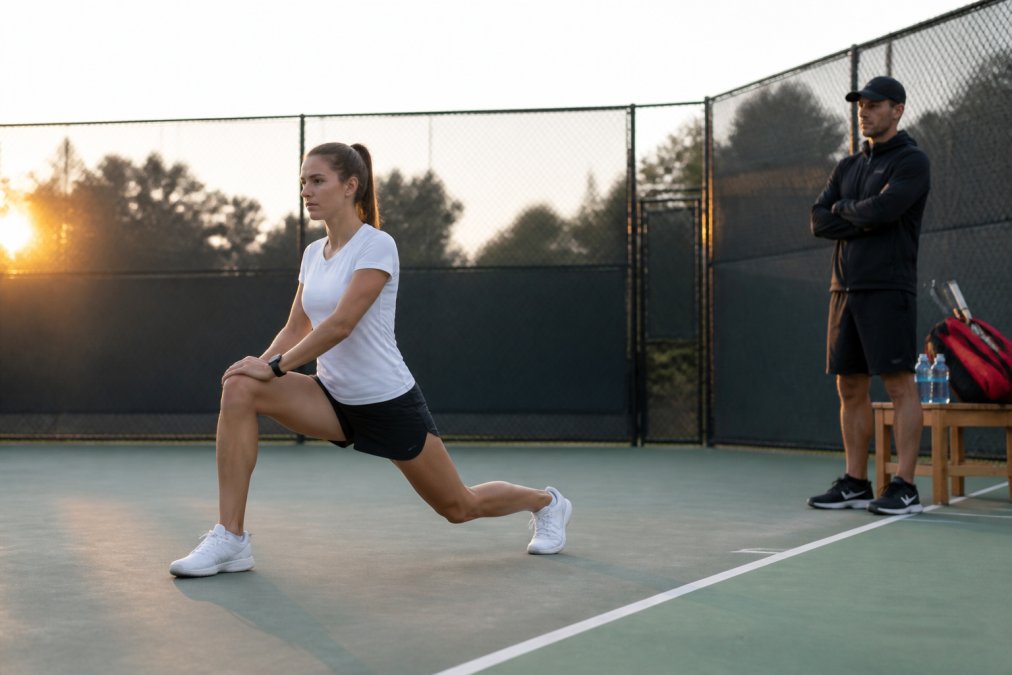
A proper tennis warm up follows a logical sequence: elevate heart rate, activate key muscle groups, then progress to on-court hitting. Skip any phase and you leave performance on the table.
How Long to Warm Up Before a Tennis Match
The ideal warm-up duration is 20 to 30 minutes for tournament play. This window gives you enough time to activate major muscle groups, elevate your heart rate, and complete on-court hitting without fatiguing before the first point.
That said, the answer to how long to warm up before a tennis match depends on your age, fitness level, and match intensity. Players over 40 often need closer to 30 minutes. Younger players with consistent training may feel ready in 20.
Break your time into three blocks:
- 5-8 minutes: cardiovascular activation and dynamic movement
- 5-7 minutes: mobility drills and muscle activation
- 10-15 minutes: on-court hitting progression
The USTA’s dynamic warm-up and flexibility training guide outlines a standardized sequence that competitive players can follow. It emphasizes progressive movement patterns over static holds.
Cardiovascular Activation and Agility Drills
Cardiovascular activation raises your core temperature and prepares your heart for the demands of match play. Start with progressive jogging around the court, then layer in lateral movement patterns.
A common mistake is going too hard too early. You want to elevate your heart rate gradually, not sprint out of the gate and arrive at the first point already winded.
Try this sequence:
- Progressive jogging: two laps at conversational pace, one lap at moderate intensity
- Lateral shuffles: 10 yards each direction, two sets
- Carioca: 10 yards each direction, two sets
- Arm circles: 15 forward, 15 backward
- Leg swings: 10 front-to-back, 10 side-to-side per leg
These agility drills target the hip rotators, glutes, and stabilizers you rely on for court coverage. The American Council on Exercise’s guide to dynamic stretching explains why movement-based preparation outperforms static stretching for power sports.
Do your carioca and lateral shuffles on the actual court surface, not the parking lot. Your proprioception calibrates to the surface you warm up on, and hard courts play differently than carpet or grass.
Upper Body and Lower Body Mobility Drills
Mobility drills raise joint range of motion and switch on the muscles you are about to load, without the fatigue of a full workout. For tennis, the priority joints are the shoulders (serve and overhead), the thoracic spine (rotation on groundstrokes), the hips (lateral coverage and open-stance loading), and the ankles (split-step and change of direction).
The order matters. Open the thoracic spine and shoulders before you load them, and wake up the hips and glutes before you ask them to push off. A common pattern is to run upper-body mobility first, then lower-body activation, so the trunk is free to rotate by the time you start swinging.
Upper body mobility (5-6 minutes)
- Arm circles: 10 small to 10 large, each direction. Start at the shoulder, not the elbow.
- Band shoulder dislocates: 10 slow reps with a light resistance band held wide. Keep the elbows straight and move only as far as the shoulder allows.
- Thoracic trunk rotations: 8 per side, on one knee with the trailing hand behind the head. The rotation should come from the mid-back, not the lower back.
- Wrist and forearm circles: 10 each direction, plus 10 gentle wrist flexor stretches. Grip and racquet control start here.
Lower body activation (5-7 minutes)
- Glute bridges: 10-12 reps, pause 2 seconds at the top. This is the single most useful drill for players who sit at a desk before matches.
- Walking lunges: 8-10 per leg, controlled, with a slight forward torso lean.
- Hip circles: 8 per direction, standing on one leg with the free knee lifted.
- Ankle mobility rocks: 10 per foot, knee driving over the toe while the heel stays down.
- Lateral band walks: 10 steps each direction with a band above the knees. This targets the hip abductors that stabilize you during the split-step and the first push to the ball.
Why the rotator cuff and glutes get special attention
Your serve depends on shoulder stability, and a cold shoulder is more prone to injury under the repeated overhead load of a match. A few sets of band external rotations (10-12 reps per arm, elbow pinned to the side) before you hit gives the rotator cuff a chance to wake up before the first serve.
Glute engagement matters just as much. Inactive glutes force the lower back and knees to absorb the braking forces of lateral movement, which is a common source of late-match soreness. Bridges, lunges, and band walks address this directly.
Do the band work on the court, not in the locker room. The resistance is light, the drills take under three minutes, and warming up on the surface you will actually play on helps your proprioception calibrate to the court.
If you only have time for three drills, choose band shoulder dislocates, glute bridges, and lateral band walks. Those three cover the shoulder, the hip, and the stabilizers that drive every serve and every first step.
On-Court Hitting Progression and Shadow Strokes
On-court hitting progression moves from gentle rallying to match-intensity strokes. Shadow strokes bridge the gap between off-court prep and live hitting.
Start with shadow swings: forehand and backhand shadow swings, 10 each, focusing on rhythm and timing. Then add serve mechanics with half-speed serves before progressing to full speed.
The hitting progression:
- Mini tennis: rally inside the service boxes for 3-5 minutes
- Baseline rallying: cooperative hitting at 70% pace
- Directional hitting: cross-court and down-the-line patterns
- Serve and return: 10-15 serves, then return practice
- Point play: a few practice points to simulate match conditions
Patrick Mouratoglou, who has coached top professionals, emphasizes that on-court warm-up time is limited at tournaments, so efficiency matters. Every minute should have a purpose.
Pre-Match Tennis Nutrition for Tournament Day
Most warm-up guides treat nutrition as a footnote. In a tournament, it is a logistics problem, not a menu problem. Start times get pushed, matches run long, and you may play two or three times in a day. The routine that works at a club match often falls apart at a tournament because you cannot control when you eat relative to when you play.
The timing window
Eat your main meal two to three hours before your scheduled match, then top up with a light, easily digestible snack 30 to 60 minutes out. The goal is a stomach that is settled but not empty when the first ball is struck.
What works well:
- Banana with a small handful of almonds
- Half a bagel with peanut butter
- A sports drink or electrolyte beverage
- Water sipped consistently, not chugged
What to avoid: heavy fats, large protein portions, and anything unfamiliar. Tournament day is not the time to test a new energy gel or supplement.
The delayed-start problem
This is where most players get it wrong. If your match is pushed back an hour, do not eat a second full meal. Add a small carbohydrate snack (half a banana, a few crackers) and keep sipping fluids. Eating a full meal during a delay leaves you heavy and slow when the match finally starts.
A useful rule: treat every 45-60 minutes of delay as one small snack, not one meal. Keep the snacks in your bag so you are not hunting for the concession stand when the call comes.
Multiple matches in one day
Between matches, the priority shifts to recovery. Within 30 minutes of finishing, take in carbohydrates and fluids. A recovery drink, chocolate milk, or a banana with a sports drink covers most of what you need. Then eat a light, real meal once your stomach settles, ideally 60-90 minutes before your next warm-up begins. Consistent attention to these nutritional windows establishes a foundation for your body to recover after workouts more efficiently between the intense demands of tournament play.
Avoid the trap of eating a large meal immediately after a match because you are hungry. Your body is still shunting blood to the muscles, and a heavy meal will sit. Small and frequent beats large and infrequent on tournament day.
Heat changes the plan
In hot conditions, hydration and electrolytes matter more than calories. Aim for pale yellow urine as your hydration benchmark, and start the day before, if you show up dehydrated, no amount of drinking right before the match fully fixes it. Add electrolytes rather than plain water alone when you are sweating heavily across multiple matches.
Caffeine timing matters. If you rely on coffee or a pre-workout for energy, drink it at least 45 minutes before your warm-up starts. Caffeine right before play can leave you jittery during the first few games, when you need fine motor control for the serve and the return.
The tournament-day nutrition rule is simple: control what you can. You cannot control the draw or the start time, but you can control what is in your bag. Pack snacks, fluids, and electrolytes the night before so a delayed start never turns into a missed meal.
Mental Preparation for Tennis Tournaments
Mental preparation for tennis tournaments is the most overlooked part of the warm-up. Physical readiness means nothing if your head isn’t in the match.
A pre-match ritual helps. Same sequence every time: same music, same warm-up order, same self-talk cues. Rituals reduce anxiety by giving your brain a predictable script.
Try this mental sequence during your physical warm-up:
- Name your one tactical goal for the match
- Identify your opponent’s likely weakness from prior scouting
- Rehearse one go-to pattern for pressure points
- Set a breathing rhythm for between-point reset
Players who struggle in tiebreakers often have no between-point routine. The breath is your anchor. Four counts in, four counts out. It sounds simple because it is.
The NCAA Sport Science Institute’s mental health resources for athletes highlights that structured pre-competition routines reduce performance anxiety and improve focus under pressure.
Crunch Time Coaching builds mental toughness work into its challenge-based curriculum alongside technical instruction. The platform’s step-by-step daily lessons cover both the physical and psychological sides of competitive play.
Conclusion
Warming up properly before a tournament match is one of the few things entirely within your control. The players who treat it as a checklist item rather than a performance tool leave points on the court.
Crunch Time Coaching helps competitive players build complete preparation systems, not just stroke mechanics. The platform offers step-by-step daily lessons, a specialized challenge-based curriculum, and hands-on in-person training sessions designed to sharpen every part of your game.
Reserve Your Spot Today and walk onto the court knowing your body and mind are ready for the first point.
Frequently Asked Questions
What should I do to warm up before a tennis match?
Start with 5 minutes of light cardio like jogging or jumping jacks to raise your heart rate. Then move into dynamic stretches such as arm circles, leg swings, and torso rotations. Follow with lateral movement drills like carioca and side shuffles. Finish with 10-15 minutes of on-court hitting, progressing from gentle rallying to full-intensity strokes. This sequence activates your muscles, improves joint range of motion, and primes your nervous system for match play.
How long should a pre-match tennis warm-up last?
A complete warm-up should take 20-30 minutes. This includes 5 minutes of cardiovascular activation, 5-8 minutes of dynamic stretching and mobility drills, and 10-15 minutes of on-court hitting. If you’re short on time, a 10-minute routine covering light cardio, dynamic stretches, and quick shadow strokes can still prepare you. The key is to elevate your heart rate, activate key muscle groups, and rehearse tennis-specific movements before the first point.
Why is a dynamic warm-up better than static stretching before tennis?
Static stretching holds muscles in a lengthened position, which can temporarily reduce power and reaction time. Dynamic warm-up exercises for tennis move your joints through their full range of motion while raising your heart rate. This increases blood flow, improves proprioception, and activates the neuromuscular system. Studies show dynamic routines improve sprint speed and agility compared to static stretching. Save static stretches for after your match when your muscles are warm and you’re focusing on post-match recovery.
What should I eat 30 minutes before a tennis match?
Eat a light snack with easily digestible carbohydrates and a small amount of protein. Good options include half a banana with a tablespoon of peanut butter, a small bowl of oatmeal, or a handful of crackers with a slice of turkey. Avoid heavy fats, fiber, or large meals that can cause stomach discomfort during play. Drink 8-16 ounces of water in the 30 minutes before your match. If you’re playing in a tournament with multiple matches, sip a sports drink between sets to maintain electrolyte balance.
How do pro tennis players prepare mentally before a match?
Pros use a consistent pre-match ritual that includes visualization, breathwork, and keyword triggers. They visualize successful serves, returns, and point patterns. Box breathing or 4-7-8 breathing calms the nervous system and sharpens focus. Many players repeat a single word or phrase like ‘move’ or ‘watch the ball’ to center their attention. This mental preparation for tennis tournaments builds match readiness and reduces tiebreak anxiety. Try a 5-minute routine: 2 minutes of breathing, 2 minutes of visualization, and 1 minute reviewing your game plan.