
Table of Contents
- The Reality of Tennis Footwork Improvement Timelines
- First 4 Weeks: Building Movement Fundamentals
- Tennis Footwork Drills for Speed and Court Coverage
- How Long to Master the Tennis Split Step and Reaction Time
- Beginner Tennis Footwork Mistakes That Slow Progress
- Weeks 8-16: Measurable Performance Gains on Court
- Training Frequency and Work-to-Rest Ratios That Drive Results
- Tracking Your Progress: Psychological and Physical Markers
- Frequently Asked Questions
Last Updated: September 24, 2026
The Reality of Tennis Footwork Improvement Timelines
How long does it take to improve tennis footwork? The honest answer depends on your starting point, training frequency, and how you measure progress. Most players see noticeable changes in movement speed and court coverage within 4-8 weeks of consistent practice. Measurable competitive improvements typically emerge around the 12-16 week mark.
This guide breaks down the realistic timeline, the drills that work, and the markers that show you’re improving.
The first 4 weeks build your foundation. Weeks 8-16 deliver visible match results. Beyond that, you’re refining consistency and adapting to pressure situations.
First 4 Weeks: Building Movement Fundamentals
The opening month establishes the basics through repetition. Week one feels clumsy as your nervous system processes new movement patterns. By week two, movements feel less foreign and the split-step becomes more automatic. Weeks three and four bring real change: lateral movement smooths out, you stop overcommitting, and court positioning improves noticeably.
What’s happening physically:
- Your neuromuscular system adapts to new movement patterns
- Muscle memory begins forming
- Balance and coordination improve
- Reaction time starts decreasing
Film yourself during week one and week four. Watch both videos back-to-back. The difference will surprise you. This visual proof keeps you motivated through the harder weeks ahead.
Tennis Footwork Drills for Speed and Court Coverage
The drills you choose determine your progress speed. Some build explosive power; others build consistency and positioning awareness.
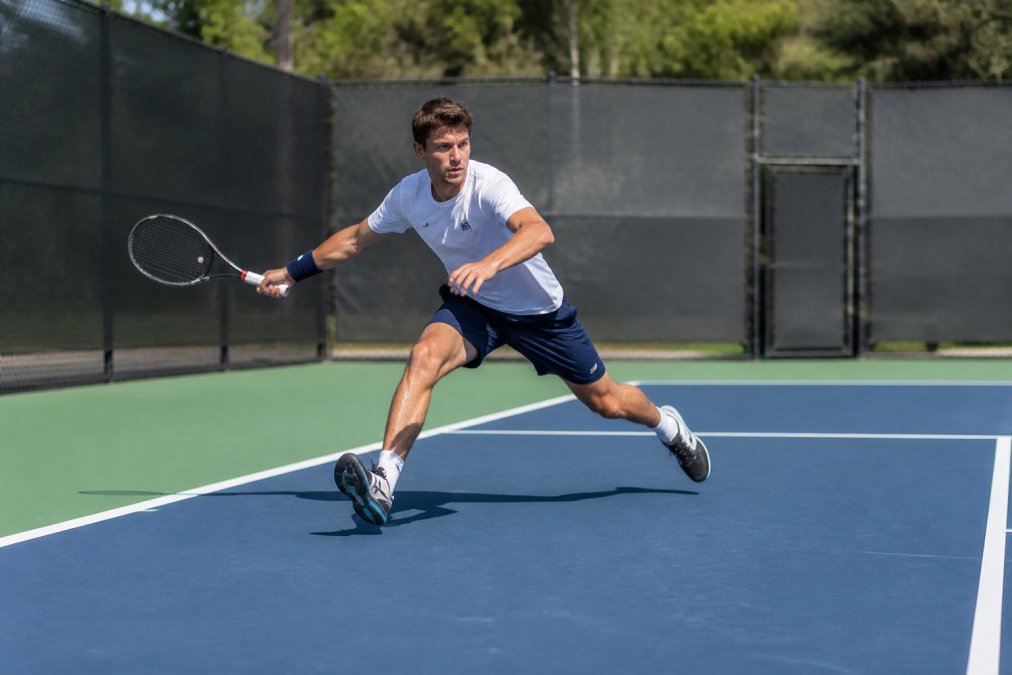
Essential drills for footwork improvement:
The ladder drill builds foot speed and coordination: three sets of 30 seconds, three times weekly. The cone shuttle drill trains change of direction by sprinting forward, backpedaling, and shuffling between cones at the baseline, service line, and net. The split-step reaction drill sharpens anticipation with a partner hitting random balls to your forehand and backhand; do this 10 minutes twice weekly. The baseline sprint drill builds explosive acceleration: six to eight repetitions with 45 seconds rest between sprints.
These drills train match-relevant movement patterns, build tennis-specific muscles, and reveal footwork weaknesses. Pick two drills and master them before adding more.
How Long to Master the Tennis Split Step and Reaction Time
The split-step is the small hop you take as your opponent strikes the ball, positioning your weight to accelerate in any direction. Most players execute a basic split-step within two weeks; timing becomes automatic by week four; true mastery under pressure takes 12-16 weeks. Reaction time (how fast your brain registers direction) and footwork (how fast your body responds) improve simultaneously with proper training.
The split-step progression:
- Week 1-2: You consciously think about the split-step
- Week 3-4: It happens automatically during drills
- Week 5-8: You do it in casual matches
- Week 9-16: It’s automatic even in competitive pressure
Reaction time typically improves 10-15% over eight weeks, allowing you to reach the ball faster with better positioning.
A common mistake is practicing the split-step in isolation. It only matters when paired with explosive first-step acceleration. Always practice split-step with immediate movement to the ball.
Beginner Tennis Footwork Mistakes That Slow Progress
Most beginners make the same errors. Recognizing them early saves weeks of wasted training.
The Weight-on-Heels Mistake
New players keep weight on their heels, delaying the first step by 0.1-0.2 seconds. Weight should be on the balls of your feet. Spend two minutes each session on this cue. Correction timeline: 2-3 weeks on clay in responsive shoes; 3-4 weeks on hard courts in heavy shoes.
The No-Split-Step Error
Some players skip the split-step and shuffle continuously instead, preventing explosive movement. On clay courts, this mistake is obvious within one week. On hard courts, it’s less obvious because the surface is forgiving, delaying recognition by 2-3 weeks. Correction timeline: 2-3 weeks on clay, 4-5 weeks on hard courts. Film yourself on hard courts to catch this earlier.
The Over-Rotation Problem
Players over-rotate their shoulders, creating unnecessary movement and throwing off balance. Worn shoes with poor lateral support encourage this compensation. Upgrade to shoes with firm lateral support to cut correction time by 1-2 weeks.
The Inconsistent Practice Trap
Consistency matters more than intensity. Three sessions weekly for four weeks beats five sessions for two weeks because your nervous system needs repeated exposure. Commit to 3-4 sessions weekly for 16 weeks minimum; one missed week sets you back 3-4 days.
The Speed-Over-Technique Issue
Slow, controlled footwork builds better patterns than fast, sloppy movement. If you can’t execute a drill with perfect technique at 70% speed, you’re going too fast. Once technique is locked in (weeks 3-4), increase speed.
The Wrong Shoe Choice
Shoes designed for your court surface matter. Clay-court shoes (herringbone tread, heavier, cushioned) grip clay but clog on hard courts. Hard-court shoes (denser tread, firmer support, lighter) are ideal for hard courts. Match your shoes to your primary surface to accelerate improvement by 2-3 weeks.
The Fatigue-Induced Form Breakdown
Do footwork drills first in your training session when your nervous system is fresh. Fatigued footwork practice ingrains poor patterns.
Weeks 8-16: Measurable Performance Gains on Court
This is where theory becomes match reality. By week eight, your footwork changes how you play.
You’ll notice you’re reaching balls you previously couldn’t. Your positioning improves automatically. You’re making fewer unforced errors from poor court position. Your confidence in movement increases noticeably.
Week twelve brings another shift. You’re now moving efficiently under pressure. Your footwork holds up in tiebreaks. You’re not thinking about where your feet go, they just go there.
By week sixteen, footwork is no longer your limiting factor. Your consistency improves. Your shot selection gets better because you’re positioned correctly. Match results improve.
Measurable markers at week 16:
- You reach 15-20% more balls
- Your unforced errors from poor positioning drop significantly
- You feel confident moving in all directions
- Your first-step quickness is noticeably faster
- You recover to court center more quickly after shots
This 8-16 week window is where most players see competitive improvement. League players move up in rankings. Tournament players win more matches. The footwork work translates directly to results.
Training Frequency and Work-to-Rest Ratios That Drive Results
How often should you train footwork? Three to four times weekly is optimal for most players. This allows adequate recovery while maintaining consistency.
Each session should include footwork work. Twenty to thirty minutes of focused footwork training per session is sufficient. More isn’t always better. Quality matters more than volume.
Effective training structure:
Monday: Agility ladder drills and cone shuttles. Twenty-five minutes total.
Wednesday: Split-step reaction work with a partner. Twenty minutes total.
Friday: Baseline sprint work and change-of-direction drills. Twenty minutes total.
Saturday: Match play or competitive drill work. This applies your footwork under pressure.
The work-to-rest ratio within sessions matters too. For explosive drills like sprints, work hard for 20-30 seconds, then rest for 45-60 seconds. This allows your nervous system to recover while building explosive power.
For footwork drills that emphasize technique, you can work longer with shorter rest. Agility ladder work can go 30-45 seconds with 30 seconds rest.
Track your training frequency. Most players who plateau do so because they’re training inconsistently. Three focused sessions weekly beats five sporadic ones.
Tracking Your Progress: Psychological and Physical Markers
You need to know if you’re improving. Subjective feelings are unreliable.
Video Analysis as Your Feedback Loop
Here’s the system:
Week 1 baseline video: Film yourself executing the cone shuttle drill from the side angle. Record three full repetitions. Note the time it takes to complete the course. Save this file.
Physical Markers to Track
Psychological Markers That Predict Match Improvement
These internal shifts happen before your ranking improves:
Automatic split-stepping: You stop thinking about the split-step. It happens unconsciously, even in high-pressure situations. This shift typically occurs between weeks 6-10 and signals your nervous system has encoded the movement pattern.
Age-Specific Progress Markers
Junior players (under 18): Nervous systems adapt faster. Juniors typically see the 4-week foundation phase compress to 2-3 weeks. However, they often lack the body awareness to self-correct, so video feedback becomes even more critical. Expected timeline: 10-12 weeks to competitive improvement.
Competitive Markers
These are the results that validate all the work:
- Your win-loss record improves by 10-15% within 12 weeks
- You beat players you previously lost to consistently
- Your performance in tiebreaks improves (footwork holds up under fatigue)
- You handle aggressive net-rushing opponents better because positioning is automatic
- Your unforced errors from poor court position drop by 20-30%
Frequently Asked Questions
How long does it take to see noticeable improvement in tennis footwork?
Most players notice measurable changes in court positioning and movement speed within 4 weeks of consistent practice. Significant improvements in footwork efficiency and consistency typically emerge between weeks 8 and 12. The timeline depends on training frequency, players practicing 3-4 times per week see faster results than those training once weekly. Age and prior athletic experience also affect progression speed, but dedicated work-to-rest interval training accelerates neuromuscular adaptation across all age groups.
How often should I practice tennis footwork drills to see results?
Train footwork 3-4 times per week for optimal progress. Each session should include 20-30 minutes of focused drills using proper work-to-rest ratios, typically 30-40 seconds of intense movement followed by 15-20 seconds recovery. This frequency allows your neuromuscular system to adapt without overtraining. Players training only once weekly will progress significantly slower. Consistency matters more than single long sessions; frequent, shorter practice builds muscle memory and movement patterns faster than occasional marathon training.
Can you improve tennis footwork at any age?
Yes. Players over 40 can improve footwork substantially, though timelines may extend 2-4 weeks longer than younger players. Age-specific progression focuses on movement efficiency and recovery time rather than raw speed. Proper technique, consistent practice, and adequate rest between sessions remain critical regardless of age. Video analysis of your movement patterns helps identify which drills match your specific needs. Many competitive players in their 40s and 50s achieve significant footwork improvements through structured training that respects recovery demands.
What is the difference between agility and footwork in tennis?
Footwork refers to your positioning, weight transfer, and movement patterns to reach the ball efficiently. Agility is your ability to change direction quickly and explosively. Both matter: solid footwork with poor agility limits your court coverage, while good agility without proper footwork creates inconsistent shots. Tennis-specific conditioning develops both through drills that emphasize split-step timing, lateral movement, acceleration, and deceleration. Effective training addresses coordination and balance alongside raw movement speed to build complete court mobility.