
Table of Contents
- Why Spin Matters on Your Tennis Serve
- Master the Continental Grip for Tennis Serve Spin
- Perfect Your Tennis Serve Toss for Spin
- The Brushing Motion: Building Topspin Through Ball Contact
- How to Fix Common Beginner Serve Mistakes
- Essential Drills to Build Spin Consistency
- Physical Conditioning and Equipment for Maximum Spin
- Mental Visualization and Serve Confidence
- Frequently Asked Questions
Last Updated: September 26, 2026
Why Spin Matters on Your Tennis Serve
Spin changes everything about your serve. A ball with heavy topspin dips sharply after clearing the net, forcing your opponent to hit up. Without spin, your serve floats predictably. Your opponent crushes it.
The ones who master spin win more points. It’s that simple.
Spin does three things for you:
- Makes the ball harder to read in flight
- Pulls the ball down into the court after it peaks
- Lets you hit harder without the ball flying long
Players with spin consistency win tiebreaks. They hold serve under pressure. They control rallies from the start.
The challenge? Spin isn’t about arm strength. It’s about technique. Most beginners swing too flat or too vertical. Neither generates real spin. You need the right grip, the right toss, and the right brush motion. Get these three things right, and spin becomes automatic.
Master the Continental Grip for Tennis Serve Spin
Your grip determines everything. The continental grip is the foundation for spin on tennis serve. It’s the only grip that lets your wrist snap naturally at contact.
Here’s what continental grip looks like:
- Place the base of your index finger on bevel 2 of the racquet handle
- Your thumb sits on bevel 1, just under your index finger
- Your hand feels neutral, not rotated forward or back
Why this grip works:
The continental grip keeps your wrist loose. When you pronate (rotate your forearm) at contact, your wrist snaps through naturally. Eastern or western grips lock your wrist. You lose pronation. You lose spin.
Test your grip right now. Hold the racquet with continental grip. Shake your wrist side to side. It should feel free. If your wrist feels stiff, adjust your grip until it loosens.
Many beginners grip too tight with their fingers. Loosen your grip pressure by 20 percent. A loose grip lets your wrist snap through contact. Tight grip kills pronation.
Switch to continental grip for every serve practice session. Your arm will fight it for a period. After that, it becomes natural. Don’t go back to eastern grip just because it feels more comfortable. Comfort is not the goal. Spin is.
Perfect Your Tennis Serve Toss for Spin
Your toss controls your contact point. Your contact point controls your spin. Get the toss wrong, and spin becomes impossible.
For topspin, your ball toss needs to be higher and further forward than a flat serve. The ball should land about 12 inches in front of your baseline, at a height where you reach up and slightly forward to hit it.
Here’s the toss sequence:
- Hold the ball in your fingertips, not your palm
- Raise your arm straight up with a relaxed elbow
- Release the ball at shoulder height
- Let it rise 6-12 inches above your maximum reach
- The ball lands in front of your body, not directly over your head
Why forward toss matters:
A forward toss forces you into the right contact point for topspin. You can’t generate brush motion if you’re reaching back. Forward toss pulls you into the court naturally.
Practice your toss 50 times a day without a racquet. Toss to the same spot every time. Most beginners toss inconsistently. Inconsistent toss means inconsistent contact point. Inconsistent contact point means no spin development.
Tossing too high wastes energy and creates timing problems. Tossing too low forces you to hit down instead of up. Either mistake kills topspin. Practice until your toss lands in the same spot consistently.
The Brushing Motion: Building Topspin Through Ball Contact
The brushing motion is where topspin gets created. This is the most important technique for spin on tennis serve. It’s also the most misunderstood.
Brushing means moving your racquet from low to high across the ball. Your racquet face brushes up the back of the ball, creating forward rotation. The ball spins forward as it travels. Forward spin is topspin.
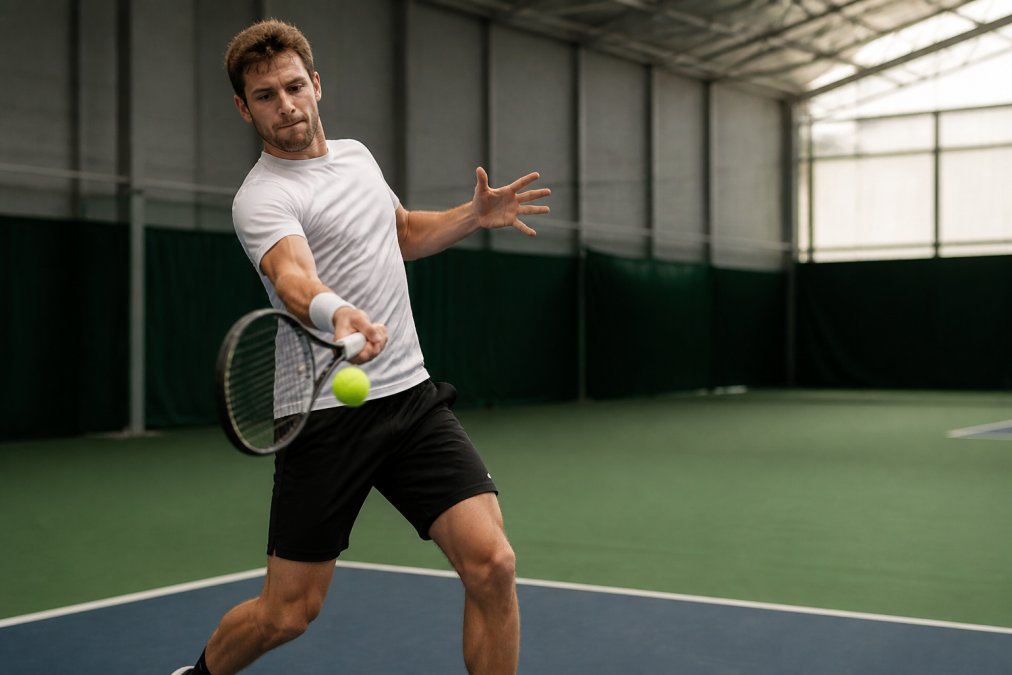
Here’s the brush motion broken down:
- Start with your racquet head below the ball at the ready position
- Accelerate upward into contact
- Make contact on the back of the ball, slightly below center
- Continue moving upward and forward after contact
- Your follow-through finishes over your opposite shoulder
The motion feels like you’re scraping the strings up the back of the ball. You’re not hitting through it. You’re brushing it.
Understanding Racquet Head Speed and Swing Path
Racquet head speed determines how much spin you generate. Higher speed creates more friction. More friction creates more spin.
But speed alone doesn’t work. Your swing path matters equally. The path of your racquet must be vertical or slightly forward-tilted. A horizontal swing path doesn’t brush the ball. It hits it flat.
Here’s what separates spin servers from flat servers:
- Flat servers: horizontal swing path, racquet moving sideways through contact
- Spin servers: vertical swing path, racquet moving up through contact
Your swing path is set by your shoulder rotation and your arm position. If your shoulders rotate too much, your swing becomes horizontal. You lose spin.
Practice this drill: serve 10 balls focusing only on an upward swing path. Ignore power. Ignore placement. Just move the racquet upward. You’ll notice the ball drops faster and moves more. That’s topspin working.
Pronation and Wrist Snap at Contact Point
Pronation is the rotation of your forearm. At contact, your forearm rotates inward. Your palm faces down. This rotation adds racquet head speed and spin.
Wrist snap happens naturally when you pronate. Your wrist doesn’t initiate the snap. Pronation creates it. If you try to “snap” your wrist manually, you’ll tense up. Tension kills pronation.
Here’s the pronation sequence:
- Your arm comes up with your palm facing slightly outward (supinated)
- As you approach contact, your forearm rotates inward
- At contact, your palm faces down (pronated)
- Your wrist follows the forearm rotation naturally
- Your follow-through continues the pronation motion
The continental grip enables pronation. Any other grip restricts it. This is why grip matters so much.
Pronation is not a wrist action. It’s a forearm action. Your wrist responds to pronation, not the other way around. Let pronation happen naturally instead of forcing wrist snap.
How to Fix Common Beginner Serve Mistakes
Most beginners make the same mistakes. Recognizing them speeds up your improvement.
Mistake 1: Swinging too flat
Flat swings produce no spin. The racquet moves horizontally through contact. The ball leaves with no rotation.
Fix: Focus on an upward swing path. Your racquet should move from low to high. Practice 20 serves where you exaggerate the upward motion. It will feel awkward. That’s correct.
Mistake 2: Tossing too high or too far back
High or back tosses force you to reach backward. Backward reach kills spin. You can’t brush the ball when you’re reaching away.
Fix: Lower your toss by 6 inches. Move it 12 inches forward.
Mistake 3: Gripping too tight
Mistake 4: Using the wrong grip
Mistake 5: Hitting down instead of up
Essential Drills to Build Spin Consistency
Drills build muscle memory. Muscle memory builds consistency. Consistency builds confidence.
Drill 1: Toss-Only Practice (10 minutes daily)
Drill 2: Brush Motion Drill (15 minutes)
Drill 3: Pronation Drill (10 minutes)
Drill 4: Target Serve Drill (20 minutes)
Drill 5: Pressure Serve Drill (15 minutes)
Physical Conditioning and Equipment for Maximum Spin
Spin isn’t just technique. Your body needs strength and flexibility. Your equipment matters too.
Shoulder mobility
- Arm across your chest: 30 seconds each side
- Behind-the-back shoulder stretch: 30 seconds each side
- Shoulder circles: 10 forward, 10 backward
Do these stretches before every practice session.
Core strength
Core exercises that help:
- Planks: 3 sets of 60 seconds
- Rotational medicine ball throws: 3 sets of 15 each side
- Dead bugs: 3 sets of 12
Do core work twice per week.
Racquet selection
Don’t buy an expensive racquet early in your development. Focus on technique first. Equipment matters less than fundamentals when you’re learning. Upgrade your racquet once your technique is solid.
Mental Visualization and Serve Confidence
Mental preparation is as important as physical technique. Visualization builds confidence. Confidence builds consistency.
Here’s your pre-serve routine:
- Take a breath and relax your shoulders
- Visualize your toss landing in the correct spot
- Visualize your brush motion from low to high
- Visualize the ball landing in the box with topspin
- Execute the serve
Frequently Asked Questions
How do I add spin to my serve if I’m just starting out?
Start with the continental grip, which naturally positions your racquet face to brush the ball upward. Toss the ball slightly in front and to the right of your body, then accelerate your racquet head from low to high, brushing the ball’s side rather than hitting flat. Focus on pronation at contact, your forearm rotates inward, creating the spin. Practice the motion slowly before adding speed. Most beginners see noticeable spin improvement with consistent practice.
What is the best tennis serve technique for beginners to maximize spin?
The kick serve is the most effective spin-heavy serve for beginners. It combines a vertical swing path with a continental grip and proper ball toss positioning. The key is brushing the ball from the 7 o’clock position upward, which creates topspin and causes the ball to bounce high. This technique also provides better net clearance and control than flat serves, making it ideal for building consistency before advancing to slice serves or other variations.
How does the continental grip help with spin serves?
The continental grip positions your hand on the side of the racquet handle, naturally angling the racquet face to brush rather than hit flat. This grip allows your wrist and forearm to pronate freely at contact, generating the rotational force needed for topspin. Unlike the eastern grip, which promotes flat hitting, the continental grip mechanically encourages the low-to-high brushing motion that creates spin. It also gives you better reach and control on faster serves.
How long does it take to develop a reliable spinning serve?
With focused practice, most beginners see consistent spin development. Early improvement comes from mastering grip and toss positioning. Noticeable RPM increases typically appear as your body learns the brushing motion. However, integrating spin serves into match play under pressure takes longer with regular play and drilling. Age and prior tennis experience affect the timeline; returning players often progress faster than complete beginners.