
Quick Summary
To increase serve speed and spin, build the serve as a sequence rather than adding arm force: push from the legs, turn the hips and shoulders, and let the racket whip through last. Spin then comes from the racket path and contact point, so practice the flat, slice, topspin and kick paths separately, with a consistent toss.
- Power starts in the legs and moves through the hips, torso and then the racket hand.
- Rotate your shoulders and torso fully before the racket accelerates, letting your chest turn toward the net.
- Spin comes from racket path and face angle at contact, not from swinging harder.
- Use a continental grip so the flat, slice, topspin and kick paths all stay accessible.
- Hit first serves flat or slice at 85-90 percent effort and second serves kick or topspin at 75-85 percent.
Table of Contents
- Why Your Serve Lacks Speed and Spin
- Building a Consistent Toss and Trophy Position
- How to Serve Faster in Tennis Through Kinetic Chain Sequencing
- How to Get More Spin on a Tennis Serve
- Kick Serve Technique: Racket Acceleration and Contact Point
- Tennis Serve Drills for Power and Progressive Training
- Measuring Progress and Protecting Your Shoulder
- Booking Your Serve Upgrade with Crunch Time Coaching
- Frequently Asked Questions
Why Your Serve Lacks Speed and Spin
Last Updated: October 29, 2026
Many players assume a bigger serve comes from swinging harder, but the sequence of the motion matters more than force. A common pattern is a player who muscles the ball, loses control, and still gets no extra pace or spin.
A tennis serve is a chain of movements. Research on the serve describes an eight-stage model in which effective servers store energy in the rear lateral shoulder and pelvis tilt during the acceleration phase, then release it for both speed and spin (eight-stage tennis serve model published in Sports).
Energy storage and release is a useful way to think about the serve.
Common causes of a slow or weak serve
- Arm-only motion with little leg drive
- A late or rushed toss that forces a stiff reach
- Little shoulder and torso rotation
Watch out: many players respond to a weak serve by trying harder with the arm. That adds tension and removes the timing that creates speed.
Building a Consistent Toss and Trophy Position
Your toss sets up everything after it. A toss that drifts forward, backward, or too low forces you to adjust mid-motion, costing pace.
Aim for a toss that lands in the same spot every time, roughly above your front shoulder and high enough to let your body fully extend. Then reach your trophy position: racket arm bent behind the head, shoulders turned, weight loaded onto the back leg, so the racket drops into a clean path.
How to Serve Faster in Tennis Through Kinetic Chain Sequencing
Serve speed depends on sequence. Your legs push up, hips turn, torso follows, and the arm whips through last. Each link adds momentum to the next, so the racket head moves faster at contact without extra arm effort.
Shoulder and torso rotation
Rotate your shoulders and torso fully before the racket accelerates. Many players stop turning too early, then try to make up the difference with the arm. Keep your chest turning toward the net through contact, your rotation is the engine, your arm the whip.
Creating separation between upper and lower body
Separation means your hips lead while your shoulders lag, storing energy like a pulled-back rubber band. Practice by slowly turning your hips toward the net while keeping your upper body back, then let the shoulders catch up on the way up.
How to Get More Spin on a Tennis Serve
Spin comes from how the racket face travels across the back of the ball at contact, not from how hard you swing. Two variables control it: the direction of the racket path through contact and the angle of the racket face.
Most players treat “spin” as one thing. It isn’t. There are four serve types, each with a different racket path and contact point. Learning to feel the difference is the fastest way to add spin on purpose.
The four spin types and their racket paths
| Serve type | Racket path through contact | Contact point | Intended ball flight |
|---|---|---|---|
| Flat | Directly through the back of the ball, minimal brushing | Slightly in front, near the top of your reach | Low net clearance, minimal curve, skids through the court |
| Slice | Across and slightly under the ball, from low to high on the right side (for a right-hander) | Slightly right of center, a touch lower than flat | Curves away from a right-handed receiver, stays low after the bounce |
| Topspin | Up and over the back of the ball, low to high | Slightly behind the top of your reach | Higher net clearance, dips into the court, bounces forward and up |
| Kick | Up and across the back of the ball at a steeper angle than topspin | Behind and slightly left of the ball (for a right-hander) | Arcs high, kicks up and away from the receiver’s backhand |
A continental grip, the handshake grip, makes all four paths accessible because the racket face stays neutral in your hand. An Eastern forehand grip closes off the up-and-across path you need for kick, which is why most coaches teach the continental grip first and keep it for every serve type.
How to feel the difference in one session
Set up 10 feet from a fence or wall and hit 10 serves of each type at half speed, watching only the racket path, not the result:
- Flat: finish with the racket pointing at the target, palm facing the net.
- Slice: finish with the racket moving across your body toward your opposite hip.
- Topspin: finish with the racket brushing up past your ear, palm facing your own face.
- Kick: finish with the racket moving up and across, palm facing away from your body.
The finish tells you what the path did. If your finishes look the same on all four, your racket path isn’t changing, and neither is your spin.
The speed-versus-spin trade-off
You cannot max out both at once. A flat serve at 100 percent effort produces the most speed and least spin; a kick serve at 100 percent effort produces the most spin and less speed. The practical rule most players settle into:
- First serve: flat or slice at 85-90 percent effort, using the spin to keep the ball in the box.
- Second serve: kick or topspin at 75-85 percent effort, using the spin as your margin for error.
Add speed to the flat and slice serves first; add spin to the second serve for consistency. Trying to add both to the same serve at once is the most common reason players plateau.
A quick check: if your second serve bounces below shoulder height on a hard court, you are probably hitting slice when you mean to hit kick. Raise the contact point and brush more steeply up the back of the ball.
Kick Serve Technique: Racket Acceleration and Contact Point
The kick serve is where spin and speed meet. It depends on accelerating the racket up and across the back of the ball, with contact made higher and farther out in front than most players expect.
Here is the rhythm to practice:
- Start with the toss slightly farther back.
- Drop into the trophy position and load the legs.
- Accelerate up the back of the ball with a brushing motion.
- Let the racket finish high and across the body.
The ball should kick up and away from the receiver when the technique is right.
Tennis Serve Drills for Power and Progressive Training
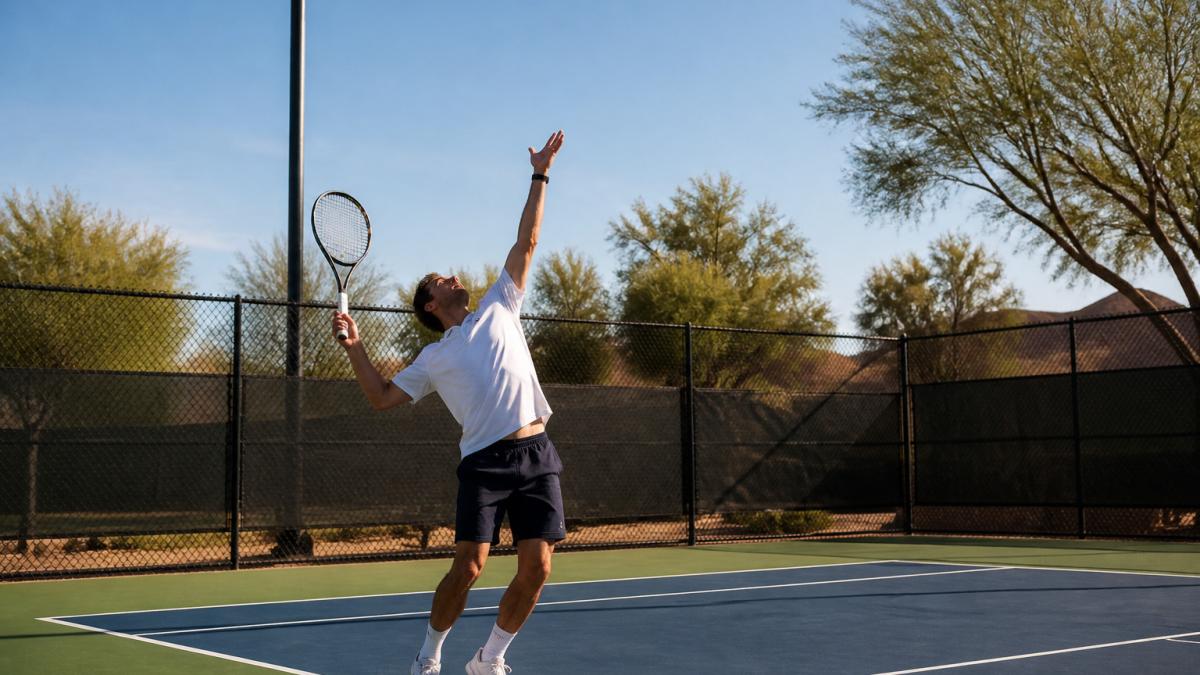
Most serve advice stops at “do these drills.” What moves the needle is a progression with a start point, a weekly structure, and a way to measure whether it’s working. Here is a six-week plan you can run on your own, plus checkpoints that tell you when to advance.
Before you start: establish a baseline
You cannot improve what you don’t measure. In your first session, hit 20 first serves and 20 second serves and record three numbers:
- In percentage: how many of 20 land in the correct service box.
- Speed: with a radar gun or phone app, record the average of your 10 fastest serves. Without one, use 60fps side video and count frames from contact to bounce, fewer frames means more speed.
- Spin proxy: for second serves, note how high the ball bounces at the receiver’s contact point. A kick serve should bounce near or above shoulder height on a hard court; a slice stays lower.
Write these numbers down. Every two weeks, repeat the same test under the same conditions, same court surface, time of day, and ball brand, so the comparison is fair.
The six-week progression
Run three serve sessions per week, with at least one rest day between them. Each session is 45-60 minutes and follows the same structure: 10 minutes warm-up, 25-35 minutes of the week’s focus, 10 minutes of serves at full effort, 5 minutes cool-down.
| Week | Focus | Session structure | Checkpoint to advance |
|---|---|---|---|
| 1-2 | Toss and trophy position | 30 toss-and-catch reps, then 30 serves at 50% effort focusing only on a consistent toss and a full trophy position | 8 of 10 tosses land in the same spot without a step |
| 3-4 | Leg drive and rotation | 20 shadow swings focusing on hip-shoulder separation, then 40 serves at 60-70% effort | Chest faces the net at contact on 8 of 10 serves |
| 5-6 | Racket acceleration and spin | 20 flat serves at 75% effort, 20 kick serves at 75% effort, then 20 full serves | Second-serve bounce reaches shoulder height on 6 of 10 kick serves |
| Week 7+ | Full serves with targets | 40 serves at 85-90% effort into a target zone, alternating first and second serves | In percentage improves by 10 points over baseline without a speed drop |
The drills that drive each phase
- Toss-only drill (weeks 1-2): toss and catch with your hitting hand, no racket. Goal is 10 in a row landing in the same spot, the single highest-return drill for most players.
- Trophy-position hold (weeks 1-2): freeze at the trophy position for two seconds, then complete the serve at half speed. Builds the feel of a loaded, balanced position.
- Separation drill (weeks 3-4): stand with your back to the net, turn your hips toward the net while keeping your shoulders back, then let the shoulders catch up. Do 10 reps without a ball, then 10 with a toss.
Skill-level adjustments
- Beginners: stay in weeks 1-2 for four weeks instead of two. Skip the kick serve until the trophy position is consistent. Use a foam or low-compression ball for the brush drill so you can feel the path without chasing the result.
- Intermediate players: run the full six weeks but keep full-effort serves to 10 per session. Most plateaus at this level come from too many full-speed reps and too few focused ones.
- Advanced players: compress weeks 1-4 into two weeks and spend the extra time on the kick serve and target work. Add a video check every two weeks to catch drift in the trophy position.
Troubleshooting common outcomes
- Serves going long: contact point is too far back, or the toss is drifting behind you. Move the toss slightly forward and check that your chest faces the net at contact.
- Serves into the net: you are decelerating at contact or dropping your toss too low. Finish the swing high and let the racket pass your ear.
- Inconsistent toss: your toss arm is bending or your release point is changing. Toss with a straight arm and release at eye level.
Cap full-effort serves at 40-60 per session and no more than three sessions per week. Most serve-related shoulder irritation comes from volume, not technique. If pain persists past 48 hours, stop serving and see a medical professional.
Measuring Progress and Protecting Your Shoulder
Track your progress with simple numbers: how many of 20 serves land in the box, approximate speed if you have a radar gun, and how often the ball spins as intended.
Protect your shoulder as your serve gets stronger. Warm up with light arm circles and band work before serving. Limit total serves on hard days, and rest when your shoulder aches after training.
Booking Your Serve Upgrade with Crunch Time Coaching
Improving your serve takes structure, feedback, and consistent practice. Crunch Time Coaching offers step-by-step daily lessons and challenge-based curriculum, along with online coaching and in-person training camps.
Pricing depends on the program, the dates, and how you want to train, so check the current options and request a quote on our website. Reserve your spot today.
Frequently Asked Questions
How can I increase my tennis serve speed?
Serve speed comes mainly from sequencing your body rather than swinging the arm harder. Start with a consistent toss, turn your shoulders and torso through the hitting zone, drive up from the legs, and let the racket accelerate through contact. Practice these elements slowly first, then add pace once the motion feels repeatable. Track your speed with a radar gun or a serve-speed app so you can see whether each change actually adds miles per hour over several weeks.
How do you add more spin to a tennis serve?
Spin depends on racket-head speed and the path the racket takes through the ball. A continental grip lets you brush up and across the back of the ball for topspin or slice. Contact the ball slightly higher and let the racket move upward and across it. Test each change with a few dozen serves into the same box and note the bounce height and direction to confirm the spin is changing.
Does a faster racket swing make a serve faster?
Not by itself. A faster arm swing without proper kinetic-chain sequencing usually reduces accuracy and wears on the shoulder. Serve speed comes from storing energy in the rear shoulder and pelvis and releasing it in order, so the racket arrives at contact at its highest speed. Build the sequence first, then increase racket speed gradually.
What grip should I use for a faster, spin-heavy serve?
Most players use a continental grip for a serve that generates both pace and spin, because it lets you pronate the forearm and brush the ball. Switching grips to chase spin often costs control, so change one variable at a time. Practice the continental grip with simple flat serves before adding heavier topspin.
