
Table of Contents
- Understanding Court Speed and the Court Pace Index
- How to Improve Footwork Speed for Tennis
- Surface Composition and Friction: The Foundation of Court Speed
- Environmental Factors: Temperature, Humidity, and Ball Compression
- Reaction Time Drills for Tennis Performance
- ATP Tournament Court Speed Rankings for 2026
- Court Maintenance Techniques to Control Surface Speed
- Adapting Your Game to Faster Courts
- Frequently Asked Questions
Last Updated: September 25, 2026
Understanding Court Speed and the Court Pace Index
Court speed affects how the entire playing surface influences your game, not just ball velocity, and understanding how to increase tennis court speed through maintenance and preparation changes how you train. Understanding this distinction changes how you train.
The Court Pace Index (CPI) measures how quickly a ball loses energy after bouncing. Faster courts mean less energy loss, lower ball trajectory, and less reaction time, requiring adapted footwork and positioning.
Different surfaces play at different speeds:
- Hard courts (like the Australian Open) play medium to fast
- Clay courts (French Open) play slow
- Grass courts (Wimbledon) play very fast
Faster courts demand more explosive footwork. Most players assume court speed is fixed, but you can influence it through surface maintenance and preparation.
Court speed changes throughout a tournament as the surface wears down. Day 1 plays slower than Day 5. Track this pattern and adjust your positioning accordingly.
How to Improve Footwork Speed for Tennis
Footwork speed determines whether you reach the ball before the second bounce. The fastest footwork combines explosive leg power with efficient movement patterns.
Start with explosive drills that build lateral quickness:
- Ladder drills: 30 seconds on, 30 seconds rest (repeat 6 times)
- Cone sprints: Accelerate and decelerate around cones placed 10 feet apart
- Lateral shuffles: Side-to-side movement mimicking court positioning
- Box jumps: Build explosive power in your calves and quads
These drills target rally-specific muscles. Court-specific footwork training produces faster court movement in weeks, not months, unlike generic cardio.
Consistency matters: three sessions per week beats one intense session. Your nervous system needs frequent exposure to explosive movements to build match-firing neural pathways.
Improving footwork speed also means eliminating wasted motion. Every step should move you toward the ball. Specialized drills teach the exact foot placement pros use.
Footwork speed improves fastest when you train the specific movement patterns used in tennis, not generic fitness. Court-specific drills beat general conditioning every time.
Surface Composition and Friction: The Foundation of Court Speed
Surface friction controls court speed: more friction slows the ball, less friction speeds it up.
Acrylic Coating and Sand-to-Paint Ratio
Acrylic coatings contain sand particles that create friction. More sand means slower play. Professional tournaments carefully control this ratio.
Acrylic surfaces contain acrylic binder, sand particles, and water. Sand-to-paint ratios range from 1:3 to 1:5 by volume: higher ratios create slower courts, lower ratios create faster courts.
DIY Surface Modification vs. Professional Resurfacing: A Practical Guide
If you’re managing a facility court, you have two paths to adjust court speed: temporary modifications and permanent resurfacing.
Temporary DIY modifications include: sweeping (removes debris, lasts 3-7 days, free), adding sand (2-4 lbs per 1,000 sq ft, lasts 5-14 days, $15-$40), and water misting (increases friction 2-6 hours, free).
DIY modifications fail long-term because weather, foot traffic, and ball impact undo changes quickly, creating inconsistency that defeats court-speed training.
Professional resurfacing is the permanent solution:
Professional resurfacing includes pressure washing, base repair, applying 2-4 acrylic coats with controlled sand ratios, and curing (7-14 days). Cost: $8,000-$15,000 ($3-$5/sq ft). Timeline: 2-4 weeks. Durability: 5-8 years.
When ordering professional resurfacing, specify your target Court Pace Index (CPI) or desired speed category (slow, medium, fast). Reputable contractors will adjust sand ratios to meet your specification. For example, if you want a faster court than your current surface, request a lower sand-to-paint ratio (1:4 or 1:5 instead of 1:3).
Measuring Current Court Speed
Before you modify or resurface, measure your baseline. This tells you whether changes are working.
Simple field test: Drop a ball from shoulder height, measure bounce height across 5 locations, and average. Faster courts produce higher bounces. This is repeatable and free.
Professional measurement: Use a ball-drop device or hire a contractor with a Court Pace Index meter.
When to Modify vs. When to Resurface
- Modify temporarily if: You’re testing court-speed preferences, training for a specific tournament surface, or managing short-term facility requests.
- Resurface professionally if: Your court is more than 5 years old, you want permanent speed changes, you’re hosting tournaments, or temporary fixes have failed repeatedly.
Never strip or heavily modify a court surface without professional guidance. You can damage the base layer, creating drainage problems and expensive repairs. Temporary fixes often create bigger problems. If you’re unsure whether your court can handle modification, consult a professional contractor first.
Facility managers can adjust court speed temporarily through sweeping, sand application, and water treatment, but these changes last days to weeks, not months. Permanent speed control requires professional resurfacing with specified sand-to-paint ratios. For competitive play, invest in resurfacing; for training flexibility, temporary modifications work.
Environmental Factors: Temperature, Humidity, and Ball Compression
Air density affects ball behavior. Temperature and humidity alter ball compression and bounce.
Reaction Time Drills for Tennis Performance
Reaction time is the gap between seeing the ball and moving. Faster reaction time gives you extra time to position yourself. This extra time wins matches.
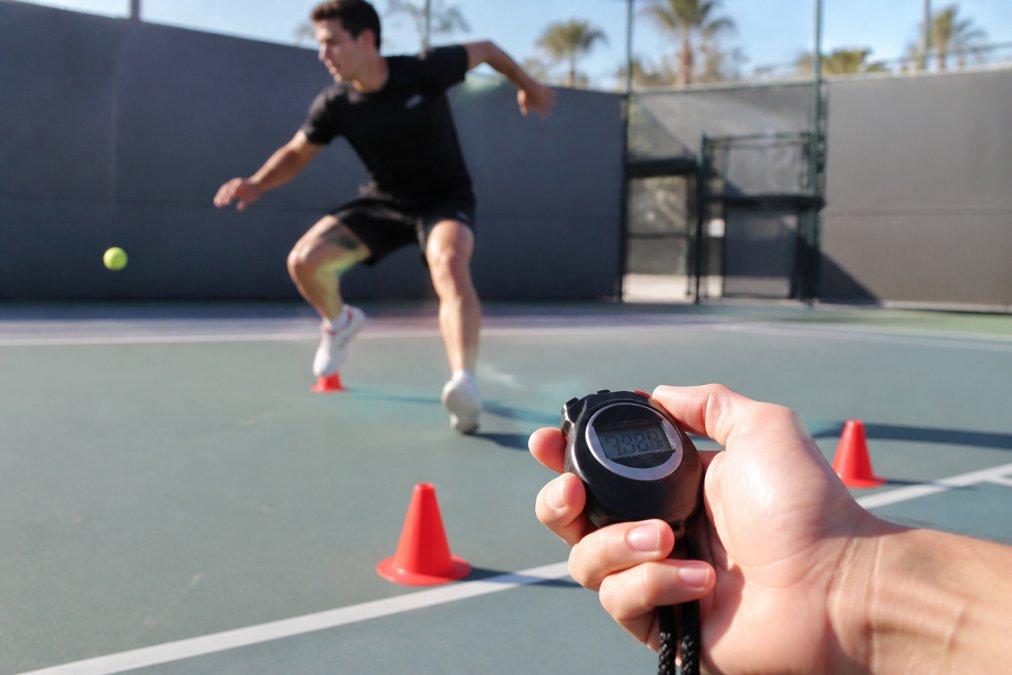
Effective reaction drills:
- Ball drop drills: Partner drops a ball from shoulder height. You react and catch it before the second bounce. Start 10 feet away, move closer as you improve.
- Directional sprints: Coach points left or right. You sprint that direction. Repeat 10 times per direction, rest 60 seconds, repeat 3 sets.
- Volley reaction: Stand at net. Partner hits balls at increasing speeds. You volley without stepping back. This trains explosive reaction under pressure.
- Serve return anticipation: Opponent serves. You guess direction and move before the serve lands. Correct guesses earn a point. Wrong guesses cost one.
Reaction time improves fastest when you train under slight pressure (fatigue, speed increases, consequences for mistakes). Comfortable drills don’t trigger nervous system adaptation.
ATP Tournament Court Speed Rankings for 2026
The ATP rates court surfaces by speed to help players prepare for tournaments. In 2026, equipment changes are shifting how courts actually play.
Traditional Court Speed Categories
Fast courts (Australian Open, Wimbledon): quick ball travel, fast rallies, serve dominance, explosive footwork required. Medium courts: balanced serve/baseline play, consistent footwork required. Slow courts (French Open clay): extended rallies, baseline dominance, endurance required.
2026 Ball Specification Changes and Perceived Court Speed
Starting in 2026, the ITF tightened ball compression tolerances (52-55 inches rebound vs. previous 53-58 range), reducing variability between new and worn balls during matches.
Practical impact for players:
- Fast courts (Australian Open, Wimbledon) now play noticeably faster than they did in 2025 because the ball doesn’t lose compression mid-match.
- Medium courts feel slightly faster because the compression consistency removes the “slow down” effect that occurred when balls aged.
- Slow courts (clay) feel less slow because the tighter compression standards prevent the extreme softening that used to happen with worn balls.
Equipment Changes Affecting Court Speed Perception
Beyond balls, racket technology in 2026 also influences how court speed feels:
- Larger sweet spots: Modern rackets (2026 models) have expanded sweet spots, which means off-center hits produce faster ball speeds. This makes courts feel faster because more of your shots carry pace.
- Stiffer frames: New materials allow stiffer frames without adding weight. Stiffer frames transfer more energy to the ball, increasing perceived court speed by 2-4 mph on average.
- String tension standards: The ATP now monitors string tension more closely. Tighter strings (52-56 lbs) produce faster ball speeds than looser strings (48-52 lbs). If you’re competing, match the string tension your opponents use.
How to Prepare for 2026 Court Speed Variations
Train specifically for tournament surfaces and equipment, generic conditioning doesn’t prepare you for surface-specific demands.
When preparing for a specific tournament:
- Identify the court surface and its historical speed rating.
- Check the 2026 ball specifications the tournament will use (usually posted 4 weeks before the event).
- Practice with balls and rackets that match tournament equipment.
- Adjust your footwork and positioning based on the equipment-court combination, not just the court alone.
Court speed in 2026 is no longer just about the surface, it’s about the interaction between surface, ball compression standards, and racket technology. Train with 2026-compliant equipment to avoid surprises during competition.
Court Maintenance Techniques to Control Surface Speed
Maintenance directly affects court speed. A well-maintained court plays consistently. A neglected court plays unpredictably. This matters for your facility and your training.
Adapting Your Game to Faster Courts
Faster courts demand different tactics than slow courts. Your footwork, positioning, and shot selection must adapt.
Frequently Asked Questions
How can I actually increase tennis court speed if I don’t own the court?
You can’t change the court surface itself, but you can master the skills that make you faster on any court. Focus on reaction time drills, footwork conditioning, and understanding how surface friction affects ball bounce and movement. If you manage a court or facility, professional resurfacing or adjusting the sand-to-paint ratio of the acrylic coating increases court speed. For competitive play, study ATP tournament court speed rankings to know what surface conditions you’ll face and train accordingly.
What’s the difference between court speed and player speed?
Court speed refers to how fast the ball travels and bounces based on surface composition, friction, and environmental conditions. Player speed is your ability to react, move, and position yourself on that court. You control player speed through footwork drills, reaction time training, and agility work. Court speed is determined by the surface itself. Increasing your player speed means you can handle faster courts, and any court, more effectively.
Do 2026 equipment or ball changes affect court speed?
Ball compression and design influence how courts play. Harder, less-compressible balls generate higher bounce and faster court conditions. In 2026, equipment standards remain consistent with recent years, but understanding ball compression helps you anticipate court behavior. Courts with higher acrylic coating density and optimal sand ratios also produce faster conditions. Temperature and humidity further affect ball compression and air density, making courts play faster in cold, dry conditions.
How long does it take to see improvements in court speed adaptation?
Reaction time improvements typically show within 2-3 weeks of consistent drills. Footwork speed gains develop over 4-8 weeks with focused training. Understanding court pace index readings and surface friction takes practice but can improve your tactical decisions immediately. With structured coaching that addresses your specific technique gaps, competitive players can achieve a higher level of play.
Faster courts demand explosive footwork, quick reactions, and aggressive tactics. Slower courts reward patience, consistency, and baseline control. The best competitive players master both. Start by identifying which court type challenges you most. Then target that weakness with deliberate, surface-specific training. Reserve your spot today with Crunch Time Coaching and get personalized guidance on adapting your game to any court speed you encounter in 2026 competition.