
Table of Contents
- Why Serve Power Matters as You Age
- Master the Continental Grip and Racket Position
- Perfect Your Ball Toss and Loading Phase
- How to Increase Racquet Head Speed Without Injury
- Tennis Injury Prevention for Older Players
- Tennis Fitness for Over 50: Building Explosive Power
- Drills to Build Serve Velocity and Consistency
- Mental Approach and Rhythm for Tournament Success
- Frequently Asked Questions
Last Updated: September 22, 2026
Why Serve Power Matters as You Age
Your serve is your most important weapon on the court. It’s the one shot you control completely. As you age, maintaining tennis serve power older players need becomes harder, but it’s absolutely possible with the right approach.
Many players over 50 think power is gone for good. That’s the biggest mistake. The issue isn’t age itself. It’s that most players stop using proper technique. When you master the right mechanics, you can hit a powerful serve well into your 60s and beyond.
Here’s what changes: your muscles recover slower. Your joints need more care. But your brain gets sharper. You can use better technique to make up for what you lose in raw athleticism. This guide from Crunch Time Coaching breaks down exactly how.
The real secret isn’t trying harder. It’s using your whole body as one connected system. Most older players try to muscle the serve with their arm alone. That’s backwards. Your legs, core, and shoulders do most of the work.
Master the Continental Grip and Racket Position
The continental grip is non-negotiable for power. This grip lets your wrist snap through the ball with maximum speed. It also protects your arm from injury, something critical as you age.
Hold the racket like you’re shaking hands with it. Your thumb and index finger form a V pointing toward your right shoulder (for right-handers). This position is the foundation for everything else. Without it, you’re fighting physics.
Your racket position at the start matters too. Bring the racket up to ear level as you prepare. Don’t drop it behind your back, that wastes energy and strains your shoulder. Keep it high and ready. This cuts down on unnecessary motion.
The continental grip also changes your follow-through. Your wrist naturally pronates (rotates inward) through the contact point. This pronation creates racket head speed without forcing your arm to do all the work.
Many older players grip too tight. A tight grip kills wrist snap and tires your forearm fast. Hold the racket firmly but not rigid. Your grip should feel like you’re holding a bird, firm enough it doesn’t fly away, loose enough it can breathe.
Perfect Your Ball Toss and Loading Phase
The ball toss is where most serves fall apart. A bad toss forces you to adjust mid-motion. That kills consistency and power. Get this right first.
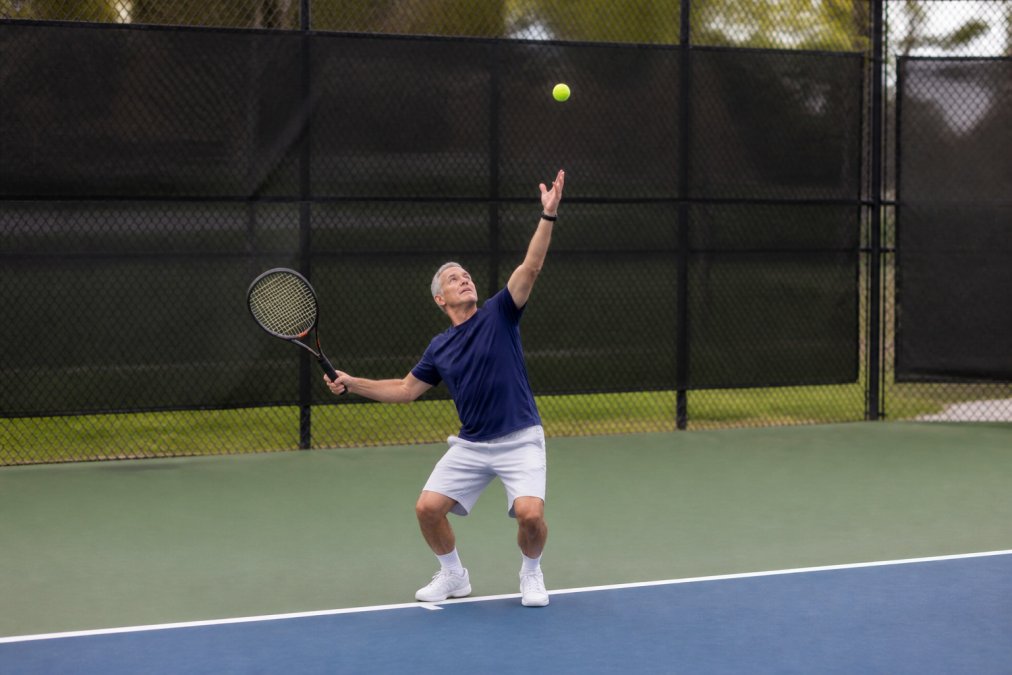
Toss the ball about 12 inches in front of you and slightly to the right. It should rise about 6 inches above your fully extended arm reach. The toss should be consistent every single time. Practice it without hitting, just toss 20 times and catch it.
The loading phase is what happens next. As the ball rises, you load your body like a spring. Your knees bend slightly. Your shoulders rotate back. Your weight shifts to your back foot. This is where you store energy. Without proper loading, you have no power to release.
Think of it like cocking a gun. You pull back first. Then you fire forward. Your body works the same way. The loading phase is the pull-back. The service motion is the fire.
Most older players rush this phase. They try to hit the ball too fast. Slow down. Load properly. The power comes from the sequence, not from rushing. A smooth, controlled loading phase generates more speed than a fast, sloppy one.
How to Increase Racquet Head Speed Without Injury
Racket head speed is the main driver of serve power. The faster your racket moves through the contact point, the faster the ball travels. But speed without control causes injury.
The key is using your entire kinetic chain. Your legs start the motion. Your core continues it. Your shoulders add to it. Finally, your arm and wrist finish it. Each part transfers energy to the next. This is biomechanical efficiency.
Weight Transfer and Kinetic Chain Sequencing
Weight transfer is where power comes from. It’s not your arm. It’s your legs pushing into the ground and that force traveling up through your body.
Start with your weight on your back foot during the loading phase. As you begin your forward swing, drive your front knee up slightly. This triggers your back leg to push hard into the court. That push sends energy up through your hips, core, and shoulders.
The sequence matters more than the speed of each part. Legs first. Then hips. Then shoulders. Then arm. Then wrist. Each segment accelerates slightly faster than the one before it. This is the kinetic chain. It’s how a 55-year-old can hit a serve as fast as a 25-year-old.
Most tennis serve power older players try to generate comes from breaking this chain. They try to generate power from their shoulder or arm alone. That’s inefficient and dangerous. Your shoulder joint isn’t built for that kind of force. Your legs are.
The kinetic chain is the foundation of power without injury. Master the sequence: legs → hips → core → shoulders → arm → wrist. Each part accelerates the next. This spreads force across your whole body instead of concentrating it in one joint.
Shoulder Rotation and Pronation Timing
Your shoulder rotation is critical. As you load, rotate your shoulders back hard. Your front shoulder should point at the net. Your back shoulder should point away from the net. This rotation stores elastic energy in your core.
As you start your forward swing, your hips rotate first. Your shoulders follow a split second later. This sequence creates lag, your hips are ahead of your shoulders. That lag is where power comes from.
Pronation happens at the contact point. Your forearm rotates inward. Your wrist snaps. Your racket face closes slightly. This pronation is what creates topspin and speed. It also protects your arm because it lets your wrist absorb shock naturally.
The timing of pronation is everything. Start it too early and you lose power. Start it too late and you don’t have time to generate speed. The sweet spot is right at contact.
Tennis Injury Prevention for Older Players
Injury prevention is your real priority. You can’t build power if you’re hurt. The best serve is one that keeps you healthy.
The rotator cuff takes most of the stress in the serve. Your rotator cuff is four small muscles that stabilize your shoulder. They’re not big muscles. They can’t handle constant heavy load. But they’re crucial for shoulder health. Strengthening these stabilizers requires a deliberate approach to muscle growth for seniors that prioritizes tendon resilience and long-term joint integrity.
Strengthen your rotator cuff with light resistance bands.
Flexibility and Mobility Work for Serve Power
Flexibility is often overlooked. Many older players think they just lose it. That’s not true. You lose it when you stop working on it.
Most older players skip mobility work. That’s why they get hurt. Spend 10 minutes before practice on mobility and stretching. It prevents injury and improves your serve. It’s the best investment you can make.
Tennis Fitness for Over 50: Building Explosive Power
Explosive power comes from fast-twitch muscle fibers. These fibers fire in short bursts. They’re what you need for a powerful serve.
The right program makes a huge difference.
Drills to Build Serve Velocity and Consistency
Drills are where theory becomes practice. Spend 20-30 minutes on serve drills at least 3 times per week.
Serve Rhythm Drill
Target Serving
Slow-Motion Serves
Power Serves
Consistency Challenge
| Drill | Duration | Frequency | Focus |
|---|---|---|---|
| Serve Rhythm | 5 minutes | 3x/week | Smooth flow |
| Target Serving | 10 minutes | 3x/week | Accuracy |
| Slow-Motion Serves | 5 minutes | 3x/week | Technique |
| Power Serves | 5 minutes | 3x/week | Full effort |
| Consistency Challenge | 10 minutes | 2x/week | Pressure |
Mental Approach and Rhythm for Tournament Success
Your mental game matters as much as your technique. A powerful serve is useless if you’re nervous.
Frequently Asked Questions
How can I increase the power of my tennis serve without risking injury?
Focus on the kinetic chain: power flows from your legs through your core and shoulders before reaching your arm. Build flexibility with daily mobility work targeting your shoulders, hips, and wrists. Strengthen your core and legs with exercises that mimic the serve motion. Start with slower, controlled practice, gradually increasing racquet head speed as your technique solidifies. Warm up thoroughly before serving hard, and use proper footwork to distribute impact forces rather than isolating stress to your shoulder and elbow.
Can you play competitive tennis at 70+ years old?
Yes. Competitive tennis at 70+ is entirely possible with proper technique, conditioning, and injury prevention. Your serve remains a powerful weapon when built on biomechanically sound mechanics rather than raw muscle. Many players over 70 compete successfully in age-group tournaments. The key is prioritizing technical efficiency and consistency over power alone, maintaining flexibility and core strength, and listening to your body to avoid overuse injuries that can sideline you longer than in younger years.
What role does the kinetic chain play in serving for older adults?
The kinetic chain is everything for older players. Rather than relying on arm strength alone, power comes from coordinated sequencing: legs drive upward, hips rotate, core engages, shoulders rotate, and finally the arm accelerates. This distributes the load across multiple muscle groups, reducing stress on your shoulder and elbow. A broken kinetic chain forces your arm to generate power independently, causing injury and limiting velocity. Proper sequencing also improves consistency and reduces fatigue, letting you serve effectively throughout long matches.
How long does it take to see improvement in serve power and accuracy?
With focused practice on technique and conditioning, most players notice improved consistency within 2-3 weeks and measurable velocity gains within 4-6 weeks. However, this assumes you’re training 3-4 times per week with proper instruction. Real transformation, where your serve becomes a reliable weapon in matches, typically takes 8-12 weeks of consistent work. Mental confidence also plays a role; as your technique improves, your willingness to trust your serve in tiebreakers and pressure situations grows naturally.