
Table of Contents
- Is One Week Realistic? What You Actually Need to Know
- Day 1-2: Grip and Stance Fundamentals
- Day 3-4: Master Tennis Serve Ball Toss Technique
- Day 5-6: Swing Path, Kinetic Chain, and Power Generation
- How to Fix Tennis Serve Faults in Real Time
- Tennis Serve Practice Drills for the Week
- Day 7: Test, Adjust, and Build the Habit
- Frequently Asked Questions
Last Updated: August 31, 2026
Is One Week Realistic? What You Actually Need to Know
Can you truly master your tennis serve in one week? You won’t transform into a touring pro in seven days, but you absolutely can fix fundamental technical flaws, build muscle memory, and develop serve reliability with focused daily practice.
Here’s what’s actually possible: fixing poor mechanics, correcting grip issues, stabilizing your ball toss, and improving consistency on key points. Many competitive players hit a plateau because they’ve grooved poor mechanics, a continental grip that’s slightly off, a ball toss that drifts, or a swing path that collapses under pressure. These are fixable with structured daily work.
One week gives you a foundation and momentum. It creates the conditions for rapid improvement. But tennis serve mastery, where your serve becomes a genuine weapon in matches, requires ongoing refinement beyond day seven. Think of this week as an intensive reset and rebuild, not a destination.
Your success depends on three things: honest assessment of your current mechanics, willingness to feel uncomfortable making changes, and daily repetition. Commit to all three and you’ll surprise yourself.
Day 1-2: Grip and Stance Fundamentals
Your grip is the foundation of everything that follows. Most recreational players grip the racket like a baseball bat. This eastern grip works for forehands and backhands but sabotages your serve.
The continental grip is non-negotiable for an efficient serve. Your index knuckle sits on bevel two of the racket handle. Your thumb wraps underneath for stability. The grip should feel firm but not tense.
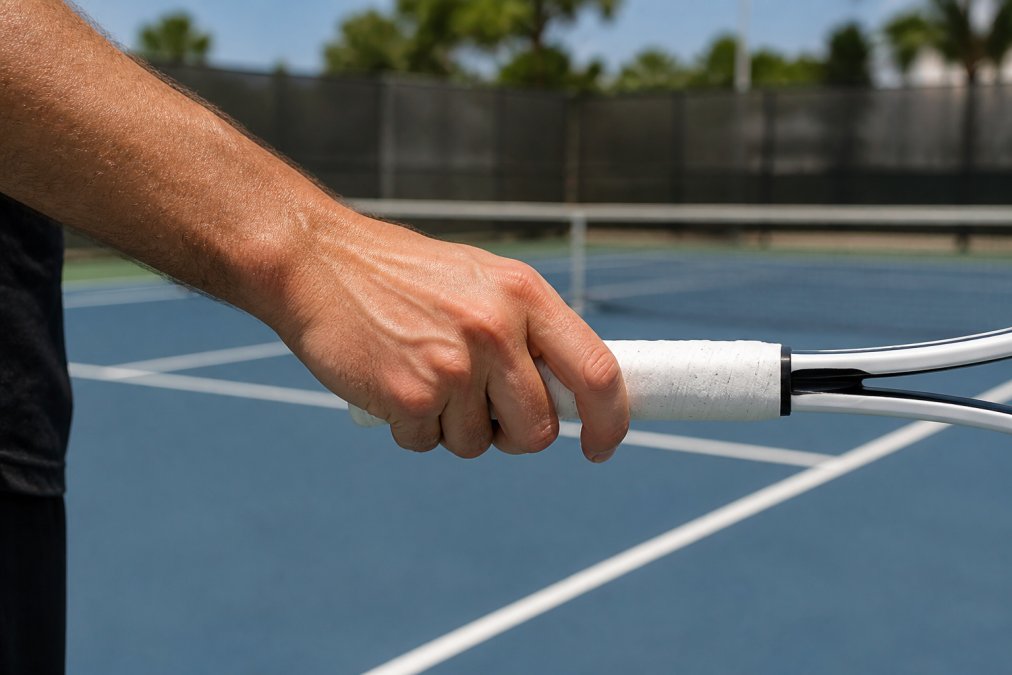
Why does grip matter so much? The continental grip naturally positions your racket head at the right angle during loading. It allows your wrist to pronate naturally during acceleration. A different grip forces compensations that destroy consistency and limit power.
Spend 15 minutes today holding the racket with the continental grip. Walk around. Do practice swings without a ball. Your hand will resist this at first. That’s normal.
Your stance comes next. Stand sideways to the baseline with your feet shoulder-width apart. Your non-dominant shoulder points toward the net. Your weight sits on the balls of your feet. From here, step into the court with your front foot as you begin your serve motion.
Common mistake: standing too close to or too far back from the baseline. You want roughly one foot inside the baseline. Spend tomorrow practicing your stance and footwork. Step forward smoothly 20 times without a racket, then 20 times with one. The rhythm should feel natural, not forced.
Day 3-4: Master Tennis Serve Ball Toss Technique
Your ball toss is the second most important technical element after your grip. A consistent ball toss is the difference between serves you can repeat and serves that feel random.
The ideal ball toss for a flat serve lands approximately 12-18 inches in front of you and 6-12 inches to the right of your body (for right-handers) (usta.com). The ball should reach its peak just as your racket makes contact.
Your toss doesn’t need to be perfect every time, it needs to be consistent. A toss that’s slightly high is better than one that varies wildly. Consistency allows your body to adapt and time the serve correctly.
Hold the ball in your fingertips, not your palm. The toss motion should be smooth and relaxed, a gentle push upward, not a throw. Many players toss too hard, creating unpredictable trajectories.
Practice your ball toss without a racket for 10 minutes today. Toss and catch, focusing on the same release point every time. By the end, you should toss 10 times in a row landing within a 2-foot circle.
Tomorrow, add the racket back. Stand in your service stance, toss, and let the ball bounce without swinging. Repeat 20 times. Then do 20 more where you swing and make contact. Focus only on the toss and timing.
By the end of day four, your ball toss should feel automatic. You should be able to toss and swing without thinking about the toss mechanics.
Day 5-6: Swing Path, Kinetic Chain, and Power Generation
This is where your serve transforms from technically correct to powerful. The swing path determines how much speed and spin you can generate. The kinetic chain, the sequential engagement of your legs, hips, shoulders, and arm, determines how much energy you transfer into the ball.
Your serve motion has distinct phases. The ready position leads into the loading phase, where you bring the racket up and back. Your non-dominant arm extends toward the net for balance. Your racket hand drops below your hip. This is the trophy position.
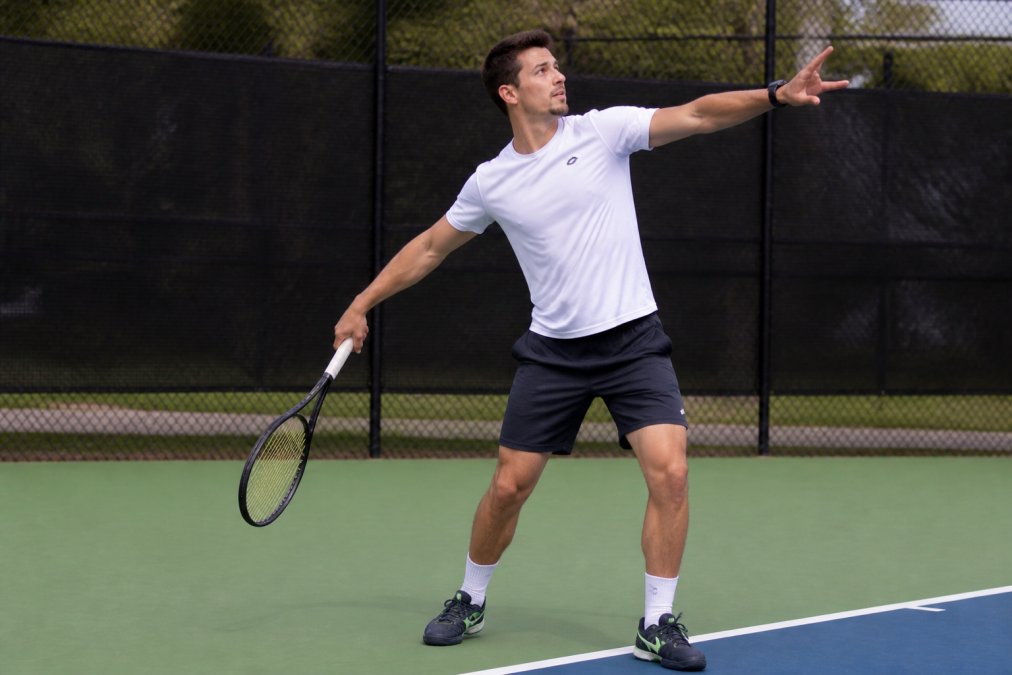
From the trophy position, you initiate the acceleration phase. Your legs drive upward. Your hips rotate toward the net. Your shoulders follow. Your arm extends upward and forward. Your wrist pronates as you accelerate through the ball. This sequential engagement, legs, hips, shoulders, arm, wrist, is your kinetic chain.
Most players generate power from their arm alone. When you engage your legs, hips, and shoulders first, your arm is already moving at high speed before it accelerates. This multiplies your racquet head speed dramatically.
Spend 30 minutes today practicing the trophy position and acceleration phase. Do slow-motion swings emphasizing each phase. Feel your legs driving upward, hips rotating, shoulders following, then arm accelerating.
Tomorrow, practice at normal speed. Do 30 serves focusing on your kinetic chain. You should feel your whole body contributing, not just your arm. Your swing path should be smooth and continuous without hesitation in the trophy position.
How to Fix Tennis Serve Faults in Real Time
The serve lands in the net: Your contact point is too low or your racket head isn’t traveling upward through the ball. Check your trophy position and arm extension. If both are correct, your ball toss might be too low. Toss higher and adjust your timing.
The serve sails long: Your contact point is too far behind you or your racket head is tilted too far backward. Adjust your ball toss slightly forward. You can also reduce your swing speed slightly, a controlled swing with good technique produces better results than maximum effort.
Double faults under pressure: Your mechanics collapse when stakes rise. Slow down your serve motion slightly. Take a deeper breath. Bounce the ball a few times before serving. These rituals reset your nervous system.
Weak second serve: You’re likely decelerating instead of accelerating through the ball. Accelerate fully through your second serve. Add slice or kick instead of reducing speed. A fast, spinning serve is harder to hit than a slow, flat serve.
Inconsistent placement: Your ball toss is drifting. Film yourself serving or have someone watch. Notice where your toss lands and adjust your release point. Place a towel or cone where you want the serve to land and serve 10 balls aiming for that spot.
The real-time fix process: identify the fault, isolate the cause, make one small adjustment, test it with 5-10 serves. Never make multiple changes at once.
Tennis Serve Practice Drills for the Week
Drills create the structure that turns practice into improvement. Random hitting doesn’t build consistency. Targeted drills with specific outcomes do.
Drill 1: Toss Consistency (10 minutes, daily)
Toss 20 balls without a racket. Count how many land in a 2-foot circle. Aim for 18-20 perfect tosses.
Drill 2: Serve Placement Targets (15 minutes, days 3-7)
Place cones or towels in the four corners of the service box. Serve 10 balls to each corner. Track how many land in the box.
Drill 3: First Serve Percentage (10 minutes, days 5-7)
Serve 20 first serves. Count how many land in the service box. Aim for 14-16 out of 20 (70-80%).
Drill 4: Pressure Serves (5 minutes, day 7)
Imagine you’re down 0-40 in a tiebreaker. Serve 5 balls. Then imagine you’re at 30-all, match point. Serve 5 more.
Drill 5: Rhythm and Timing (10 minutes, days 1-4)
Serve without worrying about accuracy. Focus only on your rhythm. Do 20 serves counting “one, two, three” for each phase.
| Drill | Duration | Focus | Days |
|---|---|---|---|
| Toss Consistency | 10 min | Ball toss reliability | Daily |
| Serve Placement Targets | 15 min | Court positioning accuracy | Days 3-7 |
| First Serve Percentage | 10 min | Consistency under pressure | Days 5-7 |
| Pressure Serves | 5 min | Mental toughness | Day 7 |
| Rhythm and Timing | 10 min | Smooth motion flow | Days 1-4 |
Total daily practice time should be 45-60 minutes. Quality matters more than quantity. Thirty minutes of focused practice beats three hours of mindless hitting.
Film yourself serving on your phone. Watch the footage with the sound off. You’ll spot mechanical issues you can’t feel. Your ball toss drifting right? Your arm not extending upward? Video reveals everything.
Day 7: Test, Adjust, and Build the Habit
By day seven, your fundamentals should feel solid. Your grip is continental. Your stance is consistent. Your ball toss is reliable. Your swing path flows smoothly.
Serve 50 balls into the service box. A realistic target is 35-40 out of 50 (70-80%) (peer-reviewed research). If you’re hitting 70%+, you’ve made real progress.
Serve 20 first serves at 75% effort, then 20 more at 90% effort. Notice the difference. Most players lose accuracy when they increase speed. If your accuracy drops significantly at higher speeds, your technique breaks down under pressure.
Play a practice point where you serve. Do this 10 times. Notice how your serve performs in a realistic scenario. Match pressure is different from practice pressure.
The real test: serve 10 balls imagining you’re at deuce in a match. Track your percentage. This reveals your true technical level.
One week creates momentum and fixes obvious technical flaws. Real mastery requires ongoing work. But the foundation you build this week is the launching point for everything that follows.
Building the habit beyond day seven: Your serve won’t maintain improvement without continued practice. Commit to 20-30 minutes of serve practice three times per week. Maintain your grip, toss consistency, and kinetic chain engagement. Every few weeks, revisit the drills that helped most.
If you’re serious about competitive tennis, Crunch Time Coaching offers personalized coaching that goes beyond a one-week sprint. Our step-by-step daily instruction helps you identify your specific technical issues and build sustainable improvement. Many players find that working with a coach accelerates their progress beyond what they can achieve alone.
Mastering your tennis serve in one week is realistic if you focus on the right fundamentals and commit to daily practice. You won’t become a pro, but you’ll fix technical flaws, build muscle memory, and develop genuine serve reliability. One week is a beginning, not an ending. The foundation you build now becomes the platform for everything you do on the court. According to research on motor skill development from the Journal of Sports Sciences, consistent daily practice over short periods creates measurable improvements in technique and consistency. The serve is learnable. The question isn’t whether you can improve, it’s whether you’re willing to do the work. Start today. Track your progress. Adjust based on what you learn. By day seven, you’ll have a serve you can trust.
Frequently Asked Questions
Is it realistic to improve a tennis serve in one week?
Yes, but with an important caveat: one week delivers immediate technical fixes and consistency improvements, not a complete serve overhaul. You’ll fix grip errors, stabilize your ball toss, and groove your swing path through intensive daily practice. Most players see measurable improvement in serve percentage and accuracy within seven days. However, mastering your serve at an elite level, adding spin variation, hitting aces consistently, and performing under tournament pressure, requires weeks of reinforcement. This week builds the foundation and breaks bad habits; sustained practice locks in the gains.
How do I develop a consistent ball toss in seven days?
Your ball toss is the foundation of serve consistency. Start Day 3 by tossing without a racket, aiming for the same release point and height every time (typically 12-18 inches above your head). Hit 50 tosses daily, focusing on rhythm and timing rather than power. By Day 4, integrate the toss into your full serve motion at 50% speed. Track your toss misses, most occur because you’re not releasing the ball from the same hand position or height. Video analysis helps: film yourself and compare tosses side-by-side. Within seven days, your toss will stabilize enough to build reliable serve mechanics.
What are the most common tennis serve mistakes to avoid?
The biggest faults happen in the loading phase and follow-through. Gripping too tightly restricts racquet head speed and control. Tossing too far forward or backward throws off your contact point and causes double faults. Failing to rotate your shoulders limits power generation and forces your arm to do all the work, leading to injury and inconsistency. Many players also collapse their wrist at contact instead of maintaining a firm position, reducing serve accuracy. Finally, skipping the leg drive, pushing off the baseline with your legs, wastes kinetic chain energy. Fixing these four areas in one week transforms your serve reliability.
How many serves should I hit per day to see improvement?
Aim for a consistent volume of serves daily during this intensive week. Break them into focused blocks: tosses without a racket, serves at 50-75% intensity focusing on mechanics, serves at full speed targeting placement, and serves under simulated match conditions (targeting specific service boxes). Quality beats quantity, each serve should be deliberate, not mindless. Rest 2-3 minutes between blocks to maintain form and avoid fatigue-induced faults. This volume builds muscle memory and rhythm while keeping your technique sharp. Video a few serves each day to catch form breakdowns.
What drills build power and accuracy in a tennis serve?
Box-target drills are essential: divide your service box into quadrants and hit serves into each, tracking accuracy. The ‘first-serve percentage’ drill challenges you to hit consecutive first serves in the box, reset if you miss. Medicine ball rotations (holding a 4-6 pound ball, rotating your torso explosively) strengthen your kinetic chain off-court. Serve-and-volley drills force you to focus on placement, not just power. Finally, the ‘rhythm and timing’ drill: hit serves with a metronome or music at 80 beats per minute, syncing your motion to the beat. This builds consistency and prevents rushing your serve motion.
Can I actually see wins on the court after one week of training?
Absolutely. Your serve percentage will improve noticeably, most players cut double faults in half and land more first serves in the box. This directly impacts match results because holding serve is foundational to winning. You’ll also develop better serve placement, targeting weaker returns or exploiting your opponent’s positioning. However, one week gives you the technical foundation; translating that into match wins depends on how consistently you practice the drills and maintain focus under pressure. Many players see immediate league-match improvements within 2-3 weeks as the new mechanics become automatic.
How does video analysis help me fix my serve faster?
Video is your feedback loop. Film yourself from the side and behind the baseline so you can see your grip, ball toss height, shoulder rotation, and follow-through. Compare your video to your Day 1 footage, you’ll spot faults instantly. Common issues revealed by video: tossing too far forward (causes net errors), insufficient shoulder rotation (limits power), and early wrist snap (reduces accuracy). Watch your serve in slow motion to isolate the loading phase and contact point. This visual feedback accelerates learning because you don’t have to rely on feel alone. Most players self-correct faster when they see the problem.
What physical conditioning do I need for a powerful serve?
Serve power flows from your kinetic chain: legs, core, shoulder, and arm. Spend 10 minutes daily on explosive leg work: jump squats, lateral lunges, and calf raises build the leg drive that initiates your serve. Core rotations, using a medicine ball or cable machine, strengthen the torque needed for racquet head speed. Shoulder mobility drills (arm circles, band pull-aparts) prevent stiffness and injury. Wrist and forearm strengthening (wrist curls, grip exercises) stabilize your contact point. You don’t need a gym, bodyweight exercises work. This conditioning week prevents injury, improves serve speed, and builds the muscular endurance to hit serves daily without form breakdown.
This article was written using GrandRanker