
Table of Contents
- Why Mental Drills for Tennis Match Play Matter
- 1. The Reset Drill: Master Your Tennis Between-Point Routine
- 2. Visualization Exercises for Pre-Match Mental Preparation
- 3. The One-Point Match Drill
- 4. Breathing and Release Drills for Match Pressure
- 5. Building Tennis Mental Toughness Drills Through Scoreboard Pressure
- 6. Self-Talk and Challenge Thinking Drills
- 7. Measuring Progress in Your Mental Game
- Why This Matters for Your Game
- Frequently Asked Questions
Last Updated: October 16, 2026
Why Mental Drills for Tennis Match Play Matter
The gap between practice and match performance is usually mental: players who crush strokes in warm-ups freeze once the scoreboard counts. Mental drills for tennis match play aren’t optional extras, at Crunch Time Coaching, the fastest improvers train their minds as deliberately as their forehands. A player with solid technique but poor focus loses to a weaker opponent who stays present.
1. The Reset Drill: Master Your Tennis Between-Point Routine
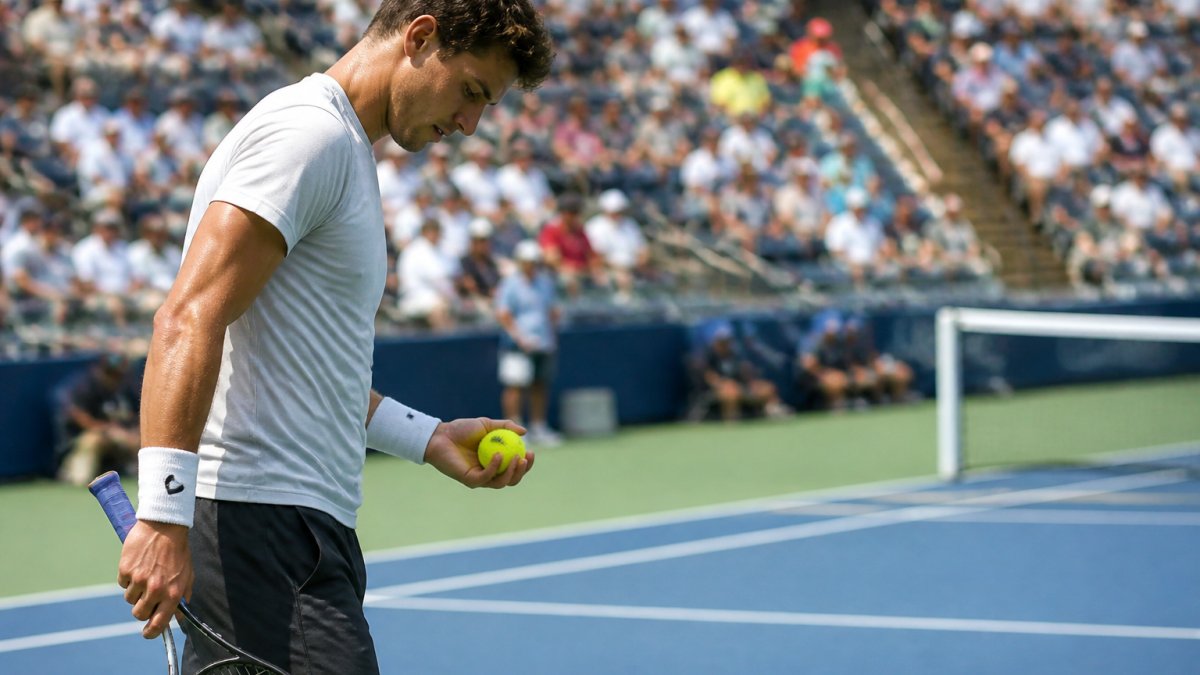
The 15-20 seconds after each point is the only time you control your mental state before the next point. A strong between-point routine prevents frustration from building and keeps you present.
Solo Practice Version
Start without a court. Sit in a chair and simulate the emotions of winning and losing points.
- Imagine you just lost a point you should have won. Feel the frustration.
- Stand up and execute your reset: one deep breath, bounce the ball three times, say a single word (“next” or “focus”), and reset your posture.
- Sit back down and repeat: lose an imaginary point, reset, stand, execute the routine.
- Do 20 repetitions to make the routine automatic during matches.
This trains your nervous system to fire the routine automatically on court.
Match Play Application
In your next match, run the same routine after every point, won or lost, don’t skip easy points.
2. Visualization Exercises for Pre-Match Mental Preparation
Visualization is one of the most underused mental drills for tennis match play: your brain fires the same neural pathways as if you’d physically hit the shot.
Building Your Pre-Match Mental Routine for Tennis
Run this 30 minutes before your match in any quiet space where you can sit undisturbed for 10 minutes.
- Close your eyes and visualize yourself on your match court. See the specific court, the lighting, the surface.
- Picture yourself hitting your best shot, your most reliable stroke. See the ball clearly, feel the racket in your hand, hear the contact sound.
- Visualize a pressure moment: you’re down 30-40 in the second set. See yourself staying calm, taking your between-point routine, and hitting a clean winner.
- Visualize winning the match. See yourself shaking hands at the net, feeling the relief and satisfaction.
- Open your eyes and step on court with that feeling fresh in your mind.
Run it before every match. Specificity matters: concrete scenarios tied to your actual court and shots beat generic “imagine playing well.”
3. The One-Point Match Drill
This drill teaches you to treat every point like a match point. Play practice sets where each point counts as 1-0, first to 10 wins; run 5-10 in a row. You can’t coast after a bad point, so your nervous system adapts to high intensity on every point. Use it in the weeks before tournaments.
4. Breathing and Release Drills for Match Pressure
Pressure tightens your chest, shoulders, and wrists, and shallow breathing cascades into anxiety, rushing, and poor decisions. Breathing and release drills interrupt that chain.
Box Breathing for Clutch Moments
Use box breathing between points or during timeouts: inhale for four, hold four, exhale four, hold four, repeat three times. It activates your parasympathetic “rest and digest” system, counteracting the stress response in 48 seconds. Use it down a break, facing set point, or after a frustrating error. Practice three rounds daily at home for a week so it’s automatic on court.
Shoulder and Wrist Release
Between points, roll your shoulders backward three times, then forward three times, and shake out your racket wrist in loose circles. Five seconds of release stops physical tension from compounding into mental tension.
5. Building Tennis Mental Toughness Drills Through Scoreboard Pressure
Mental toughness is built through controlled exposure to pressure, but “play under pressure” gives you nothing to run in practice.
Drill A: Break-Point Rehearsal
Setup: One player serves from 0-40 down (returner leads). Play out the game from that score.
Rules: Server gets one second serve only on break point (no first serve).
Duration: 15-20 minutes, or until each player has served 10 break points.
Adaptations: Solo players can serve 10 break points to an empty service box, calling the target aloud.
Drill B: Tiebreak Ladder
Setup: Play tiebreaks to 7, win by 2. Start at 0-0.
Rules: No coaching between points. Players must use their between-point routine after every point, win or lose.
Duration: 20-30 minutes.
Skill target: Emotional control when trailing; executing routine under the highest-stakes score in tennis.
Adaptations: Solo: serve 10 tiebreak points from 4-6 down, tracking how many you win.
Drill C: Serving to Close
Setup: Server leads 5-4, 40-30. Play the game out. If the server holds, the drill is a success; if not, reset and repeat.
Rules: Server must announce the serve placement (wide, body, T) before each first serve.
Duration: 10-15 minutes.
Skill target: Committing to a tactical plan on the biggest serve of the game; managing the urge to push or guide the ball.
Adaptations: Solo: serve 20 points from 40-30, calling placement aloud.
Drill D: Playing From Behind
Setup: Start every set at 0-3 down. Play a full set. Track how many games you win from that deficit.
Rules: No scoreboard complaints, no visible frustration (racket taps, head shakes) allowed. A visible frustration reaction costs a point.
Duration: 30-40 minutes (three sets).
Skill target: Resilience and the ability to separate the score from the next point; body-language discipline.
Adaptations: Solo: play a practice set against a ball machine or wall, starting each game at 0-30.
Drill E: Sudden-Death Games
Setup: Every game is sudden death: first player to win one point wins the game. Play a set to 6 games.
Rules: Between every point, both players must complete a full between-point routine before the next point begins. No quick serves.
Duration: 15-20 minutes.
Skill target: Sustaining focus and routine consistency when every point is effectively a game point.
Adaptations: Solo: serve 30 sudden-death points, resetting fully between each.
Drill F: Momentum-Shift Set
Rules: Players must verbalize one tactical adjustment after each declared shift.
Duration: 25-35 minutes.
Skill target: Adaptability under pressure; connecting emotional reset to a concrete tactical change.
Adaptations: Solo: alternate serving games from 0-0 and 0-30, treating each as a momentum scenario. Coach: coach controls the shift declarations and can increase frequency to simulate a match spiraling.
Run these drills in the two to three weeks before a tournament, not the week of. The goal is to build familiarity with pressure, not to arrive at the event fatigued.
Why This Library Works
Each drill isolates a specific score situation, forces a routine or verbal commitment that makes the skill observable, and works solo, with a partner, or with a coach. Players who struggle in matches usually don’t lack toughness, they lack rehearsal.
6. Self-Talk and Challenge Thinking Drills
Most players let self-talk run on autopilot as complaints: “I can’t hit my backhand,” “I always lose tiebreakers.” Write down three automatic negative thoughts from your matches, then a challenge-thinking response for each that acknowledges difficulty but commits to effort, e.g., “My serve is off today, but I can adjust my toss and commit to the process.” Replace the negative version with the challenge version 10 times per session; after two weeks it becomes automatic.
7. Measuring Progress in Your Mental Game
You can’t film a mental drill, but you can track behavioral measures, which hold up better than subjective self-ratings that drift with mood and outcome. Log these five within an hour of every competitive match.
Measure 1: Routine Consistency
Count how many points you completed your full between-point routine (physical reset, breath, cue word). Divide by total points played. A strong target is 90% or higher. Below 70% usually means the routine isn’t automatic yet, and the reset drill should stay in your weekly plan.
Measure 2: Reset Time After an Error
Note the number of points between a clear error (double fault, easy miss, bad decision) and your next point won. Players often drop the next two to three points after a frustrating error. A shrinking gap is one of the clearest signs of improving emotional control.
Measure 3: Tactical Intention Execution
Before each service game, state one tactical intention (for example, “serve wide to the backhand and attack the first short ball”). After the game, mark whether you executed it on at least half the points. This connects mental focus directly to shot selection, where mental training shows up in play.
Measure 4: Body-Language Lapses
Count visible frustration reactions: racket taps, head shakes, slumped shoulders, audible self-criticism. These are observable and easy to tally. The goal isn’t zero (that’s unrealistic), but a downward trend across 10 matches indicates better emotional regulation.
Measure 5: Pressure-Point Conversion
Track your win rate on break points, set points, and tiebreak points separately from your overall point win rate. Most players see a gap between the two. Closing that gap is the direct payoff of scoreboard-pressure drills.
Log these five measures for 10 to 15 matches. You’ll see patterns: if routine consistency is high but pressure-point conversion is low, add more break-point and tiebreak drills. If body-language lapses are frequent, prioritize the reset drill and self-talk work. The log tells you which drill to run next.
Making the Log Useful
Record only the five measures, no narrative. Every four matches, circle the weakest measure, pair it with one drill from this article for two weeks, then re-measure.
Why This Matters for Your Game
These mental drills for tennis match play work because they’re specific and repeatable, you’re training your mind the way you train your strokes.
Ready to transform your mental game and reach a higher level of competitive play? Crunch Time Coaching’s mental toughness resources provide step-by-step guidance on implementing these drills with personalized coaching. Our specialized challenge-based curriculum and hands-on training sessions help competitive players master the mental skills.
Frequently Asked Questions
How do you develop mental toughness for tennis through drills?
Mental toughness develops through repeated practice of specific mental drills in match-like conditions. The most effective approach combines breathing exercises, visualization, one-point drills under pressure, and between-point routines. Practice these mental drills regularly during training sessions, gradually increasing the pressure by playing against opponents or simulating match scenarios. Consistency matters more than intensity, even 15 minutes daily of focused mental training builds stronger mental resilience than sporadic longer sessions.
What should you focus on between points in a tennis match?
Between points, use your tennis between-point routine to reset and refocus. Take a deep breath, bounce the ball to regain composure, and repeat a positive phrase like ‘next point, fresh start.’ This routine should take 15-20 seconds and serve as a reset button that prevents frustration from accumulating. Focus only on what you can control: your effort, attitude, and preparation for the next point. Avoid replaying the previous point or anticipating future outcomes.
How long should mental training sessions be for tennis players?
Effective mental training sessions for tennis typically last 15-30 minutes when done as dedicated practice. If you integrate mental drills into your regular on-court training, they can be woven throughout your session without requiring extra time. Junior players and beginners benefit from shorter, more frequent sessions (15 minutes, 3-4 times weekly), while competitive adults can handle longer sessions (30 minutes, 2-3 times weekly). Quality and focus matter more than duration, a focused 15-minute session beats an unfocused 45-minute one.
What is the best pre-match mental routine for tennis?
A strong pre-match mental routine for tennis should include visualization of key match scenarios (serving under pressure, handling break points), controlled breathing to calm your nervous system, and positive self-talk affirming your preparation. Start this routine 30-60 minutes before match time in a quiet space. Visualize yourself executing shots with confidence, recovering from mistakes, and staying calm in tight situations. Finish with box breathing (4 counts in, hold 4, out 4, hold 4) to center yourself before stepping on court.
Can mental drills for tennis actually improve match performance?
Yes, mental drills directly improve match performance by building concentration, confidence, and emotional control. Players who practice mental drills consistently report better focus during matches, faster recovery after mistakes, and improved performance under pressure. The key is practicing these drills in conditions that simulate match stress, not just in calm practice settings.