
Table of Contents
- Understanding Tennis Elbow and Why Older Players Are at Higher Risk
- Step 1: Warm Up and Cool Down Properly Every Session
- Step 2: Master Proper Technique and Form to Avoid Injury
- Step 3: Choose the Best Tennis Racket for Tennis Elbow Prevention
- Step 4: Build Forearm Strength with Tennis Elbow Exercises for Seniors
- Step 5: Optimize Your Daily Ergonomics and Recovery
- Step 6: Use Compression and Support Strategically
- Common Mistakes That Lead to Tennis Elbow
- Frequently Asked Questions
Understanding Tennis Elbow and Why Older Players Are at Higher Risk
Tennis elbow, or lateral epicondylitis, is an overuse injury affecting the tendons on the outside of the elbow where the forearm extensors attach to the bone. For older players, preventing tennis elbow becomes critical because tendons lose elasticity and become more vulnerable to injury with age. Your tendons aren’t what they were at 25, and understanding why older bodies respond differently to repetitive strain is the first step toward effective prevention.
What Happens to Tendons as You Age
Your tendons lose elasticity and become more prone to micro-tears as you age. The collagen structure that gives tendons their resilience gradually degrades, recovery takes longer, and inflammation lingers. Tendon loading capacity, how much stress a tendon can handle before breaking down, decreases with each decade. A serve that felt effortless at 35 now demands more from your forearm extensors. The good news: understanding this shift changes how you train. You stop fighting your body and start working with it.
How Lateral Epicondylitis Develops in Competitive Play
Tennis elbow develops through repetitive strain on the wrist extensors and forearm muscles. The rapid wrist snap required in serves, overheads, and aggressive forehands creates tension in the tendons. For older players, recovery mechanisms slow down. A younger player might tolerate 10 hours of intense practice weekly and recover fully. An older player doing the same volume often develops tendinopathy, inflammation and micro-damage in the tendon tissue itself.
The onset is usually gradual. Pain starts as a dull ache on the outside of the elbow, often worse after play or the next morning. Many players ignore it, thinking it will pass. Instead, the injury compounds, turning what could have been prevented with two weeks of modified training into a two-month setback.
Step 1: Warm Up and Cool Down Properly Every Session
A proper warm-up prepares your tendons for the demands of play by increasing blood flow, raising tissue temperature, and activating stabilizer muscles. For older players, this step separates those who stay healthy from those who don’t.
Start every session with 5-10 minutes of light activity: arm circles, gentle wrist rotations, and easy jogging. Then move to dynamic stretching: arm swings, wrist flexion and extension movements, and light racket swings without full effort. Cool-down matters equally. After your session, spend 5-10 minutes gently stretching your forearm extensors, wrist flexors, and shoulder muscles. The cool-down reduces inflammation and begins recovery immediately rather than waiting hours.
Step 2: Master Proper Technique and Form to Avoid Injury
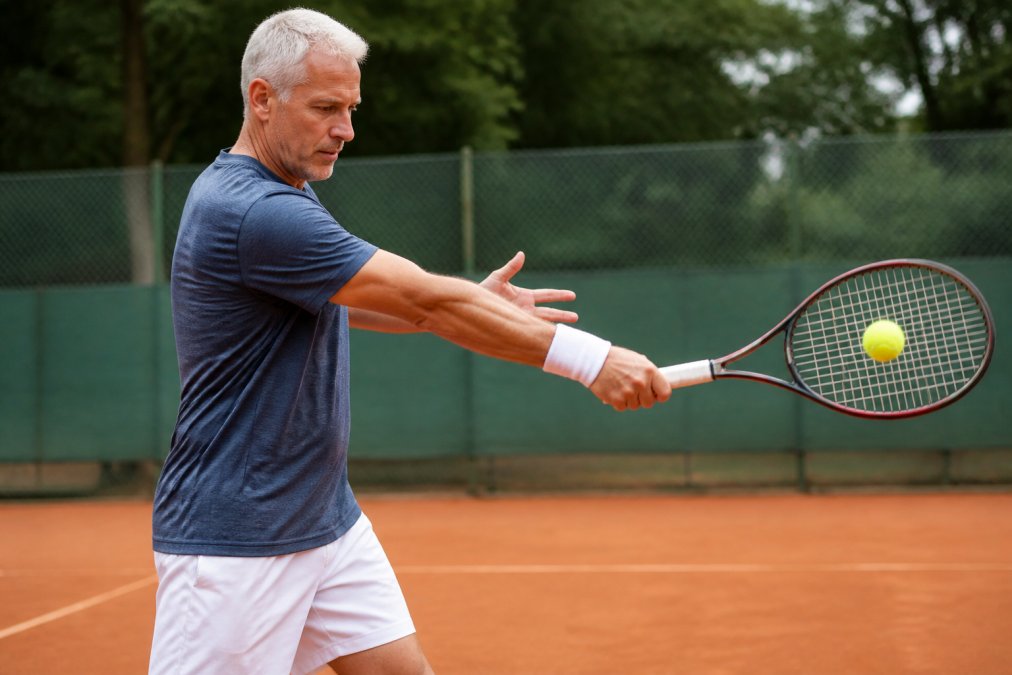
Technique is your primary defense against tennis elbow. Poor form forces your tendons to compensate for biomechanical inefficiencies. When your forearm extensors are engaged correctly, your larger shoulder and core muscles share the workload. When they’re not, your tendons bear almost all of it.
Focus on three fundamentals. First, grip pressure: many older players grip too tightly, especially during serves and overheads. Grip with enough pressure to control the racket, then consciously relax your forearm. Second, wrist position: keep your wrist relatively neutral during forehands and backhands, slightly ahead of the racket head at contact. Third, footwork: proper positioning allows you to hit with your arm closer to your torso, reducing lever arm stress on your elbow and forearm. If you’re uncertain about your technique, video yourself hitting or work with a coach.
Step 3: Choose the Best Tennis Racket for Tennis Elbow Prevention
Your racket is either your ally or your adversary in preventing tennis elbow. The wrong racket amplifies forces transmitted to your arm. The right one absorbs shock and reduces demand on your tendons.
Grip Size and String Tension Matter
Grip size is critical and often overlooked. A grip that’s too small forces your hand and forearm muscles to work harder to control the racket. For older players, the ideal grip circumference is usually between 4.25 and 4.5 inches. String tension directly affects how much shock your arm absorbs. Higher tension (above 60 pounds) creates a stiffer string bed that transmits more vibration and impact force to your arm. Lower tension (below 55 pounds) creates more string movement, which dampens shock. For older players concerned with preventing tennis elbow, string tension between 50-55 pounds offers better shock absorption. Synthetic gut or natural gut strings absorb shock better than polyester strings. workout gear for seniors.
Racket Balance and Weight Distribution
Racket balance affects how much effort your arm must expend. A head-heavy racket generates more power but requires more arm effort to control. For older players, a slightly head-light to neutral balance is ideal, reducing demand on your forearm extensors while still providing adequate power. Racket weight should be between 10 and 11.5 ounces. A larger head (100+ square inches) provides a bigger sweet spot, meaning off-center hits generate less vibration and force transmission to your arm.
Step 4: Build Forearm Strength with Tennis Elbow Exercises for Seniors

Strengthening your forearm muscles and tendons is non-negotiable for preventing tennis elbow. Strong muscles stabilize your joints and reduce demand on tendons. Eccentric exercises, where you lengthen a muscle under tension, are most effective for tendon health.
Eccentric Exercises for Forearm Extensors
The most effective exercise is eccentric wrist extension. Hold a light dumbbell (1-3 pounds to start) with your palm facing down. Use your other hand to help lift your wrist to an extended position. Then slowly lower the weight using only your forearm extensor muscles, taking 3-4 seconds for the downward movement. Perform 3 sets of 15 repetitions, three times weekly. The reverse wrist curl targets the wrist flexors, which balance your forearm. Farmer’s carries, walking while holding heavy dumbbells at your sides, build grip strength and tendon loading capacity.
Wrist Extension and Flexion Drills
Wrist circles, rotating your wrist in full circles both directions, should be performed daily. Resistance band work provides variable loading. Loop a resistance band around your fingers and perform wrist extensions and flexions against the band’s resistance. Pronation and supination drills strengthen the muscles that stabilize your wrist.
Grip Strength and Tendon Loading Progression
Grip strength directly correlates with forearm stability. For older players, a grip strength of 70+ pounds in your dominant hand is a reasonable target (peer-reviewed research). Start with a stress ball or hand gripper, performing 3 sets of 10-15 squeezes daily. Tendon loading must increase progressively. Expose your tendons to slightly more stress than they’re accustomed to, allow recovery, then increase again. A practical progression: Week 1-2, perform exercises with 1-pound weights. Week 3-4, increase to 2 pounds. Week 5-6, increase to 3 pounds.
Step 5: Optimize Your Daily Ergonomics and Recovery
How you use your arm in daily activities either compounds or reduces your injury risk. Adjust your workspace so your forearm is neutral when typing, with your elbow at roughly 90 degrees. Avoid repetitive gripping and use your whole hand and arm when lifting objects.
Recovery is where adaptation happens. Your tendons strengthen during rest, not during activity. Aim for 7-9 hours of sleep nightly; this is when your body repairs tissue damage and reduces inflammation. Ice therapy after play reduces inflammation. Apply ice to the outside of your elbow for 15-20 minutes within 2 hours after playing on days when you played hard or feel soreness developing. Adequate protein (0.8-1 grams per pound of body weight daily) provides amino acids for tissue repair (the NIH). Omega-3 fatty acids reduce inflammation.
Step 6: Use Compression and Support Strategically
A counterforce brace sits just below the elbow, compressing the muscle belly of the wrist extensors and reducing strain on the tendon attachment point. Many older players find that wearing a brace during play allows them to compete without exacerbating symptoms. Don’t rely on a brace as your primary prevention strategy. Use it while you’re building strength and correcting form, not as a substitute for those interventions. Compression sleeves covering your entire forearm provide similar benefits with less targeted compression.
Common Mistakes That Lead to Tennis Elbow
The biggest mistake is ignoring early warning signs. A dull ache on the outside of your elbow after play isn’t something to push through. It’s your body signaling that something needs to change. The second mistake is overtraining without adequate recovery. Older bodies need more recovery time than younger ones. If you’re playing 5+ hours weekly plus additional training, you’re likely exceeding your recovery capacity. Many older players compare their training to younger competitors. Your 25-year-old opponent can handle more volume with faster recovery. You can’t. Train smart, not hard. Equipment mistakes compound over time. The final mistake is skipping warm-ups and cool-downs because you’re in a hurry.
The path to preventing tennis elbow as an older player requires consistency. Warm up properly. Master your technique. Choose equipment that protects your tendons. Build forearm strength progressively. Optimize your daily habits. Use support strategically when needed.
Your competitive years aren’t behind you. But they require a different approach than you used at 30. Embrace that difference, and you’ll play better and longer than you ever thought possible.
| Prevention Strategy | When to Apply | Expected Timeline |
|---|---|---|
| Warm-up and cool-down | Every session | Immediate injury risk reduction |
| Technique refinement | Ongoing, with coaching | 4-6 weeks for noticeable improvement |
| Equipment adjustment | Before pain develops | Immediate comfort improvement |
| Eccentric exercises | 3x weekly | 6-8 weeks for tendon adaptation |
| Grip strength training | Daily | 4-6 weeks for measurable strength gain |
| Compression support | During/after play | Immediate symptom management |
Preventing tennis elbow requires addressing the specific vulnerabilities of older bodies. According to the American Academy of Orthopaedic Surgeons, overuse injuries in older athletes often result from inadequate warm-up and recovery protocols. The framework we’ve outlined, progressive strengthening, technique mastery, equipment optimization, and recovery prioritization, directly addresses these risk factors.
Your competitive potential doesn’t decline with age when you train intelligently. Crunch Time Coaching specializes in helping players 40+ stay healthy while competing at high levels. Our step-by-step approach to technique, conditioning, and injury prevention is designed specifically for mature athletes. Reserve your spot today to work with coaches who understand that preventing tennis elbow is about respecting your body’s capabilities, not fighting against them.
Frequently Asked Questions
Q: Is there anything you can do to prevent tennis elbow?
A: Yes. Preventing tennis elbow involves multiple strategies: warm up before every session, use proper technique on every stroke, choose a racket with appropriate grip size and string tension, perform strengthening and stretching exercises regularly, manage repetitive strain through rest days, and wear a counterforce brace during play if you’re at high risk. For older players, addressing age-related changes in tendon elasticity through consistent eccentric exercises is especially important. Most cases of lateral epicondylitis are preventable with these measures applied consistently.
Q: What are the best warm-up exercises for older tennis players?
A: Start with 5-10 minutes of light cardio to increase blood flow, then perform arm circles and shoulder rotations in both directions. Follow with gentle wrist flexion and extension movements without resistance, then gradually increase range of motion. Include forearm pronation and supination drills. Finally, hit easy groundstrokes and serves at 50-60% intensity before moving to full-speed play. This prepares your tendons, joints, and muscles for the demands ahead and significantly reduces injury risk.
Q: How does racket grip size affect tennis elbow risk?
A: Grip size directly impacts how much force your forearm extensors must generate to stabilize the racket. A grip that’s too small forces your hand and forearm muscles to work harder, increasing tendon loading and strain. A grip that’s too large prevents proper control and creates compensatory muscle tension. Most older players benefit from a grip size between 4.25 and 4.5 inches. Have your grip measured at a pro shop or measure your own: from the crease at your palm’s base to the tip of your middle finger. Correct grip size reduces strain on the tendons that cause lateral epicondylitis.
Q: Does tennis elbow ever fully go away?
A: Tennis elbow can resolve completely with proper treatment and prevention, especially if caught early. However, the tendon damage (micro-tears in the forearm extensors) takes weeks to months to fully heal. Once you’ve had tennis elbow, your tendon is more susceptible to re-injury if you return to the same activities without addressing the underlying cause. Prevention through proper technique, equipment adjustments, and ongoing strengthening exercises is critical to prevent recurrence. Many older players manage it successfully by maintaining these habits indefinitely.
This article was written using GrandRanker