
Last Updated: October 22, 2026
Quick Summary
Tennis footwork patterns for groundstrokes are the foundation of consistency and control, starting with the split step as your opponent makes contact. The three main forehand stances, open, neutral, and closed, each offer different trade-offs between power and recovery speed, while backhand patterns require specific adjustments because the geometry is reversed.
- The split step resets your weight just as the ball leaves your opponent’s racket, synchronizing movement with the ball’s flight.
- Open stance suits wide balls and quick recovery; closed stance provides maximum power when you have time to step in.
- One-handed backhands require earlier preparation and almost always use closed or neutral stance for stability and power.
- Recovery footwork is equally important as approach footwork, reset with a split step as your opponent prepares to hit.
- Cone drills, shadow swings, and partner feeds build muscle memory to execute patterns under match pressure.
Table of Contents
- Understanding Tennis Footwork Patterns for Groundstrokes
- Forehand Footwork Patterns: Open, Neutral, and Closed Stances
- Backhand Footwork Patterns: Adjusting Your Movement
- Essential Tennis Footwork Drills for Groundstrokes
- Groundstroke Recovery Footwork: Return to Home Position
- Common Footwork Errors and How to Fix Them
- Footwork Progressions by Skill Level and Court Context
- Conclusion
- Frequently Asked Questions
Understanding Tennis Footwork Patterns for Groundstrokes
Tennis footwork patterns for groundstrokes are the foundation of consistency and control. Without solid movement mechanics, even sound swings fall apart under pressure.
At Crunch Time Coaching, we empower competitive tennis players to achieve a higher level of play. Most players focus on the arm swing and forget the feet dictate power, stability at contact, and recovery speed.
Why footwork matters for consistency
When footwork breaks down, you’re late to the ball, your weight moves forward when you should be decelerating, your base is narrow, and your knees aren’t bent, all cascading from poor footwork, not swing mechanics.
Consistency requires arriving at the ball in the same position every time, which isn’t possible without repeatable footwork patterns. The pattern creates the position, and the position creates the shot.
The most common mistake is thinking footwork is about speed. It’s not. It’s about timing. Early feet beat fast feet every time. Get to your spot early, stay low, and wait for the ball to come to you.
How the split step initiates movement
Most players skip it or time it wrong. Your feet should land just as the ball leaves your opponent’s racket, synchronizing your movement with the ball’s flight.
Timed correctly, your weight is neutral, you’re on the balls of your feet, and your knees are slightly bent, so your first step can go anywhere.
Forehand Footwork Patterns: Open, Neutral, and Closed Stances
Forehand footwork patterns for groundstrokes vary by court position, ball type, and situation. Knowing when to use each stance separates advanced players from intermediates.
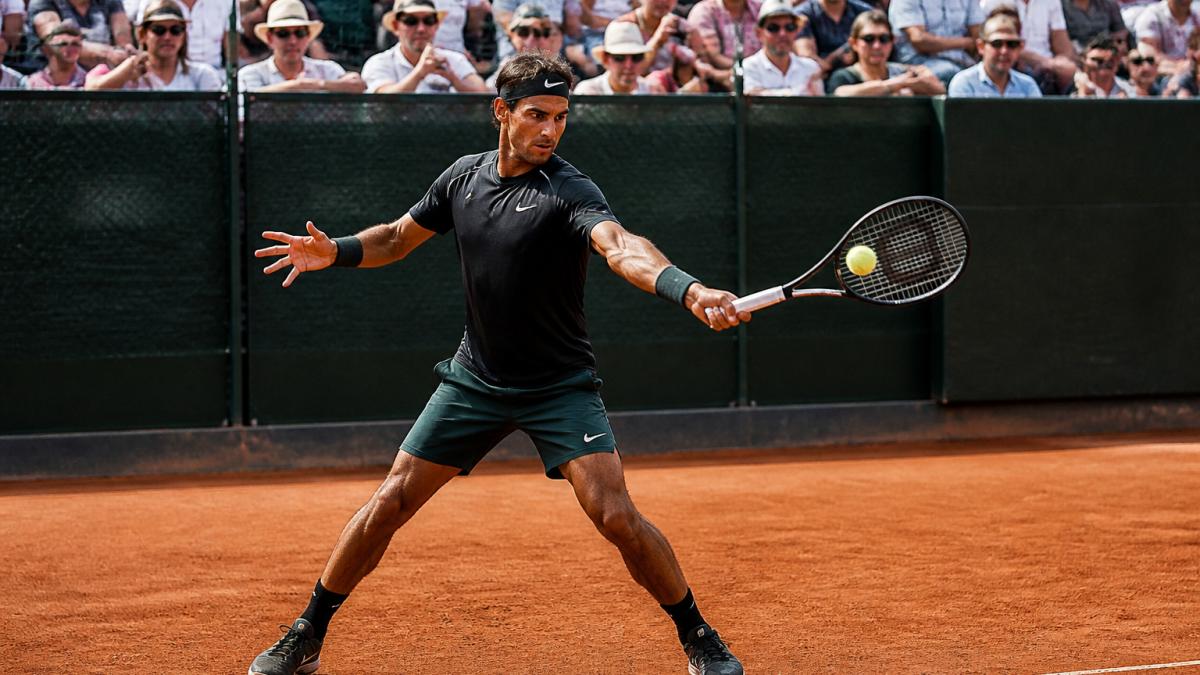
The three main forehand stances, open, neutral, and closed, each have trade-offs. The best players move fluidly between all three depending on the ball.
Open stance positioning and weight transfer
Open stance suits balls that pull you wide: you hit and recover quickly without stepping in. The trade-off is less power, since your weight doesn’t transfer as far forward.
Use open stance when:
- The ball pulls you wide
- You need to hit and move immediately
- You’re defending and need quick recovery
Closed stance requires stepping forward with your outside foot, transferring weight fully into the court, more power, but slower recovery.
Use closed stance when:
- You have time to step in
- You want maximum power
- The ball sits up or lands short
Neutral stance for court balance
Neutral stance is the middle ground: one foot steps forward, but not as far as a closed stance, so weight transfers partially forward, reasonable power without sacrificing recovery speed.
Neutral stance is the safest choice when unsure, and most intermediate players should default to it.
The neutral stance sequence: split step, small adjustment step toward the ball, then a step forward with your outside leg.
Closed stance for depth and power
Closed stance gives the deepest weight transfer and most power: both feet cross the baseline plane, your inside leg drives forward, and your weight finishes on your front foot.
The risk is execution time. If the ball is faster than expected or you misjudge the depth, you won’t have time to set up, so use it only when you’re confident about speed and placement.
Backhand Footwork Patterns: Adjusting Your Movement
Backhand footwork patterns for groundstrokes differ from forehand patterns because the geometry is reversed, your body position relative to the ball changes how your feet move.
Most players struggle because they copy their forehand patterns. That doesn’t work, the backhand requires specific adjustments.
Two-handed backhand positioning
Two-handed backhands are mechanically similar to forehands because both hands are on the racket: the stance options and footwork sequence are the same.
For a two-handed backhand:
- Split step is the same as forehand
- First adjustment step is bigger because you need more rotation
- Stance can be open, neutral, or closed
Footwork timing is easier on a two-handed backhand because both hands provide stability, you can be slightly late and still hit a decent shot.
One-handed backhand footwork adjustments
One-handed backhands require earlier preparation and more precise footwork. Without a second hand for stability, your base must be perfect.
One-handed backhands almost always use a closed or neutral stance.
Here’s the footwork sequence for a one-handed backhand:
- Split step as opponent hits
- Adjust step toward the ball (bigger than forehand)
- Step forward with your outside leg into a closed stance
- Finish with weight on your front foot
That sequence takes practice to groove, if you’re late on step 2, you’ll never catch up.
A common error is not stepping in far enough on the one-handed backhand. Players try to hit it at arm’s length instead of stepping into the court. This kills your power and stability. Step in aggressively.
Essential Tennis Footwork Drills for Groundstrokes
Footwork drills build the muscle memory to execute these patterns under pressure by isolating one movement and repeating it until automatic.
The best drills combine footwork with hitting, because shadow swings build awareness but not the confidence you need when a ball is coming at you.
Cone drill for lateral movement and acceleration
The cone drill trains lateral movement and quick first steps.
The drill:
- Sprint to the right cone, touch it, and return to middle
- Sprint to the left cone, touch it, and return to middle
- Repeat for 30 seconds
- Rest 30 seconds
- Repeat 5-8 times
This builds an explosive first step and quick direction changes, the cone forces you to commit instead of drifting.
Once grooved, add a ball feed: a partner feeds to each cone as you touch it, combining footwork with hitting.
Shadow swing drill for pattern repetition
Shadow swings let you practice footwork patterns without a ball. They’re best for learning new patterns or for warm-up.
The shadow swing drill:
- Assume your ready position at the baseline
- Perform a split step
- Move laterally to simulate chasing a wide ball
- Execute your footwork pattern (open, neutral, or closed stance)
- Perform your forehand swing without a ball
- Return to ready position
- Repeat 10 times per side
Shadow swings build awareness of where your feet are. They’re slower than real hitting, giving your brain time to process the pattern.
Partner feed drill for reactive footwork
Partner feeds are the closest thing to match conditions: your partner feeds balls to different locations while you move and hit.
The drill:
- Partner feeds a ball to your forehand
- You execute your footwork pattern and hit
- Return to ready position
- Partner feeds to your backhand
- Repeat for 10 balls per side
Start with slow, predictable feeds, then vary depth, speed, and direction to train adjusting your footwork to what the ball demands.
Groundstroke Recovery Footwork: Return to Home Position
Every groundstroke ends with recovery: you hit and immediately move back to a neutral court position. That recovery footwork is often overlooked but critical.
Poor recovery leaves you scrambling instead of moving with purpose. The better you recover, the more aggressive you can be, knowing you’ll be ready.
The adjustment step and reset timing
After you hit, the adjustment step resets you to a neutral position.
The recovery sequence:
- Hit your groundstroke
- Finish your swing
- Push off your front foot to start moving backward
- Take one or two adjustment steps back toward the baseline
- Perform a split step to reset your weight
- You’re now ready for the next ball
Time the recovery split step just as your opponent is about to hit, the same timing as your initial split step.
Most players rush recovery, sprinting backward without a plan.
Staying low and maintaining balance during recovery
Balance during recovery means keeping your knees bent and your center of gravity low throughout.
Here’s what good recovery balance looks like:
- Knees stay bent the entire time
- Your weight is on the balls of your feet
- Your shoulders stay over your hips
The common mistake is standing up during recovery, straightening your legs and jogging back slows you down and throws off balance.
Stay low, keep knees bent, move backward in a controlled manner, and reset with a split step.
Recovery footwork is just as important as approach footwork. Spend as much practice time on getting back to ready position as you do on moving to the ball.
Common Footwork Errors and How to Fix Them
Most footwork problems fall into three categories, timing, positioning, and balance. Identifying yours makes it easier to fix.
Late preparation and rushed first steps
Late preparation is the most common error: you see the ball, then move, and by the time your feet are set the ball is already close.
The fix: move as soon as you recognize where the ball is going. Early movement gives you time to set your feet and prepare your swing.
If your split step is late, your first step will be rushed.
Poor spacing and ball tracking
Poor spacing means you’re too close or too far when you hit, throwing off weight transfer and swing mechanics.
The fix is ball tracking during your approach: watch the trajectory and adjust your steps to arrive at the right distance.
Use the cone drill for spacing: set cones at different distances from the baseline and practice arriving at the right distance for each.
Neglecting the split step and recovery position
Some players skip the split step thinking it slows them down.
The same applies to recovery position: skip the reset and you’re always scrambling for the next shot.
Make the split step and recovery reset non-negotiable in every drill so they become automatic in matches.
Footwork Progressions by Skill Level and Court Context
Footwork development happens in stages: beginners learn basic patterns, intermediates learn when to use each, and advanced players execute at high speeds and adjust tactically.
Beginner progressions: building foundational movement
Start with shadow swings, no ball, no pressure, 10 reps per side. Quality over quantity.
Once natural, add a slow ball feed so you have time to think about your footwork: execute the pattern, hit, and recover.
Progress to moderate-speed feeds, forcing quicker movement while keeping the pattern clean at a higher tempo.
Intermediate progressions: adapting to ball types and court positions
Intermediate players should adjust footwork to the ball’s characteristics, a deep ball differs from a short ball, a fast ball from a slow one.
Practice with varied feeds to different depths, speeds, and directions, adjusting your pattern to what the ball demands.
Also practice from the baseline, inside the baseline, and near the net, each position requires different adjustments.
Advanced progressions: explosive movement and tactical positioning
This requires explosive first steps, quick direction changes, and understanding how your footwork choices affect your position for the next shot.
Practice with match-simulation drills: play points focused on footwork and court positioning rather than winning, executing clean patterns while moving strategically.
Conclusion
Tennis footwork patterns for groundstrokes are the foundation of consistency, power, and court positioning: the split step initiates movement, stance choice determines weight transfer and power, and recovery footwork prepares you for the next shot.
The players who improve fastest isolate footwork in practice and drill it repeatedly.
The footwork patterns covered here, split steps, stance choices, adjustment steps, and recovery movements, are the same patterns used by elite players.
Reserve your spot today with Crunch Time Coaching and start sharpening your footwork for unmatched consistency on the court.
Frequently Asked Questions
What is the split step and why does it matter for tennis footwork patterns?
The split step is a small, timed hop you perform as your opponent strikes the ball. It synchronizes your footwork with the incoming ball and positions you to move in any direction. Executing a split step at the right moment gives you better first-step quickness and court coverage. Most elite players split step approximately 0.5 seconds before the ball reaches them, allowing immediate lateral or forward movement.
How do forehand footwork patterns differ from backhand footwork patterns?
Forehand footwork patterns typically involve an open or neutral stance with wider hip rotation and more aggressive weight transfer. Backhand footwork patterns, especially for two-handed backhands, require tighter positioning and smaller adjustment steps. The key difference is court geometry: forehands often use lateral movement to the right (for right-handers), while backhands demand quicker, more compact footwork to maintain balance and generate power from a closed stance position.
What tennis footwork drills for groundstrokes can I practice alone?
Shadow swing drills and cone drills work well solo. Set up cones in a semi-circle around the baseline and move laterally between them, mimicking groundstroke footwork without a ball. Shadow swings let you repeat movement patterns and weight transfer steps in sequence. These drills build muscle memory for split steps, lateral acceleration, and recovery positioning without requiring a partner or ball feed.
How quickly should I recover to my home position after hitting a groundstroke?
Recovery footwork should happen immediately after your follow-through. Most competitive players reset to the baseline center within 1-2 adjustment steps. The speed depends on court position: if you’re deep in the court, recovery is slower; if you’re near the net or far wide, it’s faster. Staying low with bent knees during recovery helps you react to your opponent’s next shot and maintain balance for the next groundstroke.