
Table of Contents
- What is the Eastern Forehand Grip?
- Semi-Western vs Western Forehand Grip
- How to Hit Heavy Topspin Forehand with Each Grip
- Pros and Cons of Different Forehand Grips
- How Grip Affects Racket Face Angle and Contact Point
- Grip Transition Drills for Match Performance
- How to Choose the Right Grip for Your Game
- Conclusion
- Frequently Asked Questions
Last Updated: September 28, 2026
What is the Eastern Forehand Grip?
The Eastern forehand grip is the foundational grip that dominated tennis for decades before modern power-based tactics shifted preferences toward heavier spin. Your base knuckle sits on bevel 3 of the racket handle, positioning your hand so the racket face remains relatively neutral at contact. This grip naturally encourages a flatter stroke path and gives you immediate control over ball placement.
The Eastern grip works best on shoulder-height balls or higher, where the square racket face requires no wrist manipulation and the horizontal swing path naturally favors flat drives and slice approaches over topspin.
The Eastern grip excels on high-bouncing balls and net transitions, but requires precise timing because it doesn’t naturally generate the spin margins modern players need for consistency.
The Eastern grip is your stability grip. Use it when you need control over power, especially on high balls where a more extreme grip would force you to compensate with excessive wrist lag.
Semi-Western vs Western Forehand Grip
What is the Semi-Western Forehand Grip?
The Semi-Western forehand grip is the modern standard. Your base knuckle sits on bevel 4, closing the racket face and positioning your wrist for the low-to-high swing path required for topspin generation.
The Semi-Western grip excels at creating heavy topspin because the closed face requires upward brushing, naturally building spin generation. Your contact point shifts lower and more in front of your body than the Eastern grip.
Most competitive players use the Semi-Western because it balances power, spin, and control without the extreme adjustments the Western grip demands, while handling mid-court balls naturally.
What is the Western Forehand Grip?
The Western forehand grip positions your base knuckle on bevel 5, creating a dramatically closed racket face that forces a steep low-to-high swing path and maximum wrist lag. Players generate the heaviest topspin available, but at significant technical cost.
The Western grip requires contact much lower and further in front than other grips, this adjustment is non-negotiable. The grip struggles with low-bouncing balls because the extreme closure forces you to drop your knees significantly or risk hitting into the net.
The Western grip suits players who’ve mastered the kinetic chain and want maximum spin. Professional clay court players favor it because the slower surface rewards extreme spin and the lower bounce suits the grip’s geometry.
The Western grip punishes timing errors. A half-second late contact point means hitting into the net because the extreme face closure leaves no margin for error on lower contact points.
How to Hit Heavy Topspin Forehand with Each Grip
Heavy topspin demands a low-to-high swing path regardless of grip, but when tennis forehand grips for topspin compared, each creates different biomechanical pathways. The Eastern grip requires the most conscious effort because the neutral face fights natural swing mechanics, you must actively brush and maintain wrist lag, demanding precision timing.
The Semi-Western grip makes topspin generation feel natural because the closed face points toward brushing and the wrist position supports lag. Your body mechanics align with grip geometry, generating topspin through the kinetic chain rather than fighting your hand position.
The Western grip produces the heaviest topspin because extreme face closure maximizes the brushing angle and low contact point creates a steeper swing path. The challenge is controlling where that spin takes the ball, as Western grip forehands dip lower into the court.
Topspin production depends on contact point height and swing path angle. The Eastern grip forces higher contact and flatter swings, limiting spin. The Western grip allows lower contact and steeper swings, maximizing spin. The Semi-Western balances both, which is why it’s become the standard.
Pros and Cons of Different Forehand Grips
Eastern Grip Strengths and Weaknesses
Strengths: The Eastern grip excels at control and feel, with neutral racket face providing immediate feedback on stroke mechanics. You can hit flat drives with precision and handle high-bouncing balls naturally, while slice transitions are easier since your hand position is already close to the slice grip.
Weaknesses: The Eastern grip struggles with topspin generation because the neutral face works against the low-to-high swing path. You’ll work harder to create spin margins, especially on clay courts. The grip becomes difficult on modern fast courts where heavy topspin is expected, and lower contact points feel awkward.
Semi-Western Grip Strengths and Weaknesses
Strengths: The Semi-Western grip balances spin generation with versatility and handles mid-court balls naturally. The closed face supports kinetic chain mechanics that modern coaching emphasizes. Most competitive players find it easiest to master because grip geometry aligns with efficient biomechanics.
Weaknesses: The Semi-Western compromises on feel compared to the Eastern grip and makes flat drives harder to hit with precision. High-bouncing balls require more adjustment, and the contact point shift feels unnatural for players transitioning from the Eastern grip. Sloppy mechanics produce inconsistent results.
Western Grip Strengths and Weaknesses
Strengths: The Western grip produces the heaviest topspin, ideal for clay court specialists and players who’ve mastered the kinetic chain. Extreme spin generation creates high net clearance margins for aggressive hitting, and the grip naturally supports wrist lag mechanics.
Weaknesses: The Western grip is unforgiving on low-bouncing balls and struggles on fast courts where balls stay low. It demands precise timing, contact errors result in net balls immediately. Net play transitions are awkward, and overall court coverage is narrower despite easier high-ball handling.
| Grip Type | Best For | Topspin Production | Control | Versatility | Learning Curve |
|---|---|---|---|---|---|
| Eastern | High balls, feel, flat drives | Moderate | High | Good | Easy |
| Semi-Western | Baseline rallies, modern tennis | High | Moderate | Excellent | Moderate |
| Western | Clay courts, maximum spin | Very High | Moderate | Limited | Hard |
How Grip Affects Racket Face Angle and Contact Point
Racket face angle at address drives everything about your stroke. The Eastern grip positions the face nearly square, allowing high contact points and flat trajectories. The Semi-Western closes the face 30-45 degrees, requiring lower contact points. The Western grip closes the face 60+ degrees, forcing very low contact and steep upward brushing.
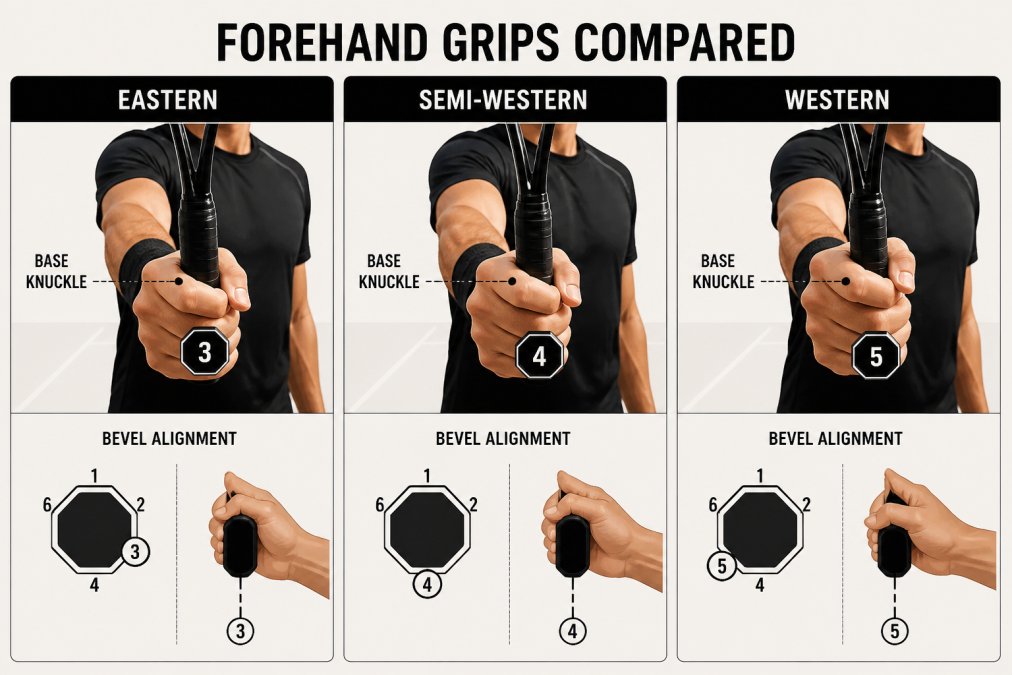
Contact point height is non-negotiable once you choose a grip.
Your grip choice determines your contact point height, which determines your swing path angle, which determines your spin production. Change one variable, and the others follow automatically. Fighting this relationship is why grip transitions feel awkward.
Grip Transition Drills for Match Performance
Transitioning between grips during a point requires practice because hand adjustments happen in milliseconds. Hit 10 forehands with each grip (Eastern, Semi-Western, Western) and focus on feeling the contact point shift. Your body naturally lowers contact points with more extreme grips, let it happen rather than fighting it.
How to Choose the Right Grip for Your Game
Choosing the right grip starts with honest assessment of your skill level and court surface, understanding how tennis forehand grips for topspin compared affects your game. Recreational players benefit from the Semi-Western grip because it balances spin generation with forgiveness and is modern enough to compete against topspin-heavy players without punishing timing errors.
Semi-Western grip: Players aged 40+ returning to competitive tennis, recreational league players, hard court specialists
Western grip: Clay court specialists, players with mastered kinetic chain mechanics, competitive baseline grinders
Eastern grip: Secondary grip for all players, primary grip for feel-focused hitters, slice specialists
Conclusion
Choosing between the Eastern, Semi-Western, and Western forehand grips isn’t about finding the “best” grip, it’s about matching your grip to your skill level, court surface, and match situation. The Semi-Western grip has become the modern standard because it delivers genuine topspin production without the extreme technical demands of the Western grip. However, mastering grip transitions and understanding how each grip affects your racket face angle and contact point separates competitive players from recreational hitters.
Frequently Asked Questions
Which tennis grip is best for generating topspin?
The Semi-Western grip is the modern standard for topspin generation because it naturally closes the racket face and positions your wrist for the low-to-high swing path required for heavy spin. The Western grip generates even more extreme topspin but sacrifices flat-shot capability and control on low balls. The Eastern grip produces less topspin but offers better versatility across court heights and shot types.
What is the difference between Semi-Western and Western forehand grips?
The Semi-Western places your base knuckle on bevel 4 of the racket handle, creating a closed racket face ideal for baseline rallies with moderate topspin. The Western grip positions your base knuckle on bevel 5, creating an extremely closed face optimized for maximum spin generation but making it harder to handle low balls and slice serves. Semi-Western offers better versatility; Western sacrifices adaptability for pure spin production.
Can you hit flat shots with a Western grip?
Hitting flat shots with a Western grip is difficult because the extremely closed racket face forces you to swing harder and higher to clear the net, limiting your shot variety. While some players manage it, the grip’s design prioritizes topspin generation over flat-shot production. If you need consistent flat-shot capability, the Eastern or Semi-Western grip provides better control and flexibility for all shot types.
How does changing my grip affect my forehand consistency?
Grip choice directly impacts consistency through racket face angle and swing mechanics. The Eastern grip requires less wrist lag and offers the most forgiving contact window, making it ideal for consistent baseline play. The Semi-Western demands better swing path timing but rewards consistency with heavier spin. The Western grip is the most unforgiving, poor timing or contact-point height creates errors, which is why professional players transition grips during points rather than relying on one extreme grip for all situations.
Is the Semi-Western grip the most versatile for topspin?
Yes, the Semi-Western grip balances topspin generation with versatility. It handles shoulder-height and waist-height balls effectively, produces significant spin on baseline rallies, and allows you to hit flatter shots when needed without a grip change. The Eastern grip is more versatile overall across all court situations, but the Semi-Western is the best compromise between topspin production and shot variety, which is why it dominates professional tennis.