
Table of Contents
- Why League Matches Are Won Before You Step on Court
- Your Pre-Match Game Plan: Scouting and Pattern Recognition
- Tennis Singles Tactics for Intermediate Players: Point Construction
- How to Beat a Pusher in Tennis: Control the Rally
- Serve and Return: The Two Shots That Dictate Everything
- Tennis Match Play Mental Toughness: Winning the Close Ones
- Post-Match Analysis: A Framework for Constant Improvement
- Your League Playbook: Putting It All Together
- Frequently Asked Questions
Last Updated: September 7, 2026
Why League Matches Are Won Before You Step on Court
League tennis punishes inconsistency more than any other format. A single loose game can erase twenty minutes of solid play, which is why tennis match strategy for league players must begin before you walk through the gate.
The player with the clearer game plan wins the close sets. League play rewards percentage tennis, court positioning, and rally tolerance over flashy winners.
Your Pre-Match Game Plan: Scouting and Pattern Recognition
A pre-match plan starts with honest opponent scouting. Watch your opponent play once if you can, or recall their tendencies from previous meetings. Ask three questions: do they prefer cross-court or down-the-line rallies, do they struggle with low balls or high balls, and how do they respond under pressure in match tie-breaks?
Build your game plan around those answers. If their backhand breaks down under depth, your entire tennis match strategy centers on feeding them deep, heavy balls to that side. If they chase down everything but lack power, you control the point with placement rather than pace.
Most league players skip scouting entirely and pay for it in the first set. A 10-minute warm-up observation of your opponent’s serve toss, grip changes, and footwork tells you more than any highlight reel ever will.
Tennis Singles Tactics for Intermediate Players: Point Construction
Most league players treat every point as an isolated battle. In a best-of-three-set match, you will play roughly 80 to 120 points, and the patterns you establish in the first ten points will shape the rest of the match (peer-reviewed research). Point construction is about building a tactical profile your opponent has to solve under fatigue and scoreboard pressure.
The standard three-phase model, neutralize, create, finish, is correct but incomplete. The missing layer for league play is the shot-to-shot sequencing that makes the model work against different body types and footwork patterns. In the first two games, identify which of the four rally profiles you are facing:
- The Blocker, takes the ball early, no swing, feeds on your pace. Sequence: use heavy topspin to push them off the baseline, then hit a lower, heavier ball to their feet to force a weak reply.
- The Windshield Wiper, heavy topspin both wings, loves high balls. Sequence: slice low and short to drag them forward, then pass or lob based on their net posture.
- The Pusher, no pace, no misses, deep moonballs. Sequence: come in behind a solid approach to their weaker wing, and do not rally more than five shots before transitioning.
- The Flat Rock, flat, deep, no spin, loves the middle of the court. Sequence: use angles to pull them wide, then attack the open court with a down-the-line shot.
Each profile demands a different neutral rally target. Against the Blocker, your neutral ball needs more net clearance and depth. Against the Windshield Wiper, your neutral ball should be a slice that stays low and forces them to generate their own pace. The mistake most league players make is using the same neutral ball against every opponent.
A concrete mechanism that wins league matches is the three-ball rule in neutral rallies. If you have not created a short ball or a change of direction by the third shot, you are losing the point construction battle. The rule forces you to hit deeper, change spin, or change direction, preventing passive rallying.
When you get the short ball, your decision tree should be automatic. Inside the service line, your options are: hit a winner, hit a deep approach to the backhand corner, or drop shot if your opponent is behind the baseline. The highest-percentage play is the deep approach to the backhand corner, forcing a passing shot on the run from their weaker wing. The approach shot is a higher-percentage play than the outright winner.
Track your own numbers for one league match. Note every short ball you get and what you did with it. Most players discover they are choosing the lowest-percentage option, the winner, over 70 percent of the time. That single adjustment, choosing the deep approach instead, will shift your win rate in close sets more than any other tactical change.
A second mechanism that separates strong league tacticians is change-of-direction discipline. The highest-percentage pattern is the cross-court rally, because the net is lower in the middle and the court is longer diagonally. Changing direction down-the-line means hitting over the higher part of the net to a shorter target, so it should only be hit on a short ball or when the open court is available.
Finally, point construction must account for the scoreboard state. At 15-15 in the first game, you can afford to test a pattern. At 5-5 in the second set, only hit the shots you have proven you can make that day. Tighten your construction as the score tightens: more margin over the net, more cross-court targets, fewer low-percentage winners.
A practical drill is the pattern rehearsal drill. Play points from 30-30 with a constraint: start with a cross-court rally of at least four shots, then attack only if you get a ball inside the service line. Do this for 15 minutes per session, and the patterns become automatic.
How to Beat a Pusher in Tennis: Control the Rally
Learning how to beat a pusher in tennis comes down to one principle: control the rally tolerance, not match it. Pushers thrive when opponents try to out-consist them from the baseline.
The winning tennis match strategy against a pusher is disciplined aggression. Come to the net behind approach shots, use topspin to push them behind the baseline, and force them to hit passing shots they do not own.
Do not try to out-rally a pusher. You will lose the patience contest and hand them the match on your own unforced errors. Commit to net play and offensive transition, even when it feels uncomfortable early.
Use the slice to change the tempo and bring them forward, where their lack of net dominance becomes obvious. Lobs and overheads become your weapons when they start cheating in.
Serve and Return: The Two Shots That Dictate Everything
The serve and return are the only shots where you control the start of the point, making them the highest-leverage place to invest your tactical attention. League play introduces a format-specific twist: the match tie-break. In USTA league play, the third set is typically a 10-point match tie-break (first to 10, win by 2), so the entire match can hinge on four or five service points (usta.com).
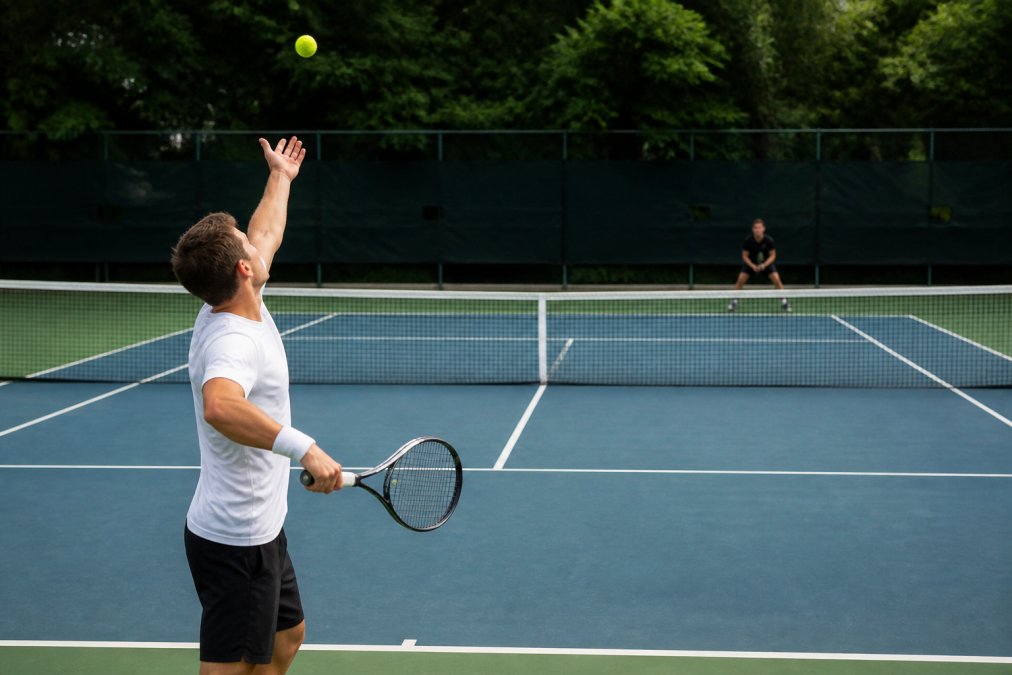
In a 10-point tie-break, the serve becomes even more dominant. The player serving first has a significant psychological advantage: if they hold, the pressure shifts immediately to the returner. Your tactical approach must include a specific tie-break plan.
Serve tactics for league play:
Your first serve percentage should be your primary metric, not your serve speed. At the 3.5 to 4.5 level, a first serve landing at 60 to 70 percent with consistent placement wins more free points than a 100 mph flat serve landing at 40 percent (PubMed).
Target selection matters more than pace. If you identify your opponent’s weaker wing in the first service game, you can exploit it for the rest of the match. The body serve is underused at league level: a serve aimed at the hip or armpit jams their swing and produces weak returns that float to the middle.
Your second serve is where league matches are won or lost. A second serve that lands short and in the middle is a gift. The goal is not to avoid a double fault; it is to force a weak return. A kick serve to the backhand corner, landing deep, forces your opponent to hit up from a defensive position, giving you the offensive transition.
Return tactics for league play:
The return of serve is the most under-practiced shot in recreational tennis. The return is a defensive shot with an offensive goal: get the ball deep and cross-court, forcing the server to hit up.
Adjust your return position based on the server’s tendencies. If they serve wide to your forehand, cheat a step in that direction. If they favor the body serve, stand slightly further back. If their second serve is weak, step inside the baseline and attack it.
A specific league-play tactic is the return pattern on big points. At 30-40 or break point down, most returners try to hit a winner and miss. The higher-percentage play is to get the return deep and cross-court, forcing the server to play a rally point under pressure.
The match tie-break serve and return plan:
In the 10-point tie-break, the first four points are critical: a mini-break early puts immense pressure on your opponent’s serve. Your serve plan should prioritize first serves to the weaker wing, with the body serve as your change-up on the biggest points. Your return plan should be even more conservative: get every return deep and in play.
The tie-break is a sprint, not a marathon. Players who try to grind from the baseline often lose because they are not used to the compressed format. The players who win have a clear plan: serve to patterns, return deep, and let the opponent make the first mistake.
Do not change your serve mechanics or try new shots in a match tie-break. Stick to the patterns that got you there. The tie-break is not the time to experiment; it is the time to execute what you have practiced.
A practical drill is the tie-break simulation drill. Play a practice set where every game is a 10-point tie-break, starting at 0-0. Track your first serve percentage and return depth to see the patterns that win or lose tie-breaks.
Tennis Match Play Mental Toughness: Winning the Close Ones
Tennis match play mental toughness separates league champions from players who plateau. Close matches rarely turn on shot quality; they turn on who handles the big moments better.
The mental game starts with a reset ritual between points. Take a breath, wipe your grip, and replay your target for the next point. This blocks the negative spiral that follows a double fault or a missed overhead.
Your mental resilience is trainable. Practice playing practice sets where every game starts at 30-30, and you will build the experience of handling pressure before it matters in league standings.
Anchor your mindset to process goals rather than outcome goals. Focus on making your opponent hit one more ball, on court positioning, and on executing your game plan.
Post-Match Analysis: A Framework for Constant Improvement
Most league players close their match, shake hands, and lose the lesson. A structured post-match analysis turns every win and loss into progress. Within a few hours, write down three things: which patterns won you points, which patterns lost you points, and what your opponent did that you could not handle.
This analysis feeds directly back into your next pre-match game plan. If you lost points when your opponent hit deep topspin to your backhand, your practice week has a clear focus. If you won every point when you came to net, you have found a strength to lean on.
The framework is simple enough to use after every match:
- Record the score and the court surface
- Note three patterns that earned you points
- Note three patterns that cost you points
- Identify one tactical adjustment for next time
- Set one drill for the practice court that addresses it
Your League Playbook: Putting It All Together
A winning tennis match strategy is not a collection of tips; it is a repeatable system you trust when the score tightens. Build your league playbook around the patterns that produce wins for your specific game style, then execute them with confidence.
Our step-by-step daily lessons and challenge-based curriculum help you master the serve, sharpen footwork, and build the mental toughness that wins close matches. Whether you need personalized online coaching or hands-on in-person training camps, the path to a higher level of competitive play starts with a plan.
Frequently Asked Questions
How do you develop a winning game plan for a league match?
Start by scouting your opponent’s last match or warm-up. Identify their weaker wing, usually the backhand, and their preferred pattern on big points. Build your tennis match strategy around neutralizing their strengths, like a big serve, while targeting that weakness with high-percentage shots. Plan your own serve placement patterns and return positions before the match. This pre-match preparation turns vague hopes into a concrete, executable plan.
How should you adjust your strategy when playing a higher-ranked opponent?
When facing a better player, your goal is to raise their unforced error count, not out-hit them. Focus on depth and a consistent rally tolerance to force them into risky shot selection. Keep your first serve percentage high to avoid giving them free points on second serves. Use a change of pace with slice and topspin to disrupt their timing. Do not abandon your game plan after losing the first few points; stick with the tactics that force errors.
What are the most common tactical mistakes in league tennis?
The most common tactical errors are trying to hit a winner from the first ball of the rally and failing to move the opponent around the court. Many league players also have poor court positioning after a shot, leaving the middle open. Another frequent mistake is not adjusting to an opponent’s weaknesses, like continuing to hit to a player’s strong forehand. Finally, a lack of a clear plan for the return of serve often gives away free points.
What is the best way to beat a pusher in a league match?
Playing a pusher requires patience and disciplined shot selection. Do not try to end the point with your first aggressive shot; instead, build the point with heavy topspin and depth to push them behind the baseline. Be prepared to hit multiple shots to create an opening. Use the slice to bring them to the net if they have a weak volley, then hit a passing shot. Above all, maintain your mental toughness and avoid getting frustrated by their defensive style.
How can you use court geometry to your advantage in singles?
Court geometry is about creating angles to move your opponent and open up the court. Hitting deep cross-court shots is the highest-percentage play because it travels over the lowest part of the net and gives you a larger margin for error. To change the point, hit an aggressive down-the-line shot to push them wide. Then, use your court coverage to take control of the middle and hit into the open space they leave behind.
What are the key components of tennis match play mental toughness?
Mental toughness in match play is built on a repeatable routine between points. After each point, take a deep breath, analyze what happened in that specific point, and commit to a clear intention for the next one. This process prevents your mind from wandering to the score or past mistakes. Focus on your own tactics and energy, not your opponent’s behavior. Practicing this routine in practice matches will make it automatic during tight league matches.
League tennis rewards the player who thinks clearly under pressure. Build your strategy before the match, trust your point construction during it, and analyze your performance after it. Reserve your spot with Crunch Time Coaching and turn your tennis match strategy into consistent wins on the court.