
Last Updated: November 5, 2026
Quick Summary
The right tennis serve equipment for practice targets one specific fault in your motion, such as the toss, swing path, contact point, or rhythm, rather than trying to fix everything at once. Beginners should start with a hopper, a rebound net, and cones before buying specialized trainers.
- A serve stand holds the ball at a set height so you can rehearse contact without a toss.
- A home setup needs a way to hit balls, collect them, and measure change, not a court.
- Beginners should buy a hopper, rebound net, and cones before any specialized trainer.
- Track first-serve percentage into the target zone and how many serves felt relaxed.
- Do not advance stages until you hit your target zone on roughly half your serves.
Table of Contents
- Why the Right Tennis Serve Equipment Changes Your Practice
- What a Tennis Serve Trainer Actually Fixes in Your Motion
- Tennis Serve Stand: What It Does and When You Need One
- Building a Tennis Practice Equipment at Home Setup
- Tennis Training Equipment for Beginners: Start With the Basics
- Buying Criteria and Total Cost: What to Check Before You Spend
- Drills and Progress Checks: Measuring Improvement With Your Gear
- Reserve Your Spot and Build a Serve That Holds Up
- Frequently Asked Questions
Why the Right Tennis Serve Equipment Changes Your Practice
Most players practice the serve more than any other shot and improve it less than any other shot. The reason is simple: a serve is the one stroke you cannot rehearse with a rally.
That is where tennis serve equipment for practice earns its place. The right aid does not swing for you.
Below, we break down the main categories of tennis serve equipment, who each one suits, and how to check whether it is working. We also cover the drills that make the gear pay off, and the limitations to keep in mind.
What a Tennis Serve Trainer Actually Fixes in Your Motion
A serve trainer is a practice aid that constrains or guides one element of the service motion, usually the toss, the swing path, or the contact point.
The serve breaks into four checkpoints, and each type of aid targets a different one:
- Toss: height and placement consistency, the foundation everything else sits on
- Swing path: whether the racquet travels up and through the ball or around it
- Contact point: where the ball meets the strings relative to your body
- Rhythm: the sequence of toss, leg drive, and swing that produces a fluid motion
What most guides miss is that no single trainer fixes all four.
If the toss is your problem, the fixes are mechanical and specific. Our breakdown of how to improve your tennis serve ball toss covers the common release errors that no piece of equipment will correct for you.
Tennis Serve Stand: What It Does and When You Need One
These stands suit a narrow but real situation.
Where they fall short: a stand removes the toss entirely. You can build a beautiful swing and still lose the serve because your toss is inconsistent.
Before you buy, run these checks:
- Adjustability: Can you set the ball height to your actual contact point, or is it fixed? A stand that forces you into someone else’s contact height teaches the wrong position.
- Base stability: A weighted base matters for anything you swing near. A tipping stand is a hazard, especially on a hard surface.
- Footprint and setup time: Confirm it fits your space and assembles in minutes, or it will stay in the closet.
- Ball retention: Check how the ball is held and released. A stand that drops the ball cleanly lets you swing through; one that grabs it changes your path.
- Total cost: Add shipping and any replacement parts to the sticker price, and confirm the return window before you commit.
Serve stands vary widely in design and cost, from simple fixed-height models to adjustable contact trainers and guided swing frames. Check current pricing with the seller before you buy.
One insider note. Our guide to serve footwork and stance tips covers the leg drive that a stand cannot teach.
A simple way to use a stand in a session: five minutes of slow swings at the fixed contact point, focusing on a relaxed arm and a full extension, then ten live serves trying to reproduce that same contact height. Count how many live serves you strike at the height the stand trained. That number, not the number of swings, tells you whether the stand is transferring to your real serve.
Building a Tennis Practice Equipment at Home Setup
A home serve setup needs three things: a way to hit balls, a way to collect them, and a way to measure whether anything changed. You do not need a court.
Start with a rebound net or a sturdy practice backboard. Both return the ball so you can hit continuous serves without a partner, which is the single biggest upgrade for solo practice.
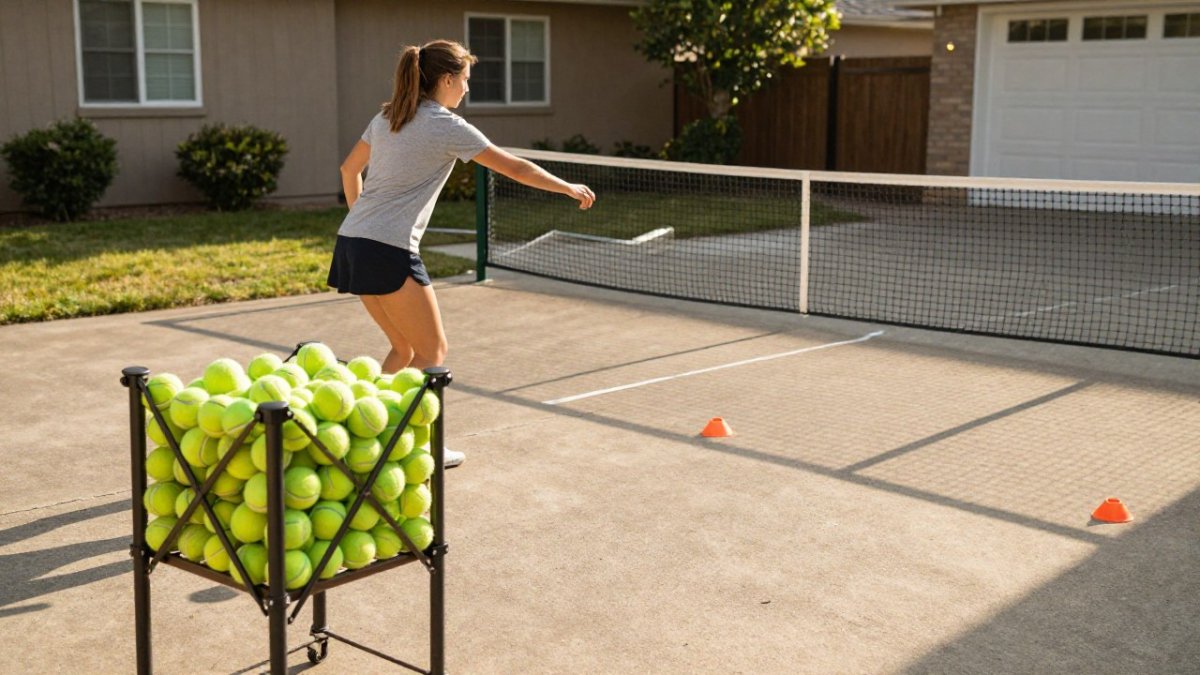
Once the rebound net, ball cart, and target cones are in place, the same thoughtful approach to practice can inspire gifts for tennis fans who enjoy bringing the game into everyday life.
The mistake we see most often is buying gear with no plan for using it. Our guide to building a tennis training routine for beginners shows how to sequence serve work alongside footwork and match play so the gear gets used.
Tennis Training Equipment for Beginners: Start With the Basics
Beginners should buy in this order: a hopper or ball cart, a rebound net, and cones. Skip the specialized trainers until you have a repeatable toss and a general idea of your contact point.
Two beginner-friendly additions are worth considering. Light training balls slow the serve down so you can feel the motion without muscling it. A simple target, even a towel laid on the ground, gives you feedback on placement from day one.
The pronation and forearm rotation that give a serve its snap are worth learning early, before bad habits set in. Our tennis serve pronation exercises for beginners pair well with basic equipment because they need no gear at all, just a few minutes and a mirror.
Watch out: beginners often buy a heavy weighted trainer first because it feels serious. Weighted aids can be harder on the body than lighter ones. Start light, add load slowly, and stop the moment your motion gets sloppy.
Buying Criteria and Total Cost: What to Check Before You Spend
Before you buy any serve aid, run it through five checks. This is the part most roundups skip.
- Does it target your actual fault? Match the aid to the problem you can name, not the one you assume you have.
- Does it need a partner or a court? Confirm it works in the space you actually have.
- Is the base stable? A weighted base matters for anything you swing near. A tipping stand is a hazard.
- What is the total cost? Add shipping, replacement balls, and any mounting hardware to the sticker price.
- Can you return it? Check the return window before you commit.
On price, the range across serve aids is wide, from simple tools to specialized swing trainers. Pricing depends on the product, quantity, and delivery, so confirm the current figure with the seller.
| Equipment Type | Typical Role | Space Needed | Best For |
|---|---|---|---|
| Rebound net | Continuous reps, solo practice | Driveway or wall | All levels |
| Ball cart or hopper | Fewer interruptions, more reps | Any | All levels |
| Serve stand | Contact point and swing path | Small | Rebuilding a motion |
| Target cones or net target | Placement and accuracy | Any | Accuracy work |
| Training balls | Slower motion, feel | Any | Beginners |
| Weighted swing aid | Strength and path | Small | Experienced players |
A common mistake is judging cost by sticker price alone. The cheaper aid you actually use beats the expensive one that sits unused. Buy for the drill you will run this week.
Drills and Progress Checks: Measuring Improvement With Your Gear
Equipment only pays off when you measure something. Pick one metric per session and track it over a month.
Beginner stage (weeks 1-2): build the toss and the feel.
- Toss-only reps (5 minutes): Ten tosses, catch each one. Count how many land in a target zone in front of your front foot. Rest 30 seconds between sets of ten.
- Training-ball serves (10 minutes): Twenty serves with light training balls at half speed. Focus on a relaxed motion, not power. Rest one minute halfway through.
- Target serves (10 minutes): Twenty serves at a cone or net target from a short distance. Count how many land in the zone.
Intermediate stage (weeks 3-4): add the stand and the net.
- Stand reps (5 minutes): Twenty swings at a fixed contact point, then ten live serves trying to reproduce that height.
- Rebound-net reps (10 minutes): Continuous serves into the net, focusing on swing path and a full finish. Rest 60 seconds every five minutes.
- Target serves (10 minutes): Twenty serves at a cone or net target from the baseline. Count how many land in the zone.
Advanced stage (weeks 5-6): add pressure and variety.
- Pressure set (5 minutes): Ten serves where you call the target out loud before you hit.
- Serve-and-recover set (10 minutes): Twenty serves at full pace, resting 20 seconds between each, to practice serving under mild fatigue.
- Placement ladder (10 minutes): Five serves to each of three target zones, counting first-serve percentage into each zone.
Track two numbers every session: first-serve percentage into the target zone, and how many serves felt relaxed versus muscled. Both matter. A serve that goes in but feels tight will break down under pressure.
Watch out: do not advance to the next stage until you can hit your target zone on roughly half your serves at the current stage.
For a full library of serve drills you can run at home with the gear above, see our collection of tennis serve drills for accuracy at home.
The limitation to accept: no piece of equipment sees your motion the way a coach does. Gear gives you feedback on outcomes.
Reserve Your Spot and Build a Serve That Holds Up
Equipment gives you reps. It does not give you a diagnosis. The players who break through a plateau are the ones who pair their practice gear with coaching that identifies the actual fault, then prescribe the drill that fixes it.
That is what we do at Crunch Time Coaching. Crunch Time Coaching offers step-by-step daily lessons, a challenge-based curriculum, and in-person training camps. The structure is the same for any player: find the fault, drill it, measure it, repeat.
Visit the Crunch Time Coaching website for current pricing and to reserve your spot.
Frequently Asked Questions
How can I practice my serve in tennis without a partner?
Solo serve practice works best with a ball cart, a net target or rebound net, and a set number of reps. Start with 20 tosses only, no swing, to build toss consistency. Then hit 30 serves to a target cone in the service box, tracking how many land within two feet of it. Finish with 10 serves at full speed. Twenty focused minutes beats an hour of aimless hitting, and a serve trainer or stand can keep your motion repeatable when no one is feeding you balls.
What equipment helps improve a tennis serve the most?
The highest-return tennis serve equipment targets your toss and contact point first, because most serve faults start there. A serve trainer that guides the swing path or a serve stand that holds a ball at your contact point lets you rehearse the motion without chasing bad tosses. Add a net target for placement and a ball cart to keep reps moving. Weighted training balls can build rhythm, but only after your toss is repeatable. Fix the toss before you buy power tools.
Can you practice a tennis serve at home, and what do you need?
You can practice the toss and swing motion at home with very little space. A serve stand or a ball held at contact height lets you rehearse the trophy position and extension without hitting. A short rebound net or a blanket against a wall handles low-speed swings. For full serves you need about 20 feet of clear space and a soft ball. Skip full-power serves indoors. The goal at home is rhythm and toss consistency, not speed.
What tennis training equipment is best for beginners working on the serve?
Beginners get the most from a ball cart, a set of cones for targets, and a simple serve trainer that shows the swing path. Skip the expensive swing machines until your toss is consistent and you can hit 7 of 10 serves into the correct service box. A rebound net helps with contact and rhythm. Check current prices with the seller for a starter setup. Coaching can help diagnose a grip or stance problem that equipment cannot.
