
Table of Contents
- The Biomechanics of Depth and Power in Tennis Volleys
- Tennis Volley Technique for Power: The Split Step and Ready Position
- Common Tennis Volley Mistakes That Kill Your Depth
- Volley Footwork Drills to Build Consistency
- Equipment Influence on Volley Performance
- Timing and Psychology: The Mental Side of Net Play
- Putting It All Together: Your Action Plan
- Frequently Asked Questions
Last Updated: September 27, 2026
The Biomechanics of Depth and Power in Tennis Volleys
Your tennis volleys lack depth and power because mastering tennis volleys depth power requires energy flowing from your body through the racket to the ball. Most players treat the volley as a small, controlled shot, the core problem. Players who struggle with depth and power disconnect their lower body from their upper body at contact.
Depth and power come from energy transfer through your kinetic chain: legs generate momentum, core transfers it, arm and racket deliver it. Break any link and your volley flattens.
How Body Weight Transfer Creates Momentum
Body weight transfer is the foundation of volley power. Most players plant their feet and freeze at contact instead of continuing forward momentum.
Keep moving through the ball: your back foot pushes off as you make contact, your front foot lands as you finish.
Split-step as your opponent hits, shift weight to the balls of your feet, drive your back leg forward, rotate hips slightly, land your front foot at contact, and continue momentum through the shot.
The most common mistake is stopping your forward movement too early. Keep your momentum moving through the net for the full duration of the shot. Your follow-through should show your weight fully transferred to your front foot.
The Role of Racket Head Speed and Contact Point
Racket head speed comes from the kinetic chain: legs create the base, core rotates, arm accelerates, wrist stays stable.
The ideal contact point is slightly in front of your body at waist height, allowing body weight to transfer directly into the ball.
A common error is contacting the ball with a stiff wrist. Your wrist should be stable but not locked. A locked wrist prevents the natural deceleration that protects against mishits and gives you directional control.
Tennis Volley Technique for Power: The Split Step and Ready Position
The split step and ready position trigger explosive volley movement. Without them, you’re slow, off-balance, and weak.
The split step is a small hop timed with your opponent’s contact that unloads your legs and prepares them to move in any direction. Your ready position before the split step positions your body to move forward, backward, or sideways with equal ease.
Timing Your Split Step for Explosive Movement
Split-step as your opponent’s racket makes contact with the ball to read direction and respond immediately.
Your split step should be a slight hop with feet leaving the ground briefly. Land with weight on the balls of your feet, knees slightly bent, ready to move in any direction.
The split step unloads your legs and resets your balance, letting you move in any direction with equal speed.
The split step is your most important net movement. Master the timing and you’ll instantly improve your court positioning and reaction speed.
Positioning Your Body at the Net
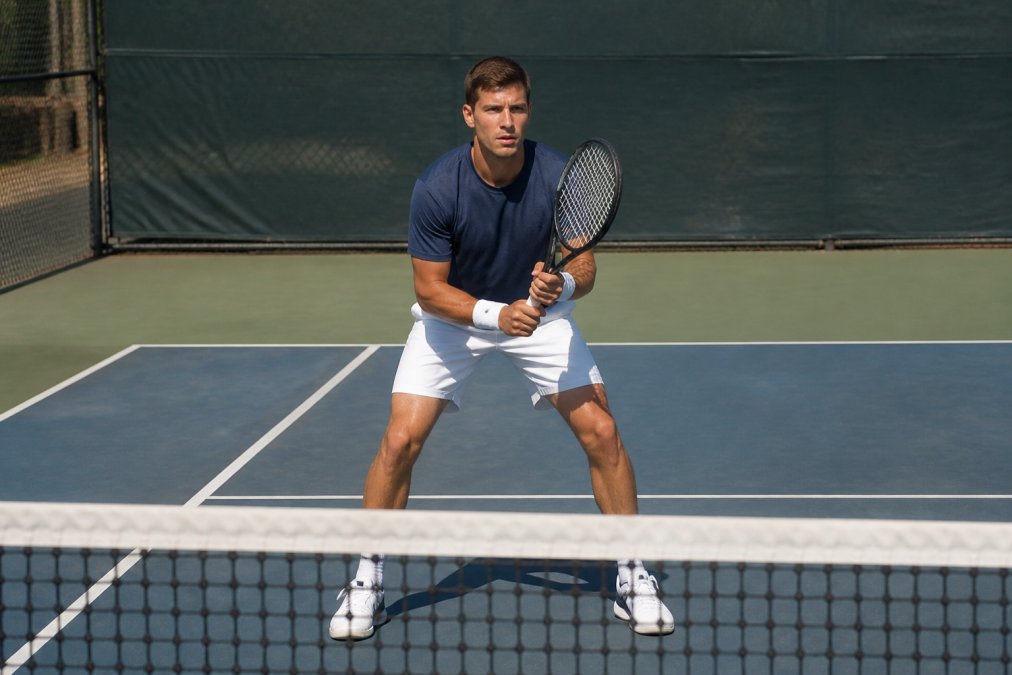
Ready position: feet shoulder-width apart, knees slightly bent, weight on balls of feet, racket at shoulder height, elbows bent at 90 degrees.
After the split step, step into the ball: right foot toward right balls, left foot toward left balls.
Keep shoulders slightly open to the net and hips relatively square to prevent excessive rotation that kills stability.
Common Tennis Volley Mistakes That Kill Your Depth
Mistakes that disconnect your body from your racket turn volleys into arm shots, which lack depth, power, consistency, and vulnerability to pace.
Over-Swinging and Losing Control
The most common mistake is over-swinging. The volley is a compact stroke; power comes from body weight transfer and racket head speed, not from a long swing.
Over-swinging worsens timing, reduces control, and disconnects your body from forward momentum.
Shorten your backswing to 12-18 inches, keep your elbow bent, stabilize your wrist, and generate power from stepping into the ball and rotating your core.
The punch volley, a short, compact stroke where you block the ball and let the opponent’s pace do the work, is the most common volley and gives the most control.
Poor Wrist Stability at Contact
Wrist stability determines accuracy. A loose wrist causes mishits; a locked wrist causes loss of feel. Keep your wrist firm but not rigid.
Practice punch volleys with a firm grip and stable wrist. Move your feet and body, keep the racket in front, and let your wrist absorb impact without collapsing.
Excessive wrist movement at contact is one of the biggest reasons volleys lack directional control. Keep your wrist stable throughout the shot. Let your body movement and footwork create the power, not your arm.
Neglecting the Follow-Through
The follow-through shows whether your body weight transferred into the shot. No follow-through or backward follow-through signals poor technique.
A proper follow-through shows weight fully transferred to your front foot, racket finishing high and across your body, with forward momentum.
Volley Footwork Drills to Build Consistency
Footwork drills build consistency, confidence, and muscle memory. Practice the footwork that makes volleys effective, not just hitting them.
The Box Drill for Court Positioning
The box drill teaches efficient net movement and court positioning without a ball.
Set up a 10×8 box around the net. Sprint forward to the net line and back to baseline for 30 seconds. Add lateral sprints side-to-side for 30 seconds. Combine both movements for 30 seconds.
This drill builds leg strength and coordination for quick net movement. Practice three times weekly for four weeks.
The Split-Step Reaction Drill
Stand at the net in ready position. As your partner hits from the baseline, split-step as the ball leaves their racket, then move and volley.
Time your split-step at your partner’s contact. Do 20 volleys with balls at different speeds and locations to train reaction to variety.
The Punch Volley Progression
The punch volley is the foundation of net play. It’s the volley you use most often. This drill teaches you to hit punch volleys with the tennis volleys depth power needed for consistency and control.
Start at the net, about 12 feet from the baseline. Your partner feeds you balls from the baseline. You hit punch volleys back. The goal is to hit the ball deep into the court. Aim for the baseline. Do 20 volleys.
Next, move back to about 15 feet from the baseline. Your partner feeds you balls. You hit punch volleys. The balls are coming faster now because they have further to travel. Do 20 volleys.
Finally, move back to the service line. Your partner feeds you balls. You hit punch volleys from the service line. This is the most challenging version. Do 20 volleys.
The progression teaches your body to generate depth and power from different positions. It also teaches you how to adjust your technique when the ball is coming faster or slower.
Equipment Influence on Volley Performance
Your racket influences your volley power and consistency. A heavier racket transfers more momentum to the ball. A lighter racket requires more racket head speed to generate the same power. A stiffer racket frame gives you more power but less feel. A more flexible frame gives you more feel but less power.
The string tension also matters. Tighter strings give you more control but less power. Looser strings give you more power but less control. Most volleyers use string tension between 55 and 62 pounds. This is a middle ground that provides both power and control.
The grip size affects your ability to generate racket head speed and maintain wrist stability.
Timing and Psychology: The Mental Side of Net Play
Volley power and depth depend partly on timing. You need to hit the ball at the right moment in its trajectory. Too early and you’re hitting a rising ball. Too late and you’re hitting a falling ball. The sweet spot is when the ball is at the peak of its bounce or slightly rising.
Putting It All Together: Your Action Plan
Your tennis volleys lack depth and power because one or more links in your kinetic chain are broken. The fix is to address each link systematically.
| Aspect | Focus | Drill | Frequency |
|---|---|---|---|
| Footwork | Court positioning | Box Drill | 3x weekly |
| Split-step | Timing and reaction | Split-Step Reaction Drill | 3x weekly |
| Punch volley | Depth and power | Punch Volley Progression | 3x weekly |
| Body weight | Forward momentum | Feeding drills | Daily practice |
| Wrist stability | Directional control | Partner drills | Daily practice |
Frequently Asked Questions
Should you swing at a tennis volley?
No, excessive swinging robs you of control and depth. A volley is a punch or block motion, not a full swing. Keep your swing path compact and let the incoming ball’s speed do most of the work. A short, controlled stroke with proper body weight transfer generates more power and accuracy than a large swing.
How do I use my legs to generate power on volleys?
Leg drive powers the kinetic chain. Start with a split step as your opponent strikes, then push off your back leg toward the net while transferring your body weight forward into the ball. This weight transfer through your legs, core, and shoulders creates momentum that travels through your arm to the racket. Without leg engagement, your volleys will lack depth and float short.
What is the most common mistake in tennis volleying?
Over-swinging and poor wrist stability at contact are the top two errors. Players either take too large a swing (losing directional control) or let their wrist collapse at impact (causing the ball to float). Keeping your wrist stiff and your swing compact preserves racket face angle and ensures the ball travels deep into the court.
Why do my volleys float instead of staying low?
Floating volleys usually stem from poor timing, a late contact point, or inadequate follow-through. If you meet the ball too late or too high, the racket face opens upward naturally. Focus on meeting the ball in front of your body at net height, keep your racket head slightly above your wrist, and follow through downward to decelerate the ball and keep it in the court with depth.