
Table of Contents
- Why Consistency Is the Foundation of Serve Mastery
- The Biomechanics Behind a Consistent Serve
- How to Fix Tennis Serve Inconsistency
- Tennis Serve Practice Routine for Daily Improvement
- Tennis Serve Toss Drills That Build Muscle Memory
- Pressure Management and Mental Focus Under Match Conditions
- Measuring Your Progress: Performance Metrics That Matter
- Frequently Asked Questions
Last Updated: September 29, 2026
Why Consistency Is the Foundation of Serve Mastery
Your serve is the only shot in tennis you control completely. No opponent influences it. No court conditions change it mid-motion. Yet most players don’t understand why consistency is key in tennis serve development.
This is where consistency becomes everything. A consistent serve isn’t about hitting harder or spinning more. It’s about executing the same motion, the same way, under pressure. That’s why consistency is key in tennis serve development. When your serve is reliable, your confidence builds. Your match strategy becomes possible. Your opponents face a predictable threat instead of a wild card.
At Crunch Time Coaching, we empower competitive tennis players to achieve a higher level of play through personalized guidance and hands-on sessions, ensuring you master specific skills and elevate your mental toughness on the court. Consistency requires deliberate structure, a pre-serve routine, measurable feedback, and training methods that simulate pressure.
The difference between a player who serves at 70% reliability and one who serves at 90% reliability often isn’t raw talent. It’s how they’ve engineered their serve motion and mental approach. This guide breaks down exactly how to build that reliability into your game.
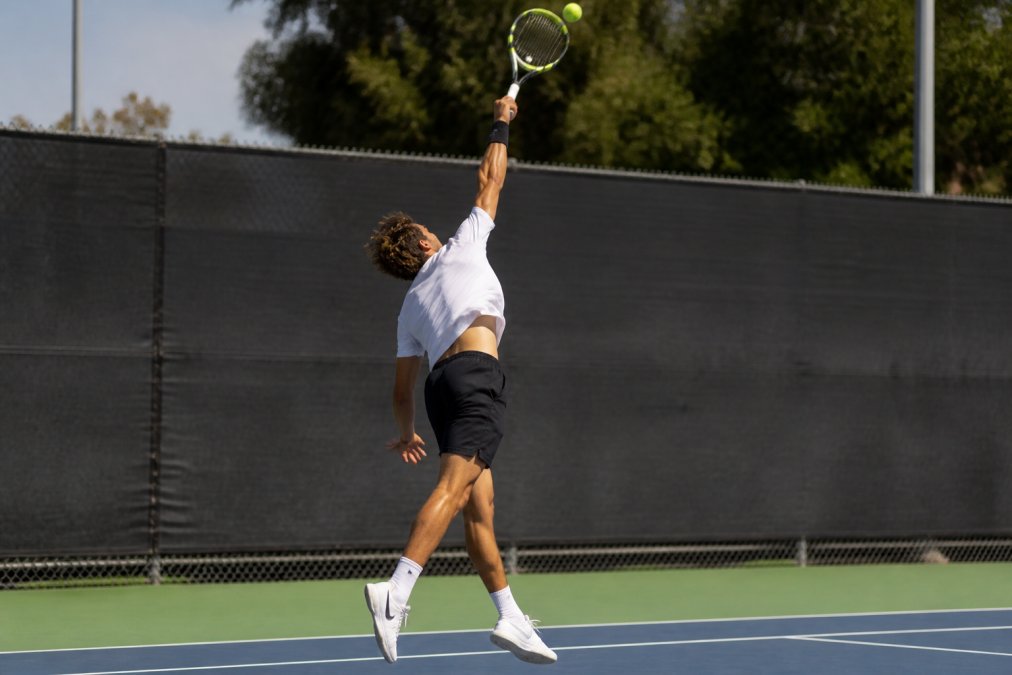
Refining these mechanical sequences requires not only dedicated repetition but also the right essential tennis gear to ensure that every movement remains fluid and unencumbered throughout the entire match.
The Biomechanics Behind a Consistent Serve
A consistent serve depends on repeating the same biomechanical sequence every single time. Small deviations compound. Your shoulder rotates 2 degrees differently, your weight transfers unevenly, your contact point shifts an inch, and suddenly your serve goes wide or into the net.
The foundation of serve consistency is understanding how your body generates power. Your legs drive the motion. Your core transfers that energy. Your shoulder and arm follow a specific trajectory. Your wrist and fingers finish the stroke. This chain of movements must fire in the same order, with the same timing, on every attempt.
The Kinetic Chain and Weight Transfer
The kinetic chain is the sequence of body segments that work together to generate power in your serve. It starts in your legs, transfers through your core, and ends in your arm and racket. Breaking this chain, or executing it out of sequence, destroys consistency.
Your weight transfer is the critical first step. At address, your weight sits on your back foot. As you begin your serve motion, this weight must shift forward in a controlled, repeatable way. Players who shift their weight inconsistently will never serve consistently. The timing of this transfer determines where your contact point occurs and how much power you generate.
Common technical flaws that disrupt the kinetic chain include: rotating your shoulders too early, bending your knees unevenly, or rushing your weight transfer. Each of these creates a different serve outcome. When you fix the kinetic chain, you fix the inconsistency.
Ball Toss as Your Consistency Anchor
Your ball toss is the single most important variable you control before contact. If your toss is inconsistent, your entire serve falls apart.
A consistent ball toss requires precision and repetition. The toss should land at the same height, the same distance in front of you, and the same distance to your right (for a right-handed player) on every serve. Most players don’t realize how much their toss varies until they film themselves. A toss that’s 6 inches too far back forces you to reach. A toss that’s too high gives you extra time but disrupts your rhythm. A toss that’s too low rushes your motion.
The ideal toss height is approximately 12-18 inches above your maximum reach. This gives you time to complete your motion without forcing you to wait. Your toss should land about 18 inches in front of your baseline. Consistency here is non-negotiable.
How to Fix Tennis Serve Inconsistency
Inconsistency comes from one of three sources: technical flaws in your motion, inadequate feedback on what you’re actually doing, or lack of pressure-simulation training.
Most players blame themselves for “choking” or “having a bad day.” In reality, they haven’t trained under conditions that match match play. They haven’t built the muscle memory required. They haven’t identified the specific technical flaw that’s causing the inconsistency.
Identifying Your Technical Flaws
The first step is seeing what you’re actually doing. Your perception of your serve and your actual serve are often completely different.
Film yourself serving from multiple angles. Use your phone if you don’t have access to a camera. Record at least 20 serves in a row. Watch the footage frame by frame. Look for these common technical flaws:
- Does your ball toss vary in height or location?
- Does your weight transfer happen at the same time each serve, or does it vary?
- Does your racket follow the same trajectory, or does it deviate?
- Does your contact point stay consistent, or does it shift forward and back?
- Does your follow-through complete the same way each time?
Once you’ve identified the flaw, you can target it. A player whose toss is inconsistent needs toss-focused drills. A player whose weight transfer is erratic needs footwork and timing work. A player whose contact point shifts needs to lock in their stance and arm path.
The Feedback Loop: Video Analysis and Repetition
Video feedback is non-negotiable for serve consistency. You cannot improve what you cannot see.
After you’ve identified your technical flaw, film yourself regularly, at least twice per week during your practice routine. Compare your serves from week to week. Are they becoming more consistent? Is the technical flaw improving? This feedback loop accelerates improvement.
Repetition without feedback is wasted effort. Repetition with feedback is deliberate practice. The difference is massive. A player who serves 100 times per day without watching footage might improve over months. A player who serves 50 times per day with video analysis improves in weeks.
Tennis Serve Practice Routine for Daily Improvement
Your practice routine determines your consistency level. Mindless repetition builds bad habits. Structured practice builds reliability.
Your daily serve practice should include three components: warm-up serves to establish rhythm, targeted drills that address your specific technical flaw, and pressure-simulation serves that mimic match conditions.
Building Your Pre-Serve Routine
Your pre-serve routine is the behavioral anchor that triggers consistent execution. Before every serve, you perform the same sequence of actions. This sequence becomes automatic. Your brain knows what to expect. Your body knows what to do.
A simple pre-serve routine might look like this: take two bounces of the ball, exhale fully, take your stance, perform your toss, and serve. The specific actions don’t matter. What matters is that they’re identical every time.
Many elite players use a longer routine: bounce the ball three times, adjust their stance, take a deep breath, visualize the serve location, toss, and serve. The length varies. The consistency doesn’t.
Your pre-serve routine becomes your mental reset. When you’re frustrated, anxious, or rushing, your routine slows you down. It centers you. It gives you control over the moment before you execute.
Deliberate Practice vs. Mindless Repetition
Deliberate practice is focused, structured work on specific skills. Mindless repetition is hitting serves without purpose or feedback.
Deliberate practice for serve consistency includes: identifying your technical flaw, performing drills that target that flaw, filming yourself to confirm improvement, and progressively increasing pressure as you improve.
Tennis Serve Toss Drills That Build Muscle Memory
Your toss is the foundation. Master your toss and your serve consistency skyrockets.
Progressive Toss Drills for Accuracy
Start with toss-only drills. Stand in your serve stance and toss the ball 20 times in a row without serving. Your goal is identical tosses every single time. Film yourself. Are they consistent?
Equipment Impact on Toss Consistency
Your racket weight and balance point affect your toss consistency. A heavier racket requires more aggressive weight transfer. A lighter racket allows for smoother, more controlled motion.
Pressure Management and Mental Focus Under Match Conditions
Technical consistency means nothing if you can’t execute under pressure.
Measuring Your Progress: Performance Metrics That Matter
You can’t improve what you don’t measure. Track specific metrics to confirm that your practice is building consistency.
Frequently Asked Questions
Why is my tennis serve so inconsistent?
Inconsistency usually stems from three sources: a poor or variable ball toss, flawed biomechanics in your kinetic chain, or lack of a reliable pre-serve routine. The ball toss is the single biggest variable, even a 2-inch difference changes your contact point and racket trajectory. Without a consistent routine and deliberate practice focused on muscle memory, your serve remains unpredictable under pressure. Video analysis and feedback-driven training are essential to identify which technical flaw is breaking your consistency.
How does ball toss height affect serve consistency?
Ball toss height directly controls your contact point and the angle of your racket at impact. A toss that’s too high forces you to wait and adjust; too low requires you to reach. Both create timing errors that cascade into inconsistent serve placement and power. A consistent toss, typically 12-18 inches above your racket head when fully extended, establishes a repeatable contact point. This is why toss drills are foundational to serve consistency. Small adjustments in toss height also allow you to vary spin and placement while maintaining a stable technical foundation.
How many serves should I practice a day to see improvement?
Quality matters far more than quantity. Deliberate practice of 50-100 serves with focused feedback beats mindless repetition of 500 serves. Most competitive players benefit from 15-20 minutes of structured serve practice 4-5 times per week, targeting specific technical elements: toss accuracy, weight transfer, follow-through, and serve placement under simulated pressure. Include match-play scenarios where you practice your pre-serve routine and manage pressure. Recovery and physical fatigue management are also critical, fatigue degrades muscle memory and form, so avoid overtraining the same motion without rest.
Does a consistent serve lead to more match wins?
Absolutely. A reliable serve is the foundation of point construction and match performance. Players with high serve percentages (65%+ first serves in) win significantly more points and matches because they control the rally from the start. Consistency also builds confidence and reduces double faults under pressure, which is often the difference in tiebreakers and deciding sets. Serve consistency directly impacts your ability to dictate play, hold serve, and manage the mental side of competition. It’s not the only skill that matters, but it’s the one skill you control completely on every point.