
Last Updated: October 25, 2026
Quick Summary
For beginner tennis footwork, you only need court shoes, a set of 6-12 marker cones, and a jump rope to cover your first three months. An agility ladder and doughnut rings are nice-to-have additions, while a ball machine can wait until your split step and first step are automatic.
- Buy court shoes, cones and a jump rope first; save the ball machine for later.
- Set cones two to three steps apart, roughly 4 to 6 feet for lateral shuffles.
- Keep ladder sets to 20-30 seconds and stop when your steps get sloppy.
- Warm up five minutes before quick-feet work and avoid concrete for high-volume jumping.
- Three sessions a week is enough to see change in your movement.
Table of Contents
- The Essential Tennis Footwork Equipment for Beginners
- Tennis Footwork Drills for Beginners: Pair Each Tool With a Drill
- Tennis Agility Ladder Drills That Build Court Movement
- Tennis Footwork Exercises at Home With Minimal Space
- The Best Tennis Shoes for Beginners: Grip, Support, and Injury Prevention
- How to Choose and Lay Out Your Agility Equipment
- Building a Practice Routine That Measures Footwork Improvement
- Sharpen Your Footwork With Crunch Time Coaching
- Frequently Asked Questions
The Essential Tennis Footwork Equipment for Beginners
Walk onto any court and you’ll see players with expensive rackets and brand-new bags who still can’t get to a wide ball. The gap isn’t gear quality. It’s movement. At Crunch Time Coaching, footwork is almost always the first thing we fix. Below, we’ll show you exactly which essential tennis footwork equipment for beginners is worth buying, which items can wait a season, and how to pair each tool with a drill that actually transfers to match play. But first, here’s what most gear guides get wrong: they list products without explaining what each one trains.
What You Actually Need vs. What Can Wait
The honest answer: you need very little to start. A good pair of court shoes, a handful of training cones, and a jump rope will carry you through your first three months of tennis footwork work. Everything else is optional until your movement has a base.
Here’s the breakdown we give our own students:
| Priority | Item | Why It Matters | Approximate Cost Tier |
|---|---|---|---|
| Must-have | Court shoes | Grip and lateral support prevent rolled ankles | Mid |
| Must-have | Marker cones (set of 6-12) | Defines movement patterns and targets | Low |
| Must-have | Jump rope | Builds calf stiffness and rhythm | Low |
| Nice-to-have | Agility ladder | Adds structure to quick-feet drills | Low to mid |
| Nice-to-have | Doughnut rings or court targets | Teaches placement and recovery steps | Low |
| Later | Ball machine | Solo repetition once your patterns are clean | High |
| Later | Rebound or tethered ball | At-home stroke work, not pure footwork | Low |
A common mistake is buying the expensive items first. A ball machine feeds balls; it doesn’t teach you to move. Until your split step and first step are automatic, the machine just gives you more chances to practice bad habits.
Tennis Footwork Drills for Beginners: Pair Each Tool With a Drill
Every piece of equipment you buy should answer one question: what movement does it train? Pairing tools with drills is how beginner tennis footwork actually improves, because random practice builds random habits.
- Cones, split-step drill: Place two cones two steps apart. Split step as your partner or ball machine contacts, then push off to reach each cone. Ten reps per side.
- Jump rope, rhythm drill: Two minutes of continuous skipping before every session. This trains the light, bouncy contact you want between shots.
- Doughnut rings, recovery drill: Set three rings in a triangle. Move to each ring, shadow a stroke, and recover to center. This teaches the step-back that most beginners skip.
- Ladder, quick-feet drill: One in, one out, both feet, then lateral. Keep your head level and your steps quiet.
For a deeper set of progressions, our guide to beginner tennis footwork drills lays out a full sequence, from stationary patterns to live-ball movement.
Tennis Agility Ladder Drills That Build Court Movement
Ladder work is the cheapest way to build coordination, and it’s the tool beginners abandon fastest because they don’t know what to do with it. The fix is a simple three-drill rotation.
Start with one-in-one-out: step one foot into each square, then out, moving forward. Next, lateral in-and-out, facing the sideline the whole time, since tennis movement is mostly sideways. Finish with icky shuffle, a quick in-in-out-out pattern that trains the small adjustment steps you use when a ball bounces shorter than expected.
Keep each set to 20-30 seconds. Quality beats duration here. If your feet get sloppy, stop the set. For a step-by-step progression using cones alongside the ladder, see these tennis cone drills for agility.
Tennis Footwork Exercises at Home With Minimal Space
You don’t need a court to train movement. Tennis footwork exercises at home work best in a hallway, garage, or driveway with about three meters of clear space and no equipment beyond a rope and a few cones.
- Shadow split steps: Ten split steps in place, reacting to a hand clap. Trains timing.
- Lateral shuffles: Cone to cone, four steps each way, staying low.
- Carioca steps: Two minutes, both directions. Builds hip mobility for open-stance shots.
- Single-leg balance holds: Thirty seconds per leg, eyes closed for the advanced version. Ankle stability matters more as you age.
If you’re returning to the game after years away, start with the balance and mobility work before adding speed. Our collection of at-home footwork drills covers a full routine.
The Best Tennis Shoes for Beginners: Grip, Support, and Injury Prevention
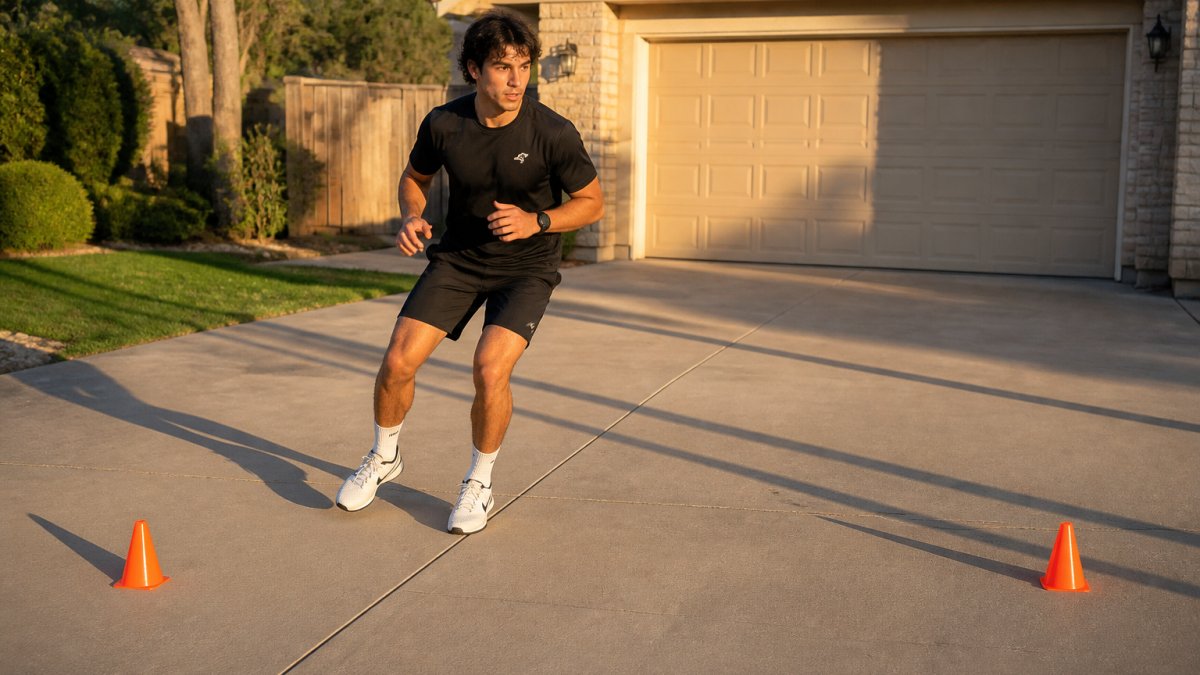
The best tennis shoes for beginners are dedicated court shoes with a herringbone or modified herringbone outsole, a reinforced toe drag area, and firm lateral support. Running shoes are the wrong tool: they’re built to go forward, and tennis asks you to stop, slide, and push sideways.
Watch out: playing in worn running shoes is a common cause of rolled ankles in adult beginners. The midsole compresses unevenly and the tread grabs on hard courts.
When you shop, check three things. First, the outsole pattern should suit your surface, with smoother patterns for hard courts. Second, the shoe should feel snug through the midfoot with room at the toe. Third, replace them when the tread under the big toe smooths out, which usually happens before the rest of the shoe looks worn. The American Academy of Orthopaedic Surgeons notes that proper athletic footwear and sport-specific warmups reduce injury risk in racket sports, and shoes are the foundation of that.
How to Choose and Lay Out Your Agility Equipment
Choosing agility gear comes down to two constraints: budget and floor space. A set of cones and a jump rope costs very little and fits in a bag. A ladder needs roughly six meters of clear run. Decide which space you actually have before you buy.
But the bigger beginner problem is setup, not purchase. Most players who abandon agility work do so because they never learned how far apart to place cones or where to put the ladder. Here is the layout guidance we give new students.
Cone spacing. For beginner footwork, set cones two to three steps apart, roughly 4 to 6 feet for lateral shuffles and 6 to 8 feet for forward and backward movement. Closer than that and you shuffle instead of taking real steps; farther apart and beginners overrun the target. Use 6-inch cones on hard courts and 9-inch cones on grass or uneven surfaces so they stay visible.
Ladder placement. Lay the ladder parallel to the sideline for lateral quick-feet work and perpendicular for forward linear work. Keep at least three feet of clear space on each side so your arms can swing naturally.
Court targets and rings. Place doughnut rings or flat targets one recovery step from your split-step position, about 3 to 4 feet, so the drill trains the step-back to center rather than a lunge. For wide-ball recovery drills, set a center target and two wide targets at roughly the singles sideline distance.
Surface and safety. Agility work belongs on a surface that gives slightly, a hard court, a sport-court driveway, or a rubber gym mat. Avoid concrete garage floors for high-volume jumping, and never run ladder drills in running shoes on a slick surface.
A useful rule: if a drill needs more than 30 seconds to explain, it’s too complicated for a beginner. Simple setups get used. Elaborate ones collect dust. Start with one cone pattern and one ladder pattern, master both, then add a third.
Measure your space before you buy: cones and a rope need about 10 feet of clear floor, a ladder needs about 20 feet of run, and a ball machine needs a court or a long driveway. Match the gear to the space and the drills will actually happen.
Building a Practice Routine That Measures Footwork Improvement
Progress in tennis footwork is measurable if you pick the right markers. Track three things weekly: the number of clean split steps per rally, your recovery time to center after a wide ball, and how many unforced errors come from being late rather than from bad technique.
A realistic routine looks like this: ten minutes of rope and ladder work, ten minutes of cone drills, then live-ball movement. Three sessions a week is enough to see change. Most players notice better balance and quieter feet within a month, though consistent match-play gains take longer. Our guide on how long it takes to improve tennis footwork breaks down the timeline, and our beginner training routine shows how to slot footwork work into your week.
Sharpen Your Footwork With Crunch Time Coaching
Equipment sets the stage. Coaching changes the movement. That’s the part most gear guides leave out, and it’s why so many players buy cones, drill for two weeks, and stall.
At Crunch Time Coaching, our “Totally Obsessed” coach delivers step-by-step daily lessons built to sharpen footwork and improve consistency, with a challenge-based curriculum that progresses as you do. Our online lessons let you film your movement and get feedback tailored to your specific patterns, and our hands-on in-person training camps put you on court with direct instruction. Whether you’re rebuilding after years away or pushing through a plateau, the goal is the same: reach a higher level of competitive play.
Frequently Asked Questions
What equipment helps improve tennis footwork?
The core kit is marker cones, an agility ladder, and court targets such as doughnut rings. Cones mark movement patterns and recovery spots, the ladder builds quick feet and coordination, and targets give you something to move toward. Add a rebound ball or tethered ball for solo practice. You do not need all of it at once: cones and a ladder cover most beginner footwork work, and you can add targets once your split step and recovery footwork are consistent.
Do beginners need an agility ladder for tennis?
An agility ladder is useful but not mandatory. It teaches fast, controlled foot contacts and coordination that carry into court movement, and it packs into a bag for at-home practice. Beginners get most of the value from two or three ladder patterns done twice a week. If budget is tight, chalk lines or tape on a driveway work for the same drills. Pair ladder work with on-court footwork drills so the speed you build has somewhere to go.
How can I practice tennis footwork at home?
You need about 10 feet of clear space. Lay out an agility ladder or tape lines, then run patterns like one-in, two-in, and lateral shuffles. Add split-step repetitions and shadow swings where you move to a spot, plant, and swing without a ball. A tethered ball or ball on a string lets you practice contact and recovery in a small area. Keep sessions to 15-20 minutes, three times a week, and focus on clean foot contacts rather than speed.
What shoes should a beginner wear for tennis?
Choose tennis-specific shoes with a durable outsole and lateral support, not running shoes. Running shoes are built for forward motion and lack the side-to-side stability tennis requires, which raises ankle and knee injury risk. Look for a herringbone or modified herringbone tread for hard courts and a snug midfoot fit. Replace shoes when the outsole tread smooths out, since worn tread is a common cause of slips during quick direction changes.
Your equipment can only take you as far as your movement patterns allow. Get the shoes, the cones, and the rope, then let a coach show you exactly how to use them. Get started with Crunch Time Coaching and turn better footwork into more wins. Reserve Your Spot Today.
