
Table of Contents
- Why Your Forehand Keeps Hitting Long
- Step 1: Adjust Your Racquet Face Angle at Contact
- Step 2: How to Add Topspin to Forehand for Better Control
- Step 3: Fix Your Tennis Forehand Swing Path
- Step 4: Manage Your Launch Angle and Net Clearance
- Step 5: Common Tennis Forehand Mistakes That Cause Long Shots
- Step 6: Drills to Lock In Depth and Consistency
- Step 7: Equipment Adjustments and String Tension
Last Updated: August 27, 2026
Why Your Forehand Keeps Hitting Long
Your forehand is hitting long because one or more technical elements are working against you: your racquet face is too open at contact, you’re not generating enough topspin, or your launch angle sends the ball on a trajectory that clears the baseline. The issue isn’t that your swing is "wrong", it’s that the mechanics producing your current result are predictable and fixable. Most players blame themselves for lack of focus, but the real culprit is almost always one of seven specific technical breakdowns. Address them systematically, and your forehand depth improves immediately.
The fastest way to stop hitting long is to check your racquet face angle first. If your face is open at contact, no amount of footwork or timing adjustments will save you. Close the face slightly, and you’ll see results in your next practice session.
Step 1: Adjust Your Racquet Face Angle at Contact
The racquet face angle at contact is the primary control for whether your ball clears the baseline or lands inside the court. An open face (tilted back) launches the ball higher and longer. A closed face (tilted forward) drives the ball down into the court with a lower trajectory.
Most players hitting long have an open racquet face at impact. This happens because the grip is too weak, the wrist is laid back too far, or the swing path doesn’t bring the face to a closed position naturally. Check your grip first. A weak grip makes it almost impossible to close the face through contact. Strengthen your grip slightly, firm enough that your fingers don’t slip. If your grip is solid, the issue is usually wrist lag. Your wrist should stay relatively neutral through contact, not laid back (open).
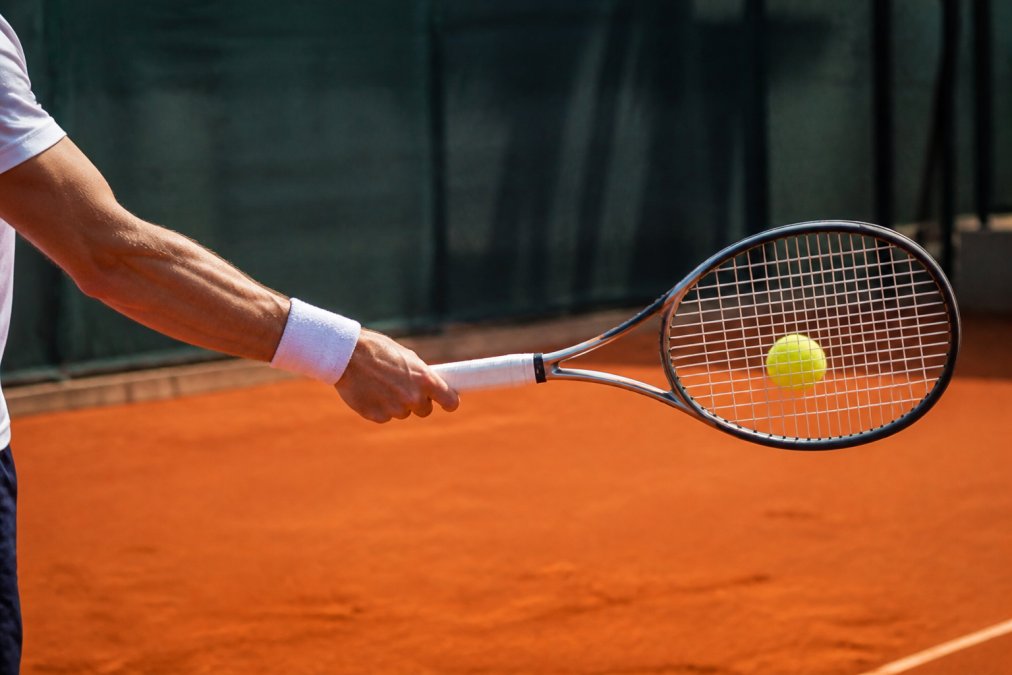
Practice this: take your ready position and make a slow-motion forehand without a ball. Stop at contact. Your wrist should feel neutral, your palm facing slightly forward. Your forearm should be slightly ahead of the racquet head. The third factor is swing path. If your swing comes from outside-in (across your body), the face naturally opens through contact. A proper forehand swing path is low-to-high and slightly inside-out (from your hip toward the opposite sideline). This path naturally closes the face and creates the angle you need for depth control.
Racquet face angle is the single biggest lever for controlling depth. Close it slightly, and [your forehand](/is-online-tennis-coaching-worth-it/) stops hitting long immediately. Everything else in this guide builds on this foundation.
Step 2: How to Add Topspin to Forehand for Better Control
Topspin is your best friend when you’re hitting long. The brush creates a downward force on the ball that pulls it into the court even when your launch angle is high. To add topspin to forehand, you need three things: a low-to-high swing path, a closed racquet face, and acceleration through the contact zone.
Your swing should start low, below hip height, and finish high, with your racquet ending above your shoulder. This vertical swing plane creates the brush and generates spin rate. Practice this drill: stand at the baseline and hit forehands focusing only on the finish position. Your racquet should end high and across your body. Once the motion is automatic, the topspin follows.
String tension affects topspin too. Higher tension (above 60 pounds) reduces spin potential (usta.com). Lower tension (55-58 pounds) gives you more string deformation, which increases spin rate and control. If you’re hitting long and using high tension, drop it down and notice the difference.
Step 3: Fix Your Tennis Forehand Swing Path
Your swing path determines the direction of your racquet head through contact and, consequently, the direction and spin of your shot. The ideal forehand swing path is low-to-high and slightly inside-out. Inside-out means your racquet moves from your hip area toward the opposite sideline as it swings forward. This path naturally closes the face, creates topspin, and produces a shot that lands deep in the court with margin for error.
Many players swing too much across their body (outside-in). This opens the racquet face and produces long, flat shots. To fix your swing path, focus on your contact point. Your forehand should contact the ball out in front of your body, roughly at hip height or slightly higher. This forward contact point naturally encourages an inside-out path.
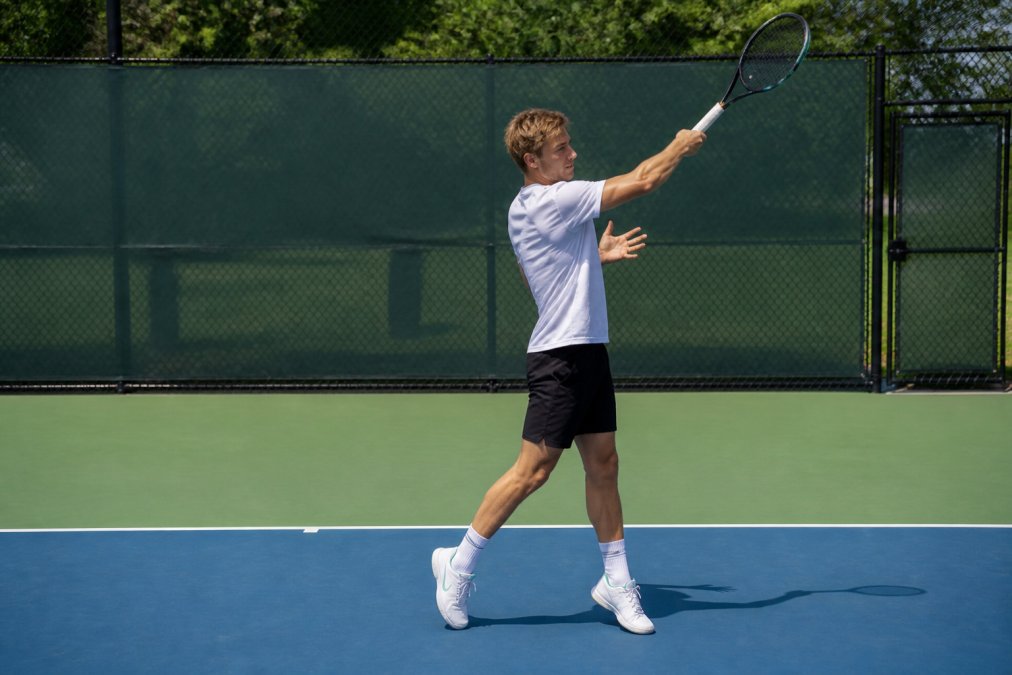
Use the "unit turn" to set up the proper path. Your shoulders should rotate away from the net as you prepare. Your racquet should be up at eye level. Footwork matters too. An open stance (feet parallel to the baseline) makes inside-out swings easier. A closed stance (front foot across toward the sideline) encourages outside-in paths. If you’re struggling with swing path, switch to an open stance and feel how much easier the inside-out motion becomes.
Step 4: Manage Your Launch Angle and Net Clearance
Launch angle is the angle at which your ball leaves your racquet. A high launch angle (30+ degrees) clears the net easily but often clears the baseline too (peer-reviewed research). A low launch angle (10-15 degrees) keeps the ball in the court but risks hitting the net. The sweet spot for consistent depth is 15-25 degrees.
Contact point height directly controls launch angle. If you contact the ball at shoulder height, your launch angle is naturally higher than if you contact it at hip height. Drop your contact point down slightly to immediately lower launch angle. Your follow-through also influences launch angle. If your finish is extremely high, you’re adding unnecessary lift to the shot. A controlled finish, with your racquet ending at shoulder height or slightly higher, produces a more neutral launch angle and better depth control.
Practice hitting with a target in mind. Place cones or use court lines as depth markers. Hit forehands aiming for a specific depth. This trains your depth perception and teaches your body what the correct launch angle feels like. relieving shoulder tension.
Step 5: Common Tennis Forehand Mistakes That Cause Long Shots
Understanding what NOT to do is just as important as understanding what to do. These five mistakes account for most long forehands.
Mistake 1: Over-rotating your shoulders. Excessive shoulder rotation creates too much power and a swing path that’s too flat. Your shoulders should rotate away from the net during preparation, but the rotation back should be controlled, not explosive.
Mistake 2: Hitting with a closed stance exclusively. A closed stance is useful for aggressive shots, but it encourages outside-in swings and makes depth control harder. Mix in open stances to groove inside-out paths.
Mistake 3: Rushing your preparation. Players hitting long often rush their unit turn. This leads to late contact points, open racquet faces, and long balls. Slow down your preparation and give yourself time to set your feet, rotate your shoulders, and get your racquet up.
Mistake 4: Swinging too hard. Trying to hit harder doesn’t always produce more control. Excess effort usually leads to poor timing, open faces, and long balls. Focus on swing smoothness and acceleration through contact, not raw power.
Mistake 5: Ignoring your grip. A weak grip is the silent killer of forehand depth. It allows your wrist to open through contact, which opens the racquet face. Strengthen your grip slightly and notice how much easier it becomes to close the face and control depth.
The biggest mistake is trying to fix everything at once. Pick one of these errors, fix it over a week of practice, then move to the next. Trying to overhaul your entire forehand in one session leads to confusion and frustration.
Step 6: Drills to Lock In Depth and Consistency
Drills are where theory becomes muscle memory. These three drills target the specific mechanics that control depth and consistency.
Drill 1: The Target Depth Drill. Place cones or use court lines to create target zones at 3/4 court depth (roughly 18 feet from the baseline). Hit 20 forehands aiming to land in that zone. Focus on swing path and racquet face angle, not power. Once you’re landing 15 out of 20 in the zone, move the target deeper and repeat.
Drill 2: The Low-to-High Swing Path Drill. Stand at the baseline and hit forehands focusing only on starting your swing low (below hip height) and finishing high (above shoulder height). Make 50 practice swings, focusing on the vertical motion. Once the motion is grooved, add the ball.
Drill 3: The Contact Point Drill. Have a partner feed you balls from the service box. Focus on contacting the ball out in front of your body (roughly at hip height or slightly higher). Hit 30 balls, concentrating only on contact point. This trains your timing and naturally encourages an inside-out swing path.
Perform these drills 2-3 times per week, 15-20 minutes per session. After 3-4 weeks of regular drilling, your forehand depth control becomes automatic.
Step 7: Equipment Adjustments and String Tension
Equipment changes can have a surprising impact on depth control. String tension is the most important equipment variable for depth. Higher tension (62+ pounds) gives you more control but less spin. Lower tension (54-58 pounds) gives you more spin and power. If you’re hitting long, try dropping your tension by 2-3 pounds. The increased string deformation creates more spin, which pulls the ball into the court.
String type matters too. Polyester strings are stiffer and produce less spin than synthetic gut. If you’re using polyester and hitting long, switching to synthetic gut can increase spin rate and help you control depth. Racquet head size affects the sweet spot and forgiveness. Larger heads (100+ square inches) are more forgiving but can make it harder to control depth (usta.com). Smaller heads (95-98 square inches) require better technique but reward you with better depth control once you develop consistency.
Most depth-control issues are technique-related, not equipment-related. Fix your mechanics first. Once your forehand is solid, equipment adjustments can fine-tune your consistency.
Hitting long on your forehand is frustrating, but it’s fixable. The seven steps in this guide address every major cause: racquet face angle, topspin generation, swing path, launch angle, common mistakes, drilling for consistency, and equipment optimization. Start with Step 1 (racquet face angle) and work through each step systematically. Your depth control improves within days.
At Crunch Time Coaching, with the right technique and consistent practice, you’ll develop the depth control that separates solid players from great ones. Reserve your spot today with Crunch Time Coaching and get personalized guidance on fixing your forehand technique through our step-by-step daily lessons and hands-on coaching.
| Technique Element | Problem | Fix | Impact |
|---|---|---|---|
| Racquet face angle | Open at contact | Strengthen grip, neutral wrist | Immediate depth control |
| Topspin generation | Flat swing path | Low-to-high brushing motion | Ball pulls into court |
| Swing path | Outside-in motion | Inside-out path with open stance | Closed face, better consistency |
| Launch angle | Too high (30°+) | Lower contact point | Ball lands in court |
| Contact point | Late or beside body | Contact out in front | Proper angle, depth control |
| Follow-through | Excessive upward motion | Controlled finish at shoulder height | Neutral launch angle |
| String tension | Too high (62+ lbs) | Drop to 55-58 lbs | More spin, better depth |
Frequently Asked Questions
Q: Why does my tennis forehand keep hitting long despite my effort to control it?
A: Forehands go long for three main reasons: an open racquet face at contact, insufficient topspin to bring the ball down into the court, or a swing path that's too flat. Most players hit long because they're accelerating through the ball without brushing it, which kills spin and trajectory control. The fix combines closing your racquet face slightly, adding upward brush motion, and managing your follow-through to reduce excess depth.
Q: How do I add topspin to my forehand to keep the ball in the court?
A: Topspin comes from a low-to-high brushing motion combined with racquet head speed. Start your swing lower than the ball's bounce point and finish high across your body. Focus on accelerating the racquet strings through the ball with a vertical swing plane rather than a flat swing path. Grip pressure matters too, hold the racquet firmly but not rigidly so your wrist can lag and snap through contact, creating ball rotation that brings the ball down into the baseline.
Q: What's the most common forehand mistake that causes long shots?
A: The biggest mistake is hitting with an open or neutral racquet face while swinging flat. Players often think 'hit harder' when the ball goes long, but more speed with a flat swing path and open face just sends the ball deeper. The second-most common error is poor weight transfer, when your weight stays back, you lose control and consistency. Fix both by closing your racquet face 5-10 degrees, using an upward brush, and driving your weight forward into the shot.
Q: How long does it take to fix a forehand that hits long?
A: Most players see improvement within 2-3 practice sessions once they understand the three core fixes: racquet face angle, topspin brush, and weight transfer. Consistency takes longer, typically 2-4 weeks of focused drilling before the new mechanics feel automatic on court. The timeline depends on your current habit strength and practice frequency.
This article was written using GrandRanker