
Last Updated: October 29, 2026
Quick Summary
Clay court speed stays consistent when you water lightly, drag the full court, brush loose or packed spots, and roll once the surface is evenly damp. Moisture, surface texture and compaction all shift with weather and play, so check the court before every session.
- Water lightly when the clay is dusty, aiming for damp clay rather than puddles.
- Drag in overlapping passes that cover the baselines and corners, not just the centre.
- Brush loose or crusted clay first, then roll once the surface is evenly damp.
- Avoid rolling a dry court, which can crack the top layer.
- Flooding the baseline area packs the clay hard and slows the court near the back.
Table of Contents
- Why Clay Court Speed Changes From Day to Day
- How to Water a Clay Tennis Court
- Setting a Clay Court Watering Schedule
- How to Drag a Clay Tennis Court
- Rolling and Brushing: Keeping the Surface Even
- Clay Court Maintenance Checklist
- Reading Your Court Before You Play: Next Steps for Consistent Play
- Frequently Asked Questions
Clay court speed doesn’t stay put. A court that played fast on Monday can feel slow and grabby by Friday, and most players blame their own form before they look at the surface. Keeping clay consistent comes down to a few routine habits: watering, dragging, rolling and brushing.
Why Clay Court Speed Changes From Day to Day
Clay court speed is set by moisture, surface texture and how packed the top layer is. For a broader look at adjusting and increasing court speed, see the full guide. Dry clay plays slow and loose. Overly wet clay plays heavy and sticky. Loose or uneven spots make the bounce unpredictable.
The clay court speed you feel is really the balance of all three. Daily weather, heavy play and wind all shift that balance, which is why the same court can change so much in a week.
- Dry, sunny days pull moisture out of the top layer
- Heavy play loosens the surface and leaves footprints and ruts
- Rain or heavy dew packs the clay and slows the ball
How to Water a Clay Tennis Court
Water the court evenly and lightly, aiming for damp clay rather than puddles. Use a sprinkler or hose with a fine spray so the top layer soaks in without washing the surface away.
Work in a steady pattern across the whole court. Skipped corners and soggy patches create the uneven bounces you’re trying to avoid.
Watch out: flooding the baseline area can pack the clay hard and make the court play noticeably slower near the back of the court.
Setting a Clay Court Watering Schedule
A simple watering schedule keeps moisture steady instead of swinging between too dry and too wet. Most clubs water on a set routine tied to play times and weather.
Check the surface before each session. If the clay is dusty and light, water it. If it’s already damp and firm, hold off.
- Morning check: Water lightly if the surface is dry
- Midday check: Water again on very hot or windy days
- Evening check: Skip watering if rain is expected overnight
How to Drag a Clay Tennis Court
Dragging smooths out footprints, ruts and loose spots. Pull a drag mat across the court in overlapping passes, working from the back of the court toward the net.
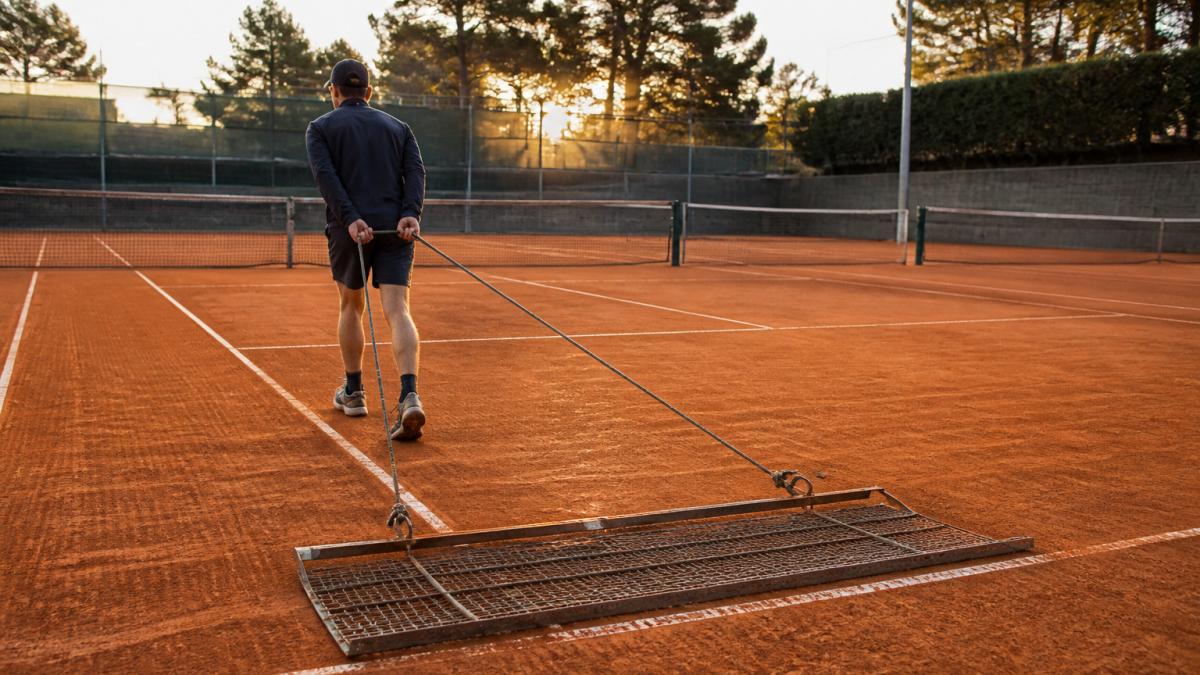
Keep the drag moving at a steady pace. Stopping in place leaves dips, and dragging too fast skips over the marks you need to fix.
A common mistake is dragging only the centre of the court. Cover the baseline areas and the corners where players hit the most shots.
Rolling and Brushing: Keeping the Surface Even
Rolling firms up the top layer so it plays consistently. Brushing loosens compacted clay and spreads it evenly. Most courts need both, and the order matters.
Brush first to loosen the surface, then roll to firm it. Rolling a loose, uneven court just pushes the bumps into a different shape.
- Brush to loosen crusted or packed clay
- Roll once the surface is evenly damp
- Avoid rolling a dry court, which can crack the top layer
Clay Court Maintenance Checklist
Use this checklist before every session to keep the court in the same condition from start to finish.
- Check the surface for dryness, dampness or standing water
- Water lightly if the clay is dusty
- Brush any crusted or packed areas
- Drag the full court, including the baselines and corners
- Roll once the top layer is evenly damp
- Mark any remaining dips or bare patches for the next session
The checklist below sums up the routine steps for keeping a clay court consistent before each session.
| Step | What to do | When |
|---|---|---|
| Check the surface | Look for dryness, dampness or standing water | Before every session |
| Water lightly | Add water if the clay is dusty | When the surface is dry |
| Brush | Loosen any crusted or packed areas | Before rolling |
| Drag | Cover the full court, including baselines and corners | Before every session |
| Roll | Firm the top layer once it is evenly damp | After brushing |
| Mark dips | Note remaining dips or bare patches | For the next session |
Reading Your Court Before You Play: Next Steps for Consistent Play
Before you hit, walk the court and feel the surface. Look for loose footprints, damp patches and areas that look packed or glossy. Those spots tell you how the ball will bounce that day.
Once you can read the court, you can adjust your own game to match it. Reserve your spot with Crunch Time Coaching.
Frequently Asked Questions
How do you keep a clay tennis court playing consistently?
Keep the surface at a steady moisture level, drag it after play, brush the lines and rolling regularly, and top up any worn areas. Consistency comes from repeating the same routine every day rather than doing large corrective work only when the court starts playing badly. Many clubs track watering and dragging in a simple log so that anyone maintaining the court follows the same steps, which keeps bounce and speed predictable from one session to the next.
How often should you water a clay tennis court?
Most clay courts need watering before play on hot, dry days, and the amount depends on temperature, humidity, wind and how much the court is used. Water lightly and evenly rather than soaking the surface, because standing water loosens the top layer and makes the court play slow and muddy. Check the surface by hand before play: if it is dusty and loose, it needs more moisture; if it is wet and sticky, it needs less.
Does rolling a clay court make it faster or slower?
Rolling compacts the surface, which generally makes a clay court play faster and gives a firmer bounce. Rolling too often or on a soaked court can make it hard and slick, while rolling a dry, loose court without moisture can cause dust and inconsistent bounce. Roll after watering has soaked in and the surface has begun to firm, and avoid rolling immediately after heavy rain.
How can you tell when a clay court needs more water?
A clay court that needs water looks pale and dusty, the balls skid and bounce low, and footing feels loose with dust puffing up at each step. A court that has enough moisture looks darker, feels slightly damp to a finger pressed into the surface, and gives a predictable, medium-paced bounce. Test a few spots across the court, since sunny and shaded areas often dry at different rates.
