
Table of Contents
- Why Tennis Shoulder Pain Happens After Serving
- Tennis Serve Mechanics for Shoulder Health
- Shoulder Warm-Up Routine for Tennis
- Rotator Cuff Exercises for Tennis Players
- Post-Match Recovery and Acute Pain Management
- Age-Specific Prevention for Players 40 and Older
- Gradual Return to Play After Shoulder Pain
- Conclusion
Last Updated: August 25, 2026
Why Tennis Shoulder Pain Happens After Serving
Tennis shoulder pain after serving stems from extreme demands placed on your shoulder during this explosive movement. During a tennis serve, your shoulder undergoes rapid internal rotation, extreme abduction, and deceleration forces exceeding 7,000 degrees per second, faster than any other human movement. Most players experience shoulder pain not from serving too much, but from serving wrong. Improper mechanics multiply stress on your rotator cuff and surrounding tissues. When your scapula doesn’t stabilize properly, your shoulder socket becomes unstable. When your kinetic chain doesn’t engage, your arm does all the work. Prevention isn’t about resting, it’s about moving correctly.
The kinetic chain in tennis starts at your feet. If your ground contact and weight transfer are off, no amount of shoulder exercises will fully protect you. Film your serve from the side and check if your weight shifts forward through your front leg before your arm starts moving.
Tennis Serve Mechanics for Shoulder Health
The tennis serve is a full-body movement, not a shoulder movement. Your legs drive the motion, your core transfers force, and your shoulder decelerates the arm. When any part of this chain fails, your shoulder absorbs the impact.
The kinetic chain and shoulder load distribution
The kinetic chain starts at ground contact. Your back foot plants, legs drive upward, hips rotate, trunk rotates, shoulder externally rotates, and finally your arm accelerates forward. Research shows players with the highest serve speeds and lowest injury rates share one pattern: their legs and hips generate 50-55% of serve velocity, their trunk generates 20-25%, and their shoulder and arm generate only 20-25%. Players with shoulder pain typically show reversed percentages, with their shoulder and arm doing 40-50% of the work because their lower body and trunk aren’t contributing.
Your scapula is the foundation of shoulder health during serving. It must upwardly rotate, externally rotate, and retract in sequence to allow your glenohumeral joint to move safely. If your scapula is stuck in a downwardly rotated or anteriorly tilted position, your rotator cuff can’t function properly. Scapular stability work is non-negotiable for serve health.
Common serve technique flaws that cause pain
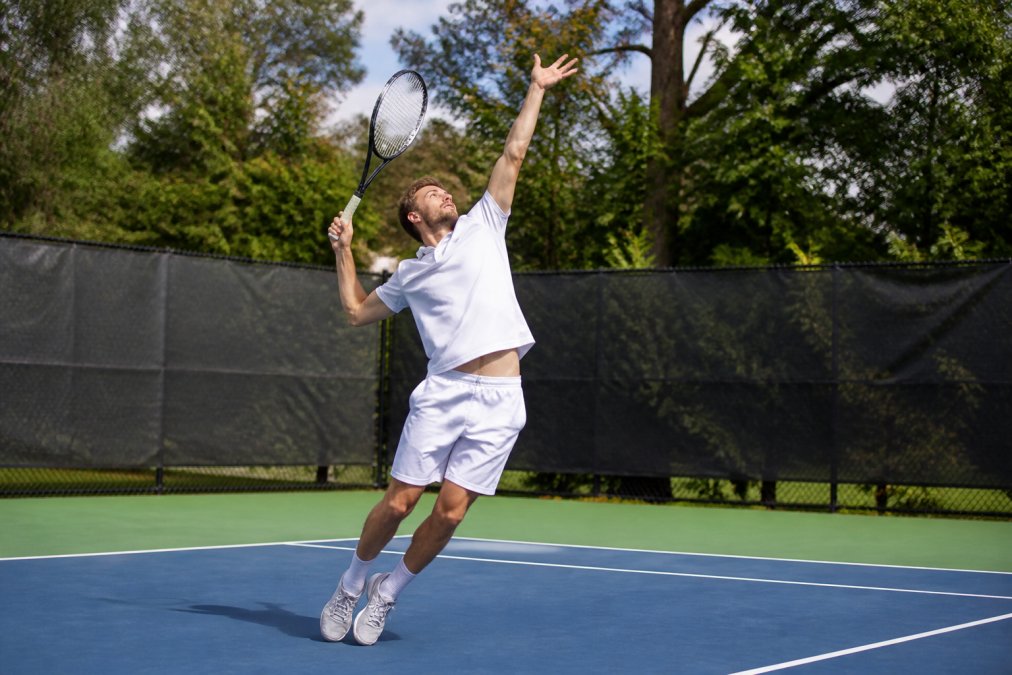
The most common flaw is the "arm-dominant" serve. Your arm starts moving before your hips and trunk have fully rotated, forcing your rotator cuff to decelerate an arm moving at maximum speed with minimal support from larger muscle groups. This causes inflammation, micro-tears, and tendinopathy.
Another frequent issue is improper external rotation at the cocking phase. Your shoulder should externally rotate 165-180 degrees during cocking. If your shoulder doesn’t achieve this range, you either compensate with excessive elbow flexion or force the rotation from your rotator cuff rather than achieving it through proper scapular positioning. Both approaches create impingement and overload.
A third flaw involves the follow-through. Many players decelerate their arm by tensing up rather than allowing their posterior shoulder muscles to work eccentrically. Eccentric loading, where muscles lengthen under tension, is how your rotator cuff absorbs deceleration forces.
If you’re experiencing shoulder pain specifically during the acceleration phase of your serve (when your arm moves forward), the problem is likely in your follow-through and deceleration. Pain during cocking (when your arm goes back) suggests scapular stability or range of motion issues. Pain during the entire serve motion suggests a combination of problems that need systematic fixing.
Shoulder Warm-Up Routine for Tennis
A proper warm-up prepares your shoulder for the extreme ranges of motion and forces it will experience during serving. Your shoulder warm-up should activate your rotator cuff, improve your thoracic mobility, and establish neuromuscular control before you hit any serves.
Pre-match mobility and activation sequence
Start with 2-3 minutes of light cardio to elevate your heart rate. Perform 10 arm circles forward and backward, controlled and deliberate. Follow with 10 cross-body shoulder stretches, holding each side for 2 seconds.
Activate your rotator cuff with band pull-aparts. Use a light resistance band, hold it with straight arms at shoulder height, and pull the band apart by moving your elbows backward. Perform 15 repetitions with a 1-second pause at full contraction.
Perform prone I-Y-T raises. Lie face down on a bench or stability ball with your chest supported. Perform 8 reps raising your arms in an "I" position (straight overhead), 8 reps in a "Y" position (45 degrees from your body), and 8 reps in a "T" position (90 degrees from your body).
Add 10 external rotations with a light dumbbell. Stand with your arm at 90 degrees abduction, elbow bent at 90 degrees. Rotate your forearm upward against gravity, then control it back down.
Finish with 8-10 scapular wall slides. Stand with your back against a wall, arms in a "W" position at shoulder height. Slowly slide your arms upward toward a "Y" position, maintaining contact with the wall throughout.
This entire sequence takes 8-10 minutes. Perform it before every practice session and match.
The difference between players who develop [shoulder pain](/tennis-training-for-players-over-40-a-complete-guide/) and those who don’t often comes down to whether they’ve established proper neuromuscular control before serving. A 10-minute warm-up prevents months of recovery time.
Rotator Cuff Exercises for Tennis Players
Your rotator cuff consists of four muscles: supraspinatus, infraspinatus, teres minor, and subscapularis. These muscles stabilize your glenohumeral joint and control shoulder rotation. For tennis players, rotator cuff strength is the foundation of serve health and longevity.
Eccentric loading and scapular stability work
Eccentric exercises involve muscles lengthening under tension, exactly what happens during the deceleration phase of your serve. Start with eccentric external rotations. Stand with a light dumbbell (2-5 pounds) in one hand, your arm at 90 degrees abduction with your elbow bent at 90 degrees. Use your other hand to help rotate your forearm upward to the top position. Then, slowly lower the weight back down using only your rotator cuff muscles, taking 3-4 seconds for the lowering phase. Perform 10-12 repetitions per side, 3 times per week.
Add prone horizontal abduction with external rotation. Lie face down on a bench with your arms hanging off the edge. Hold light dumbbells (1-3 pounds) and raise your arms up and back, rotating your forearms upward as you lift. The eccentric portion should take 3-4 seconds. Perform 12-15 repetitions, 3 times per week.
Scapular stability is equally critical. Perform prone Y-T-I raises with light dumbbells (1-2 pounds) and perform 12-15 repetitions of each position. Add dead bug variations to improve scapular control in dynamic settings. Lie on your back with your arms extended toward the ceiling, holding light dumbbells. Slowly lower your right arm overhead while simultaneously lowering your left leg toward the ground. Return to start position and alternate sides. Perform 10 repetitions per side, 2-3 times per week.
Progressive strengthening progression
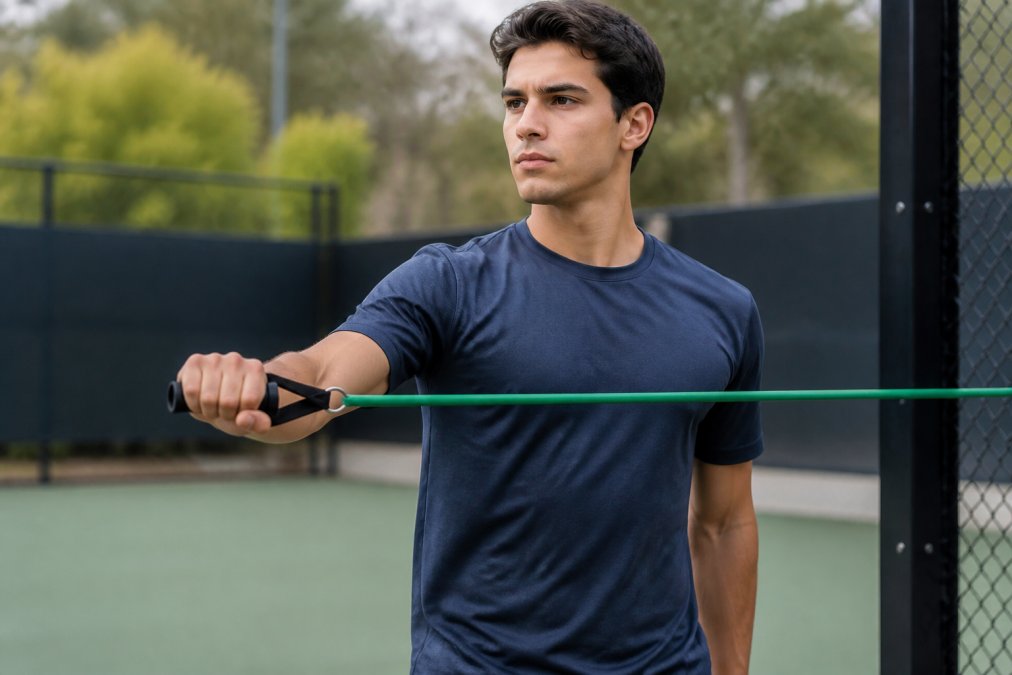
Start with isometric holds. Hold a light resistance band in external rotation position for 20-30 seconds. Perform 5 holds per side, 3 times per week.
Progress to concentric exercises (where muscles shorten under tension). Perform standing external rotations with a resistance band. Perform 15-20 repetitions per side, 3 times per week.
After 2-3 weeks of concentric work, add eccentric emphasis. Take 3-4 seconds for the lowering phase. Maintain this phase for 4-6 weeks.
Progress to dumbbell exercises once you’ve built foundational band strength. Start with 2-3 pound dumbbells and gradually increase to 5-8 pounds over 8-12 weeks. Add complexity by incorporating movement. Perform half-kneeling single-arm landmine presses. Kneel on one knee, hold a light dumbbell at shoulder height, and press upward and slightly forward. This teaches your rotator cuff to stabilize while your arm moves in three-dimensional space. Progress conservatively. Increase load or volume by no more than 10% per week. rebuilding shoulder strength.
Post-Match Recovery and Acute Pain Management
What you do immediately after serving determines whether you’ll experience lingering shoulder pain. Apply ice for 15 minutes immediately after serving. Cold reduces inflammatory response and numbs pain signals.
Perform gentle range of motion exercises while your shoulder is still warm. Perform 10 slow arm circles in both directions, 10 cross-body shoulder stretches holding each side for 5 seconds, and 10 internal and external rotation stretches with your arm at 90 degrees abduction.
Compression helps reduce swelling. Wear a compression sleeve or wrap your shoulder with an elastic bandage for 2-3 hours post-activity.
Within 2-3 hours of activity, perform gentle strengthening. Do 10-15 band pull-aparts, 10-15 prone Y-raises, and 10-15 external rotations with light resistance. This active recovery promotes blood flow and prevents stiffness.
When to seek physical therapy or medical attention
Seek immediate medical attention if you experience sudden, sharp pain during serving, hear or feel a pop in your shoulder, or experience significant weakness or loss of motion. Consult a physical therapist if pain persists for more than 2 weeks despite rest and home care, if pain worsens despite following proper mechanics, or if pain radiates down your arm. Consider imaging (ultrasound or MRI) if pain persists beyond 4 weeks of consistent home care and physical therapy.
Many tennis players try to “play through” shoulder pain, assuming rest will make them weak. The opposite is true. Continuing to serve with shoulder pain reinforces poor movement patterns and allows inflammation to become chronic. Two weeks of modified activity and proper rehabilitation is far better than two months of chronic pain.
Age-Specific Prevention for Players 40 and Older
Players over 40 experience shoulder pain more frequently because decades of play create cumulative tissue changes. Your tendons become less elastic, your rotator cuff muscles atrophy faster without consistent training, and your thoracic spine loses mobility. These changes are manageable with age-appropriate prevention.
Mobility work becomes non-negotiable. Perform daily thoracic spine rotations. Lie on your side with your knees bent and your hands clasped behind your head. Rotate your top elbow toward your bottom knee, then rotate backward, opening your chest toward the ceiling. Perform 10 rotations per side, daily.
Add daily shoulder mobility work. Perform sleeper stretches daily, lie on your side with your arm at 90 degrees abduction, elbow bent at 90 degrees, and use your other hand to gently press your forearm toward the ground. Hold for 30 seconds per side, twice daily.
Increase your training volume gradually. If you’ve had time off from tennis, return to match intensity over 4-6 weeks, not 2-3 weeks. Prioritize recovery. Players over 40 need more recovery time between intense sessions. Reduce serve volume strategically. Instead of serving 100 balls per practice session, serve 60-70 balls with perfect mechanics. Quality matters more than quantity. Consider equipment adjustments. A lighter racket (under 12 ounces) reduces deceleration forces your rotator cuff must absorb. Lower string tension (50-52 pounds for most players) increases dwell time and reduces impact shock.
Gradual Return to Play After Shoulder Pain
Once you’ve experienced shoulder pain, your return to full serving intensity must be systematic. Rushing this process re-injures your shoulder and extends recovery time from weeks to months.
Start with pain-free range of motion exercises. Perform gentle arm circles, cross-body stretches, and supported rotations. You should feel no pain during any movement.
Progress to light strengthening with resistance bands. Perform external rotations, pull-aparts, and prone Y-raises with minimal resistance. Complete 2-3 sets of 15-20 repetitions, every other day.
Add dumbbell strengthening after 3-5 days of pain-free band work. Use 1-2 pound dumbbells and perform the same exercises. Progress to 3-5 pound dumbbells over the next 1-2 weeks.
Begin serve mechanics work without a ball. Perform slow-motion serves, focusing entirely on proper kinetic chain sequencing. Perform 10-15 slow-motion serves per session, every other day.
Progress to serving at 50% intensity with a ball. Serve 10-15 balls per session, every other day. Focus on mechanics rather than power.
Increase to 75% intensity after 3-5 days of pain-free 50% intensity serving. Serve 20-30 balls per session.
Progress to 90% intensity after 5-7 days of pain-free 75% intensity serving. Serve 30-40 balls per session.
Return to full intensity and volume gradually. Serve full-intensity first serves, but limit second serves to 75% intensity. Gradually increase second serve intensity over 1-2 weeks. Limit total serve volume to 50-60 balls per session for the first week, 70-80 balls the second week, and return to normal volume the third week.
This entire progression takes 4-6 weeks minimum.
The return-to-play timeline isn’t about how quickly you can serve hard, it’s about how consistently you can serve without pain. Pain is your signal to slow down, not push through.
Conclusion
Preventing tennis shoulder pain after serving comes down to three fundamental principles: proper mechanics, consistent strengthening, and smart recovery. Your serve is a full-body movement. Your rotator cuff needs eccentric strength to handle deceleration forces. Your shoulder needs recovery time between intense sessions.
At Crunch Time Coaching, our step-by-step daily instruction guides you through serve mechanics, rotator cuff strengthening, and proper progression protocols. Whether you’re returning from shoulder pain or preventing it before it starts, Crunch Time Coaching provides the expert coaching and personalized guidance to transform your serve safely. Reserve Your Spot Today to unlock your full competitive potential without shoulder limitations holding you back.
| Phase | Duration | Focus | Serve Intensity |
|---|---|---|---|
| Mobility & Light Strengthening | 3-5 days | Range of motion, band exercises | None |
| Pain-Free Band Work | 3-5 days | Resistance band strengthening | None |
| Dumbbell Strengthening | 7-10 days | Progressive load increase | None |
| Slow-Motion Mechanics | 5-7 days | Kinetic chain sequencing | 0% (mechanics only) |
| 50% Intensity Serving | 5-7 days | Controlled ball striking | 50% |
| 75% Intensity Serving | 5-7 days | Increased power focus | 75% |
| 90% Intensity Serving | 7-10 days | Near-full power serving | 90% |
| Full Return | 3-4 weeks | Normal match intensity | 100% |
Frequently Asked Questions
How long does it take to prevent tennis shoulder pain?
Prevention starts immediately through proper warm-up, mechanics, and recovery. Building adequate rotator cuff strength takes 8-12 weeks of consistent training. Most players see significant improvements in shoulder comfort within 4-6 weeks of starting a structured prevention program.
Can I serve if my shoulder hurts?
Sharp pain during serving indicates you should stop immediately. Mild discomfort that appears only after serving can be managed with proper recovery, but you should modify your serve volume and intensity. If pain persists beyond 2 weeks, consult a physical therapist before continuing to serve.
What’s the difference between shoulder pain and a rotator cuff injury?
Shoulder pain is a symptom that can have many causes: inflammation, muscle imbalance, poor mechanics, or tissue damage. A rotator cuff injury is a specific structural problem. Pain doesn’t always mean injury. A physical therapist or physician can determine whether your pain stems from an actual injury or from mechanical dysfunction.
Do I need to stop playing tennis to prevent shoulder pain?
No. You need to modify how you play, reduce volume, focus on mechanics, add strengthening, and prioritize recovery. Smart modification allows you to keep playing while building the strength and mechanics needed to prevent pain.
How often should I do rotator cuff exercises?
Perform rotator cuff strengthening 3 times per week on non-consecutive days. This frequency allows adequate recovery between sessions while building consistent strength. On your serving days, add lighter activation work as part of your warm-up.
External Resources for Deeper Learning
For more information on shoulder anatomy and injury prevention, consult the American Academy of Orthopaedic Surgeons’ shoulder injury guidelines, which provides evidence-based recommendations for rotator cuff health. The American Physical Therapy Association’s sports medicine resources offer detailed information on rehabilitation protocols and when to seek professional care. For biomechanics-specific guidance, review research on tennis serve mechanics from the International Tennis Federation, which publishes technical coaching resources based on biomechanical analysis.
Frequently Asked Questions
Why does my shoulder hurt after serving in tennis?
Tennis serve pain typically stems from repetitive overhead motion combined with poor biomechanics or weak rotator cuff muscles. The serve generates extreme forces through the shoulder joint, and when your kinetic chain doesn't work efficiently, your rotator cuff compensates. Common culprits include improper serve mechanics, inadequate warm-up, muscle imbalances, and insufficient eccentric strength. Players who serve frequently without proper recovery or strengthening are at highest risk for tendinopathy and impingement.
How can I strengthen my rotator cuff for tennis serve prevention?
Rotator cuff exercises for tennis players should emphasize eccentric loading and scapular stability. Focus on external rotation work with bands, prone I-Y-T raises, and prone horizontal abduction exercises performed 3-4 times weekly. Eccentric exercises, where you lower weight slowly against resistance, are particularly effective for building tendon resilience. Start with lighter resistance and progress gradually. Combine isolated rotator cuff work with kinetic chain exercises like core stability drills and thoracic mobility work to create balanced shoulder girdle strength.
What's the best shoulder warm-up routine before playing tennis?
A shoulder warm-up routine for tennis should include 5-10 minutes of dynamic mobility followed by serve-specific activation. Start with arm circles, band pull-aparts, and sleeper stretches to improve range of motion. Progress to scapular activation with wall slides and prone Y-raises. Finish with light serve practice at 50% intensity before moving to full-speed serves. This sequence prepares your rotator cuff, improves proprioception, and reduces impingement risk. Never skip this, proper warm-up significantly reduces acute pain and injury risk.
How long does tennis shoulder pain take to heal?
Recovery time depends on injury severity. Mild tendinopathy may improve in 2-4 weeks with rest and proper strengthening. Moderate cases typically require 4-8 weeks of consistent physical therapy and modified play. Chronic injuries can take 8-12 weeks or longer. The key is addressing the underlying biomechanical cause, pain relief alone won't prevent recurrence. Most players return to full serve intensity gradually over 6-12 weeks following a structured rehabilitation protocol that emphasizes eccentric loading and kinetic chain integration.
This article was written using GrandRanker